Operando Decoupling of Interfacial Charge Transfer and Solid State Diffusion Degradation
Operando distribution of relaxation times isolates interfacial charge transfer resistance from solid-state diffusion, enabling precise residual value and warranty risk modeling.


Separation
Operando diagnostic methods distinguish interfacial phenomena from bulk transport kinetics inside commercial lithium-ion cells. During continuous charge and discharge cycles, voltage losses arise from distinct physical domains operating across different time scales. At high frequencies, charge transfer kinetics across the solid electrolyte interphase dominate the electrochemical response.
At lower frequencies, solid-state lithium-ion diffusion within active cathode and anode material particles dictates concentration polarization. Resolving these overlapping loss mechanisms requires measurement techniques that track impedance components dynamically without interrupting current flow or altering cell thermal equilibrium.
Electrochemical impedance spectroscopy captured under operando conditions presents significant data processing challenges due to non-stationary voltage states during charge and discharge. Standard stationary impedance models assume time-invariance, which fails during rapid current transients or high C-rate operations. Applying rapid multisine excitation signals allows high-resolution data collection within narrow state-of-charge windows.
This technique isolates rapid kinetic responses from slow solid-state concentration gradients, providing clear boundary definitions between surface film impedance, interfacial charge transfer, and bulk solid-state transport.

Frequency Domain Partitioning via Relaxation Time Distribution
Electrochemical impedance spectra recorded during cell operation map electrochemical processes along a continuous time-constant spectrum. Transforming frequency-domain impedance data into the distribution of relaxation times domain converts overlapping semicircles into discrete peaks. Each peak corresponds to a specific physical relaxation mechanism characterized by its characteristic time constant.
The high-frequency peak between 10 kilohertz and 100 hertz correlates with ion migration through surface passivation films. The mid-frequency peak ranging from 100 hertz down to 1 hertz corresponds directly to the interfacial charge transfer resistance coupled with double-layer capacitance. Processes operating below 1 hertz represent solid-state diffusion within bulk material grains, terminating in classical finite Warburg behavior.
Deconvolution of relaxation spectra relies on Tikhonov regularization to prevent numerical instability during mathematical inversion. Selecting the regularization parameter via generalized cross-validation preserves true physical peaks while filtering high-frequency experimental noise. As cells age, the interfacial charge transfer peak shifts toward longer relaxation times, occasionally merging with solid-state diffusion signals.
Precise spectral peak tracking requires continuous temperature stability within 0.1 degrees Celsius, as thermal fluctuations introduce artifact peaks that mimic chemical degradation.
| Method | Time Resolution | Targeted Parameter | Primary Limitation |
|---|---|---|---|
| Distribution of Relaxation Times | 10 seconds to 2 minutes | Charge transfer resistance and SEI impedance | Sensitivity to temperature drift during signal acquisition |
| Galvanostatic Intermittent Titration | 15 minutes to 4 hours | Solid-state diffusion coefficient | Requires non-operational equilibrium relaxation periods |
| Operando Multisine Impedance | 1 second to 5 seconds | High-frequency interfacial resistance | Lower signal-to-noise ratio at millihertz frequencies |
| Differential Voltage Spectroscopy | Full charge cycle | Phase transformation and capacity loss | Inability to isolate rapid kinetic overpotentials |
Charge transfer kinetics depend on temperature.
Operando distribution of relaxation times resolves interfacial charge transfer resistance from solid-state Warburg impedance at frequencies above 10 Hz when temperature is held at 25 degrees Celsius.
Separating surface film resistance growth from bulk crystal structural degradation dictates how engineers establish cell health metrics. When diagnostic routines lump these mechanisms into a single equivalent series resistance figure, preventive maintenance strategies fail to identify the root cause of power fade. Advanced diagnostic platforms execute real-time deconvolution during operational duty cycles, feeding distinct parameter updates directly into battery management algorithms.
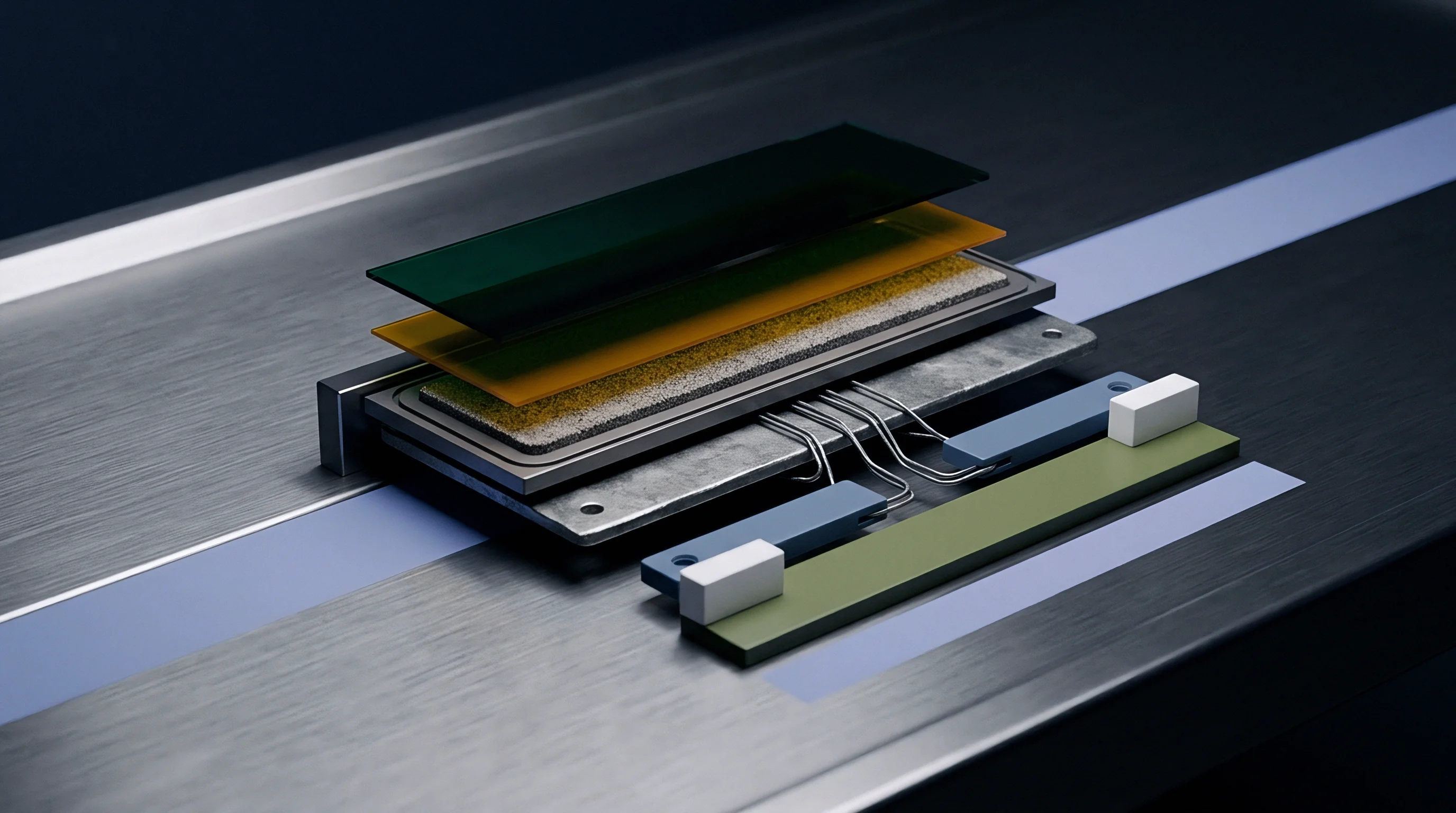
Operando Galvanostatic Titration under Dynamic Load Profiles
Pulse relaxation measurements extract chemical diffusion coefficients across defined states of charge. Modulating standard galvanostatic intermittent titration procedures for operando application involves inserting micro-pulses during normal drive cycles or grid duty profiles. Measuring the linear voltage response against the square root of time immediately following current interruption yields the chemical diffusion coefficient of lithium ions within the host lattice.
Fickian diffusion models govern this relationship, provided the current pulse duration remains shorter than the characteristic diffusion time constant of active material particles.
Interfacial impedance growth manifests as an instantaneous ohmic potential jump at the moment of current interruption. Solid-state diffusion limitation appears as a prolonged exponential voltage relaxation curve spanning several minutes. Calculating the ratio between the instantaneous voltage step and the time-dependent relaxation slope provides an isolated metric for interfacial resistance independent of bulk mass transport hindrances.
This separation reveals whether performance degradation stems from surface passivation layer growth or active material lattice collapse.
- Impedance Semicircle Resolution Failure occurs when high temperature merges interfacial charge transfer with solid electrolyte interphase relaxation arcs.
- Warburg Tail Distortion arises from non-uniform current density across large-format pouch cell tabs during operando AC perturbation.
- Diffusion Coefficient Drift manifests during extended galvanostatic intermittent titration as concentration gradients fail to relax within standard relaxation windows.
Whether distribution of relaxation times inversion algorithms maintain mathematical uniqueness across broad state-of-charge ranges without requiring synthetic initial guesses remains open to debate in literature.

Barrier
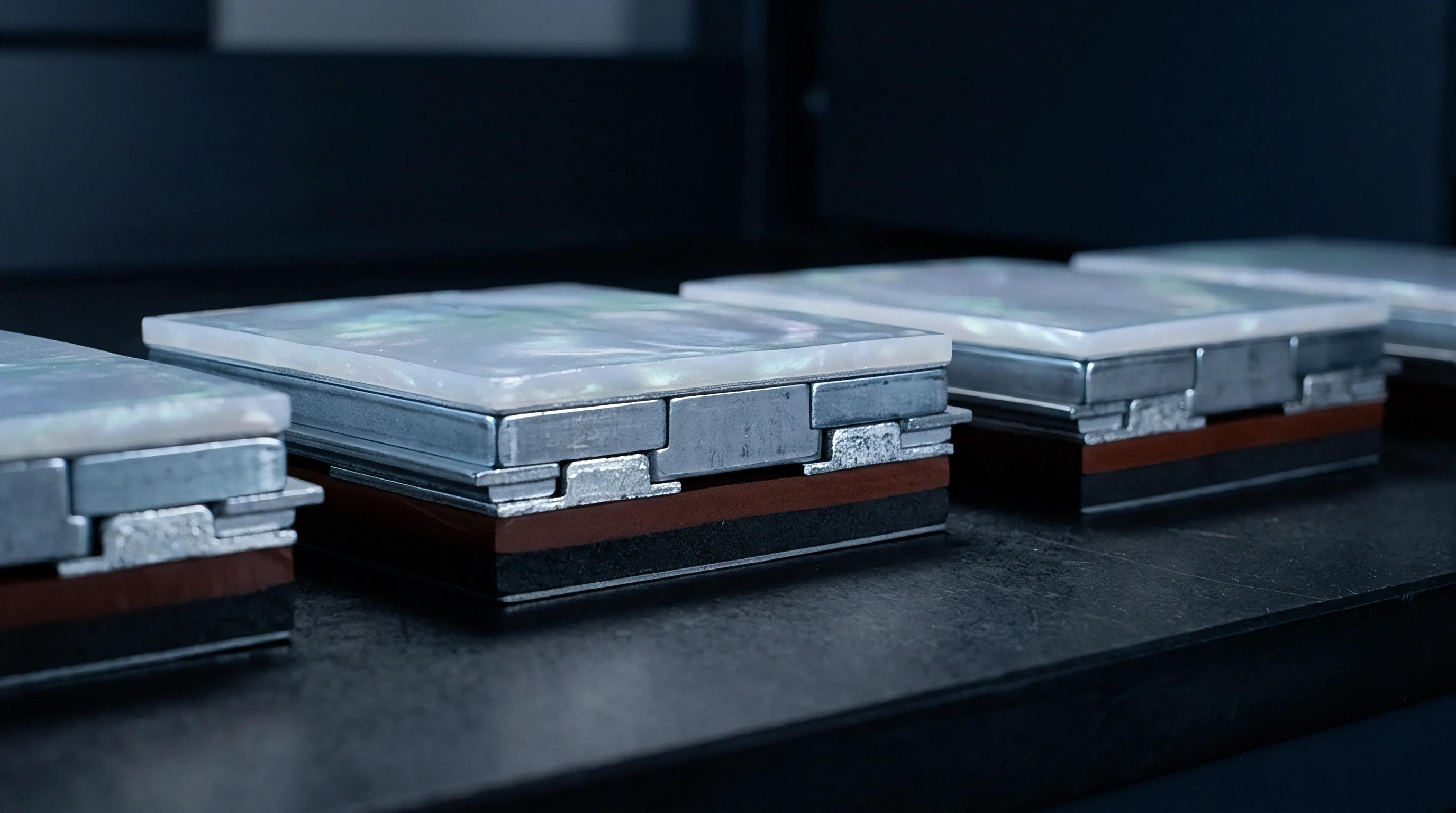
Interfacial degradation manifests through the growth of resistive surface films and loss of active lithium. The interface between the solid electrolyte interphase and active material particles acts as the primary barrier to lithium-ion transport during high-rate charging. Decomposition of organic carbonate solvents and lithium salts forms a complex heterostructure containing inorganic species such as lithium fluoride and lithium carbonate alongside organic alkyl carbonates.
As this surface layer thickens under electrochemical stress, the activation energy for lithium-ion desolvation increases, creating a dominant bottleneck for charge transfer kinetics.
SEI growth increases internal resistance.
Desolvation kinetics at the liquid-solid boundary represent a major component of interfacial charge transfer resistance. Before a solvated lithium ion enters the solid active particle, it must shed its primary solvation sheath consisting of ethylene carbonate and ethyl methyl carbonate molecules. The energy barrier associated with this desolvation step frequently exceeds the energy barrier for solid-state diffusion inside crystalline nickel-manganese-cobalt oxides.
Consequently, interfacial charge transfer dominates low-temperature cell polarization, restricting fast-charging capability long before bulk diffusion limits ion throughput.
Temperature Sensitivity of Interfacial Charge Transfer Resistance
Thermal activation energy governs reaction rates at the solid electrolyte interphase. Arrhenius formulations model interfacial charge transfer resistance as a function of absolute temperature. Measuring charge transfer resistance across temperatures ranging from minus 20 degrees Celsius to 45 degrees Celsius reveals an exponential increase in resistance at lower temperatures.
Activation energies for charge transfer typically range between 50 and 70 kilojoules per mole, whereas solid-state diffusion activation energies within layered oxides remain around 30 to 40 kilojoules per mole. This disparity explains why low-temperature performance is overwhelmingly controlled by interfacial kinetics.
Thermal control limits impedance skew.
| Temperature (C) | State of Charge (%) | Charge Transfer Resistance (mOhm) | Diffusion Coefficient (cm^2/s) |
|---|---|---|---|
| -10 | 20 | 18.5 | 1.2 x 10^-11 |
| -10 | 80 | 22.1 | 8.5 x 10^-12 |
| 25 | 20 | 3.2 | 4.5 x 10^-10 |
| 25 | 80 | 4.1 | 3.1 x 10^-10 |
| 45 | 20 | 1.4 | 1.8 x 10^-9 |
| 45 | 80 | 1.8 | 1.2 x 10^-9 |
Quantifying activation energy changes over cycle life provides early indication of surface chemistry transformation. Higher activation energy indicates the deposition of high-impedance inorganic decomposition products, such as thick lithium fluoride matrices resulting from electrolyte degradation. Monitoring this parameter over extended cycling enables predictive fault detection long before visible capacity loss occurs.

Mass Transport Hindrance at Passivated Anode Interfaces
Inorganic deposit buildup increases the activation barrier for ion desolvation. On graphite anodes, continuous growth of the solid electrolyte interphase alters the local current density distribution across particle surfaces. Thick passivation layers force lithium ions through narrow nanoscale channels, generating localized transport bottlenecks.
This spatial non-uniformity elevates local overpotential, driving lithium plating during high-current charging pulses even when the bulk graphite potential remains nominally above zero volts against lithium reference.
Lithium loss reduces discharge capacity.
Overpotential limits peak power output.
Decoupling interfacial transport from solid-state diffusion reveals that graphite exfoliation and surface film growth consume cyclable lithium without destroying active graphite host structure. Secondary surface reactions continually consume cyclable lithium ions, trapping them in insoluble interfacial species. The physical graphite host material remains intact and capable of intercalating ions, but the reduced lithium inventory permanently lowers available cell capacity under standard operating conditions.
Electrolyte breakdown forms film layers.
Failure to decouple interfacial charge transfer growth from solid-state diffusion degradation leads to incorrect cell life predictions, resulting in premature battery module replacement and inaccurate warranty pricing models.


Probe
In-situ three-electrode sensing arrangements isolate anode and cathode contributions during high-rate cycling. Commercial two-electrode cell measurements combine the impedance responses of both working electrodes, masking individual interface and diffusion dynamics. Inserting a stable reference electrode allows independent measurement of working and counter electrode overpotentials during operando conditions.
This physical separation is vital for identifying whether observed charge transfer resistance growth occurs at the passivated graphite anode or the degrading layered oxide cathode.
Integrating reference electrodes into commercial cell formats introduces structural artifacts if electrode geometry is compromised. Micro-reference wires made of metallic lithium, gold-plated copper, or lithium titanate must sit within the uniform electric field between anode and cathode. Improper placement alters local current lines, producing distorted impedance semicircles and artificial high-frequency inductive loops.
Calibration protocols must account for reference electrode potential drift caused by continuous chemical exposure to liquid carbonate electrolytes.

Reference Electrode Integration and Signal Fidelity
Inserting metallic sensing wires into pouch cell formats demands strict spatial alignment to prevent electric field artifacts. Gold-coated wire reference electrodes placed along the perimeter of pouch cell stacks provide stable reference potentials over thousands of operational hours. Alloy formation between gold and lithium forms a stable lithium-gold phase, establishing a zero-strain reference potential.
Measuring individual electrode potential swings during high C-rate cycling reveals that cathode charge transfer impedance typically rises faster than anode charge transfer impedance during high-voltage storage above 4.2 volts.
Reference wire drift skews measurements.
Signal acquisition hardware requires high input impedance buffers exceeding 10 gigohms to prevent current draw through the reference element. Polarization of the reference electrode distorts measured potential signals, corrupting derived charge transfer parameters. Shielded twisted-pair cabling reduces electromagnetic interference from nearby power electronics in active testing environments, ensuring high-frequency impedance points remain uncorrupted by operational noise.
- Mount the three-electrode cell inside a thermal chamber maintained at 25 degrees Celsius with temperature fluctuations below 0.1 degrees.
- Apply a multi-frequency sinusoidal current perturbation from 10 kilohertz down to 10 millihertz during active charging.
- Perform regularized distribution of relaxation times inversion using Tikhonov regularization with a smoothing parameter determined by generalized cross-validation.
- Extract the high-frequency surface film resistance and mid-frequency charge transfer resistance from discrete spectral peaks.
Could Strain Induced Tortuosity Permanently Slow Bulk Diffusion?
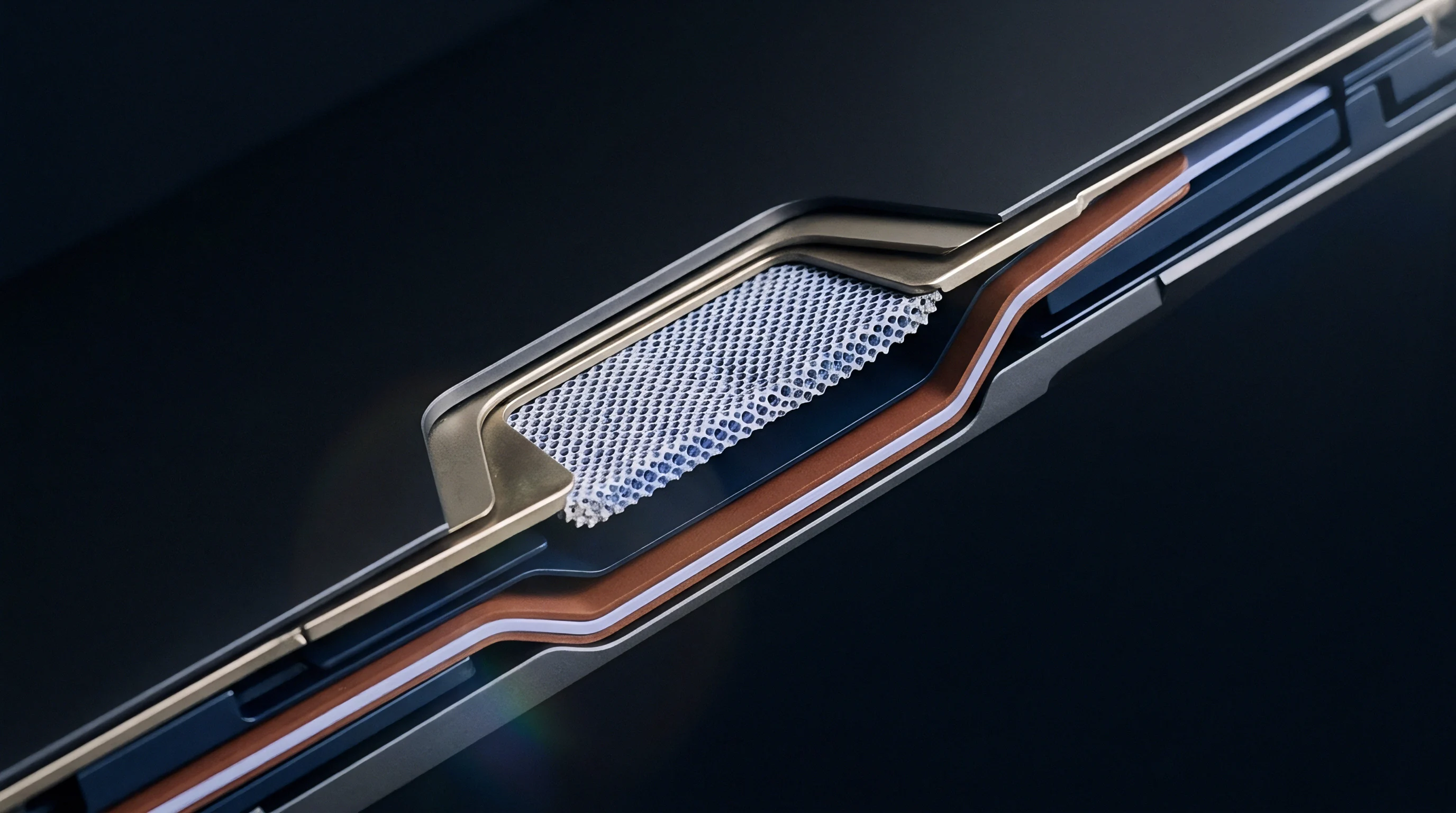
Intergranular fracturing breaks electrical continuity while creating extended ion transport paths. Volumetric changes during cyclic intercalation generate micro-cracks within secondary active material spheres. These internal fractures force intercalating lithium ions to navigate tortuous crack networks filled with liquid electrolyte or passivating SEI products.
The effective solid-state diffusion length increases proportionally with crack density, causing a drastic decline in measured apparent diffusion coefficients derived from Fickian models.
Cathode strain accelerates capacity loss.
Under IEC 62660-1 clause 6.2, pulse power degradation limits trigger cell rejection if interfacial impedance growth exceeds specified baseline tolerances.
Particle cracking creates fresh surfaces.
Operando acoustic emission monitoring combined with electrochemical impedance spectroscopy detects micro-cracking events in real time. Acoustic emission bursts coincide with rapid increases in mid-frequency charge transfer impedance, proving that new surface exposure immediately drives fresh electrolyte consumption and surface passivation film formation. The combined effect increases interfacial area while simultaneously slowing overall mass transport into particle cores.
Cell suppliers frequently attribute power degradation to temporary electrolyte concentration polarization when faced with early performance claims, claiming that extended rest periods will restore baseline capacity.


Swell
Mechanical stress during lithiation alters the solid-state diffusion matrix within cathode active particles. Repeated expansion and contraction of nickel-rich layered oxide lattices create anisotropic lattice strain during phase transitions. At high states of charge, nickel-rich compositions undergo abrupt lattice collapse along the c-axis, severely compressing interstitial lithium diffusion pathways.
This mechanical lattice compression decreases solid-state lithium mobility by several orders of magnitude, causing rapid overpotential growth independent of surface film passivation.
Phase changes alter lattice parameter.
Lattice breathing during cycling generates external physical swelling in constrained pouch and prismatic cells. Applying static mechanical restraint via external pressure plates mitigates intergranular crack propagation by maintaining physical contact between secondary particle fragments. Excess mechanical pressure increases local internal stresses, altering solid-state diffusion activation energy and accelerating particle isolation.
Optimizing external clamping pressure balances structural integrity against kinetic transport degradation.

Phase Boundaries and Tortuosity Escalation in Bulk Crystals
Lattice contraction during high-voltage extraction generates intra-granular shear stress. Phase boundary movement inside single-crystal cathode particles forms internal coherency strain during fast charging. Moving phase boundaries act as transport barriers, impeding lithium-ion motion through two-phase regions.
Operando high-energy X-ray diffraction maps lattice parameter shifts simultaneously with electrochemical impedance, proving that bulk diffusion slowing correlates directly with structural phase transformation kinetics.
Direct current pulses measure diffusion.
Solid state diffusion governs recovery.
As active particles fracture, the structural geometry shifts from spherical diffusion models to complex planar pathways. Mathematical modeling of diffusion kinetics within degraded particles requires updated geometric factors that account for non-uniform surface areas and variable diffusion path lengths. Assuming constant particle radius in standard Fickian equations understates intrinsic diffusion degradation, misattributing mass transport losses to surface charge transfer resistance.
| Mechanism | Physical Origin | Impact on R_ct | Impact on D_Li |
|---|---|---|---|
| SEI Thickening | Electrolyte reduction at anode surface | High increase | Negligible impact |
| Cation Disordering | Transition metal migration into lithium layer | Moderate increase | Severe decrease |
| Particle Microcracking | Anisotropic lattice volume change | Moderate increase | Moderate decrease (path extension) |
| Transition Metal Dissolution | Acidic byproduct attack on cathode | High increase (SEI poisoning) | Negligible impact |
Transition metal ions dissolving from cathode structures migrate across the separator and deposit within the anode solid electrolyte interphase. This catalytic poisoning alters anode surface conductivity, causing rapid charge transfer resistance escalation on the graphite electrode. Operando monitoring isolates this cross-talk effect by tracking anode impedance during cathode high-voltage exposure.

Particle Microcracking and Solid State Diffusion Length Extension
Intergranular fracturing breaks electrical continuity while creating extended ion transport paths. Secondary particle agglomerates consist of hundreds of primary single-crystal grains bound along grain boundaries. Cyclic mechanical stress causes boundary cleavage, allowing liquid electrolyte to infiltrate the core of secondary particles.
While liquid infiltration provides short-term ionic paths, surface reaction products coat primary grains, converting bulk diffusion problems into multiple series-connected interfacial resistance steps.
Resistance growth limits fast charging.
Interfacial charge transfer resistance dominates power capability loss during early cycling, whereas bulk diffusion degradation governs capacity fade at high state of charge.
Single-crystal cathode architectures eliminate intergranular grain boundaries, drastically reducing mechanical cracking during high-voltage cycling. Operando testing of single-crystal nickel-manganese-cobalt materials shows stable solid-state diffusion coefficients across thousands of deep cycles. High charge transfer resistance eventually emerges in single-crystal variants due to surface rock-salt phase formation, demonstrating that eliminating mechanical strain shifts the primary failure mode back to interfacial chemical degradation.
- Interfacial Resistance Limit defines the maximum allowable expansion of surface charge transfer resistance before warranty claims apply.
- Solid State Diffusion Floor specifies the minimum permissible chemical diffusion coefficient measured via intermittent titration prior to thermal retirement.
- Phase Degradation Threshold sets the tolerable shift in open-circuit potential derivative peaks associated with bulk structural phase changes.
Surface passivation layers growth controls low-temperature pulse power output, while bulk diffusion kinetics determine high-temperature continuous power limits.
Valuation
Residual capacity calculations fail when interfacial impedance growth masks accessible bulk energy. High internal resistance premature voltage cutoffs during constant current discharge obscure actual cyclable lithium content remaining in active particles. Decoupling kinetic polarization from intrinsic thermodynamic capacity degradation prevents premature retirement of modules that retain full chemical storage potential.
A cell exhibiting severe voltage drop under high-rate load often yields near-baseline discharge capacity when evaluated under low-rate titration currents.
Asset evaluation protocols must differentiate between recoverable power fade and unrecoverable capacity loss. Interfacial charge transfer growth represents an impedance barrier that low-rate operation or surface remediation processes can bypass. Bulk structural phase decay or permanent lithium inventory loss represents permanent asset value destruction.
Integrating operando parameter decoupling into secondary asset qualification workflows directly impacts battery second-life pricing, residual value financing, and recycling decision matrices.

Disentangling Transient Polarisation from Permanent Capacity Atrophy
High internal resistance induces early voltage cutoff under load without active material destruction. Evaluating a 100-ampere-hour commercial pouch cell lot reveals how kinetic decoupling alters residual valuation arithmetic. Assume an incoming lot of retired electric vehicle cells displays a nominal discharge capacity of 72 ampere-hours under a standard 1C continuous discharge test, suggesting a 28 percent capacity loss and placing the lot below typical second-life utility thresholds.
Applying operando multisine impedance combined with galvanostatic intermittent titration decouples the 28-ampere-hour loss into kinetic and thermodynamic components. Test calculations show that interfacial charge transfer growth (R_ct expansion from 0.8 milliohms to 3.4 milliohms) accounts for 18 ampere-hours of the apparent capacity drop via early low-voltage cutoff at 2.8 volts. Solid-state diffusion decay (D_Li drop from 4.5 x 10^-10 to 1.2 x 10^-10 cm^2/s) combined with lithium inventory loss accounts for the remaining 10 ampere-hours of permanent structural capacity loss.
Rerunning the discharge evaluation at a reduced C-rate of 0.2C recovers 16 ampere-hours of the masked capacity, delivering an actual accessible capacity of 88 ampere-hours. Re-grading the lot based on decoupled parameters reclassifies these units from scrap value (2.00 USD per kilogram bulk material value) to stationary energy storage integration value (45.00 USD per kilowatt-hour residual module value). On a 40-megawatt-hour second-life procurement lot, this diagnostic reclassification shifts lot evaluation from 160,000 USD raw material value to 1,584,000 USD usable asset value.
Uncertainty drives buyer risk margins.
Interfacial resistance growth accounts for up to seventy percent of voltage drop in low temperature pulse discharge tests.
Uncertainty surrounding underlying degradation mechanisms inflates secondary market risk premiums. Field buyers routinely discount used cell prices by 40 percent to cover potential rapid capacity knee occurrences. Operando decoupling identifies whether cells operate near their structural knee point—driven by sudden diffusion failure from particle microcracking—or within a manageable linear interfacial degradation regime, restoring buyer confidence and tightening pricing spreads.

Contractual Criteria for Decoupling Degradation Modes in Warranties
Cell procurement agreements specify distinct threshold metrics for interfacial growth and bulk phase degradation. Standard commercial battery supply contracts rely on aggregate capacity retention clauses, typically specifying cell replacement when capacity drops below 80 percent of initial nameplate rating within a defined operating period. This aggregate metric exposes buyers to unexpected operational failures if high charge transfer resistance prevents fast charging while technically passing low-rate capacity checks.
Modern cell supply framework contracts incorporate decoupled kinetic degradation limits directly into performance guarantee addendums. Master supply agreements mandate independent tracking of charge transfer resistance expansion factors alongside bulk diffusion metrics. Sourcing contracts explicitly define parameter testing conditions, specifying reference temperature, state-of-charge windows, and acceptable distribution of relaxation times inversion mathematical parameters to resolve warranty enforcement disputes.
Under the performance guarantee terms of standard energy storage procurement agreement framework annex B, clause 4.3 dictates that if interfacial charge transfer resistance growth exceeds 200 percent of the initial factory acceptance baseline while bulk diffusion coefficient retention remains above 80 percent, the supplier provides replacement modules or reimburses thermal conditioning upgrade costs without requiring proof of total capacity loss.