Quantifying Solvent Vapor Egress Mechanisms in Sealed Lithium Batteries
Solvent egress quantification demands micro-gravimetric balance tracking with air buoyancy corrections and chemical speciation to verify hermetic seal limits.
Seal

Mechanical Closure Interfaces and Microchannel Geometry
Polymer gasket relaxation under sustained compressive stress is the primary route for organic vapor escaping cylindrical cell headers. Standard 18650 and 21700 formats rely on a mechanical crimp to squeeze a polypropylene or polyfluoroalkoxy gasket between the plated steel can and the nickel-plated aluminum header cap. Over time, vibration, thermal cycling, and contact with alkyl carbonate solvents relax the polyolefin ring.
Once local radial compression drops below the hydraulic pressure required to retain gas, micro-voids from 50 nanometers to 3 micrometers across open along the boundary, opening direct channels from the interior to ambient air.
Weld Micro-Fissures in Rigid Prismatic Enclosures
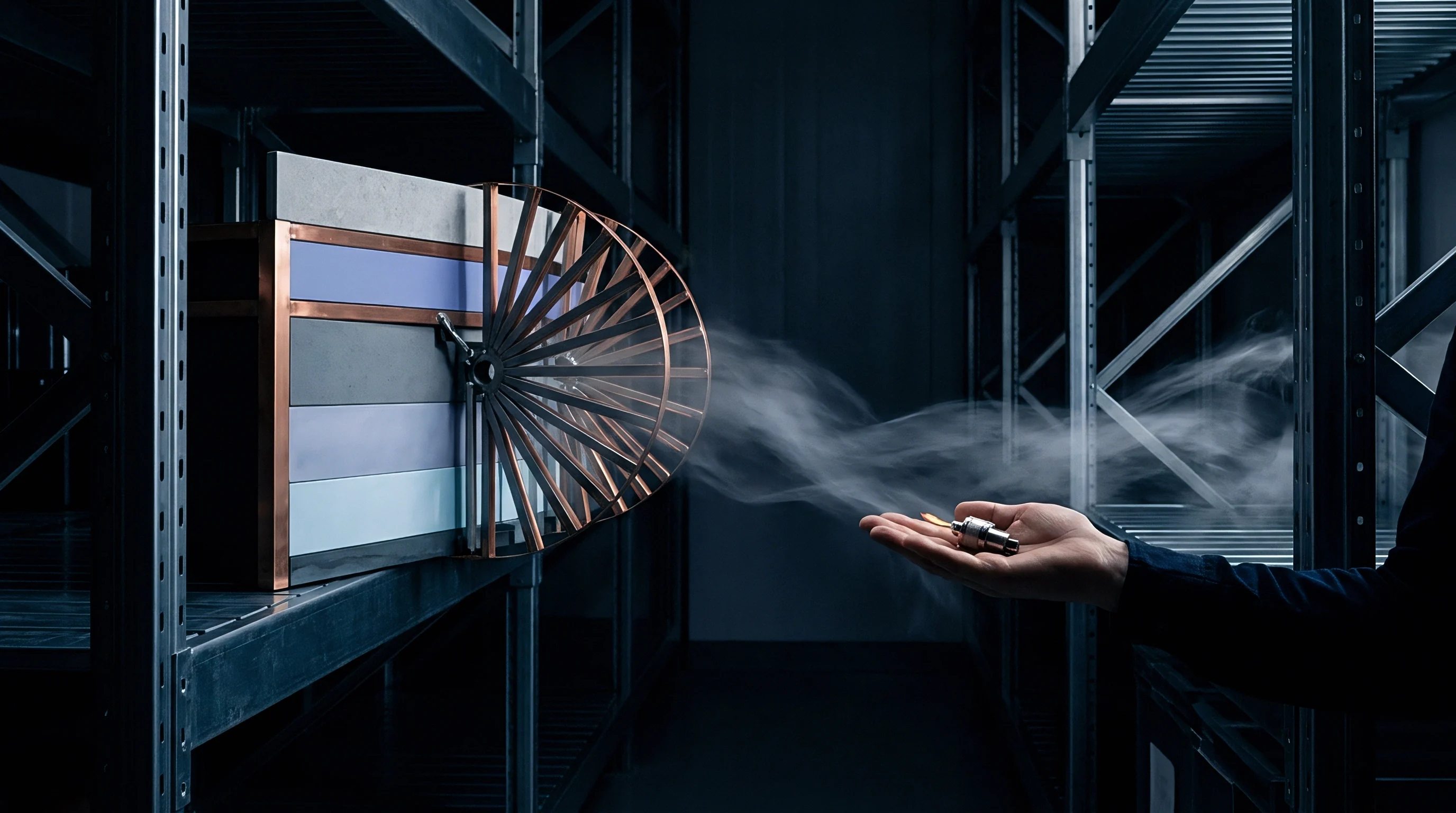
Pulsed wave laser welding of aluminum top plates can induce solidification cracking in the heat-affected zone. Prismatic cells using 3000-series aluminum alloy cans and 1000- or 4000-series alloy lids tend to form micro-fissures when cooling rates top 1000 Kelvin per second during rapid beam passes. While these micro-cracks rarely breach the full wall during assembly, pressure build-up during formation cycling and repeated expansion of the anode stack can drive them clear through.
Volatile solvent vapor then leaks out slowly, even while the wall continues to hold liquid electrolyte under atmospheric pressure.
| Format Topology | Barrier Interface Material | Primary Defect Mechanism | Helium Equivalence Leak Rate (Pa·m³/s) | Dominant Vapor Egress Phase |
|---|---|---|---|---|
| Cylindrical 21700 | Polypropylene / Polyfluoroalkoxy Gasket | Viscoelastic Creep & Radial Stress Relaxation | 1.0E-07 to 5.0E-06 | Linear & Cyclic Carbonates |
| Prismatic Hard- Case | Laser-Welded AA3003 Aluminum Alloy | Heat-Affected Zone Solidification Cracking | 1.0E-09 to 1.0E-07 | Low-Boiling Solvent Fractions |
| Pouch Laminate | Cast Polypropylene Seal Layer | Interfacial Delamination & Solvent Swelling | 5.0E-08 to 2.0E-06 | Co-Extruded Solvent Micro-Channels |
Polymer Seal Swelling and Matrix Dissolution
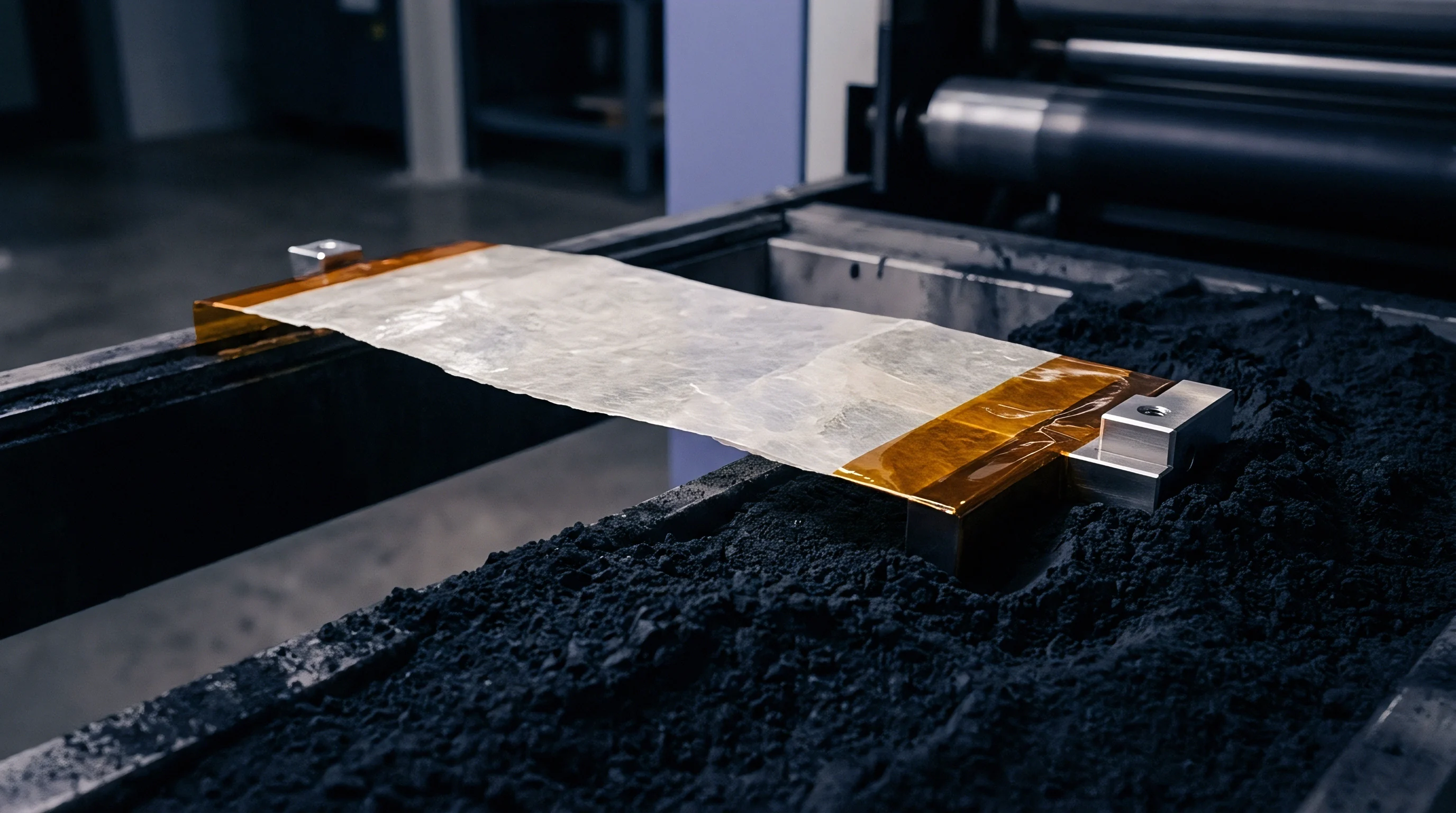
Direct contact with organic solvents degrades the long-term seal of polyolefin gaskets. Alkyl carbonates ~ specifically dimethyl carbonate and ethyl methyl carbonate ~ act as plasticizers inside cross-linked polyolefin matrices. Absorbing solvent vapor swells the polymer’s free volume and lowers its glass transition temperature, cutting the elastic modulus by up to 35 percent over 1000 thermal cycles between minus 20 degrees Celsius and 60 degrees Celsius.
This drop in sealing pressure accelerates leakage, establishing a feedback loop where local solvent saturation further weakens the interface.
Electrolyte vapor leakage through polyolefin gaskets increases by two orders of magnitude once compression stress falls below four megapascals.

Laminate Edge Seal Degradation in Flexible Pouch Formats
Heat-sealed aluminum laminate films use an inner cast polypropylene layer to protect the metallic foil barrier from corrosive electrolyte. Heat and pressure melt adjacent polymer layers into a single bond during sealing, but solvent vapor inside the pouch can migrate into the molten polypropylene, leaving micro-voids as it cools. External moisture then reacts with lithium hexafluorophosphate residue along the edge, forming hydrofluoric acid that attacks the organosilane coupling agents bonding the aluminum foil to the polyolefin layer.
Delamination slowly creeps inward to form extended diffusion paths for volatile components. Weight loss during high-temperature storage is often attributed to external washing residue evaporating, but it frequently marks a real breach along the seal line.

Permeation
Solvent Vapor Transport Kinetics across Polymeric Barriers
Solvent vapor moves through intact polymer gaskets by a classic three-stage solution-diffusion mechanism: carbonate molecules dissolve into the inner gasket surface, diffuse through the polymer along a chemical potential gradient, and desorb from the outer surface into ambient air.
Mass flux depends on this concentration gradient, the solvent’s solubility in the polymer, and its internal diffusion coefficient. Linear carbonates like dimethyl carbonate diffuse much faster than cyclic species like ethylene carbonate owing to their smaller kinetic diameters and lower steric hindrance.

Knudsen and Viscous Gas Flow Regimes
When micro-cracks or interfacial gaps breach the enclosure wall, vapor egress shifts from molecular solution-diffusion into Knudsen or viscous gas flow regimes. Transport dynamics depend on the Knudsen number ~ the ratio between the mean free path of the solvent vapor molecules and the characteristic pore dimension.
- Knudsen Diffusion Regime occurs when pore diameters drop below 100 nanometers, making wall collisions far more frequent than molecule-to-molecule collisions. Solvent flux here varies inversely with the square root of molecular weight and scales linearly with the partial pressure difference across the wall.
- Viscous Poiseuille Flow dominates once defects exceed one micrometer, where fluid viscosity governs mass flow. Volumetric egress scales with the fourth power of defect radius and inversely with vapor dynamic viscosity.
- Transition Flow State occurs in sub-micron gaps between 100 nanometers and one micrometer, where Knudsen diffusion and pressure-driven flow take place simultaneously. Modeling transport in this regime requires coupled Knudsen-Poiseuille equations; simplified models undercount solvent loss.
- Solvent Transport Creep happens along micro-roughness channels on metal sealing surfaces, where capillary forces draw liquid electrolyte into small gaps before it vaporizes outside. Surface tension gradients accelerate liquid movement toward the outer edge.
Standard helium leak detection fails to capture molecular mass transport rates when polymer swelling alters microchannel geometry under active organic solvent exposure.

Solvent Partial Pressure Mechanics and Temperature Dependence
Internal cell pressure climbs with temperature as volatile organics vaporize into the headspace. Dimethyl carbonate exerts a partial vapor pressure over 4.8 kilopascals at 20 degrees Celsius, rising exponentially to more than 28 kilopascals at 60 degrees Celsius, with ethyl methyl carbonate and diethyl carbonate following similar trajectories. This elevated pressure steepens the concentration gradient across the seal wall to accelerate permeation.
Permeation rates follow an Arrhenius relationship whose activation energy combines solvent dissolution enthalpy with diffusion kinetic energy.

Phase Equilibrium and Electrolyte Depletion Effects
As volatile solvents evaporate, the thermodynamic equilibrium of the remaining liquid shifts. Because low-boiling linear carbonates permeate faster through polymer gaskets, the ratio of cyclic to linear carbonates increases over time. Ethylene carbonate concentrations grow relative to dimethyl carbonate, raising liquid viscosity and altering the dielectric constant.
This shift hinders ion transport through separator pores and boosts electrolyte resistance. Eventually, solvent loss leaves behind concentrated lithium salts that can exceed saturation at low temperatures, precipitating salt onto the electrodes. What ambient storage duration causes the shift from Fickian diffusion dominance to pressure-driven Knudsen flow across compromised seal interfaces?

Gravimetry

Precision Mass Tracking Methodologies for Low-Rate Egress
Measuring sub-milligram solvent loss requires microgram analytical balances fitted with active buoyancy compensation. Gravimetric testing tracks mass loss in sealed cells kept under isothermal conditions across weeks or months while isolating samples from air currents and humidity swings. Because buoyant forces on the cell shift with barometric pressure, temperature, and air density, raw mass readings without air density corrections obscure microgram-level changes and corrupt seal integrity assessments.
How Does Temperature Acceleration Alter Electrolyte Volatility Ratios?
Testing at 60 degrees Celsius or 85 degrees Celsius accelerates vapor egress in line with Arrhenius kinetics. Higher temperatures boost vapor pressure and polymer chain mobility, accelerating diffusion through gasket materials. Heat alters the relative evaporation rates of multi-component solvents unevenly, however: dimethyl carbonate evaporates far faster relative to diethyl carbonate at elevated temperatures than at room temperature.
Because thermal acceleration skews escaping vapor composition, mathematical correction factors are required to translate high-temperature mass loss back to ambient storage conditions.
| Measurement Parameter | Target Precision Limit | Dominant Environmental Noise Source | Correction Method Formula or Protocol |
|---|---|---|---|
| Mass Balance Resolution | 0.1 Micrograms | Convective Thermal Air Currents | Thermal Shielding & Isothermal Enclosure Base |
| Air Density Compensation | 0.001 Kilograms per Cubic Meter | Barometric Pressure Fluctuation | CIPM-2007 Air Density Equation Calibration |
| Thermal Stability Control | ±0.05 Kelvin | HVAC Cycling Dynamics | PID Solid-State Peltier Chamber Integration |
| Cell Volume Expansion Offset | ±0.01 Cubic Centimeters | Internal Pressure Gas Accumulation | Optical Laser Displacement Sensor Surface Scan |

Worked Example of Isothermal Mass Egress and Shelf-Life Extrapolation
To quantify how solvent egress affects ambient shelf life, consider a 21700 cylindrical lithium-ion cell with a nominal mass of 68.50000 grams and an initial electrolyte load of 4.5000 grams. The test sample sat in an isothermal chamber maintained at 60 degrees Celsius (333.15 Kelvin) under constant relative humidity and continuous barometric tracking. Over a 90-day exposure period, buoyancy-corrected gravimetric measurements yielded the following mass decay sequence:
- Day 0 baseline mass: 68.50000 grams.
- Day 30 buoyancy-corrected mass: 68.49730 grams, representing a mass loss of 2.70 milligrams.
- Day 60 buoyancy-corrected mass: 68.49460 grams, representing a cumulative mass loss of 5.40 milligrams.
- Day 90 buoyancy-corrected mass: 68.49190 grams, representing a cumulative mass loss of 8.10 milligrams.
The observed steady-state mass loss rate at 60 degrees Celsius is calculated as follows:
Mass Loss Rate at 60°C = 8.10 milligrams / 90 days = 0.090 milligrams per day (90 micrograms per day).
To project mass loss to ambient storage conditions (25 degrees Celsius / 298.15 Kelvin), applying the Arrhenius relationship for solvent permeation through a polyolefin gasket matrix yields:
Permeation Rate(T) = Permeation Rate Pre-factor exp(-Ea / (R T))
Assuming a measured activation energy (Ea) of 45.0 kilojoules per mole for alkyl carbonate permeation through cross-linked polypropylene, and the universal gas constant R = 8.314 Joules per mole-Kelvin:
Ratio = exp((-Ea / R) ((1 / T_ambient) – (1 / T_accelerated)))
Ratio = exp((-45000 / 8.314) ((1 / 298.15) – (1 / 333.15)))
Ratio = exp(-5412.56 (0.003354 – 0.003001))
Ratio = exp(-5412.56 0.000353) = exp(-1.9106) = 0.1480
Multiplying the accelerated rate at 60 degrees Celsius by the temperature scaling ratio yields the ambient mass loss rate at 25 degrees Celsius:
Ambient Rate at 25°C = 90 micrograms per day 0.1480 = 13.32 micrograms per day (4.86 milligrams per year).
Over a 5-year storage period at 25 degrees Celsius, predicted solvent loss reaches 24.31 milligrams. This represents roughly 0.54 percent of the initial electrolyte mass ~ well below the 3.0 percent threshold where impedance growth severely degrades cold-cranking performance.
Isothermal micro-gravimetric mass decay tracking remains valid only when room pressure and temperature sensors run continuously alongside micro-balance channels.
Buoyancy Offset Calculations for Long-Term Chamber Runs
Changes in barometric pressure or temperature over multi-month runs alter air density, shifting buoyant force on the cell and throwing off balance readings. Calculating true mass requires multiplying apparent mass by a correction factor based on air density, calibration weight density, and cell volume. Uncompensated barometric shifts across seasons can alter apparent mass by up to 1.5 milligrams on a standard prismatic housing ~ exceeding actual solvent loss over that timeframe.
Without continuous environmental logging to correct each reading, gravimetric test data cannot yield reliable transport kinetics.


Spectrometry
Gas Chromatography-Mass Spectrometry for Organic Vapor Identification
Spectroscopic analysis identifies specific solvent molecules escaping through micro-defects or polymer gaskets. Gas chromatography ~ mass spectrometry (GC-MS) provides molecular identification and precise concentration profiles of the escaping vapor.
In a typical test, the battery sits sealed in an accumulation chamber swept with ultra-pure nitrogen. The gas flows through a sorbent trap containing porous polymer beads or carbon molecular sieves to capture organic compounds, whereupon direct thermal desorption injects the trapped vapor into the GC column to separate linear carbonates, cyclic carbonates, and trace additives.

Helium Mass Spectrometry Baseline Correlation
Helium leak testing serves as the industrial benchmark for verifying enclosure hermeticity prior to electrolyte filling. The process pressurizes the empty cell cavity with helium gas and measures external helium flow through a tuned mass spectrometer manifold. Transport models then convert helium mass flux into equivalent organic solvent flux to map helium leak rates to actual solvent vapor egress.
- Molar Mass Ratio Adjustment scales helium diffusion rates by the square root of the ratio between helium’s molecular weight and the solvent’s molecular weight under pure Knudsen flow.
- Dynamic Viscosity Corrections adjust Poiseuille viscous flow calculations based on the dynamic viscosity of the solvent vapor relative to helium at the same temperature.
- Polymer Solubility Factor Offset accounts for helium’s near-zero solubility in polymers compared to the high solubility of organic carbonate solvents in polyolefin gaskets.
- Temperature Dependent Partial Pressure Scaling converts total mechanical leak rates into mass loss for specific chemical species using active vapor pressure gradients.
| Analytical Methodology | Detection Limit Threshold | Speciation Capability | Primary Measurement Artifact |
|---|---|---|---|
| GC-MS with Thermal Desorption | 1.0 Picogram per Second | Absolute Organic Compound Resolution | Sorbent Trap Saturation & Break-Through |
| Fourier-Transform Infrared (FTIR) | 0.5 Parts per Million | Functional Group Vapor Identification | Water Vapor Band Interference |
| Selected-Ion Flow-Tube MS | 10 Parts per Trillion | Real-Time Kinetic Volatile Tracking | Background Chamber Wall Outgassing |
| Helium Sniffer Mass Spectrometry | 1.0E-12 Pa·m³/s Equivalent | Inert Gas Tracer Only | Zero Polymer Permeation Sensitivity |

Real-Time Volatile Organic Compound Detection Interfaces
Real-time mass spectrometry tracks organic vapor egress during mechanical stress or thermal shock. Methods such as selected-ion flow-tube MS and proton-transfer-reaction MS bypass the delays of sorbent trapping by sampling air continuously at the seal interface. This yields immediate detection of dimethyl carbonate spikes when mechanical impact or thermal expansion briefly unseats a crimp gasket.
Crucially, real-time tracking catches transient leaks that close again once pressure drops or strain relaxes.
Analytical vapor speciation confirms that low-boiling linear carbonates account for over eighty-five percent of total mass loss during initial gasket degradation phases.

Distinguishing Solvent Egress from Hardware Outgassing
Distinguishing true electrolyte leakage from structural outgassing requires clean baselines and targeted mass fragment analysis. External plastics, labels, and tapes off-gas residual monomers, plasticizers, and solvents into test chambers. Without mass fragment isolation, adhesive outgassing can easily be mistaken for seal failure.
Identifying specific alkyl carbonate fragment ions ~ such as mass-to-charge ratio 59 for dimethyl carbonate and 77 for ethyl methyl carbonate ~ prevents false positives from external materials and avoids unnecessary lot rejections during quality audits.

Allowance
Electrolyte Depletion and Electrochemical Cell Degradation
Continuous loss of volatile solvents degrades internal electrochemical performance long before a physical seal defect becomes obvious. As low-viscosity linear carbonates escape, overall electrolyte viscosity climbs and ionic conductivity drops within the electrodes and separator.
This elevates ohmic resistance and increases polarization losses during high-rate discharge. Once mass loss exceeds 3.0 percent of initial electrolyte volume, solid electrolyte interphase breakdown accelerates, driving lithium plating during low-temperature fast charging.

Regulatory Limits and Transport Safety Integrity Standards
International transport regulations set strict enclosure integrity and leak rate limits to prevent hazardous material release during transit. Section 38.3 of the United Nations Manual of Tests and Criteria mandates thermal exposure and pressure differential testing with zero internal mass loss or structural leakage.
- UN 38.3 Test T.2 Thermal Protocol subjects cells to temperature cycling between minus 40 degrees Celsius and 72 degrees Celsius, setting a maximum mass loss limit of 0.1 percent for cells over 5 grams nominal mass.
- UN 38.3 Test T.3 Vibration Protocol applies variable-frequency sinusoidal vibration along three orthogonal axes, requiring zero mass loss or venting along the seals.
- IEC 62133-2 Design Verification requires long-term seal integrity under internal gas pressure and thermal stress, prohibiting liquid or solvent vapor leakage.
- EU Battery Regulation 2023/1542 mandates comprehensive carbon footprint and durability tracking, requiring verifiable performance backed by quantitative seal metrics.

Commercial Limits and Warranty Lifetime Modeling
Tier-one automotive and industrial battery specifications set tight upper limits on annual mass loss. High-reliability systems typically restrict solvent egress to less than 0.10 grams per year per cell over a 10-year design life. Exceeding this allowance voids performance warranties, as electrolyte dry-out causes steep capacity drops late in cell life.
Validating seal hermeticity to back up warranty claims requires both micro-gravimetric and helium tracer testing on production samples.
Standard transport safety compliance mandates that total cell mass loss during thermal shock cycling remain strictly under zero point one percent.

Contractual Compliance Frameworks and Acceptance Thresholds
Master supply agreements tie seal integrity standards directly to lot release and incoming inspection protocols. Purchase contracts specify acceptable quality levels for hermeticity and set clear liability when shipments exceed solvent egress limits. Under standard environmental testing clauses, cell samples from incoming lots undergo 30 days of accelerated thermal testing prior to batch acceptance. If gravimetric testing shows solvent loss above contractual limits, the buyer can reject the entire manufacturing batch at the supplier’s expense. Mass loss exceeding 0.2 percent during accelerated aging typically triggers immediate delivery holds and mandatory quality audits.