Resolving High-Voltage Isolation Breakdown Discrepancies between Module Qualification Reports and Freight Enclosure Safety Clearances
Resolving isolation discrepancies requires testing battery enclosures under combined mechanical vibration, low atmospheric pressure, and condensation cycles.

Dielectric
High-voltage battery modules routinely pass factory release gates on insulation resistance measured in dry laboratory conditions. Qualification testing under IEC 62619 and UL 1973 applies high-potential voltage sweeps ~ typically 2500 V DC or twice maximum operating voltage plus 1000 V ~ between cell terminals and grounded chassis frames. Standard factory ambient parameters of 23°C and 50 percent relative humidity keep surface conductivity low and sparkover thresholds high.
Static clearance distances of 6.3 mm and creepage paths of 10.0 mm satisfy IEC 60664-1 specifications for basic insulation under Pollution Degree 2, giving qualification dossiers a clean set of pass figures as evidence of high-voltage isolation capability.
Those lab figures can be deceptive, as physical conditions inside a shipping crate alter the environment completely. Module enclosures deflect under stacking loads, narrowing physical air gaps between live internal busbars and external aluminum shields. Once manufacturing tolerances in polyimide insulation films combine with minor sheet-metal bending variances, nominal 8.0 mm clearances shrink to margins that cannot survive transit dynamics.
Bench Qualification Benchmarks versus Transport Enclosures
Factory hi-pot testing evaluates purely static geometry: a test probe clips to a fixed terminal, voltage ramps over five seconds, and leakage current below 1.0 mA yields a passing grade. The test bench ignores mechanical compression experienced during pallet strapping, sea container stacking, and road transit shock. Polyolefin isolation sheets that easily hold 3000 V DC uncompressed narrow their dielectric barrier once clamped into freight packaging.
In uniform electric fields, dry air has a dielectric strength of roughly 3.0 kV per millimeter. Sharp busbar edges and stamped enclosure corners distort that field, dropping the sparkover threshold to less than 1.2 kV per millimeter. Yet module qualification reports rarely account for how sharp edges intensify local electric fields within transport packaging frames.

Electric Field Intensity and Air Gap Dynamics
Electric field stress naturally concentrates at geometric discontinuities inside high-voltage housings. When a busbar corner sits 4.0 mm away from an enclosure wall, field density peaks right at the metal apex, initiating localized micro-arcing long before gross physical contact occurs. Standard qualification dossiers report nominal clearance distances measured from engineering drawings rather than actual minimum clearances measured under maximum physical tolerance stack-ups.
Plant quality engineering departments often contend that test bench insulation resistance logs satisfy production line quality gates and that dynamic shifts in the transit envelope fall outside component-level qualification scope.
Transit
Mechanical excitation during freight movements forces battery components into continuous relative motion. Protocols under UN 38.3 subject full battery packs to sinusoidal vibration sweeps from 7 Hz to 200 Hz, applying peak accelerations up to 8g along three orthogonal axes, while shock testing adds 150g acceleration pulses over 6 milliseconds. Under these mechanical forces, flexible pack covers and module retention straps undergo measurable structural deflection, dynamic compression narrowing air gaps that appeared stable on factory inspection sheets.
A structural enclosure designed with an 8.0 mm nominal internal clearance experiences enclosure wall flex of 5.2 mm during standard transport drop events. The remaining 2.8 mm air gap cannot withstand transient overvoltage spikes or residual static charges carried by high-voltage cell strings. Packaging designs relying solely on air clearance without solid insulation barriers fail when dynamic structural deflections compress the gap.

Vibration Dynamic Clearance Compression
Resonance further amplifies internal component displacement. Polycarbonate cell retainers and fiberglass insulation plates flex at specific resonant frequencies within the 10 Hz to 50 Hz transport spectrum. At resonance, relative movement between live conductor surfaces and grounded enclosure structural members reduces effective clearance by up to 60 percent ~ a temporary compression that static pre-shipment measurements fail to reflect.
- Dynamic Frame Deflection structural flex of aluminum side plates compresses internal air gaps during 8g acceleration peaks.
Fastener Displacement vibration loosens retention screws, allowing busbar support brackets to shift closer to grounded casing walls.
Barrier Abrasion continuous micro-movement wears away thin dielectric coatings on metallic mounting surfaces.
Thermal Expansion Drift high transit temperatures soften plastic insulation spacers, increasing mechanical compliance and dynamic displacement.
What Causes Altitude Sparkover in Flight Freight?
Air cargo transportation introduces atmospheric pressure drops that lower the dielectric breakdown voltage of air gaps. Aircraft cargo holds operating at nominal cruising altitudes maintain pressurization levels equivalent to 2,400 meters above sea level, corresponding to ambient pressures of approximately 75 kPa. Emergency decompression events or unpressurized feeder aircraft drop internal cargo pressures down to 55 kPa.
Under Paschen’s Law, gas breakdown voltage varies non-linearly with the product of pressure and gap distance. As ambient pressure decreases at a fixed clearance distance, the mean free path of gas molecules increases, allowing electrons to accelerate to higher kinetic energies before collisions, initiating avalanche ionization at significantly lower voltages. An air gap rated for 3000 V breakdown at sea level atmospheric pressure of 101.3 kPa breaks down at 1950 V DC when exposed to 70 kPa air cargo conditions.
| Atmospheric Condition | Ambient Pressure (kPa) | Nominal Gap (mm) | Compressed Gap (mm) | Breakdown Voltage (V DC) |
|---|---|---|---|---|
| Sea Level Standard | 101.3 | 8.0 | 8.0 | 24,000 |
| Standard Air Cargo (2,400m) | 75.3 | 8.0 | 8.0 | 18,200 |
| Unpressurized Freight (4,000m) | 61.6 | 8.0 | 5.0 | 10,400 |
| Maximum Decompression Shock | 55.0 | 8.0 | 2.5 | 4,800 |
Testing laboratories still debate whether transient clearance compression during UN 38.3 shock tests permanently alters the dielectric strength of polyolefin isolation barriers or merely creates fleeting arc pathways.


Moisture
Intermodal shipping containers encounter extreme temperature swings during ocean transit and port staging. Rapid ambient cooling causes absolute humidity inside sealed freight packaging to reach saturation, condensing moisture onto cold metal surfaces. Water droplets forming across module covers and insulation sheets turn dielectric surfaces into conductive tracking paths, reducing surface breakdown resistance.
Dust particles and ionic contaminants deposited during factory assembly dissolve into condensed water layers. Liquid film formation converts the micro-environment from dry Pollution Degree 2 conditions to conductive Pollution Degree 3 or 4 conditions. Insulation resistance values exceeding 500 Megohms under factory bench conditions drop below 2 Megohms when condensation coats the module interface inside transport crates.

Condensation Cycles and Surface Tracking Pathways
Temperature changes across day-night cycles drive water accumulation inside plastic wrap and foam packaging. Dew point conditions occur rapidly when warm, humid air trapped within freight packaging meets cold aluminum module enclosures during ocean transit. Liquid water bridges physical creepage distances between high-voltage busbars and chassis ground points.
Surface tracking resistance depends directly on the Comparative Tracking Index of the insulation material. Standard module qualification testing measures insulation breakdown across clean, dry test samples. In real transit environments, ionic contamination combined with moisture lowers the effective dielectric breakdown threshold of polybutylene terephthalate and polyimide sheets, causing tracking failures along material surfaces long before direct volume breakdown occurs.
Insulation materials with high dry breakdown ratings fail rapidly when surface moisture forms continuous conductive ionic pathways across creepage gaps.

Comparative Tracking Index Degradation under Humidity
Material selection governs tracking susceptibility under high humidity. Insulating materials designated under CTI Material Group IIIb carry tracking resistance ratings between 105 V and 175 V under standardized ammonium chloride droplet tests. Exposure to oceanic salt spray or high-humidity freight environments degrades these materials faster than high-grade CTI Material Group I materials rated above 600 V.
Continuous leakage currents through moisture films generate localized heating, carbonizing the underlying plastic matrix. This carbonized track forms a permanent short circuit path between live battery terminals and grounded transport structures. Module qualification certificates based on dry CTI testing fail to guarantee field performance when transport packaging permits moisture condensation.
Failure to specify hydrophobic isolation barriers across module-to-enclosure interfaces causes sudden insulation resistance failure upon customs inspection, turning fully certified battery lots into non-compliant scrap stranded at port terminals.
Norms
Regulatory frameworks for component qualification and transport packaging safety evaluate high-voltage risk through contrasting methodologies. Component standards like IEC 62619, UL 2580, and ISO 6469-3 focus on functional safety and operational durability inside a completed vehicle or stationary energy storage system. Transport safety regulations, specifically UN 38.3, the UN Model Regulations for Dangerous Goods, and IATA Dangerous Goods Regulations PI 965, focus on hazard containment during public carriage.
Component qualification protocols permit compliance through solid insulation layers without enforcing minimum physical air clearances, provided the solid barrier passes localized puncture voltage testing. Transport packaging regulations enforce physical clearance distances and structural isolation to prevent external short circuits even when outer packaging suffers severe mechanical impact or water ingress.

Regulatory Scope Gaps in High Voltage Testing
Isolation testing under IEC 61960 and UL 1973 occurs in controlled environments after a fixed thermal stabilization period. UN 38.3 Dangerous Goods testing requires battery systems to maintain structural integrity and electrical isolation after surviving sequential thermal, vibration, shock, external short circuit, and impact tests. Standard factory qualification testing treats each stress factor in isolation, missing synergistic degradation where vibration cracks solid insulation before moisture enters.
| Standard Designation | Scope Domain | Minimum Clearance (800V) | Minimum Creepage (800V) | Environmental Conditioning |
|---|---|---|---|---|
| IEC 60664-1 / IEC 62619 | Module Qualification | 6.3 mm (PD2, CAT II) | 10.0 mm (CTI Group IIIa) | Static dry ambient (23°C, 50% RH) |
| UL 2580 | EV Component Safety | 8.0 mm (Basic) | 12.5 mm (Basic) | Pre-conditioned thermal shock |
| UN 38.3 / UN DG Regulations | Transport Safety | 10.0 mm (Enclosure) | 15.0 mm (Transport Crate) | Sequential vibration, shock, altitude |
| IATA Packing Instruction 965 | Air Freight Safety | 12.0 mm (Cargo Air) | 16.0 mm (Unpressurized) | Low atmospheric pressure (11.6 PSI) |
Transport Packaging Insulation Standard Mismatches
Dangerous Goods packaging requirements under UN Special Provision 384 mandate secondary insulation linings inside metal outer shipping containers carrying high-voltage lithium modules. Shippers frequently assume that a module holding a valid UL 2580 qualification certificate satisfies all carriage safety requirements without additional freight enclosure insulation barriers. Forwarders reject shipments when incoming dielectric checks reveal leakage currents passing from module structures to outer packaging walls during transit inspections.
Section 38.3.2.3 of the UN Manual of Tests and Criteria forces shippers to re-test isolation resistance following all mechanical conditioning steps, invalidating qualification reports that relied solely on static factory dry-bench data.
A compliance dossier containing valid module qualification test reports does not exempt the shipper from proving that the final packaged freight enclosure maintains safe clearance distances under transport conditions specified in UN Dangerous Goods Model Regulations Chapter 2.9.

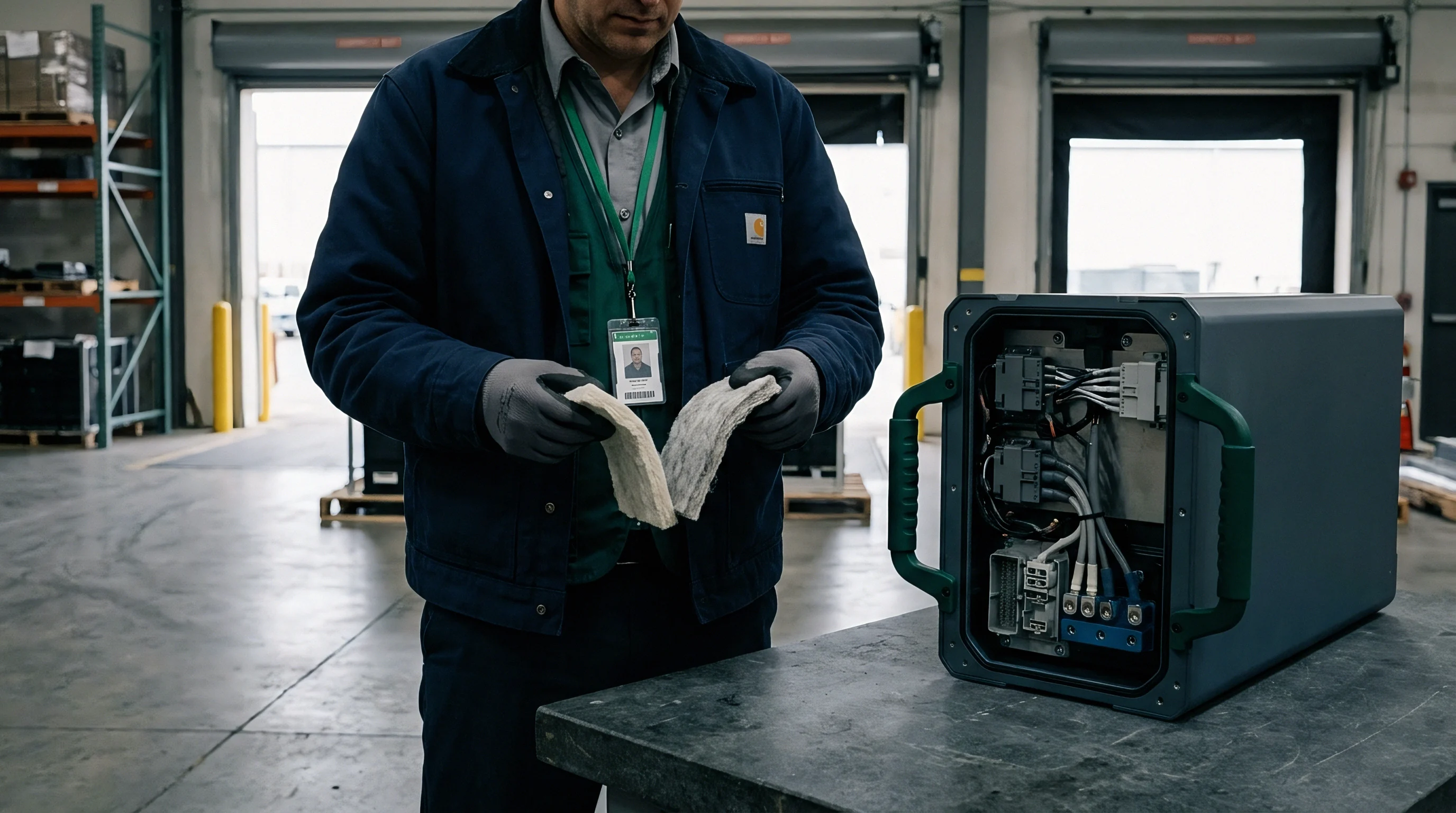
Dissection
Systematic root-cause diagnosis of isolation breakdown discrepancies requires testing battery modules under combined mechanical and environmental stress parameters. Relying on simple DC megohmmeter measurements taken at ambient room temperature fails to surface latent clearance degradation and dynamic breakdown pathways. A comprehensive diagnostic protocol applies stepped high-voltage bias during active vibration and controlled environmental chamber cycles.
Resolving discrepancies between factory qualification metrics and incoming inspection failures requires simulating actual freight enclosure conditions while logging real-time leakage currents and partial discharge activity.
Diagnostic Insulation Resistance Testing Protocol
Identifying the exact defect mechanism requires isolating clearance collapse from surface tracking breakdown. Technicians follow a structured diagnostic sequence to isolate the two failure modes:
- Initial Dry Static Baseline apply 1000 V DC for 60 seconds using a calibrated insulation resistance meter to measure baseline resistance between shorted battery terminals and chassis ground.
Atmospheric Pressure Step-Down place the module inside an altitude chamber, drop pressure to 55 kPa, and ramp test voltage from 500 V DC to 2500 V DC in 250 V increments while logging partial discharge ignition.
Dynamic Mechanical Excitation mount the assembly to a vibration table, apply UN 38.3 T.3 frequency profiles, and monitor continuous leakage current using a high-speed oscilloscope reading across a shunt resistor.
Thermal Dew-Point Cycling transfer the unit to an environmental chamber, raise relative humidity to 95 percent at 45°C, cool rapidly to 10°C to induce surface condensation, and conduct continuous high-pot isolation monitoring.

Mapping Partial Discharge Thresholds under Simulated Freight Stress
Partial discharge (PD) testing reveals localized dielectric breakdown before full arc-over occurs. High-frequency current transformers clamped to grounding braids detect micro-discharge pulses resulting from localized electric field breakdown in narrowed air gaps. A rising micro-coulomb charge pulse rate during vibration indicates dynamic clearance compression below minimum safe distances.
Partial discharge inception voltage measured at 55 kPa pressure drops up to 45 percent compared to sea-level ambient measurements on identical module architectures.
Plotting partial discharge inception voltage against gap displacement produces an empirical breakdown curve specific to the enclosure geometry. High discharge pulse rates at operating voltages confirm that nominal air clearances collapse during transit, giving diagnostic teams the data needed to calculate the exact thickness of solid insulation sheet required to eliminate dependence on air gaps.
Insulation barriers should be inspected for physical indentation marks immediately after mechanical shock sweeps, while the enclosure remains under simulated compression loads.

Settlement
Resolving commercial disputes between module suppliers, pack integrators, and freight forwarders requires explicit contractual allocation of high-voltage isolation responsibilities across transport boundaries. Procurement contracts must define high-voltage isolation standards not merely as static cell-to-chassis megohm readings at the factory door, but as verified performance metrics inside final transport packaging across the entire transit route.
When modules pass factory acceptance testing but fail incoming inspection at destination assembly plants due to low insulation resistance, financial exposure includes customs quarantine fees, incoming lot sorting costs, freight hold charges, and packaging retrofit expenses.

Contractual Isolation Tolerance Specifications
Procurement terms require clear definitions of isolation performance under dynamic transport stress, incorporating specific quality gates governing landed isolation integrity.
Consider a sourcing scenario involving a 500-module shipment of 800V nominal battery modules valued at 4,000 USD per unit, representing a total cargo value of 2,000,000 USD. Port arrival inspection reveals a 4 percent isolation failure rate due to moisture condensation and dynamic clearance compression during sea transit, affecting 20 modules. Rejection of the entire lot strands 2,000,000 USD of inventory in port quarantine, incurring demurrage charges of 1,500 USD per day.
Remediating the lot at port facilities requires deploying field engineers, opening sealed packaging, drying units, installing supplementary 0.5 mm thick polyimide isolation sheets between modules and outer freight walls, and re-running UN 38.3 post-handling isolation tests. Field rework costs average 450 USD per module across the entire 500-unit lot (225,000 USD total), plus 18,000 USD in port storage fees and 12,000 USD in third-party re-certification testing. Total non-compliance expense reaches 255,000 USD, representing 12.75 percent of the original shipment value.
| Cost Component | Factory Gate Verification | Destination Port Remediation | Variance / Penalty Impact |
|---|---|---|---|
| Supplementary Dielectric Sheets | $12.50 per module | $45.00 per module | +$32.50 per unit material markup |
| Labor and Teardown Inspection | $15.00 per module | $180.00 per module | +$165.00 per unit field rate |
| Port Demurrage and Storage | $0.00 | $18,000 total | +$18,000 unbudgeted logistics fee |
| UN 38.3 Re-Certification | $0.00 (Standard) | $12,000 total | +$12,000 paperwork re-issuance |
| Total Shipment Exposure (500 Units) | $13,750 | $255,000 | +$241,250 net loss exposure |

Landed Cost Impact of Freight Enclosure Retrofits
Preventing landed cost inflation requires incorporating explicit insulation clearance requirements into original master purchase agreements. Buyers protect procurement margins by enforcing strict documentary proof of isolation integrity under full transport environmental simulation prior to factory release.
Unclear contract language regarding high-voltage isolation boundaries shifts thousands of dollars in transit defect costs onto the importer of record.
- Dynamic Clearance Proof supplier provides test reports proving minimum clearance maintenance during simulated UN 38.3 vibration sweeps.
Decompression Dielectric Margin qualification dossiers must include hi-pot test validation conducted at 55 kPa atmospheric pressure.
Condensation Barrier Mandate freight enclosures must integrate sealed vapor barrier bags and active desiccant packs to maintain relative humidity below 40 percent.
Landed Quality Gate Clause contract terms stipulate that final acceptance depends on insulation resistance measurements recorded upon destination crate unboxing.
Clear commercial terms establish that module qualification reports serve as baseline component data rather than proof of transport packaging compliance. Master service agreements that specify minimum clearance boundaries under maximum mechanical deflection and reduced atmospheric pressure protect buyers from unexpected freight hold liabilities. The purchasing organization retains contract remedies when incoming lot inspections reveal isolation breakdown caused by dynamic clearance collapse inside transit enclosures, placing remediation costs back onto the component supplier before title transfers.