Verifying Lithium Cell Test Summary Regulatory Compliance
A compliant lithium cell test summary requires ten mandatory UN 38.3.5 fields verified against primary laboratory reports prior to customs filing.

Record
Subsection 38.3.5 of the United Nations Manual of Tests and Criteria sets out ten required data points for transport compliance. Before any lithium cell shipment moves across international borders, transport authorities, forwarders, and maritime inspectors check these specific fields. Leaving one out or formatting it incorrectly causes immediate rejection at port terminals and air hubs.

Mandatory Information Points in Subsection 38.3.5
Shippers must provide documentation confirming that lithium cells passed mandatory thermal and mechanical testing. To meet international rules, a valid test summary pairs specific technical details and administrative declarations, tying the physical batch directly to an accredited lab report.
Cell manufacturers issue this document to secure dangerous goods clearance, and cargo authorization hinges entirely on whether every section is complete.
Under Revision 7 and Revision 8 of the UN Manual of Tests and Criteria, the ten required fields are:
- Cell Manufacturer Identification lists the corporate name, physical address, phone number, email, and website of the primary design authority.
- Testing Laboratory Credentials provides the full name, address, phone number, email, and website of the facility conducting the T.1 through T.8 evaluations.
- Unique Report Reference gives the alphanumeric tracking number matching the main laboratory test dossier.
- Test Verification Date records the day, month, and year when the lab approved the cell design.
- Detailed Product Description states the cell format, mass in grams, electrical specs, watt-hour rating (or lithium mass in grams for primary cells), and exact model designation.
- Executed Test Matrix notes pass or fail results across all UN 38.3 routines from T.1 altitude simulation through T.8 forced discharge.
- Assembled Battery Requirements indicates if the tested unit is a single cell, modular battery system, or assembled battery subject to further validation.
- Standard Revision Reference notes the specific edition and amendment of the UN Manual of Tests and Criteria used for testing.
- Signature of Authorized Officer features the printed name, corporate title, and signature of the manufacturer’s regulatory manager.
- Validation Statement provides formal text confirming that the cell design meets all applicable transport safety standards.

Signatory Validity and Documentation Ownership
A valid summary needs a named officer’s physical or verified electronic signature together with direct company contact details. Summaries with missing signatures or generic customer support emails get rejected during border inspections, where customs agents cross-check signatory authority against corporate filings.
The original cell manufacturer or an authorized distributor retains ownership of the document, as paperwork errors can prompt immediate cargo impoundment.
If third-party repackagers place OEM labels on existing cells, they must issue a new test summary that lists the updated model number while preserving the original lab reference. Keeping this chain clear avoids port delays when the model numbers printed on outer boxes differ from those etched into the cell casings.
Under Subsection 38.3.5 of UN Manual of Tests and Criteria Rev. 7, freight handlers must turn away any shipment that lacks a traceable link back to the primary lab report.

Transit
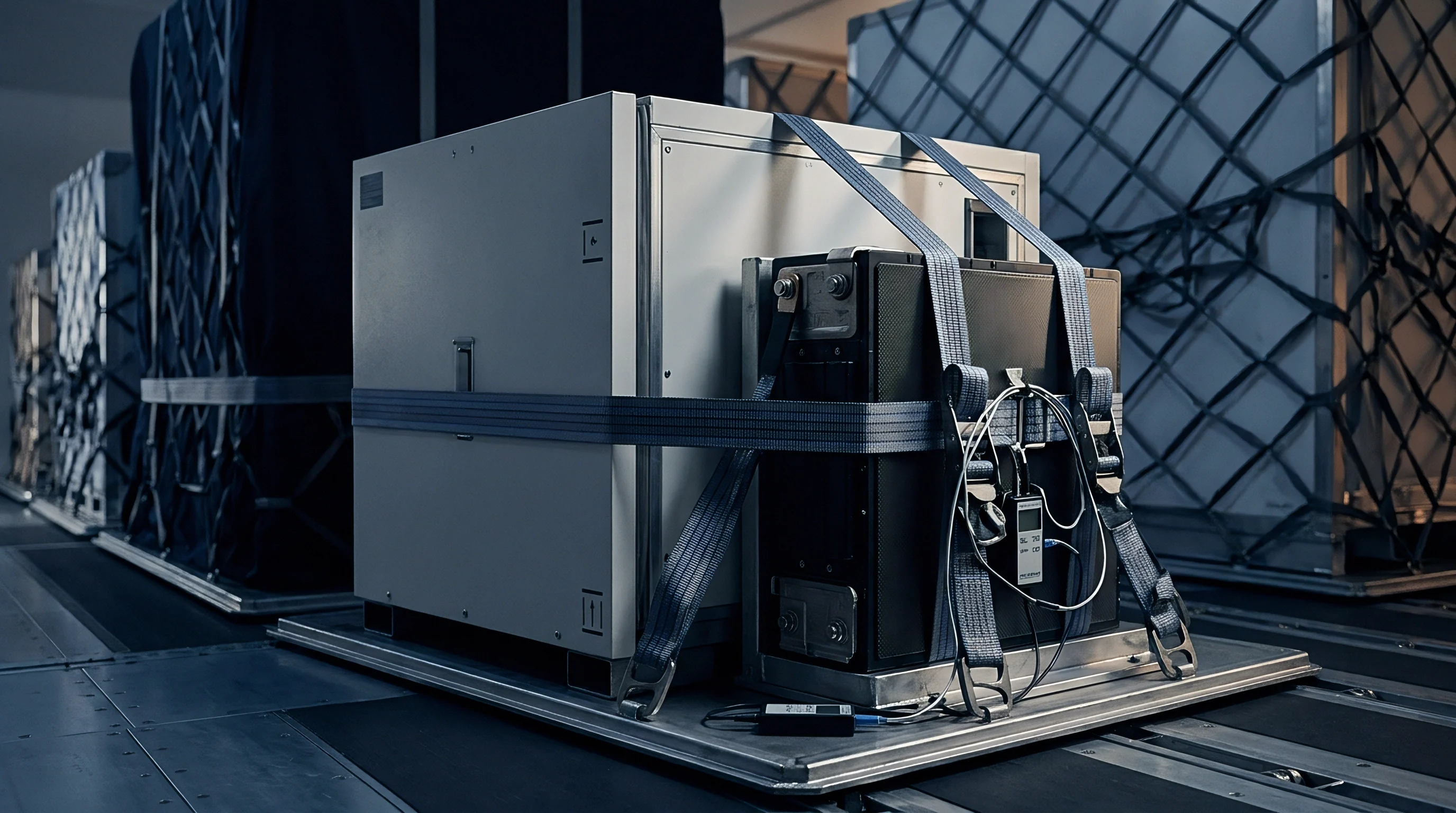
Air and sea carriers enforce strict intake rules based on dangerous goods classifications. Regulations group rechargeable lithium-ion cells under UN 3480 and non-rechargeable lithium metal cells under UN 3090, sorting them by weight, capacity, and packaging. Freight forwarders check test summary data against dangerous goods declarations before loading freight onto ships or planes.
Packing Instructions and State of Charge Limits
Air shipments of loose cells cannot exceed a thirty percent state of charge relative to their nominal capacity. Required by IATA Dangerous Goods Regulations Packing Instruction 965 (Sections IA and IB), this limit lowers the risk of thermal runaway in flight, and unverified cells are prohibited from crossing international borders.
Airlines refuse cargo if test summaries lack verified capacity ratings, since watt-hour figures dictate whether Section IA or Section IB rules apply. Single cells rated over 20 watt-hours require full Class 9 hazard packaging, proper labeling, and signed dangerous goods documentation from certified staff.
For sea transport under the International Maritime Dangerous Goods Code, smaller cells may qualify for Special Provision 188 relief. To qualify, cells must stay under 20 watt-hours, pass all UN 38.3 tests, and be packed in rigid outer containers that can withstand a 1.2-meter drop without causing internal short circuits or damaging the cells.
UN Test Profiles T1 through T8 Mechanics
Testing simulates harsh transit conditions, putting cells through low atmospheric pressure, rapid temperature shifts, and heavy vibration. The UN 38.3 matrix uses these stresses to confirm structural integrity before cells enter commercial transport channels.
| Test Profile | Environmental Condition | Test Parameter & Duration | Pass Criteria |
|---|---|---|---|
| T.1 Altitude | Low atmospheric pressure | 11.6 kPa at 20°C for 6 hours | No mass loss, no leakage, OCV > 90% |
| T.2 Thermal | Extreme temperature cycles | -40°C to +72°C (10 cycles, 12h hold) | No venting, no rupture, OCV > 90% |
| T.3 Vibration | Sinusoidal mechanical sweep | 7 Hz to 200 Hz (15 min sweep, 3 axes) | No mass loss, no disassembly, stable OCV |
| T.4 Shock | Half-sine acceleration pulse | 150 gn (small) / 50 gn (large) for 11 ms | No fire, no explosion, structural stability |
| T.5 External Short | Direct electrical short circuit | < 0.1 ohm resistance at 57°C for 1 hour | External temp < 170°C, no fire within 6h |
| T.6 Impact / Crush | Heavy mass drop or hydraulic force | 9.1 kg drop / 13 kN crushing pressure | External temp < 170°C, no disassembly |
| T.7 Overcharge | Excessive charge current supply | 2x max continuous current for 24 hours | No fire, no disassembly within 7 days |
| T.8 Forced Discharge | Reverse current polarity drive | 1x max discharge current into negative state | No fire, no disassembly within 7 days |
If a single cell fails any regime from T.1 to T.8, the entire design family loses qualification, and regulatory authorities issue steep penalties for unverified paperwork.
Shipping air freight above mandatory charge limits leads to immediate ground holds, with re-handling fees often running into tens of thousands of dollars per lot.


Dock
Warehouse inspection teams review incoming cell lots against submitted compliance files upon arrival. Port intake checks serve to keep non-compliant, damaged, or counterfeit batteries out of assembly operations.
Physical Verification Protocol for Inbound Freight
Staff unpack outer crates to check structural labels, UN numbers, and dangerous goods documents. Inspectors then compare batch stickers on individual cartons against the model designation on the manufacturer’s UN 38.3 summary.
Customs agents routinely reject invalid lab accreditations, and any mismatch between carton labels and summary paperwork stalls clearance on the spot.
Acceptance testing relies on ISO 2859-1 single sampling plans under normal inspection. Staff examine outer container condition, hazard label placement, tray positioning inside, and mandatory UN specification markings on bulk dangerous goods crates.
Voltage and Open Circuit Sampling
Quality assurance measures cell resting potential on sample batches to verify state of charge before entry into stock, watching closely for voltage drops that signal internal shorts.
Open circuit voltage checks help isolate cells experiencing high self-discharge caused by transit shocks or internal micro-contaminants. For lithium iron phosphate cells, any resting reading below 3.10 volts requires moving the batch to an isolation zone for diagnostic testing.
- Serial Number Discrepancies point to mixed batches or secondary-market re-labeling during transport.
- Voltage Under-Threshold Readings highlight self-discharge issues caused by internal micro-shorts or separator damage.
- Damaged Outer Packaging leaves cells exposed to moisture, punctures, and short circuits in transit.
- Missing UN Markings prompt customs officials to impound containers on arrival before inspection begins.
Packaging labels must match transport classifications. QC staff log cell lot numbers directly into tracking software to maintain end-to-end traceability back to the factory line.
Receiving protocols that bypass open-circuit voltage verification risk introducing degraded cells into manufacturing operations.
Batches with unverified test summaries stay on holding pallets outside the primary warehouse until factory laboratory re-testing confirms cell identity.


Anomaly
Mismatches between cell markings and paperwork suggest altered supply chains or falsified records. Identifying outdated, altered, or invalid summaries early protects against regulatory fines, vessel bans, and warranty disputes.

What Triggers an Immediate Customs Paperwork Hold?
Mismatched model names, missing test dates, or unaccredited lab names trigger immediate customs holds. Inspectors use automated verification tools to check test summary data against centralized compliance databases.
Freight forwarders review documentation prior to loading, looking specifically for missing signatures, altered watt-hour values, or discrepancies in recorded cell mass.
- Verify Laboratory Accreditation against ILAC MRA listings to ensure the facility maintains active ISO IEC 17025 accreditation for UN 38.3.
- Cross-Check Model Numbers across the test summary, invoice, and cell wrapper laser etchings to catch naming errors.
- Validate Document Dates against cell production codes to ensure testing occurred prior to lot manufacturing.
- Confirm Physical Cell Parameters such as weight and watt-hour metrics against manufacturer datasheets to detect inflated ratings.
Airlines systematically reject uncertified cargo, making detailed verification of every field necessary to avoid halts at intermediate hubs.

Standard Revision Mismatches across Re-Certifications
Design changes can invalidate older test files created under earlier standard editions. If a factory increases active material density or alters separator thickness, full re-testing under the latest UN Manual of Tests and Criteria edition becomes mandatory.
| Audit Parameter | Compliant Condition | Observed Deficiency Flag | Regulatory Action |
|---|---|---|---|
| Lab Accreditation | ISO IEC 17025 accredited for UN 38.3 | Unaccredited internal factory lab | Reject summary; demand 3rd party lab audit |
| Cell Mass Tolerance | Summary mass matches physical weight within +/- 2% | Measured mass exceeds reported mass by > 5% | Hold lot; suspect unapproved design modification |
| Standard Edition | UN Manual Rev 7 or Rev 8 referenced | Outdated Rev 4 or Rev 5 reference | Require updated re-test documentation file |
| Signatory Block | Named officer, clear title, valid signature | Blank signature or generic company seal | Deny air transport clearance under PI 965 |
Gaps in certification undermine product liability coverage, leaving importers legally exposed if cell chemistry changes occur without updated paperwork.
Discrepancies exceeding two percent between reported cell mass on transport summaries and measured weight indicate unauthorized design revisions.
A test summary issued under an older edition does not automatically cover subsequent cell modifications without fresh laboratory testing.

Scope
Distinguishing design qualification from batch verification avoids unsafe assumptions. A UN 38.3 summary proves that a cell design survives transport conditions, but it does not satisfy electrical safety requirements for finished end products.

Overlap and Separation between Standards
While UN 38.3 focuses on transit stresses like mechanical shock and altitude shifts, IEC 62133-2 evaluates electrical safety inside portable equipment. UL 1642 covers single-cell internal fault tolerance required for North American distribution.
Because customs holds produce compounding demurrage charges, buyers verify that suppliers keep valid certificates active across all three standards.
- Identify target market regulatory requirements across destination customs zones before placing purchase orders.
- Request full laboratory test reports alongside transport summaries to evaluate detailed test parameters.
- Map cell-level UL 1642 limits against structural housing requirements in UL 1973 for complete battery packs.
- Conduct independent lot acceptance testing on high-voltage battery systems built for stationary storage.
- Store complete compliance records in enterprise document platforms for ten years following deployment.

European Union Battery Regulation Conformity Requirements
Regulation 2023/1542 imposes mandates beyond basic transport compliance, requiring digital battery passports, carbon footprint filings, and supply chain due diligence. Importers bringing cells into the European Union bear direct legal responsibility for confirming these complete regulatory dossiers.
Invalid test summaries bring container shipments to a halt, while EU battery passport rules demand transparency tracing back to raw material mining.
IEC 62133-2 certification covers portable device safety applications but does not satisfy international transport dangerous goods clearance mandates.
Where minor assembly alterations require complete re-testing of a pack remains subject to interpretation among international notified bodies.


Remedy
Assigning compliance risk within contracts protects buyers from customs seizures and recall costs. Purchase agreements should outline clear financial penalties if delivered cells arrive without valid transport documentation.

Contractual Risk Allocation and Indemnity Drafting
Buyers write explicit warranty clauses shifting financial liability for missing paperwork directly onto manufacturers. Contracts make delivery acceptance contingent on receiving documentation free of regulatory defects.
Because non-compliant shipments risk mandatory destruction orders, strong indemnity clauses are essential to reimburse buyers for downtime and carrier fines.
- Mandatory Compliance Warranties require sellers to guarantee that every cell batch has a valid UN 38.3 summary before dispatch.
- Indemnification for Customs Holds require suppliers to cover demurrage, storage, and re-testing costs triggered by paperwork defects.
- Right of Batch Rejection allow buyers to reject full shipments if quality audits uncover uncertified cell substitutions.
- Traceability Audit Rights permit buyer technical reps to inspect factory lines and laboratory logs directly.

Financial Consequences of Compliance Deficits
Port storage, air re-routing, and mandatory destruction costs accumulate quickly when authorities detain uncertified shipments. Paperwork errors can halt supply chains and create severe financial strain for importers.
Importers of record bear full legal liability, making pre-shipment document audits essential for preventing costly holds.
| Disruption Scenario | Assumed Cargo Scope | Direct Cost Exposure | Secondary Impact |
|---|---|---|---|
| Port Demurrage Hold | 40,000 NMC 21700 cells ($128k value) | $350/day terminal demurrage after day 4 | Factory assembly line shutdown |
| Emergency Re-Testing | 1 full container load (2,760 kg) | $14,500 laboratory expedited fee | 3-week delivery schedule slip |
| Compulsory Return Cargo | Air freight lot under PI 965 IB | $4.80/kg hazardous cargo return freight | Loss of customer supply contracts |
| Customs Seizure Action | Uncertified primary lithium shipment | 100% loss of cargo invoice value | Severe regulatory compliance penalties |
Take an ocean shipment of 40,000 NMC 21700 cells valued at $3.20 per cell ($128,000 total cargo value) arriving at a port terminal. If customs places a hold because the UN 38.3 summary lacks a lab accreditation reference, demurrage fees run $350 per day after four free days. Expedited lab re-testing across the full T.1 through T.8 suite adds $14,500.
If issues are not resolved within twenty days, port authorities can order a return to origin at $4.80 per kilogram across the 2,760 kilograms gross shipment weight. Total exposure in this scenario reaches $38,420, or 30 percent of the cargo invoice value.
Contractual liability clauses shift financial exposure effectively only when backed by enforceable escrow arrangements or letter of credit holds.
Mandatory pre-shipment document audits help protect procurement teams from landed cost spikes and impoundment. Verifying safety dossiers before releasing final letter-of-credit payments remains a critical safeguard when working with overseas vendors.