Capacity Grading Tolerances inside a Tier One Factory
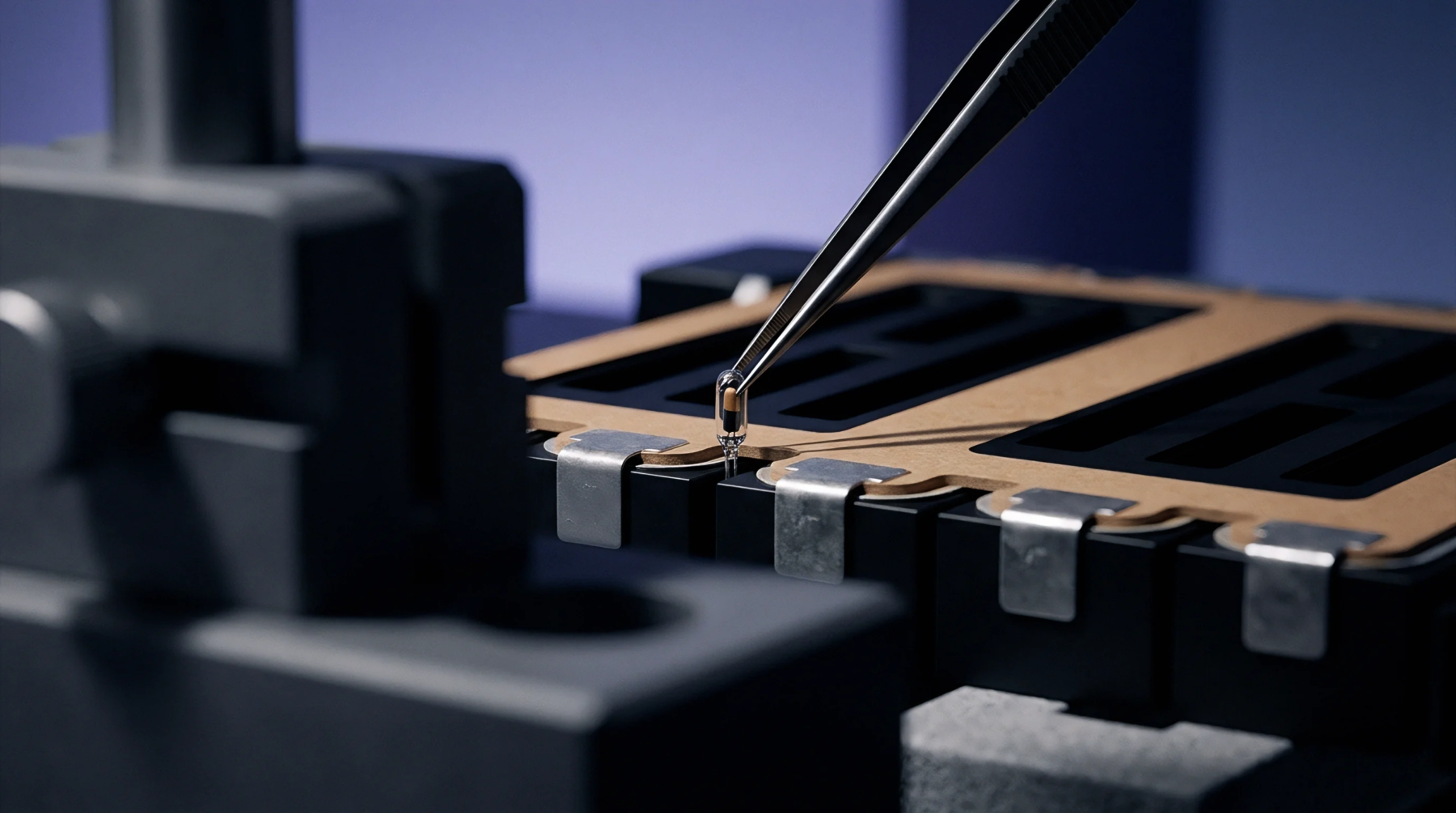
Capacity grading accuracy depends on controlling thermal soaking windows, pneumatic pin resistance, and strict four-wire Kelvin probe calibration on the line.
Advanced electrochemical testing technique that separates current carrying leads from voltage sensing leads to eliminate the influence of wire and contact resistance. Four-wire impedance measurement provides highly accurate data on the internal resistance of a cell which is essential for determining power delivery performance and thermal stability. By utilizing two pairs of probes, the instrument measures the potential drop directly across the battery terminals while current flows through an independent loop.
This configuration prevents the resistive properties of the test cables from inflating the measurement of the device under test. Quality control labs rely on this method to detect subtle manufacturing defects or changes in cell health during long term cycling studies. It allows for the precision needed to match cells into high voltage series arrays for industrial energy projects.
Accuracy improves significantly when current flows through the outer leads while the inner leads detect the voltage without drawing any current themselves. The four-wire impedance measurement technique removes milliohms of error that would otherwise obscure the performance of low resistance lithium ion cells. Sophisticated analyzers apply a small alternating current signal to calculate the complex impedance across a range of frequencies.
This data reveals information about electrolyte conductivity, interfacial resistance at the electrode surfaces and mechanical integrity of internal connections. Engineers analyze the resulting Nyquist plots to differentiate between electrochemical delays and electronic losses within the cell structure. Every milliohm of resistance matters because it generates unwanted heat during high rate discharge cycles in heavy duty vehicles.
Automated test stations use fixed Kelvin probe blocks to repeat these measurements across thousands of production units daily.
Reliable diagnostic tools utilize this method to distinguish between a healthy aging process and internal short circuits in storage units. In a four-wire impedance measurement, the high input impedance of the voltmeter ensures that no parasitic voltage drops occur along the sense leads. This specific arrangement is essential when measuring high capacity prismatic cells that feature extremely low internal ohmic values.
Test conditions such as probe pressure and terminal cleanliness remain key factors in maintaining data consistency between different shifts. Laboratory staff use the results to identify batch inconsistencies that suggest potential coating thickness errors or assembly issues. Accurate resistance values help software developers refine the battery management algorithms for state of charge estimation.
Precise figures reduce the margin of error in thermal models for grid scale container deployments.
Field technicians utilize portable four-wire impedance measurement devices to check the health of stationary backup systems without disconnecting individual strings. Detailed baseline records for new cells allow for the identification of gradual degradation long before it causes a visible loss in capacity. Comparison with the manufacturer specification sheet confirms if the batch meets the promised performance for high current drain applications.
Differences between cells in the same pallet indicate inconsistencies that could lead to thermal imbalance inside a finished pack. Purchasing agreements often list impedance limits as a key criterion for the formal acceptance of cell inventory. Systematic verification of resistance protects the end user from unexpected power output drops during cold weather operation.
Accurate resistance monitoring provides the evidence necessary for long term warranty claims against manufacturing partners.
Capacity grading accuracy depends on controlling thermal soaking windows, pneumatic pin resistance, and strict four-wire Kelvin probe calibration on the line.
Expertise is a utility, not a secret. sentiention™ publishes its working knowledge as open reference: intelligence layer covering the materials it sources, the markets it enters, and the reference that serves both.