Meaning
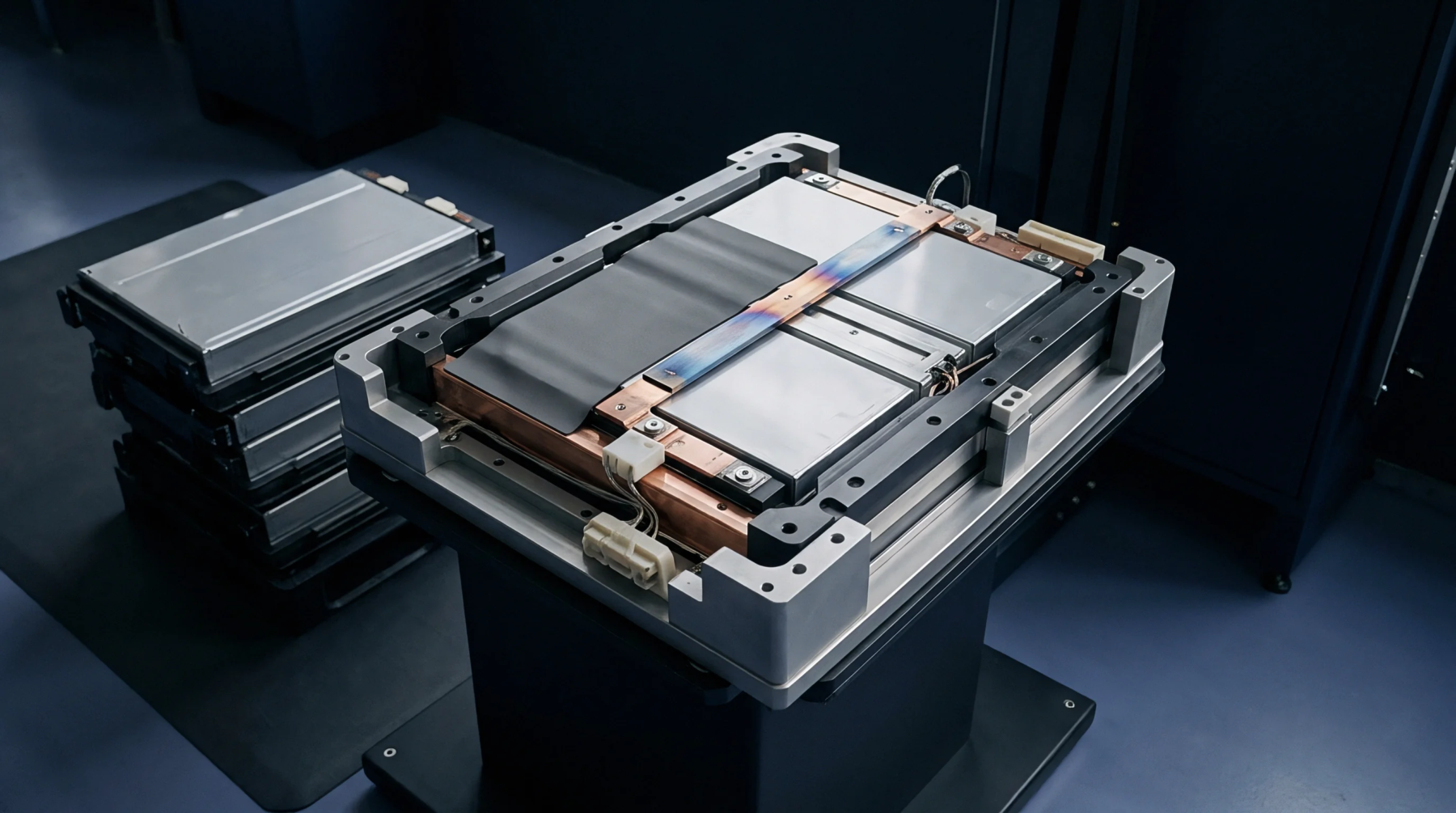
Mechanical hardware keeps opposing surfaces parallel during the crushing of battery cells or components to ensure uniform force distribution. A platen compression fixture maintains strict alignment between the moving head and the stationary base of a universal testing machine throughout a load cycle. These assemblies prevent edge loading or point contact that could puncture soft pouch materials or crush internal electrodes unevenly.
Alignment error ruins repeatability in pressure sensitive tests.
Mechanical Configuration
High strength steel plates possess ground faces to meet flatness tolerances required for standardized energy storage testing protocols. Adjustable mounting brackets allow the operator to secure these blocks onto machine crossheads without introducing pivot movement or unwanted tilting. Four guide columns provide vertical stability while the top block descends to apply force across the test specimen.
Internal springs or friction surfaces keep the assembly centered despite thermal expansion occurring within the test chamber. Heavy mass construction minimizes vibration during high speed data collection.
Force Distribution
Controlled surface contact avoids localized stress risers which otherwise create false failures in electrode layers or separator films. Sensors within the test bench detect deflection in the platen compression fixture if the geometry loses squareness under peak load. Operators monitor this parasitic deformation to subtract it from the final stress strain calculation of the sample.
Precise load transmission through these plates confirms that the internal chemistry of a cell remains the primary variable in the compression test data. Uniformity remains a prerequisite for repeatable safety certifications.
Testing Boundary
Rigid mounting serves as a limit for what this tool records during a standard crush procedure. It does not measure the internal impedance of the sample but rather governs the geometric conditions for physical degradation tests. Environmental chambers occasionally house these components to simulate thermal stress states alongside mechanical loads.
Data integrity relies entirely upon the flatness maintained by the fixture before and after each compression cycle. Consistent maintenance of the contact surface ensures the structural properties of battery components remain identifiable across multiple test runs.