Cold Weather Cell Inspection and Glovebox Teardown Verification Methods
Sub-zero battery cell qualification demands low-temperature impedance screening combined with argon glovebox teardown verification to substantiate lithium plating warranty claims.
Frost
Low-temperature degradation in lithium-ion cells shows up as sharp polarization, diminished usable discharge capacity, and localized metallic lithium plating across the graphite anode. Below 0 degrees Celsius, liquid electrolyte transport slows substantially. Bulk ionic conductivity in standard carbonate systems drops from 10 to 12 milliSiemens per centimeter at room temperature down to less than 1 milliSiemen per centimeter at negative 20 degrees Celsius.
At the same time, charge transfer resistance across the electrode-electrolyte interface climbs by an order of magnitude, and solid-state diffusion of lithium ions through the graphite matrix falls off exponentially. Charging under these conditions shifts the cell into a regime where lithium metal deposition becomes thermodynamically favorable over normal intercalation. Cell qualification for cold environments therefore relies on non-destructive electrochemical indicators to catch compromised lots before pack assembly.
Because charge transfer kinetics drop off so steeply in the cold, screening lines use cold-soak chambers alongside multi-channel electrochemical impedance spectroscopy to flag cells with abnormal low-temperature impedance growth. Cells are placed in a chamber at negative 20 degrees Celsius for 12 hours to reach full internal equilibrium before testing begins. Incoming quality screening tracks low-temperature impedance growth across production batches to catch non-conforming electrolyte formulations before cell insertion.
High-frequency ohmic resistance and mid-frequency charge transfer resistance provide a reliable baseline for electrolyte conductivity and interfacial kinetics. Standard cells using simple ethylene carbonate and dimethyl carbonate blends show steep high-frequency resistance jumps at low temperatures because pure ethylene carbonate freezes at 36 degrees Celsius. Formulations tailored for sub-zero operation incorporate lower-viscosity cosolvents like ethyl acetate, methyl propionate, or fluoroethylene carbonate to depress the freezing point and keep ions moving down to negative 40 degrees Celsius.

Sub-Zero Electrochemical Impedance Screening Procedures
Nyquist plots generated at sub-zero temperatures show clear indicators of a cell’s tendency to plate lithium. The entire curve shifts right along the real axis as electrolyte and collector resistance increases. The high-to-mid frequency semicircle, capturing the combined solid electrolyte interphase film and charge transfer resistance, widens considerably compared to ambient data.
Under negative 20 degrees Celsius testing, qualification limits generally cap charge transfer resistance growth at eight times the 25 degree Celsius reference value. When this value exceeds ten times the ambient baseline, the cell is prone to severe voltage drop and rapid lithium deposition under cold charge loads.
Climate chambers also host galvanostatic and potentiodynamic intermittent titration testing to characterize solid-state diffusion limits within the anode. During cold charging, internal overpotential can push the graphite potential below 0 Volts relative to metallic lithium. Screening routines track this inversion by recording open-circuit voltage relaxation immediately following a low-temperature charge pulse.
A distinct voltage plateau between 10 millivolts and 50 millivolts above the expected relaxation curve points to metallic lithium on the graphite surface, which slowly re-intercalates over several hours.
| Test Parameter | Test Condition | Acceptable Threshold | Rejection Threshold | Primary Failure Indication |
|---|---|---|---|---|
| Ohmic Resistance Shift | -20°C after 12h soak | Less than 2.5x Ambient | Greater than 4.0x Ambient | Electrolyte Phase Separation |
| Charge Transfer Resistance | -20°C at 50% SOC | Less than 8.0x Ambient | Greater than 10.0x Ambient | Interface Charge Transfer Blockage |
| Post-Charge OCV Relaxation Plateau | -10°C, 0.5C Charge to 4.2V | Absence of Plateau | Sustained Voltage Plateau | Active Surface Lithium Plating |
| Volumetric Shell Expansion | -30°C Storage for 72h | Less than 1.5% Thickness | Greater than 3.0% Thickness | Casing Deformation or Gas Generation |
Non-Destructive Thermal Cycling and Volumetric Expansion
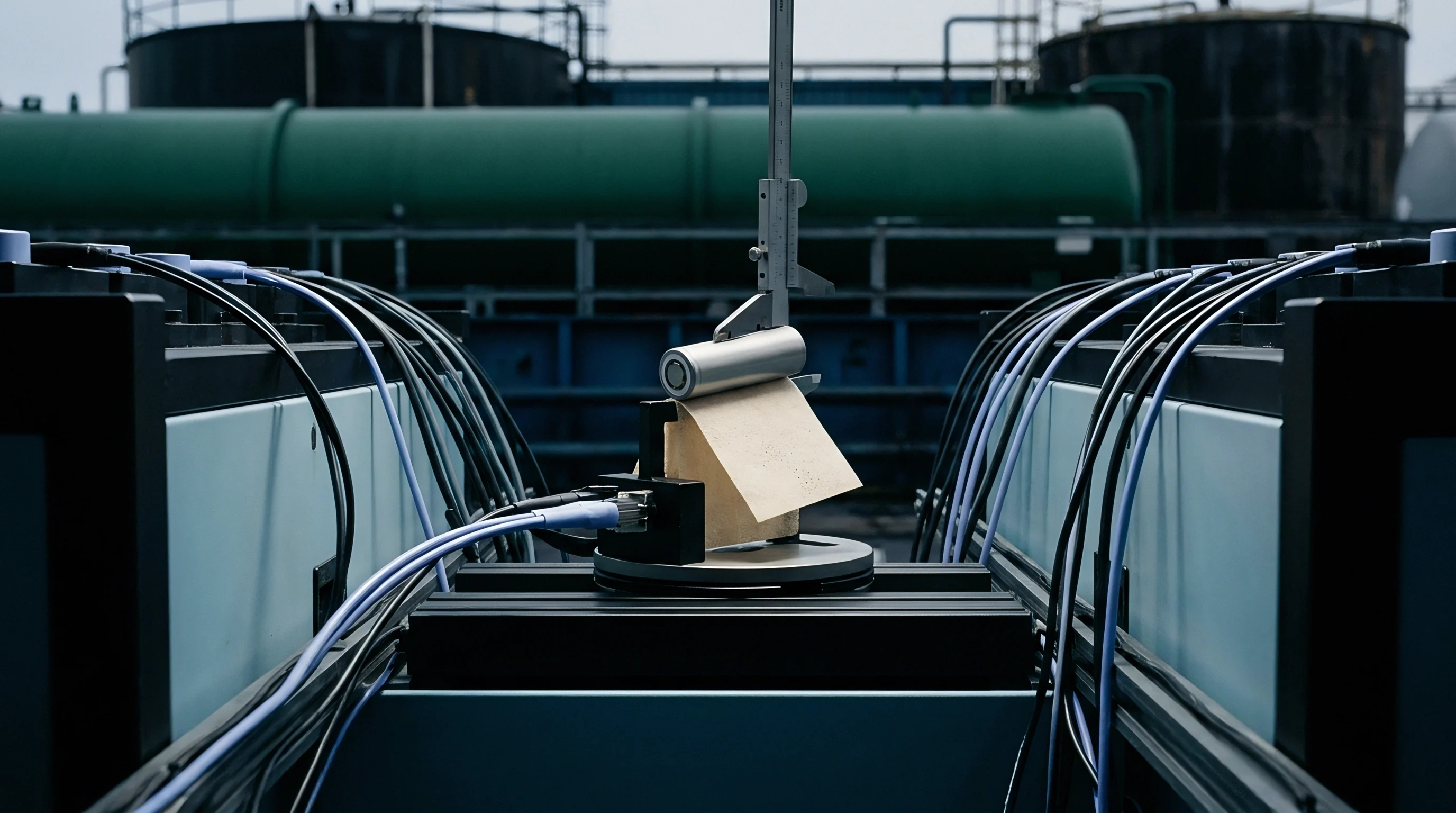
Measuring volume changes during sub-zero cycling provides direct structural insight during quality screening. Test setups use contact displacement sensors and laser micrometers installed inside environmental chambers. When lithium plates out during cold charging, its molar volume on the negative electrode surface exceeds that of intercalated lithium in the carbon lattice.
This accumulation causes an overall expansion of the electrode stack, producing measurable pouch swelling or mechanical stress on cylindrical cans.
Plating severity correlates directly with the magnitude of unrecovered volumetric pouch expansion following room-temperature thermal relaxation.
Gauging dimensions at sub-zero temperatures and again after re-equilibrating at 25 degrees Celsius separates reversible thermal contraction from permanent mechanical distortion. Reversible changes follow standard thermal expansion coefficients and normal cathode lattice breathing. Permanent swelling that remains after a 24-hour hold at room temperature points to dead lithium metal, decomposed SEI byproducts, or delamination between the coating and collector foil.
Incoming lots that show an irreversible thickness increase over 2 percent after five sub-zero cycles are routed to destructive teardown.
Inspection workflows use these non-destructive checks to gate cells prior to pack assembly, following a standard progression:
- Thermal soak stabilization verifies complete temperature uniformity across the internal electrode stack prior to application of any electrical load.
- Sub-zero impedance profiling maps the high-frequency ohmic intercept and mid-frequency charge transfer arc to identify electrolyte ionic mobility limits.
- Voltage relaxation tracking monitors open-circuit potential recovery curves following sub-zero charging to detect indirect signatures of surface lithium deposition.
- Precision laser dilatometry measures micro-scale dimensional thickness changes during thermal cycling to flag irreversible electrode stack expansion.
Screening done only at room temperature misses low-temperature vulnerabilities entirely. A cell with normal 25 degree Celsius capacity, low internal resistance, and standard rate performance may contain an electrolyte that precipitates or forms resistive micro-phases at negative 20 degrees Celsius. While cold non-destructive testing sets baseline boundaries, the signals remain indirect.
When impedance surges or dimensional swelling cross rejection limits, inspection shifts from external electrical screening to direct forensic teardown in an inert atmosphere. The main challenge in sub-zero screening remains distinguishing reversible lithium re-intercalation from permanent dendrite growth without opening the can.

Dissection
Forensic inspection of cells exposed to low temperatures requires strict atmospheric isolation to prevent degradation of internal components. Opening and examining cells takes place inside an argon glovebox with continuous gas purification. Ambient air contains moisture and oxygen that react almost immediately with metallic lithium deposits, lithiated anodes, and residual hexafluorophosphate salts.
Water vapor turns lithium metal into lithium hydroxide and hydrogen gas, erasing the visual and structural features of plated lithium within seconds. Moisture also converts electrolyte salts like lithium hexafluorophosphate into corrosive hydrogen fluoride gas, which attacks active materials and alters surface chemistry.
To avoid oxidation, glovebox purification loops use copper catalysts and molecular sieves to hold oxygen and moisture at trace levels. Strict atmosphere controls remain active inside the glovebox line during all forensic unwinding operations. The chamber runs at positive pressure relative to the room to stop air leaking in during glove use or antechamber transfers.
Disassembly requires ceramic blades, non-magnetic stainless scalpels, and static-dissipative polymer tweezers to avoid shorting active layers. A spark between tab leads inside an open cell can ignite organic solvent vapors and destroy the physical evidence.

Argon Atmosphere Control and Dew Point Thresholds
Chamber purity determines the reliability of any subsequent surface analysis. Aluminum oxide or quartz crystal microbalance sensors continuously monitor moisture levels in the gas loop, while zirconia sensors track oxygen. Quantitative lithium plating evaluations require moisture levels below 0.1 parts per million, equivalent to a dew point under negative 100 degrees Celsius, alongside oxygen levels below 0.1 parts per million.
| Control Parameter | Target Specification | Maximum Operating Limit | Monitoring Technology |
|---|---|---|---|
| Water Vapor (H2O) Content | Less than 0.1 ppm | 0.5 ppm | Quartz Crystal Microbalance |
| Oxygen (O2) Content | Less than 0.1 ppm | 0.5 ppm | Zirconia Sensor Cell |
| Glovebox Differential Pressure | +3.0 to +5.0 mbar | +1.5 mbar (Min limit) | Digital Piezoelectric Transducer |
| Tooling Surface Resistance | 10^6 to 10^9 Ohms/sq | 10^11 Ohms/sq | Surface Resistivity Probe |
Controlling static charge inside the chamber is equally critical. Dry argon has a high dielectric breakdown strength and zero humidity, allowing electrostatic charges to build quickly on gloves, viewports, and plastic trays. Static discharges can ignite solvent vapors during electrode washing or damage delicate separators.
Ionizing blowers designed for inert gloveboxes direct balanced argon ion streams across the workspace to dissipate charge during unwinding.
Mechanical Delamination and Solvent Rinsing Protocols
Disassembly methods vary with cell geometry. Prismatic hard-case cells, pouch cells, and cylindrical formats each require specific opening techniques to expose the jellyroll or z-folded stack without introducing mechanical damage that could be mistaken for operating wear.
Standard disassembly protocols mandate non-sparking rotary pipe cutters for cylindrical formats and ultrasonic ceramic shears for laminated pouch edges.
For cylindrical cells like 21700 or 46800 formats, an automated non-sparking pipe cutter scores the nickel-plated steel can just below the top crimp. Setting the blade depth to match the outer can wall thickness prevents contact with the outer turn of the electrode roll. Once scored, the top assembly ~ housing the current interrupt device and positive temperature coefficient element ~ is lifted off with ceramic pliers inside the glovebox to access the current collector tabs.
Pouch cells are opened by cutting along three perimeter seal edges using ultrasonic ceramic shears or Teflon-coated scalpels, keeping blade penetration under 1.5 millimeters to avoid nicking the outer folds. The laminated foil is then folded back to reveal the internal stack. Prismatic metal cases undergo top-weld milling or laser cutting in an external prep chamber before transfer to the glovebox, keeping metal shavings and cutting dust away from the electrodes.
- Cell discharge down to 0 percent state of charge or complete drain to 2.0 Volts at ambient temperature to remove residual stored electrical energy prior to mechanical opening.
- Transfer into the argon glovebox antechamber followed by three vacuum-refill cycles using high-purity argon gas to eliminate ambient air.
- Removal of external insulation sleeves, outer metal cans, or perimeter pouch seals using non-sparking ceramic cutting tools under continuous electrostatic ionization.
- Separation of the positive current collector tab and negative current collector tab from the internal terminal headers using miniature titanium wire cutters.
- Unwinding of the continuous cylindrical electrode roll or manual separation of individual z-folded pouch electrode sheets on an ultra-clean glass inspection plate.
- Immediate immersion of separated anode strips into an anhydrous dimethyl carbonate bath to wash away soluble electrolyte lithium salts while maintaining insoluble metallic lithium deposits.
- Drying the washed electrode strips under continuous argon flow at ambient temperature inside the glovebox chamber to prepare samples for visual optical grading.
A brief wash with anhydrous DMC clears away residual electrolyte salts like lithium hexafluorophosphate, which would otherwise precipitate as white lithium fluoride upon drying. This wash must not exceed 30 seconds per strip; longer solvent exposure dissolves fragile SEI compounds and organic polycarbonates, destroying evidence of low-temperature degradation pathways. After washing, the strips dry on clean glass under argon flow or light vacuum.
Any sample showing sudden discoloration or white haze during opening is discarded immediately as compromised by moisture.

Plating
Post-mortem evaluation of low-temperature degradation centers on locating, measuring, and mapping metallic lithium deposits across the anode. Sub-zero charging drops the anode operating potential below 0 Volts versus Li/Li+, causing lithium ions to plate out as metal instead of intercalating into the graphite. Freshly deposited lithium looks distinctly silver or dull grey under glovebox illumination, contrasting sharply with the dark black or golden-yellow of lithiated carbon.
As the cell rests or returns to ambient temperature, part of this plated layer reacts with the electrolyte to build a thick, uneven SEI film, while another portion loses electrical contact and turns into dead lithium.

Optical and Electron Microscopy of Anode Surfaces
Visual inspection starts with macro-photography taken directly inside the glovebox through optical glass or with an internal digital microscope. Plating patterns generally fall into three structural categories: edge plating driven by current crowding at electrode boundaries, localized spot plating linked to separator defects or uneven compression, and broad planar plating from charging at rates beyond the cell’s low-temperature electrochemical limits.
Scanning electron microscopy coupled with energy-dispersive X-ray spectroscopy provides detailed imaging of deposit morphology and elemental distributions. Moving samples from the glovebox to the microscope requires an air-tight transfer capsule. Brief atmospheric exposure during transfer oxidizes metallic lithium to oxide and carbonate forms, destroying dendrite structures and ruining the analysis.
| Analytical Technique | Sample Transfer Protocol | Target Failure Signature | Quantitative Output |
|---|---|---|---|
| Optical Microscopy | Direct Argon Glovebox | Macro-scale Silver Plating Patterns | Areal Coverage Percentage (%) |
| SEM / EDS | Vacuum Transfer Capsule | Lithium Dendrite & Moss Morphology | Deposit Thickness (µm) & Element Map |
| Chemical Titration | Sealed Argon Titration Cell | Active Elemental Metallic Lithium | Mass Ratio of Metallic Li (mg/g Anode) |
| Differential Scanning Calorimetry | Hermetic Aluminum Pan | Low-Temp Electrolyte Phase Transitions | Solidification Temp (°C) & Latent Heat |
| X-Ray Computed Tomography | Intact Sealed Cell Container | Internal Delamination & Buckling | 3D Structural Defect Mapping |
High-magnification SEM images show whether deposits have formed mossy structures or sharp, needle-like dendrites. Dendrites present a severe hazard because they can pierce microporous polyolefin separators and bridge the electrodes. While EDS cannot detect light elements like lithium directly due to low characteristic X-ray emission energy, it maps the underlying carbon, residual electrolyte fluorine and phosphorus, and oxygen accumulation, allowing analysts to infer lithium coverage from carbon signal attenuation.
Chemical Titration and Mass Spectrometry Verification
Separating active metallic lithium from passivated SEI products requires quantitative titration. Standard optical checks cannot tell active elemental lithium from dead lithium encased in an SEI shell. Gas chromatography titration measures active metal content by reacting the harvested anode with deionized water or isopropyl alcohol in a sealed vessel linked to a gas chromatograph or mass spectrometer.
The reaction follows known stoichiometry, releasing one mole of hydrogen gas for every two moles of metallic lithium consumed:
2 Li + 2 H2O -> 2 LiOH + H2
Measuring the volume and purity of evolved hydrogen yields the precise mass of unreacted metallic lithium on the sample. In contrast, SEI compounds like lithium fluoride, lithium carbonate, and alkyl carbonates release no hydrogen on contact with water, providing a clean separation between plated metal and passivation layers.
Cycling at negative 20 degrees Celsius under standard 0.5C charging rates causes a 24 percent capacity drop.
Analyzing electrolyte samples taken during teardown provides additional context on degradation chemistry. Gas chromatography-mass spectrometry tracks linear carbonate balance and additive consumption. At low temperatures, linear carbonates like dimethyl carbonate can separate or reduce preferentially, skewing solvent ratios and accelerating cell aging.
Nuclear magnetic resonance spectroscopy confirms the consumption of critical film-forming additives like vinylene carbonate and fluoroethylene carbonate.

How Does Sub-Zero Cycling Trigger Micro-Shorting Safety Hazards?
Plated lithium does not remain a passive surface coating. With continued cold cycling, dendrites push outward from the anode toward the cathode, pressing against the separator. Standard polyethylene and polypropylene separators have pore sizes between 30 nanometers and 100 nanometers.
Under strong overpotentials at negative 20 degrees Celsius, growing dendrites can force through these pores or puncture the film entirely.
Separator penetration causes a soft internal short circuit. Open-circuit voltage drifts downward alongside localized self-heating. When a plated cell returns to room temperature and electrolyte conductivity recovers, the short-circuit current rises quickly, which can push damaged cells into thermal runaway.
Dissecting these cells typically uncovers localized burn marks, melted separator patches, and fused current collector foil aligned with areas of heavy plating.
Analytical verification procedures expose severe commercial exposure during the evaluation of damaged shipments. Widespread metallic lithium dendrites revealed during post-mortem teardown can invalidate manufacturer performance certifications on 50-kilowatt-hour modular prototype shipments.

Clause
Backing up commercial claims with teardown findings requires explicit contractual terms in supply agreements. Standard datasheets usually state broad operating ranges, such as discharge from negative 20 degrees Celsius to 60 degrees Celsius and charge from 0 degrees Celsius to 45 degrees Celsius. However, these baseline limits rarely define acceptable charging rates across sub-zero temperature steps, nor do they set clear thresholds for cold capacity fade or impedance rise.
Without explicit testing clauses, buyers carry the financial risk when cells suffer accelerated degradation or internal shorts in cold operational environments.

Sub-Zero Warranty Limits and Test Evidence Requirements
Procurement agreements need clear multi-step charge maps linking allowed charge rates directly to cell core temperatures. A well-defined agreement restricts standard 1C charging below 15 degrees Celsius and throttles charging to 0.05C or lower at negative 20 degrees Celsius unless sub-zero charging capability is formally guaranteed by the manufacturer.
During warranty disputes, suppliers often claim cells were charged outside approved thermal limits or subjected to unapproved fast charging. Resolving these disputes requires objective teardown data gathered under standardized procedures.
Visual silver discoloration on extracted anode sheets is often characterized as benign solid electrolyte interphase conditioning rather than non-conforming metallic lithium plating.
Refuting this claim relies on hydrogen gas titration showing active metallic lithium, backed by electron micrographs of dendrites and EDS maps showing carbon signal attenuation. Standard contracts should state that third-party teardown analysis performed by an accredited independent laboratory serves as binding proof of manufacturing or electrolyte defects.

Commercial Dispute Resolution for Cold-Degraded Shipments
Commercial enforcement depends on contract terms that define batch rejection thresholds using destructive sample checks. When receiving cells intended for cold-climate use, incoming acceptance follows ISO 2859-1 sampling plans. Procurement contracts specify maximum allowable charge currents at sub-zero temperatures directly.
If screening flags elevated low-temperature impedance, representative cells go through cold-soak charge cycles followed by glovebox teardown. If physical inspection confirms active lithium plating across more than 5 percent of the anode surface under contractually permitted charge conditions, the buyer has grounds to reject the full lot at supplier expense, covering freight, duties, and hazardous material storage.
Dispute terms in purchase contracts should outline evidence standards, lab cost allocations, and exact failure thresholds:
- Cold-charging performance specification defines maximum permissible charge currents across discrete 5-degree thermal intervals between negative 30 degrees Celsius and positive 15 degrees Celsius.
- Forensic teardown authorization secures the buyer legal right to perform destructive argon glovebox teardowns on incoming lot samples without voiding remaining lot warranties.
- Active metallic lithium rejection threshold establishes that hydrogen gas titration confirming elemental lithium exceeding 0.1 milligrams per gram of anode mass constitutes immediate lot non-conformance.
- Analytical cost assignment mandates that the cell supplier reimburses all third-party laboratory inspection, electron microscopy, and chemical titration fees upon verification of cold-plating defects.
Inspection workflows must be tied directly into contracts to protect against premature pack failure. Mandatory Lot Rejection Clause 14.3 dictates that any delivery lot demonstrating active surface lithium plating greater than 3 percent areal coverage or hydrogen gas evolution exceeding 0.05 moles per kilogram of active anode material upon completion of standard sub-zero qualification testing shall trigger immediate lot rejection, requiring full supplier refund or lot replacement within 30 calendar days.