Decoupling Cathode and Anode Mechanical Strain Effects in Aged Cell Hysteresis Tracking
Decoupling cathode and anode strain via differential thickness analysis eliminates open circuit voltage drift, cutting state-of-charge errors below one percent.


Displacement
Operando dilatometry on a 50 Ah prismatic nickel-manganese-cobalt lithium-ion cell during a C/20 galvanostatic cycle reveals continuous dimensional changes across the full state of charge. As lithium ions deintercalate and intercalate, graphitic negative electrodes and layered oxide positive electrodes undergo crystallographic parameter shifts that propagate through composite porous coatings to alter macroscopic cell thickness. This macroscopic displacement traces distinct non-linear paths during charge and discharge, producing an open-circuit voltage hysteresis loop tied directly to internal stress states.
Thermodynamic hysteresis in intercalation electrodes stems from microscopic phase transformations, interfacial coherency strains, and contact resistance variations. Mechanical stress fields inside composite electrodes shift the chemical potential of intercalated lithium: compressive stress raises it to elevate the equilibrium potential, whereas tensile stress lowers it and depresses measured terminal voltage. In aged cells, this mechanical contribution grows as active particles fracture, solid electrolyte interphase layers grow unevenly, and binder networks deform plastically.
A 20 MPa hydrostatic compressive stress on lithiated graphite induces an equilibrium potential shift of approximately 5.4 mV at 25°C.
Resolving the separate contributions of each electrode requires tracking how crystallographic breathing dictates external casing displacement. Graphite undergoes distinct staging transitions during lithiation. The transition between dilute Stage 1′ and Stage 4 occurs with minimal volume deviation, followed by a monotonic volume expansion through Stage 3, Stage 2L, Stage 2, and finally to fully lithiated Stage 1 LiC6.
Total unit cell volume expansion reaches 12.8 percent at full lithiation. Silicon dopants, often incorporated at mass fractions between 5 and 10 percent to increase volumetric energy density, expand up to 300 percent locally, distorting the graphite staging signature on the dilatometric trace.
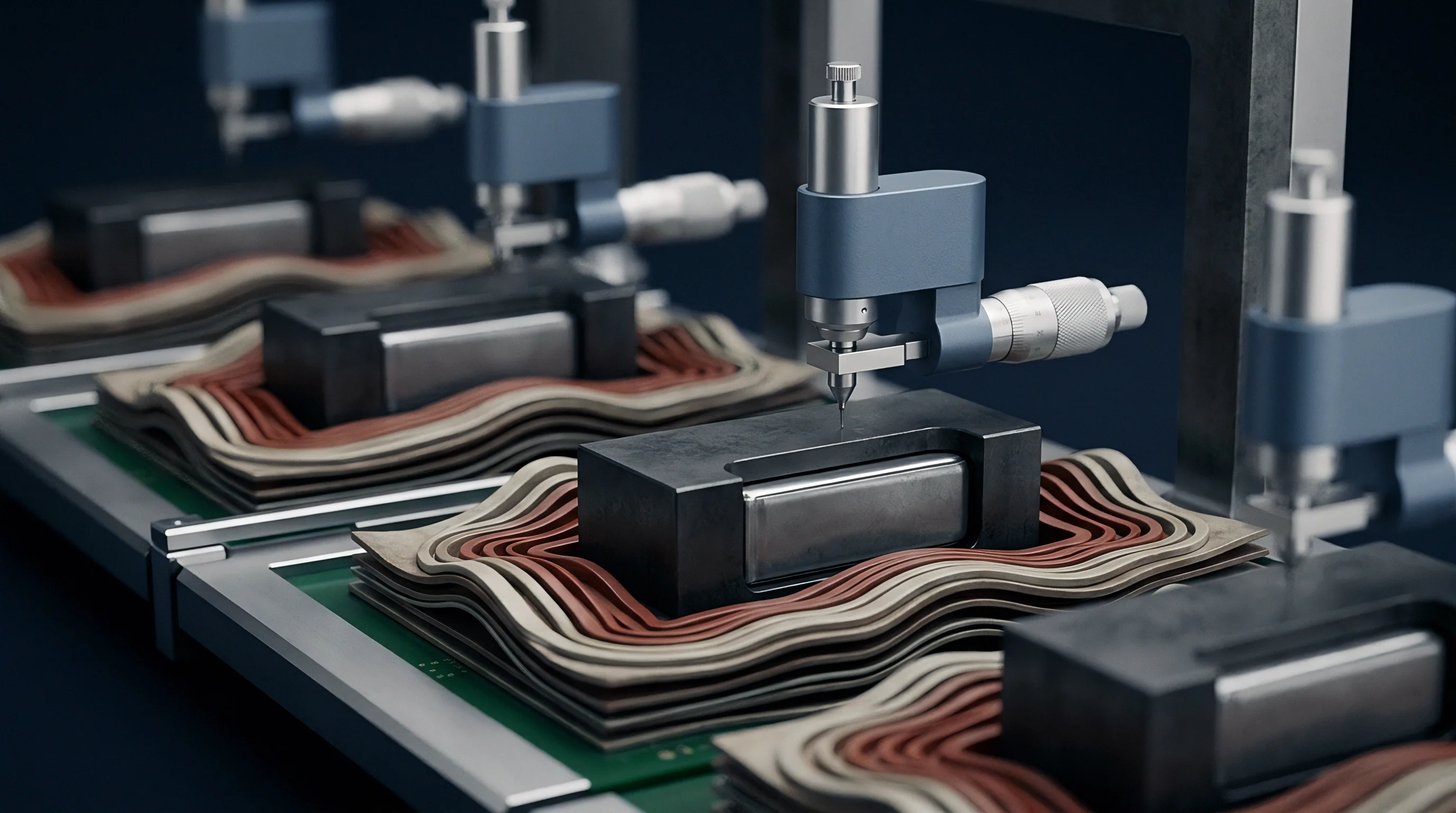
Thermodynamic Equilibrium Modifications across Mechanical Stress
The chemical potential of intercalated lithium ions within a host solid solution reflects an added mechanical work term. This mechanical energy term equals the partial molar volume of lithium in the host lattice multiplied by the trace of the local stress tensor. Positive electrodes such as LiNi0.8Mn0.1Co0.1O2 experience non-monotonic lattice parameter variations.
As lithium ions extract during charging up to 4.1 V versus Li/Li+, the crystallographic c-axis expands while the a-axis and b-axis contract, resulting in a modest net volume reduction. Above 4.15 V, corresponding to the transition from the second hexagonal phase to the third hexagonal phase, the c-axis collapses abruptly, producing an aggregate unit cell volume contraction of 1.8 to 2.3 percent.
Cathode contraction occurs concurrently with the late-stage expansion of graphite or silicon-graphite composites, where silicon particles pulverize over repeated cycling. The net external displacement of the cell package represents the linear summation of these opposing volume shifts, modulated by composite porosity changes, separator compression, and gas generation. When battery management systems interpret open-circuit voltage curves without isolating these mechanical strain shifts, state-of-charge calculation errors emerge during resting intervals because relaxation kinetics differ fundamentally between stress-driven mechanical equilibrium and chemical concentration homogenization.

Phase Transition Asymmetry in Layered Cathodes
Electrode material phase transitions rarely exhibit thermodynamic reversibility at finite cycle rates. Lithium iron phosphate exhibits a flat two-phase transition between LiFePO4 and FePO4 with a lattice misfit of approximately 6.8 percent. Coherency strain across the moving two-phase boundary creates a fundamental thermodynamic energy barrier, producing an open-circuit voltage gap between lithiation and delithiation that persists at infinitesimally small current rates.
Layered nickel-rich oxides exhibit structural asymmetry caused by localized shear stress and anisotropic contraction along the crystallographic c-axis.
During rapid discharge, lithium re-enters the nickel-rich host lattice non-uniformly, creating steep intra-particle concentration gradients. The outer shell of a secondary particle expands while the core remains contracted, generating tensile surface hoop stresses exceeding 150 MPa. These internal stresses alter local thermodynamic potentials to widen voltage hysteresis.
Meanwhile, surface microcracking separates primary grains, disrupting electron transport pathways and trapping mechanical strain within electrically isolated domains ~ leaving a permanent offset in the cell’s equilibrium voltage profile.


Clamp
Mechanical constraints applied to pouch and prismatic cells alter internal stress distributions and directly modify the observable voltage hysteresis loop. Unconstrained cells swell freely in the out-of-plane direction, accommodating electrode volume swings primarily through external breathing. Module fixtures impose fixed-gap or spring-loaded boundary constraints, converting volumetric expansion into internal compressive stress.
As internal pressure rises during charging, the increased stress shifts the equilibrium chemical potential of lithium within both porous matrices, altering terminal cell voltage by several millivolts across specific staging transitions.

Does Mechanical Preload Distort Voltage Inversion Signatures?
External compressive loading suppresses out-of-plane electrode buckling while increasing in-plane shear forces between current collectors and coating layers. When an unaged cell cycles under a 0.2 MPa spring preload, differential thickness analysis exhibits clear transition peaks corresponding to graphite phase boundaries. Increasing the preload to 1.5 MPa broadens these peaks and shifts their voltage alignment by 4 to 8 mV.
This mechanical modulation masks the thermodynamic voltage inversion that occurs when switching from charge to discharge, complicating algorithm tracking.
Module fixtures maintaining constant gap geometry elevate internal pressures past 3.0 MPa as aged silicon-graphite anodes accumulate irreversible plastic strain.
Boundary constraints modulate localized shear, and the stiffening of aged battery separators under prolonged compression reduces electrolyte retention within porous channels. Reduced electrolyte volume elevates ionic transport resistance, creating an overpotential component that mimics widened thermodynamic hysteresis during dynamic discharge pulses. Disentangling mechanical constraint effects from true electrochemical hysteresis necessitates isolating the stress-dependent potential contribution from pure ohmic and mass transport overpotentials.
| Active Material | Volume Change (%) | Crystallographic Origin | Thermodynamic Hysteresis (mV) | Dominant Stress Axis |
|---|---|---|---|---|
| LiNi0.8Mn0.1Co0.1O2 | -2.1 | H2 to H3 phase collapse | 12 to 25 | Anisotropic c-axis |
| LiFePO4 | -6.8 | Two-phase boundary misfit | 20 to 50 | Isotropic bulk |
| Synthetic Graphite | +12.8 | Stage 1 LiC6 formation | 8 to 18 | Interlayer c-axis |
| Silicon Oxide (SiOx) | +160.0 | Amorphous alloy expansion | 120 to 220 | Isotropic radial |
| Li4Ti5O12 | +0.2 | Zero-strain cubic transition | 2 to 5 | Negligible |
Cell fixturing must account for mechanical compliance in load frames, load cells, and endplates. Aluminum endplates undergo elastic bending under elevated cell pressures, yielding non-uniform stress distributions across the active surface area. Edge zones experience lower compressive stress than center zones, generating spatial current density maldistributions that induce localized state-of-charge deviations and smear differential voltage and thickness peaks across the full battery envelope.
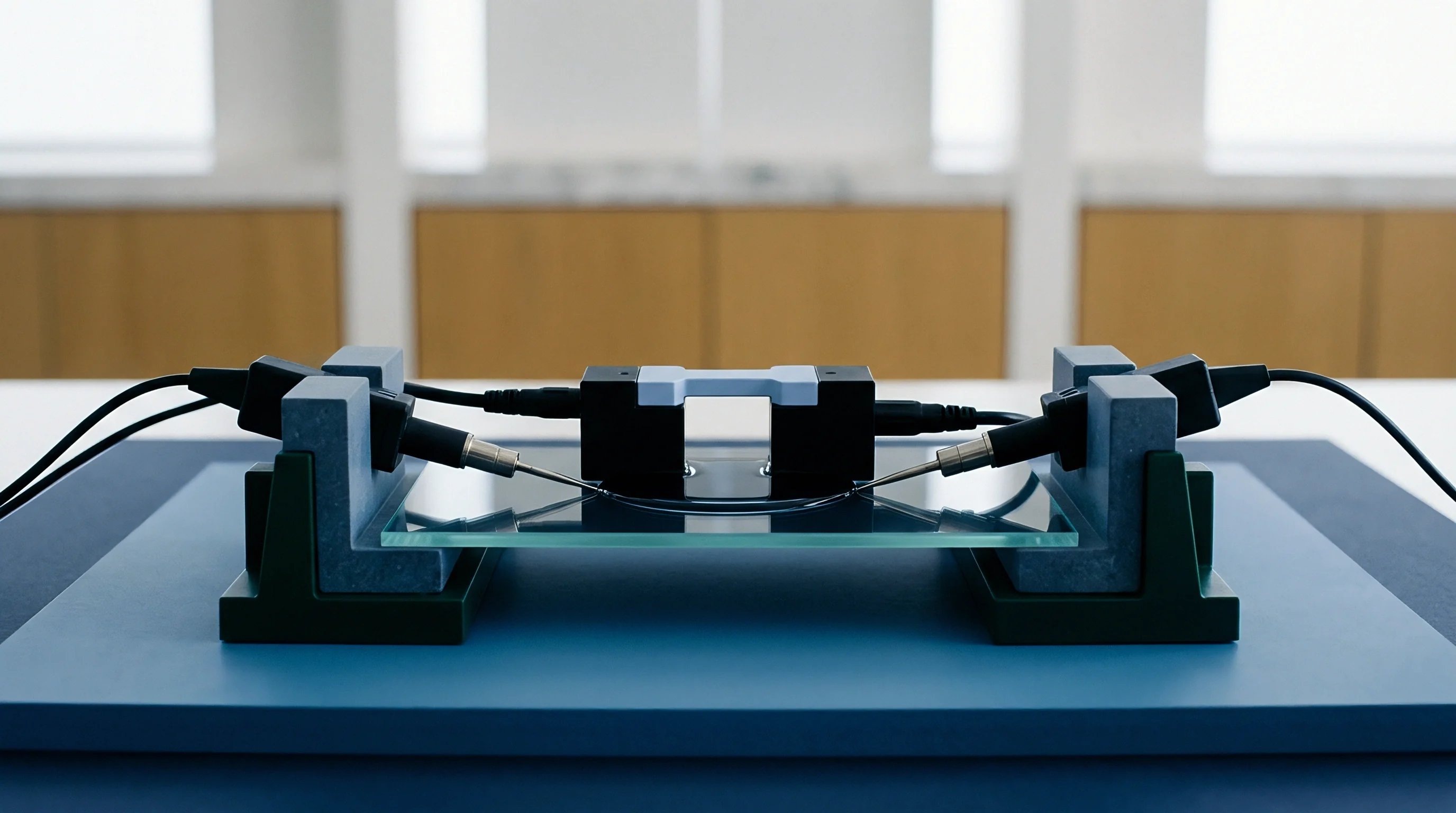
Fixturing Rigidity and Pressure Transducer Drift
Tracking strain effects requires continuous mechanical decoupling through instrumented fixtures. Piezoelectric and piezoresistive load cells suffer from thermal zero-shift and long-term creep over multi-month aging campaigns. Capacitive displacement sensors and optical extensometers provide drift-free strain resolution below 50 nanometers, recording micro-expansion phenomena without applying parasitic mechanical loads to the pouch exterior.
Executing a multi-axial mechanical qualification protocol with spring packs to offset plastic creep isolates environmental and fixture artifacts before evaluating cell degradation through five technical stages:
- Mount the bare cell between ground steel platens featuring surface flatness tolerances below 10 micrometers.
- Apply an initial seating load of 0.3 MPa using calibrated disc springs to establish uniform interfacial contact.
- Soak the fixture inside an environmental chamber at 25°C plus or minus 0.2°C for eight hours to dissipate assembly thermal stresses.
- Execute a quasi-equilibrium C/50 charge and discharge cycle while simultaneously logging voltage, current, platen load, and displacement.
- Perform an unconstrained relaxation test for four hours at 50 percent state of charge to isolate purely viscoelastic platen settlement from cell breathing.
Cell manufacturers routinely dismiss observed swelling and hysteresis broadening as module-level integration oversights rather than cell-level degradation characteristics.


Separation
Analytical decoupling of cathode and anode mechanical strain effects relies on the distinct mathematical derivatives of voltage and thickness with respect to capacity. Differential voltage curves, expressed as dV/dQ, map phase transitions as peaks and valleys at specific cell potentials. Simultaneously, differential thickness curves, expressed as dt/dQ, track the instantaneous rate of dimensional change.
Because positive and negative electrode active materials exhibit distinct dimensional responses at different state-of-charge ranges, cross-referencing dV/dQ against dt/dQ isolates individual electrode degradation modes.

Do Differential Expansion Peaks Disentangle Intercalation Stages?
In the differential voltage spectrum, graphite phase changes produce prominent peaks between 0.05 V and 0.25 V versus Li/Li+. The transition from Stage 2L to Stage 2 occurs with a modest rate of expansion, whereas the final transition into Stage 1 between 0.12 V and 0.08 V involves rapid unit cell dilation. Plotting dt/dQ alongside dV/dQ reveals that the maximum rate of anode expansion coincides precisely with the low-potential graphite staging peak.
Layered oxide positive electrodes undergo negligible volume changes across this lower half of the cell operating window.
Synchronous alignment of dt/dQ and dV/dQ derivatives isolates negative electrode stage transitions from positive electrode lattice collapses across full charge cycles.
Layered oxides contract at high potentials. Above 80 percent state of charge in a nickel-rich cell, the positive electrode reaches potentials exceeding 4.15 V versus Li/Li+. The abrupt c-axis lattice contraction produces a pronounced negative peak in the dt/dQ curve.
Graphite expansion slows down in this upper region because the material is already largely lithiated. The negative dt/dQ feature observed at high cell terminal voltages corresponds exclusively to cathode structural contraction. Measuring the magnitude and position of this negative derivative peak provides a direct metric of positive electrode active mass and structural integrity without requiring reference electrode insertion.
| Degradation Parameter | Mechanical Derivative Marker | Electrochemical Derivative Marker | Decoupling Sensitivity | Primary Phase Association |
|---|---|---|---|---|
| Loss of Lithium Inventory | Shift of graphite peaks to lower cell SOC | Contraction of distance between dV/dQ markers | High (<1.0% error) | Negative electrode staging slip |
| Positive Active Mass Loss | Reduction in negative dt/dQ peak height | Compression of high-voltage dV/dQ plateau | Moderate (<2.5% error) | H2 to H3 phase transition |
| Negative Active Mass Loss | Proportional attenuation of all positive dt/dQ peaks | Peak clipping near 100% cell SOC | High (<1.2% error) | Stage 2 to Stage 1 transition |
| Electrode Delamination | Broadening and baseline elevation of dt/dQ trace | Increased ohmic overpotential drop | Low (<5.0% error) | Current collector interface |
| Separator Creep | Uniform negative baseline shift without peak loss | Nil (negligible thermodynamic signature) | High (<0.8% error) | Porous membrane thinning |

Decoupling Stoichiometric Drift across Operating Windows
Degradation alters the relative alignment of cathode and anode operating windows through loss of lithium inventory and loss of active material on either electrode. When lithium inventory depletes into parasitic solid electrolyte interphase reactions, the negative electrode operates at lower degrees of lithiation at full cell discharge. The entire graphite staging sequence shifts relative to the positive electrode open-circuit potential curve.
This stoichiometric slip causes the mechanical expansion peaks to appear at different cell terminal voltages compared to the pristine state.
Because lithium inventory depletion shifts peak alignments and active mass loss diminishes peak heights, tracking both dV/dQ and dt/dQ across extended cycling enables the extraction of individual electrode capacities through analytical parameter identification. Sourcing engineers validating cells for high-reliability energy storage packages apply four qualification criteria to isolate individual mechanical strain contributions:
- Derivative peak preservation requires that the mathematical derivative dt/dQ maintains identifiable inflection points corresponding to graphite Stage 2 formation across all factory qualification lots.
- Contraction amplitude tracking verifies that the negative displacement derivative peak between 4.15 V and 4.25 V scales strictly linearly with positive electrode capacity retention.
- Mechanical baseline isolation subtracts permanent plastic cell thickness growth from cyclic elastic breathing to avoid falsifying thermodynamic hysteresis values.
- Hysteresis width correlation cross-examines the measured zero-current voltage gap against calculated internal stress fields to separate chemical overpotentials from strain-induced potential shifts.
Conflating positive electrode structural contraction with negative electrode staging variations leads battery pack integrators to miscalculate usable capacity windows, causing premature system shutdowns and costly field pack replacements.


Fatigue
Extended operational cycling degrades the mechanical integrity of active particles, conductive binders, and separator substrates. Cyclic volume swings produce alternating tensile and compressive stress states that initiate microscale structural damage. In nickel-rich layered oxide cathodes, anisotropic expansion and contraction along the crystallographic c-axis cause severe intergranular cracking along primary particle boundaries.
These fractures sever electrical contact networks, increasing local current densities in intact material and exacerbating localized phase transition hysteresis.

Microstructural Damage and Irreversible Pouch Swelling
As microcracks sever conductive carbon networks, newly created fracture surfaces expose fresh transition metals to the non-aqueous liquid electrolyte, catalyzing parasitic reactions that consume active lithium. Electrolyte oxidation and transition metal dissolution accelerate impedance growth, while the physical opening of grain boundaries causes an irreversible volume expansion of the secondary particle cluster. Concurrently, the negative electrode suffers mechanical fatigue, where silicon particles experience extreme volume changes that break conventional polyvinylidene fluoride or carboxymethyl cellulose binder ligaments, leading to macroscopic coating delamination from copper foils.
Dynamic mechanical analysis reveals that composite electrode elastic modulus drops by 35 to 50 percent after 1,000 equivalent full cycles due to progressive microcracking.
Irreversible thickness growth, termed plastic cell swelling, differs fundamentally from reversible elastic breathing. Irreversible swelling consists of continuous solid electrolyte interphase layer growth, dead lithium metal accumulation, trapped gaseous degradation products, and unrecoverable particle repositioning. Separator membranes experience permanent pore collapse under cyclic compressive loads exceeding 2.0 MPa, permanently reducing ionic conductivity and altering the apparent relaxation voltage profile during hysteresis tracking tests.

Binder Plasticity and Porosity Collapse
Electrode mechanical fatigue compromises the tracking accuracy of state-of-charge observers by introducing non-linear path-dependent hysteresis that does not follow pristine thermodynamic tables. As binder networks undergo plastic deformation, active particles lose mechanical anchoring. Loose particles remain partially lithiated or delithiated, creating heterogeneous potential zones within the single electrode coating layer.
The terminal voltage measured at the cell tabs reflects a mixed potential across these disconnected domains, widening the apparent hysteresis loop during low-rate discharge sweeps.
Thickness growth accelerates under prolonged cycling. Unmitigated mechanical fatigue in aged cells induces multiple interacting degradation modes that undermine long-term energy throughput:
- Intergranular particle cleavage fragments secondary cathode agglomerates, exposing fresh catalytic facets to continuous electrolyte decomposition reactions.
- Polymeric binder debonding severs conductive carbon pathways, isolating active material clusters and elevating local charge-transfer resistance.
- Current collector wrinkling occurs under localized plastic strain mismatches, promoting interfacial delamination and non-uniform current collector corrosion.
- Separator membrane densification reduces bulk electrolyte permeability, concentrating lithium flux into narrow pathways that trigger localized dendrite nucleation.
- Dead lithium trapping isolates metallic lithium deposits within electrically passive solid electrolyte interphase matrices, permanently lowering cell coulombic efficiency.
Standard qualification procedures under IEC 62660-1 mandate strict end-of-life dimension reporting, stipulating that cells exceeding an eight percent irreversible thickness growth threshold breach compliance limits regardless of retained electrochemical capacity.


Matrix
Integrating decoupled mechanical strain effects into state-estimation algorithms resolves the voltage hysteresis tracking errors that plague conventional battery management systems. Standard equivalent circuit models and open-circuit voltage look-up tables assume static thermodynamic potential curves. These models assign all path-dependent voltage differences to a single lumped hysteresis parameter.
In aged cells, unmodeled mechanical stress shifts this parameter dynamically, causing the estimated state of charge to diverge by several percentage points during extended dynamic operation.

Observer Error Propagation in State Estimation
When state filters accumulate unmodeled offset errors, advanced observers implement dual-state estimators that couple electrochemical kinetics with a mechanical strain state matrix. By processing real-time signals from module-integrated thin-film strain sensors or displacement gauges alongside terminal voltage and current, the algorithm calculates the instantaneous stress state inside the electrode stack. The model then adjusts the theoretical open-circuit voltage baseline by subtracting the strain-induced thermodynamic potential shift, restoring true thermodynamic equilibrium values to the filter.
To illustrate how drift cascades into premature cutoff thresholds, consider an aged 100 Ah nickel-rich automotive cell subjected to a validation simulation comparing an uncoupled hysteresis observer against a mechanically decoupled state-matrix observer over 1,500 full equivalent cycles at 25°C. Assume a baseline positive active material loss of 12 percent, a negative active material loss of 18 percent, a loss of lithium inventory of 15 percent, and an irreversible internal compressive stress accumulation of 1.8 MPa under fixed-gap module constraints.
In the uncoupled observer configuration, the static open-circuit voltage look-up table fails to capture the 6.2 mV positive potential shift induced by anode compressive stress alongside the 4.8 mV negative potential shift caused by high-voltage cathode lattice collapse. Over a 10-hour dynamic driving cycle featuring prolonged resting intervals, the uncoupled filter misinterprets strain relaxation as chemical polarization recovery. The uncoupled algorithm accumulates a peak state-of-charge tracking error of 6.4 percent, primarily in the critical 20 to 40 percent state-of-charge window where graphite staging slopes are shallow.
The mechanically decoupled observer ingests continuous platen strain data, dynamically separating the positive and negative electrode stress tensors using the dt/dQ and dV/dQ transformation matrix. The decoupled filter corrects the open-circuit voltage baseline in real time, constraining the peak state-of-charge estimation error to 0.9 percent across identical cycling conditions. Terminal voltage prediction residuals remain below 2.5 mV throughout the full operational discharge curve, eliminating false low-voltage cutoffs.

Commercial Sizing Impact on Pack Warranty Reserves
State-of-charge tracking errors directly dictate the usable energy margin engineered into commercial battery packs. When state estimation uncertainty reaches six percent in aged cells, system architects must expand the upper and lower buffer zones, artificially restricting usable battery pack capacity by 10 to 12 percent to prevent accidental overcharge or overdischarge under worst-case operational boundaries. This operational derating forces pack manufacturers to purchase larger cells to deliver guaranteed nameplate energy across the full warranty lifespan.
For an electric commercial vehicle platform utilizing a 200 kWh battery pack with cell procurement costs indexed at 85 dollars per kilowatt-hour, compensating for a six percent estimation error requires adding 12 kWh of redundant cell capacity. This over-sizing penalty adds 1,020 dollars in direct cell procurement costs per vehicle, excluding additional enclosure mass, thermal management volume, and dangerous-goods freight expenses. Implementing strain-decoupled hysteresis tracking algorithms eliminates the need for diagnostic buffer expansion, allowing system developers to monetize the full intrinsic capacity of aged energy storage assets.
Whether embedded fiber-optic strain sensors and piezoresistive foil arrays can survive the eight-to-ten-year chemical exposure and mechanical fatigue inside hermetically sealed production prismatic cells without inducing premature casing seal failure remains unresolved across current volume manufacturing programs.