Cathode Surface Phase Degradation Verification in Cell Qualification Dossiers
Cathode surface phase stability verification prevents sudden impedance growth and thermal instability by auditing spectroscopic depth profiles and impedance growth.


Layer
High-voltage lithium-ion cells using nickel-rich layered oxides undergo local chemical breakdown at the particle interface during extended cycling. This surface transformation alters the crystal lattice, degrading electrochemical performance long before bulk changes show up in conventional powder X-ray diffraction. Vendor qualification dossiers rely on surface structural phase retention to gauge long-term calendar and cycle life.
Without solid physical proof of phase retention at the surface, buyers take on hidden risks around sudden impedance spikes, capacity fade, and accelerated gassing in the field.

Structural Phase Transitions at Upper Cutoff Voltages
Operating lithium transition metal oxide cathodes above four point two volts releases active oxygen from the surface lattice, altering the surface stoichiometry of nickel-rich compositions like LiNi0.8Co0.1Mn0.1O2. The pristine rhombohedral structure transitions through an intermediate cubic spinel phase into an electrochemically inactive rock-salt layer. This reconstructed skin lacks sites for lithium insertion, forming an ion-blocking surface film that thickens with exposure to high states of charge and elevated temperatures.
The thickness of this reconstructed region typically grows from two nanometers in fresh cells to over twenty nanometers after extended cycling at elevated temperatures. Higher cutoff potentials deepen this depletion zone, driving transition metal reduction as high-valence nickel ions drop to lower valence states. These reduced species migrate across particle boundaries or dissolve into the liquid carbonate electrolyte, destabilizing the solid electrolyte interphase across both electrodes.
At upper cutoff potentials exceeding four point three volts against lithium, cathode particle surface layers transition from active rhombohedral structure to insulating rock-salt phase within fifty cycles at elevated temperatures.
This structural transition creates distinct domains across secondary particle agglomerates. Primary particles in the core retain their active crystal symmetry, but the outer shells in contact with electrolyte undergo lattice restructuring. During lithiation, interfacial strain builds between the rigid rock-salt crust and the expanding bulk lattice, causing intergranular cracking that exposes fresh, uncoated surfaces to ongoing parasitic reactions with the electrolyte.

Interfacial Oxygen Evolution and Transition Metal Migration
Lattice oxygen destabilization leaves under-coordinated metal cations at the cathode particle perimeter. Dissolved transition metal cations ~ manganese and nickel in particular ~ migrate through the porous separator under applied electric fields. Upon reaching the graphite anode, these cations deposit into the solid electrolyte interphase, catalyzing parasitic electrolyte decomposition that consumes active lithium and accelerates self-discharge.
Electrolyte oxidation also generates hydrofluoric acid when trace moisture reacts with the lithium hexafluorophosphate salt. These acidic species attack the cathode surface, accelerating transition metal leaching and deepening the surface reconstruction layer. Cell qualification dossiers need to detail the chemical passivation strategies used to suppress this process, such as atomic layer deposition coatings or targeted surface doping with aluminum, titanium, or zirconium.
| Cathode Active Material | Pristine Space Group | Degraded Surface Phase | Reconstruction Depth at 4.35V (nm) | Primary Evolved Gas Species |
|---|---|---|---|---|
| LiNi0.8Co0.1Mn0.1O2 (NMC811) | R-3m | Fm-3m Rock-Salt | 12.5 – 28.0 | O2, CO2, CO |
| LiNi0.6Co0.2Mn0.2O2 (NMC622) | R-3m | Fd-3m Spinel / Fm-3m | 6.0 – 14.5 | CO2, CO |
| LiMn0.7Fe0.3PO4 (LMFP) | Pnma | Disordered Olivine / Fe2O3 | 1.5 – 4.0 | Trace CO2 |
| LiCoO2 (LCO) | R-3m | Co3O4 / Fm-3m Rock-Salt | 8.0 – 18.0 | O2, CO2 |
Initial high impedance growth can stem from benign interfacial wetting behavior rather than structural phase breakdown in the cathode surface layer.

Beam
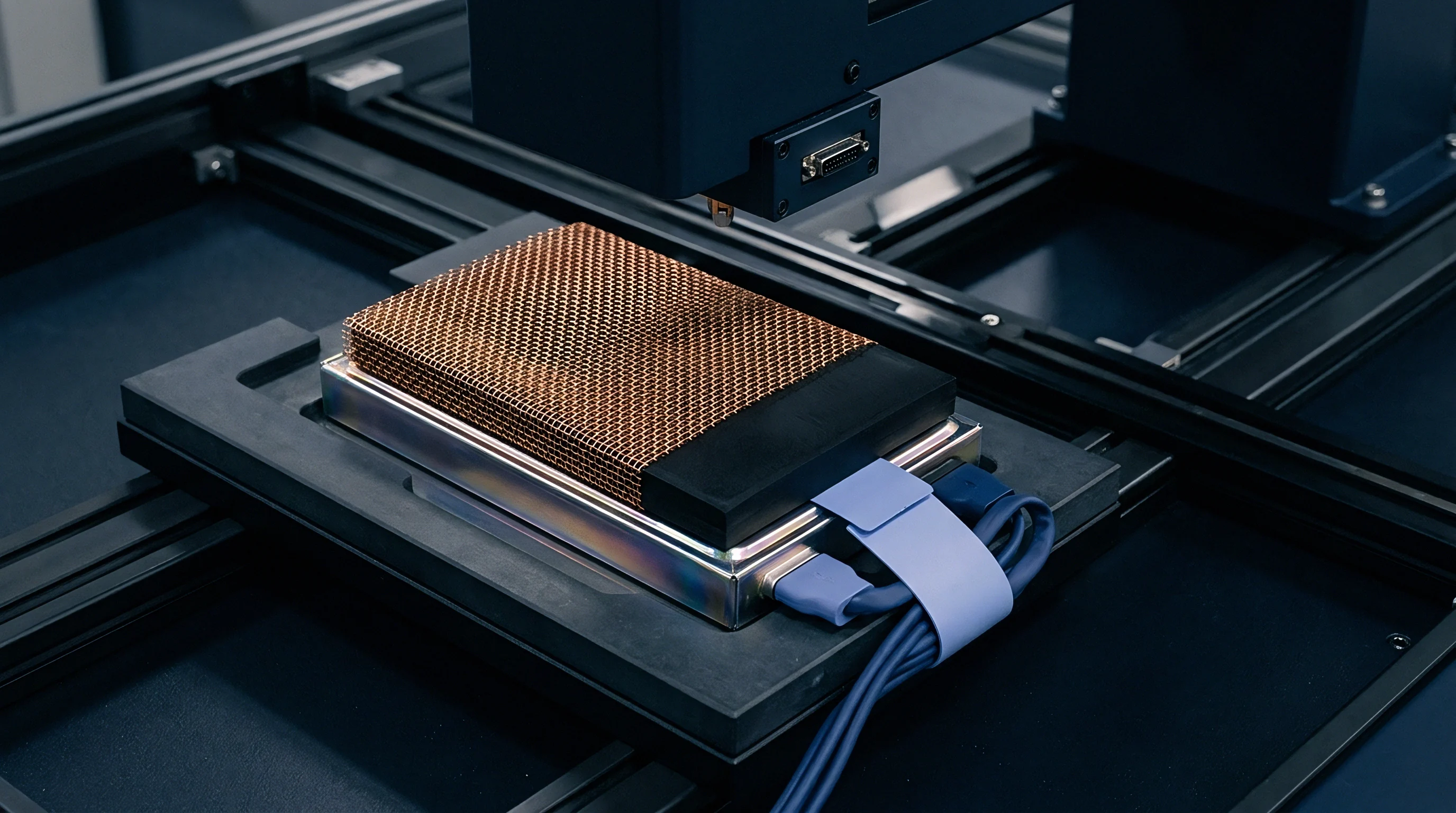
Advanced characterization tools reveal whether surface lattice breakdown has been effectively contained in qualification submissions. Standard bulk methods like powder X-ray diffraction cannot resolve structural transformations confined to the outer five nanometers of cathode particles. As a result, technical dossiers require depth-resolved spectroscopy and high-resolution electron diffraction datasets to verify physical phase stability under aggressive testing.

Spectroscopic Profiling of Interfacial Valence States
X-ray photoemission measurements detail the chemical oxidation states of nickel, cobalt, and manganese down to five nanometers beneath the particle surface. Angle-resolved X-ray photoelectron spectroscopy and argon gas cluster ion beam etching yield detailed compositional depth profiles without destroying chemical bonding states. Filings must show sustained high transition metal valence states after accelerated thermal aging, confirming that surface reduction pathways remain suppressed.
Subsurface chemical state mapping relies on surface sensitivity during photon excitation. Soft X-ray absorption spectroscopy in total electron yield mode probes depth profiles down to five nanometers, whereas transmission yield mode captures bulk signal down to one hundred nanometers. Comparing signals across both modes ~ supported by electron energy loss spectroscopy ~ reveals the precise thickness of the reduced transition metal surface zone.
IEC 62660-3 qualification rules reject cell batches where cross-sectional electron energy loss profiles demonstrate transition metal reduction across more than five nanometers of cathode particle skin after calendar storage.

Microscopic Lattice Imaging for Subsurface Phase Mapping
Transmission electron microscopy isolates atomic arrangements at the outer boundaries of harvested cathode particles. Aberration-corrected TEM combined with fast Fourier transform diffraction indexing resolves the boundary between the rhombohedral bulk and the cubic rock-salt skin. Dossiers that omit high-magnification cross-sectional imaging lack direct physical proof of interfacial lattice integrity.
Preparing air-sensitive cathode samples requires cryogenic transfer vessels to isolate harvested electrodes from ambient moisture and oxygen. Exposure to ambient air quickly forms lithium carbonate and lithium hydroxide artifacts on particle surfaces, skewing XPS valence spectra and distorting TEM lattice fringe indexing. Audits of characterization reports require reviewing sample handling chain-of-custody records to confirm non-destructive sample preparation.
Auditing analytical submissions requires strict verification of characterization testing conditions:
- Depth resolution limits ~ Ensure XPS or secondary ion mass spectrometry depth profiles explicitly state argon cluster etching calibrated against standard reference films to prevent ion-beam-induced reduction artifacts.
- Cryogenic transfer hardware ~ Verify pristine sample preservation during electron microscopy sample preparation to prevent moisture-induced surface lattice collapse prior to characterization exposure.
- Lattice fringe indexing ~ Confirm selected area electron diffraction maps explicitly differentiate between cubic rock-salt and cubic spinel phases using calibrated lattice spacing tolerances.
- Sampling statistical volume ~ Check that cross-sectional microscopic imaging samples at least ten independent secondary cathode particles from both near-current-collector and near-separator electrode regions.
Clean electron diffraction patterns at outer particle boundaries confirm a stable cathode interface before electrical impedance measurements register structural decay.


Decay
Electrochemical performance drops rapidly when the active cathode surface converts into high-resistance rock-salt structures. This transformation slows lithium-ion charge transfer, converting chemical energy into waste heat during fast charging or high-power discharge pulses. Tracking these electrochemical signatures during qualification cycling quantifies how surface lattice breakdown impacts module life.

Impedance Spectroscopic Signatures of Interfacial Resistance Growth
Alternating current impedance measurements track physical barriers to lithium transport across the cathode-electrolyte interface. Deconvoluting high-frequency and mid-frequency Nyquist semicircles separates solid-electrolyte interphase resistance from charge-transfer resistance at the cathode particle surface. Rapid expansion of the mid-frequency arc radius during calendar aging directly reflects ongoing surface rock-salt layer growth.
Interfacial charge-transfer resistance follows parabolic kinetics when surface phase breakdown is limited by solid-state diffusion through the growing rock-salt layer. By contrast, linear or accelerated exponential resistance kinetics point to active surface cracking, where newly exposed particle facets undergo continuous phase reconstruction and electrolyte consumption.

Which Analytical Metrics Flag Surface Phase Breakdown Early?
Differential capacity analysis extracts state-of-health indicators directly from standard constant-current cycling data. Converting terminal voltage and discharge capacity into differential capacity curves highlights electrochemical phase transitions within the active material. A shift in peak position toward lower potentials during discharge signals growing internal ohmic drop and polarization caused by cathode surface degradation.
Widening voltage hysteresis between charge and discharge plateaus directly tracks structural breakdown at the cathode surface. As the rock-salt layer thickens, higher overpotentials are needed to move lithium ions through the interface during charging. This added overpotential locally elevates operational cutoff potentials, driving further oxygen evolution and creating a feedback loop that accelerates surface decay.
In a qualification trial evaluating a 100 Ah NMC811 pouch cell lot subjected to a high-voltage calendar hold at 4.35 V and 45 °C for 60 days, baseline testing establishes a pristine charge-transfer resistance of 0.45 mΩ per cell at fifty percent state-of-charge. Microscopic teardown analysis of baseline reference units reveals an initial surface reconstruction layer thickness of 1.8 nm.
After 60 days of high-voltage thermal exposure, the surface rock-salt layer expands to 14.2 nm across primary particle perimeters. Charge-transfer resistance rises to 1.85 mΩ per cell ~ a 311 percent increase in interfacial impedance. Under a standard 1C pulse discharge of 100 A, this impedance growth induces an additional 140 mV internal voltage drop across the cathode interface alone.
This voltage drop reduces usable capacity by 4.2 Ah before reaching the lower discharge cutoff potential of 2.8 V. The extra internal resistance generates 14 W of additional waste heat per cell during full-rate discharge pulses, increasing module cooling demand. Gas chromatography of harvested pouch volume reveals 42 cm³ of evolved carbon dioxide and oxygen gas generated by lattice oxygen breakdown and solvent oxidation.
| Aging Stress State | Rock-Salt Layer Depth (nm) | Charge Transfer Resistance (mΩ) | Differential Capacity Peak Shift (mV) | Specific Capacity Loss (%) |
|---|---|---|---|---|
| Fresh Cell (Baseline) | 1.5 – 2.0 | 0.45 | 0.0 | 0.0 |
| 300 Cycles at 25°C (4.20V) | 3.5 – 5.0 | 0.68 | 4.2 | 1.8 |
| 1000 Cycles at 25°C (4.20V) | 7.0 – 10.5 | 1.15 | 12.8 | 5.4 |
| 60 Days Hold at 45°C (4.35V) | 14.0 – 18.5 | 1.85 | 28.5 | 8.9 |
| 500 Cycles at 45°C (4.35V) | 22.0 – 32.0 | 3.40 | 54.0 | 16.2 |
A doubling of charge-transfer resistance during forty-five degree storage directly signals surface rock-salt layer expansion regardless of nominal discharge capacity retention.
Whether atomic layer deposition coatings can permanently prevent phase reconstruction under extended four point four volt operation remains uncertain, given current limits on manufacturing defect density.


Screen
Cell qualification dossiers require multi-tiered verification combining non-destructive electrochemical batch testing with destructive chemical audits. Evaluators must verify that test packages prove consistent cathode surface quality across multiple production lots. Qualification procedures that rely solely on manufacturer datasheets leave pack integrators exposed to warranty claims if batch variations compromise surface stability.

Gatekeeping Technical Dossiers for Commercial Cell Lots
Cell documentation packages that lack quantitative data on surface lattice transformation rates fail technical evaluation. A complete qualification file requires high-precision coulometry showing charge-discharge efficiency above ninety-nine point nine five percent during early formation cycling. Low initial coulometric efficiency signals parasitic surface reactions and unchecked reconstruction.
Acceptance protocols require evaluating differential capacity drift under thermal stress before commercial lot release. Standard qualification criteria cap charge-transfer resistance growth at fifty percent after two hundred accelerated stress cycles. Documentation lacking long-term impedance deconvolution spectra cannot separate cathode surface degradation from anode solid-electrolyte interphase growth.

Batch Acceptance Testing and Destructive Harvesting Controls
Statistical sampling plans govern the selection of incoming cells for teardown evaluation. Electrode materials are harvested inside inert gloveboxes to verify cathode surface composition using grazing-incidence X-ray diffraction and photoemission spectroscopy. This destructive testing confirms whether current production lots match the atomic surface structure documented during initial cell qualification.
Differential capacity peak shifts exceeding fifteen millivolts after elevated temperature trickle storage correlate with destructive surface reconstruction verified by transmission electron microscopy.
Standardized lot acceptance testing follows a strict sequential evaluation sequence:
- Extract ten random cell units from the incoming qualification lot following standardized lot selection tables prior to cycling.
- Subject five baseline units to high-precision coulometry and multi-frequency electrochemical impedance spectroscopy at ten percent state-of-charge intervals.
- Place remaining units into accelerated thermal aging chambers at forty-five degrees Celsius under continuous four-point-three-five volt trickle charge for twenty-eight days.
- Perform high-resolution differential capacity analysis to calculate peak potential drift against baseline curves.
- Harvest cathode current collector sections inside an argon glovebox for cross-sectional focus ion beam milling and surface electron energy loss mapping.
Including mandatory differential capacity drift thresholds in cell supply agreements legally obligates manufacturers to requalify cathode slurry formulations whenever surface impedance growth exceeds contractual limits.


Paperwork
International transport regulations and battery safety passport directives require strict verification of degradation kinetics before cells enter commercial trade. Surface phase decay degrades active lithium retention while compromising thermal stability thresholds needed for dangerous goods transit approval. Qualification dossiers serve as the legal bridge connecting electrochemical metrics to safety compliance files.

Transport Safety Summary Documentation and Thermal Onset Risks
United Nations testing protocols evaluate cell stability under environmental and electrical stress. Cathode surface breakdown releases free oxygen into the hermetically sealed cell, lowering the onset temperature for exothermic thermal runaway during UN 38.3 thermal testing. Cells exhibiting advanced surface reconstruction experience accelerated self-heating at temperatures below one hundred and twenty degrees Celsius.
UN 38.3 test summaries must link directly to specific manufacturing batch numbers and cathode slurry specifications. If a manufacturer alters cathode surface coatings or formulations to curb phase breakdown without resubmitting transport safety documentation, authorities can declare the shipment non-compliant and impound goods at ports of entry.
The European battery regulatory framework mandates full technical lifecycle documentation under state-of-health tracking rules. Technical files supporting Article 10 and Article 14 performance requirements must include quantitative data covering internal resistance evolution, capacity decay kinetics, and surface degradation mechanisms.

Contractual Allocation of Cathode Degradation Liabilities
Supply agreements between cell vendors and pack integrators allocate financial risks associated with premature capacity loss. Technical dossiers must define explicit boundary conditions for operational cutoff potentials and maximum continuous operating temperatures. Operating outside these specified limits voids manufacturer warranty coverage for surface-degradation failure modes.
Procurement contracts must incorporate explicit liability allocation terms to protect pack integrators against latent surface chemistry defects:
- Thermal runaway threshold suppression ~ Surface oxygen liberation lowers self-heating initiation temperatures during UN testing by over fifteen degrees Celsius.
- Internal short circuit formation ~ Transition metal ions dissolved from degraded surface phases migrate to the anode and deposit as metallic dendrites through the separator.
- Battery passport compliance gaps ~ Technical files lacking verified surface aging mechanism data face administrative hold under European market access audits.
- Warranty coverage invalidation ~ Disregarding cathode impedance growth kinetics exposes pack integrators to full field recall liabilities without recourse to cell suppliers.
| Regulatory Standard | Applicable Scope | Mandated Dossier Evidence | Non-Compliance Enforcement Consequence |
|---|---|---|---|
| UN 38.3 Test Summary | Global Dangerous Goods Transport | T1-T8 Safety Test Verification, Cell Design Identification | Immediate Shipment Impoundment at Border Entry |
| EU Battery Regulation 2023/1542 | European Union Market Access | Electrochemical Aging Mechanism Analysis, Passport Linking | Sales Suspension and Mandatory Market Recall |
| IEC 62660-3 / UL 2580 | EV Industrial Power Pack Certification | Thermal Runaway Onset Propagation and Aging Data | Vehicle Type Approval Invalidation |
| ISO 26262 Functional Safety | Automotive System Integration | State-of-Health Diagnostic Model Validation Files | Safety Case Rejection by Technical Inspection Agencies |
Omitting quantitative cathode surface phase stability data from qualification files leaves cell importers exposed to full liability for field failures and sales suspensions across European jurisdictions.