Calculating Storage Limits under International Fire Code Chapter 12 Rules
Calculate IFC Chapter 12 battery storage limits by enforcing 20 kWh triggers, 50 kWh unit caps, 3-foot spacing, and 600 kWh fire-area aggregations.
Threshold
International Fire Code Chapter 12 sets the energy capacity thresholds where a battery installation becomes a regulated energy storage system. Table 1207.1.1 specifies these aggregate limits by indoor fire area or outdoor footprint. For lithium-ion systems, regulation begins at 20 kilowatt-hours.
Lead-acid and nickel-cadmium installations have a higher 70 kilowatt-hour threshold under the same occupancy rules, owing to their lower thermal runaway propagation rates. Exceeding these limits brings the facility under structural, electrical, and mechanical mandates enforced by the local authority having jurisdiction.
Planners calculate aggregate capacity by adding together the nameplate ratings of every cell, module, and pack in a single fire area. Individual units below the threshold are governed by standard electrical codes, as long as they don’t share an enclosure or battery management system with neighboring units. If several sub-threshold racks connect to a common inverter or share direct busbars, code officials treat them as one system.
A lithium-ion installation exceeding 20 kilowatt-hours triggers full enclosure rating and mechanical exhaust requirements under Section 1207.
Occupancy type determines the baseline allowance for a given building. Residential buildings face strict caps on single-unit and total capacity, while dedicated industrial and utility facilities can operate under higher limits if backed by approved protection systems.
| Chemistry Group | Indoor Threshold (kWh) | Outdoor Ground Threshold (kWh) | Dedicated Use Building Threshold (kWh) |
|---|---|---|---|
| Lithium-ion | 20 | 20 | 20 |
| Lead-acid (VRLA and Flooded) | 70 | 70 | 70 |
| Nickel-cadmium (Ni-Cd) | 70 | 70 | 70 |
| Sodium-beta storage | 20 | 20 | 20 |
| Flow batteries (vanadium redox) | 20 | 20 | 20 |
Unlisted chemistries are treated conservatively. Emerging or unclassified cell types automatically default to the lowest 20 kilowatt-hour threshold until testing demonstrates an equivalent fire hazard profile. Compliance calculations rely on total chemical energy potential rather than usable state-of-charge.
Battery capacity establishes the regulatory path before physical layout comes into play.
Stack
Rules on unit configuration limit how densely energy can be packed into a space. Under Section 1207.6, standalone lithium-ion units capped by default prescriptive rules cannot exceed 50 kilowatt-hours. Building larger free-standing assemblies requires full UL 9540 system listing, which covers the electrical, mechanical, and safety controls of the complete package.
Grouping units without verified physical or thermal separation causes them to be evaluated as a single larger system.
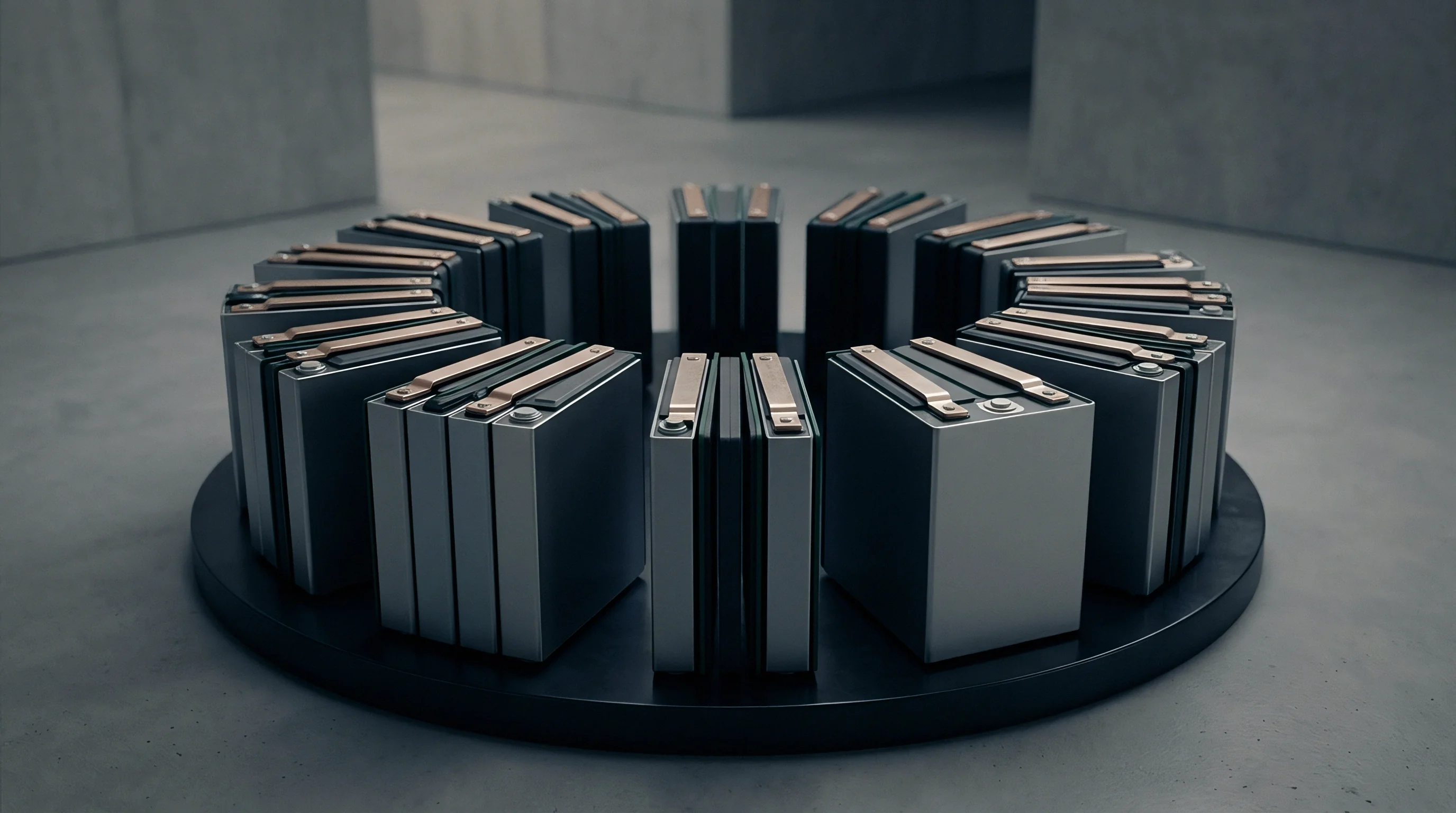
Spacing individual battery arrays apart helps prevent failure from spreading between cabinets. Standard layouts require a three-foot (914 millimeter) air gap between individual 50 kilowatt-hour enclosures, as well as between enclosures and exterior walls. This spacing maintains access for emergency responders and isolates thermal radiation if a unit off-gasses or enters thermal runaway.
- Nameplate verification establishes module capacity using cell datasheets and pack wiring designs.
- Array grouping calculations treat adjacent packs placed closer than three feet as a single thermal unit.
- Boundary clearance checks verify three feet of clearance between equipment enclosures and interior walls.
- Enclosure rating validation aligns the cabinet assembly with UL 9540 system listings and UL 1973 module certifications.
Placing units closer than three feet requires full-scale fire test data. UL 9540A testing provides the burn behavior, heat release rates, and gas composition metrics needed to justify tighter spacing. Without test documentation proving flames will not spread to adjacent units, code officials will reject closer layouts.
Does Unit Listing Modify Maximum Allowable Quantities?
A UL 9540 system certification is the primary way to exceed basic prescriptive capacity limits. Custom, unlisted assemblies remain subject to standard unit caps and detailed plan review. With a valid system listing, individual unit limits increase to 250 kilowatt-hours in non-dedicated indoor areas and 600 kilowatt-hours in dedicated energy storage buildings.
System-level UL 9540 listings permit individual unit expansions up to 250 kilowatt-hours in non-dedicated indoor spaces.
If module-level UL 1973 certificates do not match the complete enclosure’s UL 9540 label, code officials will treat the system as unlisted, stopping commissioning and withholding occupancy permits.
Enclosure
Rooms housing battery energy storage systems must protect against fire spreading inside or outside the space. Section 1207.7 requires indoor battery rooms to be separated from other occupancies by two-hour fire barriers built to International Building Code Section 707, along with horizontal assemblies conforming to Section 711. Openings in these assemblies need self-closing fire doors rated for at least 90 minutes.
Ventilation requirements depend on cell chemistry and operational conditions. Lead-acid and nickel-cadmium batteries release hydrogen during charging, requiring continuous exhaust to keep hydrogen levels below 1.0 percent by volume. Lithium-ion installations require mechanical exhaust designed for deflagration venting or toxic gas purging after an event, delivering at least 1.0 cubic foot per minute per square foot (0.0051 cubic meters per second per square meter) of floor space.
- Gas detection integration triggers mechanical exhaust at 25 percent of the lower flammability limit for off-gasses.
- Spill containment barriers hold the total electrolyte volume plus sprinkler discharge over twenty minutes for liquid chemistries.
- Thermal monitoring networks cut charging power if cell temperatures exceed safe limits.
- Impact protection bollards protect equipment cabinets from vehicle damage in shared dock areas.
Dedicated energy storage buildings follow different containment rules. Because these standalone structures share no walls with other occupancies, they allow higher aggregate energy capacities when set back at least thirty feet (9144 millimeters) from lot lines and neighboring structures.
Integrated battery management systems designed to prevent cell venting are sometimes offered to address off-gassing risks, though physical room ventilation remains a standard requirement during plan review.
Suppression
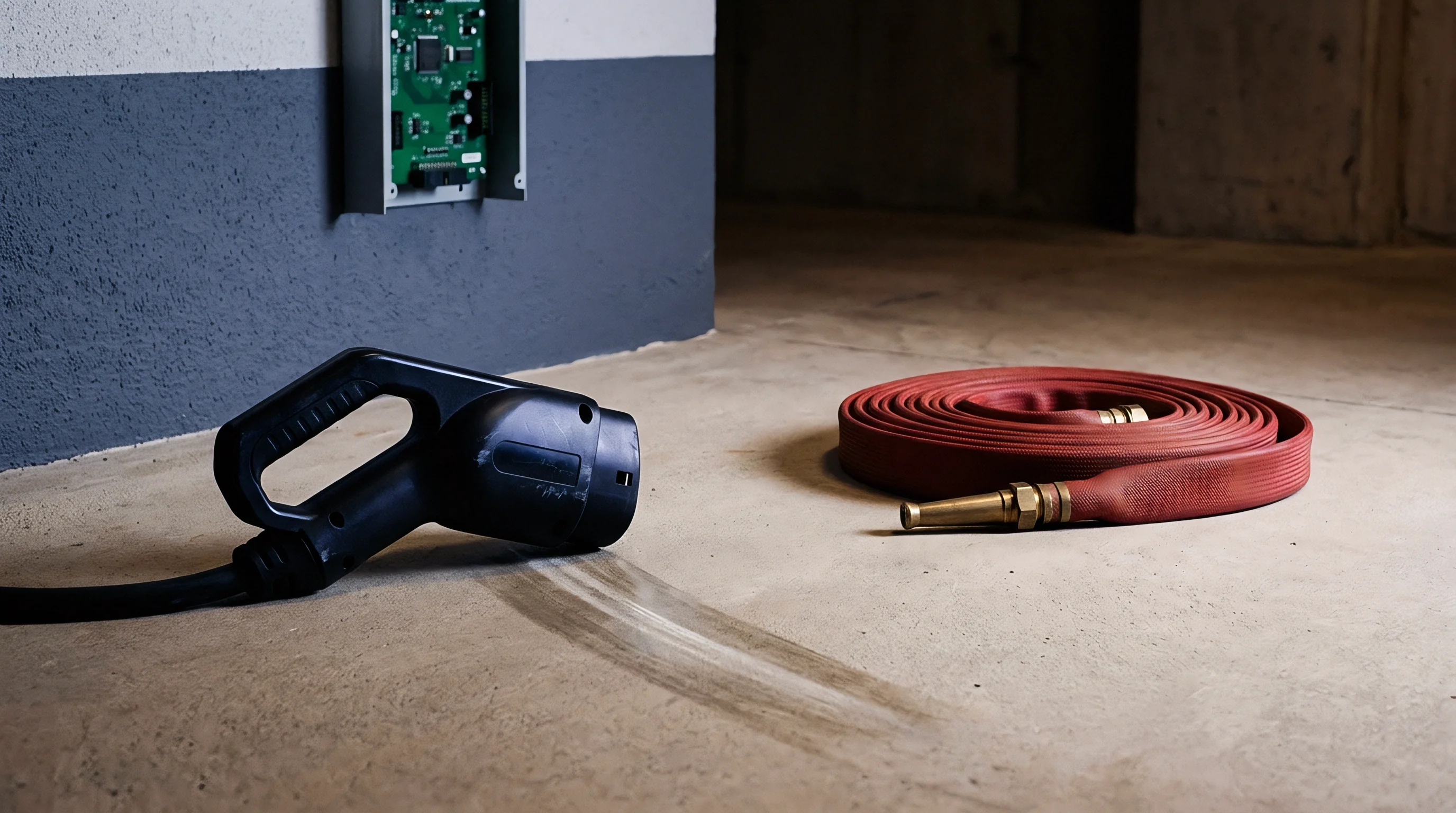
Automatic water sprinklers are the primary suppression method specified for stationary battery systems. Section 1207.10 mandates system design per NFPA 13, requiring a minimum density of 0.30 gallons per minute per square foot (12.2 millimeters per minute) over the most remote 2,500 square feet (232 square meters). High-density installations often require higher design densities based on UL 9540A test results.
Alternative extinguishing systems must meet strict criteria under Section 1207. Clean agents, aerosols, and inert gas suppressants must demonstrate that they can control thermal runaway at the cell level. While gaseous agents knock down open flames, they lack the cooling capacity required to stop internal thermal reaction inside dense pouch or prismatic cells.
| Chemistry | Sprinkler Density (gpm/sq ft) | Design Area (sq ft) | Exhaust Rate (cfm/sq ft) |
|---|---|---|---|
| Lithium Iron Phosphate | 0.30 | 2,500 | 1.0 |
| Lithium Nickel Manganese Cobalt | 0.30 to 0.45 | 2,500 | 1.0 to 1.5 |
| Vented Lead-Acid | 0.20 | 1,500 | 1.0 (continuous) |
| Valve-Regulated Lead-Acid | 0.20 | 1,500 | 1.0 (continuous) |
Explosion prevention operates alongside fire suppression. Deflagration venting designed to NFPA 68 or prevention systems built to NFPA 69 protect walls against pressure spikes during rapid off-gassing. Vent sizing relies on burning velocity and pressure rise data measured during laboratory testing.
Are Large Scale Fire Tests Required for Aggregate Caps?
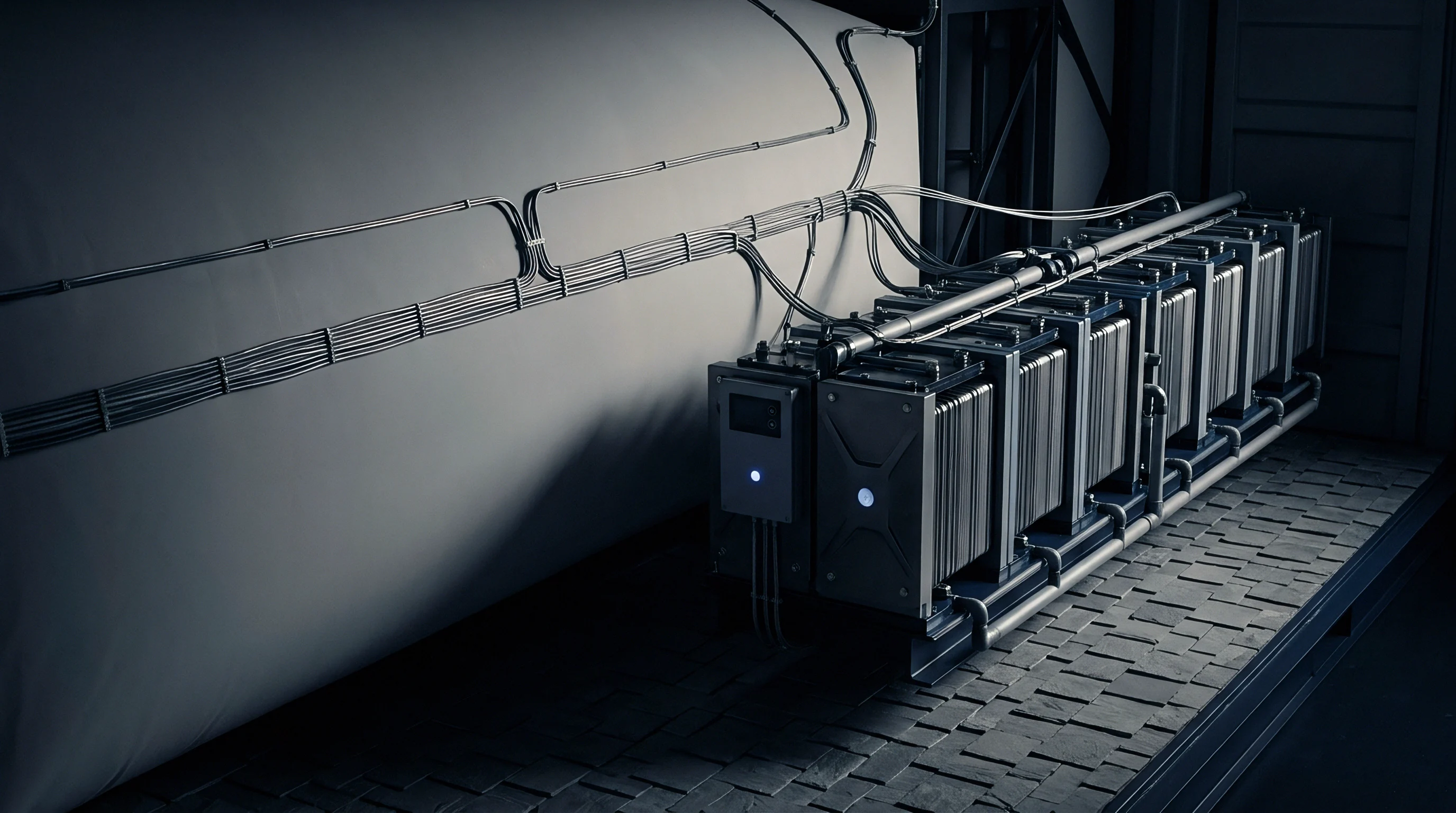
UL 9540A test protocols supply the burning and off-gas data used to adjust standard sprinkler designs. Prescriptive rules cap indoor storage at 600 kilowatt-hours per fire area. By analyzing full UL 9540A test data, fire protection engineers can show whether 0.30 gpm/sq ft density adequately controls fire spread, giving officials the basis to approve higher total capacities within a single fire area.
NFPA 855 Section 4.3 mandates complete hazard mitigation analyses when unit capacities exceed standard baseline allowances.
Section 1207.10.1 sets the base discharge rate at 0.30 gallons per minute per square foot across 2,500 square feet, directly driving water service supply calculations.
Aggregate
Determining the maximum allowable quantity for a building requires tallying unit ratings alongside room boundaries and fire separations. Standard non-dedicated indoor spaces cap lithium-ion capacity at 600 kilowatt-hours per fire area. Dividing a building with two-hour fire barriers allows total site capacity to scale across multiple compliant compartments.
For example, an industrial facility planning an indoor layout with 100 kilowatt-hour UL 9540-listed lithium-ion enclosures faces a baseline cap of 600 kilowatt-hours per fire area. The facility can install six 100 kilowatt-hour units in a single area, provided each unit maintains three feet of clearance from adjacent units and structural walls.
Reaching a total site capacity of 2,400 kilowatt-hours requires physical compartmentalization. Creating four separate fire areas using two-hour fire barriers and 90-minute fire doors allows six 100 kilowatt-hour units per compartment, each served by dedicated mechanical exhaust and an independent NFPA 13 sprinkler zone.
Physical fire barriers divide overall facility capacity into compliant discrete fire areas.
Outdoor open-air sites follow different aggregation rules. Baseline triggers remain at 20 kilowatt-hours, but property setbacks take the place of interior fire walls. Arrays located more than five feet from lot lines, public ways, and building openings can scale up, as long as individual cluster capacities stay under 600 kilowatt-hours with ten feet (3048 millimeters) of space between clusters.
Whether local authorities will accept computational fluid dynamics modeling in place of full UL 9540A burn test data remains an ongoing point of discussion across logistics projects.