Cross Border Battery Transport Compliance Mandates
Cross-border battery transport requires verified UN 38.3 test summaries, sub-30-percent aviation charge limits, and modal UN packaging marks to clear customs.


Crate
A lithium iron phosphate pack reading 3.28 volts per cell sits in an uncertified cardboard box on a Shenzhen loading bay. Customs inspectors turn it back within twenty minutes. The forwarder refuses the consignment because the outer box carries no mandatory UN specification mark under the International Maritime Dangerous Goods Code.
In transport law, a battery is not stored electricity ~ it is a Class 9 dangerous good capable of a self-sustained reaction under mechanical, thermal, or electrical abuse. Moving batteries commercially across borders takes a full chain of verified test data, certified containment, and legally binding declarations.
Cross-border rules split by mode, each enforcing its own packaging standards. Air transit falls under the International Civil Aviation Organization Technical Instructions ~ applied commercially through the International Air Transport Association Dangerous Goods Regulations. For sea freight, the International Maritime Organization enforces the International Maritime Dangerous Goods Code.
Land transport in Europe follows the Agreement Concerning the International Carriage of Dangerous Goods by Road, while Title 49 of the United States Code of Federal Regulations covers domestic US movements. All these frameworks build their baseline definitions on the United Nations Recommendations on the Transport of Dangerous Goods, Model Regulations.
A lithium battery shipment stripped of its verified UN 38.3 test summary faces immediate impoundment at the port of entry under international dangerous goods protocols.
Dangerous goods codes assign batteries to specific UN numbers based on chemistry and packaging setup. Standalone lithium ion units ~ including common lithium nickel manganese cobalt oxide and lithium iron phosphate formulations ~ travel under UN 3480. Cells installed in equipment fall under UN 3481.
Lithium metal systems go under UN 3090, or UN 3091 when packaged with or inside devices. Recent manual updates also gave sodium ion batteries dedicated listings under UN 3551 and UN 3552.
Classification Criteria and Modal Packaging Instructions
Standalone lithium ion units flying under UN 3480 have to follow Packing Instruction 965. Dedicated cargo planes are the only option for bare cells ~ passenger flights banned UN 3480 standalone shipments in April 2016. Packaging under Section IA and Section IB requires rigid, UN-specification outer boxes that survive drop, stack, and pressure differential testing.
Section II exceptions, which once allowed light paperwork for small consumer cells, are now largely rejected by commercial airlines.
| UN Designation | Proper Shipping Name | Transport Class | Air Packing Instruction | Vessel Stowage Category |
|---|---|---|---|---|
| UN 3480 | Lithium ion batteries | Class 9 | PI 965 Section IA / IB | Category A, SW19 |
| UN 3481 | Lithium ion batteries packed with equipment | Class 9 | PI 966 Section I / II | Category A |
| UN 3481 | Lithium ion batteries contained in equipment | Class 9 | PI 967 Section I / II | Category A |
| UN 3089 | Metal powders, flammable, inorganic | Class 4.1 | PI 446 / 448 | Category B |
| UN 3551 | Sodium ion batteries with organic electrolyte | Class 9 | PI 976 | Category A, SW19 |
Ocean freight under Packing Instruction P903 allows higher package weights than air shipping. Depending on condition and packing, the International Maritime Dangerous Goods Code pulls in Special Provisions 188, 230, 310, 348, 376, and 377. Small cells skip full Class 9 labeling under Special Provision 188 if lithium content stays under one gram for single cells or two grams for multicell packs.
For secondary lithium ion cells, that threshold sits at twenty watt-hours per cell and one hundred watt-hours per pack. Anything higher requires a full dangerous goods declaration, shipping notes, and packaging certified to Packaging Group II standards.
The forwarder requires a signed commercial invoice matching the dangerous goods declaration before releasing the master airway bill.

Burn
A heating element driven to 130 degrees Celsius causes the internal separator to collapse. At that temperature, microporous polyethylene films shrink, pinhole shorts form, and current focuses into narrow contact points. Within milliseconds, heat builds faster than the metal casing can shed it to the surrounding air, pushing the cell into thermal runaway.
To prevent this in transit, the UN Manual of Tests and Criteria, Part III, sub-section 38.3 ~ known as UN 38.3 ~ subjects cells and assemblies to rigorous abuse testing before certifying them for transport.
Transport regulations assume a certified design should survive typical physical handling across shipping modes without sparking an exothermic cascade. UN 38.3 divides this into eight tests, T.1 through T.8. Labs run tests T.1 through T.5 in sequence on a single set of sample units, while T.6, T.7, and T.8 use separate, dedicated samples.

Sequential Mechanical and Thermal Stress Profiles
Altitude simulation in test T.1 stores units at an absolute pressure of 11.6 kilopascals or lower for at least six hours at 20 degrees Celsius, matching conditions in an unpressurized cargo hold at 15,000 meters. To pass, units must show no visible mass loss, no venting, no rupture, and retain at least ninety percent of their pre-test open-circuit voltage. Test T.2 immediately follows with thermal shock: ten cycles between minus 40 degrees Celsius and plus 72 degrees Celsius, holding each temperature extreme for six hours with transitions under thirty minutes.
Mechanical testing then moves to T.3 and T.4. Vibration under T.3 runs a logarithmic sinusoidal sweep from 7 hertz to 200 hertz and back over fifteen minutes, repeated twelve times across three perpendicular axes. Peak acceleration hits 8 g for small cells and 2 g for large battery assemblies.
Test T.4 delivers half-sine shock pulses: small cells take 150 g peak acceleration over eleven milliseconds, while large modules take 50 g pulses lasting twenty milliseconds, applied three times in each direction across three axes.
Test T.5 short-circuits the cell terminals at 57 degrees Celsius using a resistive load under 0.1 ohms. The connection stays active until the casing cools back to 57 degrees Celsius after its peak, or for at least one hour. To pass, case temperatures cannot exceed 170 degrees Celsius, and no physical disassembly can occur during the six hours following the test.
A voltage drop exceeding ten percent across sequential tests T.1 through T.5 invalidates the transport file.

Component Level Destructive Evaluations
Destructive tests evaluate resistance to crushing and separator failure. Test T.6 applies impact or crush force depending on cell shape; for cylindrical cells over 18 millimeters in diameter, a hydraulic ram compresses the longitudinal casing until force reaches 13 kilonewtons or terminal voltage drops by one hundred millivolts. Test T.7 tests overcharge tolerance on rechargeable packs by running twice the rated maximum continuous charge current for twenty-four hours.
Test T.8 forces reverse discharge on individual cells hooked in series to a 12-volt DC supply at 20 degrees Celsius, matching their rated continuous discharge limit.
Test standards evolve over time. The UN Manual of Tests and Criteria, Seventh Revised Edition, Amendment 1, tightened rules for modified battery packs: changing cell count, component layout, or nominal capacity by more than ten percent voids the original test report, requiring a full re-test.
Once testing finishes, the laboratory issues a standardized UN 38.3 Test Summary detailing ten mandatory data points, providing customs inspectors with a uniform compliance document instead of raw internal lab files.

Charge
A shipping container loaded with lithium nickel cobalt aluminum oxide cylindrical cells reads 3.85 volts per cell across three hundred master cartons. At this voltage, the cathode remains delithiated enough to feed rapid thermal propagation if a defect shorts a cell internally. Because stored chemical energy accelerates fire during transport mishaps, aviation rules restrict state of charge on loose cell shipments.
The International Civil Aviation Organization Technical Instructions cap standalone lithium ion cells on cargo flights under UN 3480 at thirty percent state of charge. Air carriers check terminal voltages and turn away consignments that exceed this limit. The rule does not apply to road transport under ADR or sea freight under IMDG, where cells are routinely shipped at fifty to sixty percent charge to protect anodes against copper dissolution during long transit periods.

Voltage Mapping across Differing Cathode Chemistries
Enforcing the aviation charge limit requires detailed voltage mapping, as open-circuit voltage curves differ markedly by chemistry. In layered oxide cells like NMC811, a thirty percent state of charge translates to roughly 3.62 volts to 3.66 volts at 25 degrees Celsius. Lithium iron phosphate has a far flatter discharge curve ~ thirty percent charge sits between 3.27 volts and 3.29 volts, separated from sixty percent charge by less than twenty millivolts.
Cargo inspectors on the apron rely entirely on external voltage measurements. If ambient temperature drops from 25 degrees Celsius to 5 degrees Celsius on the tarmac, measured terminal voltage shifts because of temperature-dependent kinetics. Forwarders must therefore supply factory discharge logs proving state of charge was measured via coulomb counting rather than inferred solely from resting voltage.
| Stored State of Charge | LFP Terminal Voltage | NMC811 Terminal Voltage | NCA Terminal Voltage | Air Transit Permissibility |
|---|---|---|---|---|
| 100 percent | 3.60 V | 4.20 V | 4.20 V | Prohibited under UN 3480 |
| 60 percent | 3.31 V | 3.82 V | 3.80 V | Prohibited under UN 3480 |
| 30 percent | 3.28 V | 3.64 V | 3.63 V | Permitted under PI 965 |
| 20 percent | 3.25 V | 3.58 V | 3.56 V | Permitted under PI 965 |
| 0 percent | 2.50 V | 3.00 V | 3.00 V | Permitted under PI 965 |

Commercial Cost Penalties of Reduced Charge States
Shipping cells at thirty percent charge poses degradation risks if sea freight gets delayed. Consider a 40-tonne shipment of 200,000 prismatic cells with a monthly self-discharge rate of 1.5 percent. If port congestion stretches ocean transit to sixty days, followed by thirty days in a warehouse, a cell dispatched at thirty percent charge drops near twenty-five percent.
But if the factory originally drained cells down to fifteen percent to guarantee air transit compliance, that same delay pushes cell voltage below 2.0 volts.
Below 2.0 volts, the copper current collector on a standard lithium ion anode starts dissolving into the electrolyte. Once the damaged cell is eventually recharged during assembly, dissolved copper plates across the separator as metallic dendrites, creating internal shorts. Sourcing teams face a clear trade-off: air freight avoids copper dissolution through fast delivery, but costs five to eight times more per gross kilogram than container shipping.
Shippers that fail to verify state of charge before airport drop-off absorb full repacking, testing, and handling fees along with carrier penalties.


Paper
An outdated Material Safety Data Sheet from 2018 will not pass customs inspection today. Border officials, customs brokers, and terminal operators verify specific documentation before clearing battery shipments. The compliance dossier forms the legal foundation for transport; any discrepancy between physical box markings and declared entries triggers immediate hold orders.
Shipping files combine commercial, technical, and regulatory documents. Chief among them is the Dangerous Goods Declaration ~ called the Shipper’s Declaration for Dangerous Goods in air freight. The individual signing this form takes legal responsibility for properly classifying, packaging, marking, and labeling the shipment under dangerous goods law.
Mandatory Components of the Compliance Dossier
A complete cross-border shipment file demands five core technical instruments:
- UN 38.3 Test Summary conforming to the ten explicit elements defined in sub-section 38.3.5 of the UN Manual of Tests and Criteria, signed by an accredited testing facility.
- Safety Data Sheet structured according to the Globally Harmonized System of Classification and Labelling of Chemicals, containing sixteen standardized sections with transport codes in Section 14.
- Packaging Performance Certificate proving the outer packaging passed drop, pressure, and stacking assessments conducted by an internationally recognized testing body.
- Dangerous Goods Declaration detailing proper shipping names, UN numbers, net quantity of dangerous goods, packaging group equivalents, and emergency telephone contacts.
- Commercial Transport Manifest aligning physical gross weights, container identification marks, and pallet configurations exactly with accompanying hazardous cargo declarations.
The UN 38.3 Test Summary replaced full test reports to streamline border checks. It must state the manufacturer, testing lab, unique test report number, report date, product description including mass and watt-hour rating, tests conducted, and carry a signature from an authorized corporate officer. Forwarders reject generic summaries that fail to match the specific part numbers printed on physical cell jackets.
A misaligned part number between the physical cell jacket and the test summary voids the entire dangerous goods declaration.

Accreditation Scrutiny and Document Validation
Customs authorities routinely check the lab accreditation supporting a test summary. Under ISO/IEC 17025 standards for testing competence, facilities issuing UN 38.3 certificates must hold active accreditations specifically covering lithium battery testing. Authorities confirm lab credentials through national bodies like the China National Accreditation Service for Conformity Assessment or the American Association for Laboratory Accreditation in the United States.
Third-party evaluation certificates, like Air Transport Identification Reports issued by regional metrology institutes, confirm that packaging complies with current modal updates. While not required by international treaty, local port managers frequently require these annual certificates before allowing containers onto terminal docks.
The shipper warrants that all submitted documents are authentic copies of valid laboratory originals.


Pact
EU Regulation 2023/1542 reshaped compliance obligations for battery systems entering the European single market. Mandatory requirements now extend well beyond transport safety to cover environmental due diligence, carbon footprint verification, supply chain tracing, and material circularity over the product lifecycle.
Regulation 2023/1542 places direct legal accountability on the economic operator placing a battery on the market, making importers and distributors jointly liable with original manufacturers. The rules categorize batteries into five groups: portable, light means of transport, starting and ignition, industrial, and electric vehicle batteries. Each category follows an escalating enforcement timeline from 2024 through 2036.

Phased Enforcement Milestones and Operating Obligations
The European regulatory schedule imposes concrete procedural deadlines on cross-border supply chains:
- Conformity Assessment and CE Marking applies across all battery categories, requiring technical dossiers that prove safety, performance, and durability under Annex VIII.
- Carbon Footprint Declarations become mandatory for electric vehicle batteries, requiring verified lifecycle calculations from raw material extraction through cell manufacturing.
- Supply Chain Due Diligence Verification forces companies selling industrial and automotive batteries over two kilowatt-hours to perform third-party audits on raw material sourcing.
- Recycled Content Mandates set minimum recovery levels for cobalt, lead, lithium, and nickel reused in new industrial and automotive units.
- Digital Battery Passport Activation requires accessible digital ledgers tracking supply chain origin, chemical composition, and repair history.
Carbon footprint calculations must follow Commission Delegated Regulations. Producers must calculate greenhouse gas emissions across four lifecycle stages: raw material extraction, primary production, distribution, and recycling. Independent notified bodies audit these numbers before cells clear customs, and non-compliant imports are barred from entry.

Supply Chain Due Diligence and Corporate Exposure
Due diligence rules require operators to track and mitigate risks in raw material sourcing ~ specifically covering cobalt, natural graphite, lithium, and nickel. Importers must align their management systems with international standards, namely the OECD Due Diligence Guidance for Responsible Supply Chains of Minerals from Conflict-Affected and High-Risk Areas.
EU member states delegate enforcement to national market surveillance bodies authorized to issue recalls, impound inventory at border posts, and levy fines tied to annual corporate turnover. Demonstrating compliance requires traceable contracts linking cell manufacturers, refiners, and purchasing entities.
The economic operator warrants visibility across Tier 1 through Tier 4 suppliers to support compliance files during annual audits.

Dock
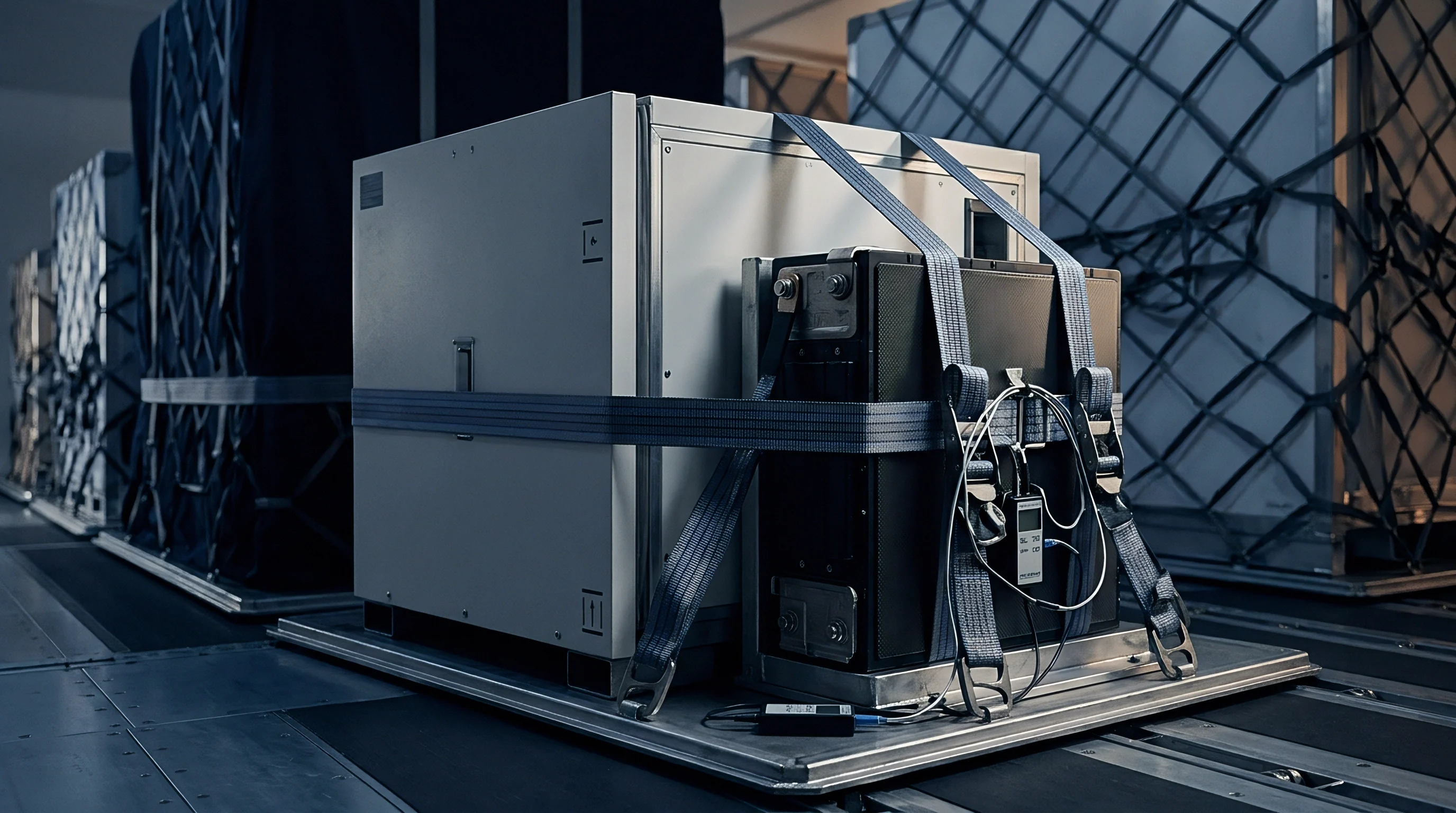
A container arrives in Rotterdam with damaged outer steel walls and an internal sensor reading 45 degrees Celsius. Terminal operators isolate the box in a hazardous containment area, refusing clearance until an accredited surveyor checks gas stability inside. It is at this physical handover point where shipping operations intersect with legal risk transfer.
Contracts assign these shipping risks through standardized International Commercial Terms from the International Chamber of Commerce. Buying batteries Ex Works shifts all classification, packaging, and export clearance obligations onto the overseas buyer. Free On Board makes the supplier handle local inland haulage and export terminal clearance, but transfers ocean transit risk to the buyer once cargo passes the ship’s rail.
Delivered Duty Paid puts full regulatory responsibility ~ including destination customs clearance ~ on the seller.

What Decides Commercial Liability When Cargo Faces Port Rejection?
Port rejections incur heavy detention, demurrage, and repacking expenses. Demurrage rates for Class 9 hazardous containers run three to five times higher than standard dry cargo rates, with terminals charging daily fees while boxes sit in hazardous holding yards. If a carrier rejects cargo because of faulty UN packaging or invalid test summaries, the designated shipper of record pays for all terminal handling, inspections, and stabilization.
Marine cargo insurance policies include explicit dangerous goods warranties. Under standard Institute Cargo Clauses, underwriters can deny claims linked to improper packaging or regulatory non-compliance. If a battery shipment catches fire on a ship and investigators find missing UN 38.3 test summaries or exceeded state-of-charge limits, the insurer voids coverage ~ leaving the shipper of record liable for general average contributions and vessel damage.

Contractual Allocation of Transport Liabilities
Experienced buyers insert strong compliance indemnification clauses into cross-border purchase orders. Contracts require suppliers to warrant compliance with UN 38.3, modal regulations, and target-market packaging rules. The agreement should explicitly state that customs holds caused by invalid documentation, flawed test reports, or uncertified packaging constitute a material breach, granting the buyer full refunds, freight reimbursement, and indemnity against carrier claims.
Supply contracts should also define who pays for batch testing. Sourcing teams typically set up lot acceptance protocols, hiring independent inspectors to sample units off the factory line before container loading. The inspector checks package integrity, UN marks, pallet strapping, state of charge, and paperwork before final payment is released.
How do emerging regional tracking rules bridge the operational verification gap between certified factory batches and delivered container consignments?