Extending Market Surveillance Enforcement Recourse across Cross Border Battery Storage Supply Chains
Cross-border market surveillance enforcement targets domestic importers directly, requiring pre-funded bank guarantees and authenticated safety dossiers for recourse.


Jurisdiction
Regulatory authority over imported stationary battery energy storage systems (BESS) and large lithium-ion cells depends on statutory anchors within the destination country. Frameworks like the European Union Battery Regulation (Regulation 2023/1542), the United States Consumer Product Safety Act, and national market surveillance laws place compliance duties directly on local entities. Because offshore cell manufacturers without a permanent local establishment sit beyond the reach of administrative fines or subpoenas from national market surveillance authorities (MSAs), modern rules route liability through a domestic chain ~ targeting the importer of record, authorized representative, or fulfillment service provider instead.
The regulatory burden falls squarely on the importer. If incoming cells, modules, or containerized racks fail safety standards under IEC 62133-2, UL 1973, or UN 38.3 transport criteria, enforcement agencies issue stop-shipment notices, recall directives, and asset freezes directly against that local entity. An importer cannot dodge responsibility by pointing to an offshore original equipment manufacturer (OEM) or a private contract clause.
Market surveillance officers judge compliance by inspecting physical hardware and paperwork at the border or site, ignoring whatever private indemnification deals the parties signed behind closed doors.

Economic Operator Designations under Market Surveillance Law
Statutory classifications determine who is on the hook when battery hardware moves from foreign factories to local grids. Under EU Regulation 2023/1542 and similar surveillance rules, four economic operator roles dictate how compliance is tracked:
- Manufacturer sets design specs, controls factory production conformity, and handles technical documentation under primary liability, wherever they happen to be located physically.
- Authorized Representative accepts a written mandate from an overseas manufacturer to deal with market surveillance authorities, taking on legal responsibility for keeping compliance files intact and responding to regulators.
- Importer brings battery hardware from a third country into the local market, holding the legal duty to confirm that the foreign factory completed proper conformity assessments.
- Distributor handles products down the supply chain after entry, required to exercise due care so that storage or handling does not ruin regulatory compliance.
Gaps open up when foreign cell factories sell straight to engineering, procurement, and construction (EPC) contractors or developers under Delivered Duty Paid (DDP) terms via transient customs brokers. These brokers clear customs without taking on product liability. To block this workaround, updated regulations mandate that offshore manufacturers selling directly into a territory appoint a resident Authorized Representative.
If an overseas supplier skips this step, whoever takes physical delivery or submits the entry becomes the de facto importer under the law, leaving local developers exposed to direct regulatory penalties.
Safety files that fail regulatory audit at border entry transform local logistics agents into primary defendants.

Extraterritorial Jurisdiction Limits for Non Resident Entities
Enforcement hits a wall across international borders. Treaties help enforce civil judgments for broken contracts, but national administrative courts and market surveillance bodies rarely have the extraterritorial power to freeze bank accounts, levy administrative fines, or press criminal charges against offshore entities. Plants manufacturing in countries without mutual enforcement agreements can often ignore compliance orders from foreign regulators without any immediate disruption to their home operations.
That boundary creates real exposure. When a bad shipment of lithium iron phosphate (LFP) cells makes it into a market, regulators train their sights on local assets. They block sales, order product withdrawals across distribution channels, and demand the destruction of non-compliant stock at the importer’s expense.
The local importer takes the full hit upfront and is left to chase private civil remedies against the offshore factory through foreign courts or international arbitration.
Regulatory liability traces back to the entity named on the customs clearance paper. In practice, cross-border recourse falls apart when contracts depend on foreign courts rather than pre-funded security. Without local financial instruments, fine assessments and recall costs stay stuck in the destination market, absorbed completely by the local project owner or importer of record.
Which statutory mechanism allows market surveillance authorities to enforce compliance orders against foreign cell manufacturers that lack physical assets within the importing jurisdiction?


Crate
Physical checks on dangerous goods packaging at entry ports mark the first line of defense in cross-border battery supply chains. Battery cells and large storage systems fall under UN 3480 (lithium ion batteries) or UN 3481 (lithium ion batteries packed with or contained in equipment). Under transport rules based on the UN Recommendations on the Transport of Dangerous Goods ~ executed via the IMDG Code for sea freight and ADR for European road transport ~ port officials and inspectors have full authority to stop, open, and inspect incoming cargo.
Inspectors look for physical proof. Officers match the printed coding on outer crates against the UN 38.3 Test Summary required under section 38.3.5 of the UN Manual of Tests and Criteria. Packaging has to carry a valid UN specification mark showing that the design passed drop, stack, and leak tests under sub-part 6.1.
If approval codes don’t line up with the actual gross weight of the battery packs, the container is held at the port, dumping demurrage and storage fees straight onto the importer.
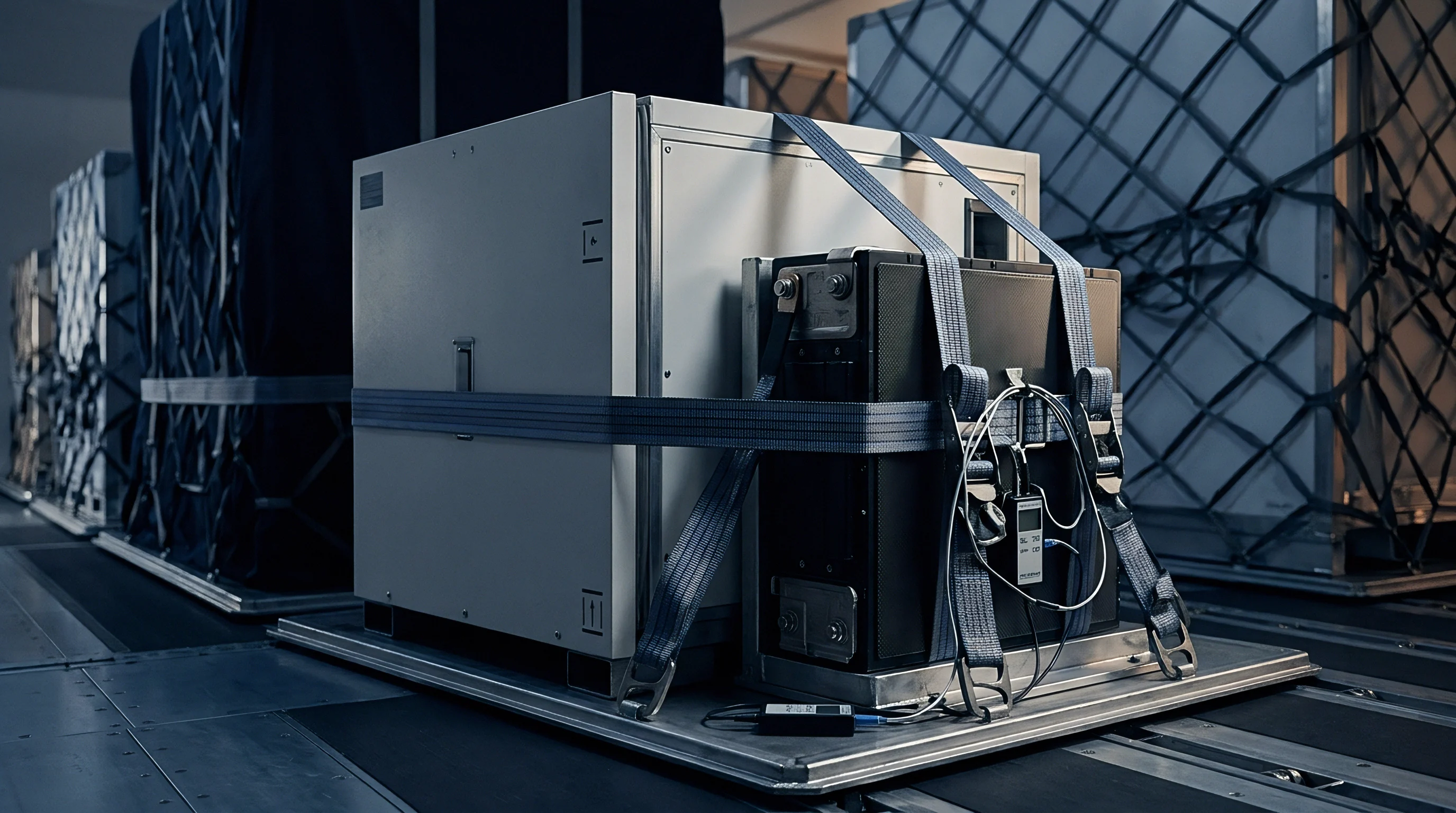
Port Checkpoint Inspection and Dangerous Goods Hold Mechanics
Border protocols mix automated paperwork scans with physical spot-checks. Market surveillance officers target shipments for inspection based on risk markers like new production facilities, unverified shipping papers, or missing test summaries. Once cargo is pulled for a hold, inspectors unpack containers to examine cell, module, and system integrity, checking for mandatory safety labels, serial codes, and flame-retardant barriers.
| Authority Type | Inspection Focus | Standard Sample Size | Average Hold Duration | Direct Cost Allocation |
|---|---|---|---|---|
| Customs Border Protection | Documentation, tariff classification, dangerous goods coding | 100% paper audit, 2% physical container open | 3 to 7 business days | Importer of record via customs bond |
| Dangerous Goods Inspectorate | UN packaging certification, UN 38.3 test summary verification | 1 outer pack per UN lot design | 5 to 14 business days | Consignee or freight forwarder |
| Market Surveillance Agency | Conformity assessment, safety labeling, IEC standard compliance | 3 to 8 cells or 1 module per batch | 14 to 45 business days | Authorized Representative or Importer |
Finding physical flaws during an inspection stops clearance instantly. Damaged cell sleeves, exposed terminals, or missing State of Charge (SoC) declarations that breach the 30% limit for air transit (under IATA PI 965) or maritime rules render the shipment non-compliant and hazardous. Customs issues a refusal of entry, forcing the carrier to either return the goods to the originating port or send them to a licensed facility for supervised destruction.

Sample Retention Requirements for Destruction and Verification
Regulators have the legal power to pull sample units from incoming battery shipments for destructive testing. Accredited third-party labs run these tests to verify compliance with electrical, mechanical, and environmental standards under IEC 62133-2 or UL 1973, subjecting samples to forced internal short-circuits, overcharging, extreme heat, and mechanical crushing.
Destructive testing wipes out product value. Importers swallow the loss of seized units, plus testing fees if the lab uncovers failures. If testing shows serious non-conformity ~ like thermal runaway propagation during UL 9540A unit-level checks ~ the agency issues a formal violation notice that applies to the entire production lot listed on the manifest.
Paperwork mismatches cause instant delays. Importers need pre-clearance dangerous goods audits right at the factory gate, verifying that packaging marks, UN test summaries, and dangerous goods declarations match actual cargo before containers are sealed and loaded.


Ledger
Paper trails form the evidence needed to back up compliance across borders. Surveillance enforcement relies on traceable technical records, lab reports, and factory quality certificates. Under upcoming rules like the mandatory EU Battery Passport, every storage system will need a digital ledger link providing direct access to supply chain audits, material provenance certificates, and safety test records.
Test summaries need authorized signatures and specific details. A valid UN 38.3 Test Summary must include every field listed in paragraph 38.3.5 of the UN Manual of Tests and Criteria: manufacturer name and address, lab details, unique report numbers, completion dates, and an official signature. Leaving out even one required field invalidates the shipping safety dossier, giving authorities clear legal cause to hold shipments at customs.

Authenticating Cross Border Battery Safety Dossiers
Regulators regularly catch fake compliance paperwork in cross-border battery channels. Scams range from submitting expired certificates and altering lab report numbers to attaching high-grade cell approvals to lower-tier, re-wrapped cells. Surveillance checks verify report numbers directly against the internal databases of accredited ISO/IEC 17025 testing laboratories.
- Report Number Verification requires contacting the issuing ISO/IEC 17025 lab directly to confirm the report is genuine and that the tested cell model matches imported specs.
- Chemical and Construction Audit checks that cathode composition, anode thickness, electrolyte formula, and separator specs on the Safety Data Sheet (SDS) match the cell’s actual physical build.
- Factory Inspection Linkage verifies that the plant listed on ISO 9001 and ISO 14001 certificates matches the manufacturing site shown on cell QR codes and customs entry forms.
- Batch Serial Traceability ensures individual cell QR codes link back to factory end-of-line testing records, confirming that capacity, internal resistance, and initial K-values meet certified tolerances.
Checking cell test summaries against primary channel logs is necessary before approving shipment clearance. Paperwork failures highlight supplier risks and invalidate transport clearances. If an importer accepts unverified third-party lab reports without confirming the lab’s actual accreditation, they take on full financial and legal liability for any enforcement action that follows.
Standard ISO/IEC 17025 laboratory accreditation covers specific test methods only, invalidating certificates issued outside the laboratory’s documented scope.

Battery Passport Data Integrity and Conformity Assessment
Digital battery passports require full data transparency across the lifecycle of stationary storage systems. Under EU Regulation 2023/1542, economic operators must host verifiable data on a decentralized digital ledger accessible to regulators, buyers, and the public. The record covers carbon footprint calculations, recycled material percentages, performance stats, state-of-health tracking, and material sourcing audits.
Regulators run integrity checks to test the mathematical and physical consistency of passport filings. Carbon footprint entries under EU rules rely on life-cycle assessment (LCA) methods set by European Commission standards. If inspectors find discrepancies between stated factory energy inputs and actual grid carbon intensity at the plant site, the battery passport certification gets revoked ~ making that product line illegal to sell in the territory.
On cell degradation, datasheets often claim a lifespan of 6,000 cycles to 80% capacity retention at 25°C under 0.5C charge and discharge rates. That figure comes from continuous lab tests using pneumatic clamps applying 300 kPa of uniform pressure. If operating conditions warm to 35°C without clamping, actual cycle life drops closer to 4,200 cycles.
During market surveillance audits, if independent lab testing under standard baseline conditions shows capacity retention falling more than 5% below claimed curves, regulators classify the filing as misleading commercial conduct ~ triggering mandatory passport corrections and financial penalties.
Notified Bodies perform third-party audits on technical files before products hit the market, issuing EC Type-Examination Certificates when designs meet essential health and safety rules. But that certificate only proves that the specific test sample complied ~ it doesn’t guarantee quality across subsequent mass production runs. Importers need ongoing batch testing to ensure continuous alignment between mass production and certified prototype baselines.
Gaps in documentation destroy commercial viability. If an importer fails to keep complete compliance files for the mandatory 10-year retention period after placing products on the market, regulators apply a legal presumption of non-conformity ~ ordering the immediate removal of all unverified storage units from service.


Sanction
Administrative penalties hit non-compliant battery supply chains hard. When lab testing or field failure audits show imported hardware violates safety rules, authorities step in to remove hazards and penalize negligence. Measures range from informal warnings and compliance agreements up to mandatory recalls, immediate sales bans, border seizures, and heavy fines.
Recalls erase profit margins. Regulators publish safety alerts on international portals like EU Safety Gate or the US CPSC database, listing non-compliant brands, cell part numbers, and batch serials. These public notices trigger reputational damage and prompt buyers to cancel contracts worldwide.

Administrative Recall Orders and Mandatory Market Withdrawals
Regulators hold statutory power to force product recalls when storage hardware poses serious safety risks. A thermal runaway event at a utility-scale BESS site triggers immediate multi-agency investigation. If forensic analysis shows the fire started from an internal cell short caused by a manufacturing defect or bad separator assembly, regulators will order recalls across every deployed system containing cells from that production run.
| Jurisdiction | Primary Statutory Instrument | Maximum Administrative Fine | Customs Action Mechanism | Primary Target Entity |
|---|---|---|---|---|
| European Union | EU Regulation 2023/1542 / Reg 2019/1020 | Up to 4% of annual regional turnover | Immediate destruction or export refusal | Importer or Authorized Representative |
| United States | Consumer Product Safety Act / EPA TSCA | 120,000 USD per violation (17.1M USD cap) | Customs seizure and bond forfeiture | Importer of Record |
| United Kingdom | Batteries and Accumulators Regulations | Unlimited fine upon criminal indictment | Border force detention order | Economic Operator placing on market |
Recalling utility-scale energy storage systems is a complex, costly operation. The responsible operator must safely de-energize BESS containers, disconnect electrical connections, pull non-compliant module racks, and ship heavy hazardous waste to certified facilities. Total financial exposure covers field replacement, lost power purchase agreement (PPA) generation revenue during downtime, specialized transport fees, and environmental disposal surcharges.

Financial Sanctions and Cross Border Judgment Enforcement
Fines are structured to strip away profits earned from non-compliant hardware sales. Penalties scale with the severity of the violation, corporate negligence, and total volume shipped into the market. In severe cases involving falsified paperwork, fines can reach millions of dollars or a set percentage of regional corporate turnover.
Maximum administrative fines under modern battery regulations reach up to 4 percent of an economic operator’s annual regional turnover for severe safety non-conformity.
Collecting fines hits a wall when the penalized entity has no physical assets in the jurisdiction. If an importer is a thinly capitalized special purpose vehicle (SPV) without cash reserves, administrative fines force immediate insolvency. Regulators counter this by attempting to pierce the corporate veil, extending personal liability to corporate officers or pursuing parent companies and local supply chain partners.
Regulators factor compliance history into fine calculations. In enforcement practice, agencies often calculate penalties by taking the cost of proper batch testing, multiplying it by three to strip any financial benefit, and adding punitive damages tied to public safety risks. An initial violation finding of $500,000 can quickly climb to a final administrative judgment of $2,500,000 if the company fails to cooperate during the investigation.
Suppliers often blame failures on poor system integration, high ambient temperatures, or bad handling by EPC contractors. Regulators routinely reject these arguments when sample testing reveals root design defects or factory flaws that breach baseline standards ~ holding the local economic operator strictly liable regardless of third-party involvement.


Covenant
Solid supply contract covenants offer the only reliable protection against cross-border enforcement gaps. Because administrative law holds local importers or project owners strictly liable for non-conformity, contracts must build parallel private rights of recourse against offshore cell and pack vendors. These terms must withstand foreign legal challenges and ensure direct access to funds if regulatory losses hit.
Escrow accounts back up buyer claims when standard warranty clauses and simple seller indemnities fail in foreign courts. Buyers should require offshore suppliers to post binding financial security ~ such as irrevocable standby letters of credit (SBLC), parent guarantees, or performance escrow funds held in neutral financial hubs.

Contractual Indemnification and Multi Jurisdictional Warranties
Indemnification provisions must cover all direct, indirect, and administrative costs stemming from regulatory actions. Contracts should spell out market surveillance intervention as a specific trigger, separate from standard product warranties. Terms must obligate foreign suppliers to defend, indemnify, and hold the local importer harmless against administrative fines, recall costs, port detention fees, destroyed sample losses, and legal expenses.
Buyers structure cross-border supply contracts around performance-contingent letters of credit. Jurisdiction clauses should name arbitration centers backed by the New York Convention on the Recognition and Enforcement of Foreign Arbitral Awards. Arbitrating in centers like Singapore, London, or Hong Kong ensures that awards against offshore vendors can be enforced directly against foreign factory assets and bank accounts without re-litigating the dispute in local courts.
Global supply lines rely on maritime shipping lanes, dangerous goods transshipment hubs, and marine insurance networks to move containerized battery systems across oceans. When regulatory holds hit cargo at transshipment ports, logistics agreements trigger vessel delay penalties and dangerous goods storage fees that quickly eat up project contingencies.

Performance Escrow Structures and Cross Border Security
Financial security provides quick liquidity to cover enforcement costs without waiting through lengthy cross-border litigation. A performance escrow agreement creates a buffer by holding back a set percentage of purchase funds in a neutral bank account until customs holds clear and final grid connection approval is granted.
- Define mandatory compliance document milestones that must be met before releasing initial contract down payments.
- Require foreign suppliers to post an unconditional Standby Letter of Credit from a rated international bank upon signing.
- Mandate pre-shipment factory acceptance testing (FAT) by an independent auditor to confirm UN 38.3 and IEC compliance.
- Set retention escrow funds at fifteen percent of total shipment value, held in a neutral jurisdiction for twelve months post-delivery to handle post-market surveillance audits.
- Include direct drawdown rights letting the buyer pull escrow funds immediately upon presenting an official market surveillance non-conformity notice or fine assessment.
Offshore factories often ignore foreign court judgments. Buyers need to protect their position by keeping financial leverage within reach of local courts before releasing full payment for cross-border hardware orders.
Under Section 14.3 of standard international energy storage supply agreements, the foreign supplier agrees that any administrative fine, recall expense, or port detention fee levied on the domestic buyer by a market surveillance authority constitutes a direct, uncapped debt payable within fourteen business days of written notice.


Recourse
Turning statutory non-conformity findings and contract terms into actual financial recovery takes systematic execution across cross-border supply chains. When regulators halt sales or order non-compliant modules pulled from an operating plant, the project owner has to move immediately on legal and financial recovery options to limit losses and claw back capital.
Local representatives take the ultimate financial hit. Facing heavy penalties, domestic authorized representatives and importers pass back-to-back claims down the chain. If the foreign cell manufacturer refuses to honor indemnification terms, local entities must pursue commercial subrogation ~ drawing down on standing bank securities or attaching offshore assets through court orders.

Economic Operator Joint Liability Execution
Modern market surveillance laws assign joint and several liability among economic operators in the destination country. If an offshore factory fails to pay regulatory fines or carry out recall orders, enforcement shifts entirely to domestic supply chain members. Regulators collect penalties directly from the importer of record, leaving them to recover those costs from foreign suppliers.
| Supply Chain Role | Statutory Exposure Type | Direct Market Recourse Level | Cross Border Recovery Mechanism |
|---|---|---|---|
| Foreign Cell Manufacturer | Primary manufacturing non-conformity | Low (No physical local presence) | International arbitration, bank guarantees |
| Authorized Representative | Mandated administrative compliance liability | High (Direct regulatory target) | Contractual counter-indemnification |
| Domestic Importer of Record | Absolute product clearance liability | Critical (Primary enforcement subject) | Escrow drawdown, seller security claims |
| Project EPC Contractor | Distributor or installer compliance duty | Moderate (Secondary hold target) | Subcontractor back-charge agreements |
Subrogation depends on clear paperwork. Importers paying fines or managing recalls on behalf of non-compliant foreign suppliers step into the legal shoes of the regulatory authority. The subrogated party presents official violation notices, accredited lab reports, and payment receipts to arbitration panels to secure binding recovery judgments against the foreign manufacturer.

Commercial Subrogation and Supply Chain Cost Allocation
Executing subrogation requires establishing a direct link between factory defects and regulatory violations. Independent engineering audits must prove that cell or pack non-conformity stems from production errors, design flaws, or false lab documentation ~ rather than transit damage, poor installation, or operational abuse on site.
Contractual recourse fails when forensic failure analysis cannot establish whether cell non-conformity originated inside the factory gate or during post-delivery transport.
Estimating subrogation claim values relies on audit data showing average module failure rates from cell manufacturing defects between 0.05% and 0.15% across major tier-one lines, based on three years of warranty returns from grid-scale storage sites. But if unannounced changes to cathode washing or electrolyte additives happen at the factory without re-qualification, batch failure rates can jump to between 2.0% and 8.0%. When failures spike like that, baseline models no longer support claim valuations; buyers need to run 100% batch isolation tests immediately to establish exact defect counts before submitting formal subrogation claims against offshore suppliers.
Identifying internal tab separation beyond permissible tolerances through thermal shock testing stops non-compliant hardware from reaching the field, avoiding market surveillance action and securing immediate refund credits under letter of credit terms.
Cross-border recourse workflows fail under predictable operational scenarios:
- Inadequate Security happens when contracts rely on corporate guarantees from foreign entities without unencumbered local bank assets, leaving court judgments uncollectible.
- Untraceable Batches occurs when cells lack clear QR codes or laser-etched serial numbers, making it impossible to prove legally that bad cells came from a specific factory lot.
- Lapsed Accreditation happens when test reports rely on labs whose ISO/IEC 17025 accreditation expired before tests were actually performed.
- Customs Broker Gaps occurs when transient brokers clear imports without formal agency agreements specifying how regulatory liability is divided.
Project owners, EPC contractors, and importers managing international battery supply chains have to build recourse mechanisms straight into their contracts, transport workflows, and banking setups. Compliance rules in target markets operate continuously, regardless of foreign legal boundaries or factory excuses. Securing enforceable covenants, verifying lab data, keeping battery passport dossiers complete, and retaining access to cash security form the basic operational foundation for running viable, legally sound energy storage supply chains.