Resolving Unaccredited Test Summary Claims in Cross Border Supply Chains for Energy Storage Packs
Validating ISO 17025 ILAC accreditation scopes for UN 38.3 test summaries before shipment prevents carrier refusals and port impoundments.


Anomaly
Cross-border logistics for lithium-ion battery energy storage systems rely on verifiable dangerous goods safety dossiers. Every commercial shipment of energy storage packs crossing international borders falls under dangerous goods regulations governed by the United Nations Recommendations on the Transport of Dangerous Goods. Paragraph 38.3.5 of the UN Manual of Tests and Criteria specifies the exact information cell and pack manufacturers must make available across the supply chain.
Commonly called the UN 38.3 Test Summary, this document provides the core proof that a given cell design or pack architecture passed mandatory safety testing without catastrophic physical or thermal failure.
Paperwork errors quickly stall shipments at port. Buyers run into serious operational friction when suppliers hand over test summaries from unaccredited in-house test benches or unverified third-party labs. While UN 38.3.5 sets out the required data points for a summary, it leaves lab accreditation rules to regional transport authorities and individual carrier policies.
That gap allows suppliers to submit self-certified test summaries that look like valid UN 38.3.5 documents on paper while lacking the baseline lab credentials international air, ocean, and ground carriers actually demand.

Regulatory Mandate of UN 38.3.5 Test Summaries
International transport rules for lithium-based batteries require a standardized document confirming compliance with thermal, mechanical, and electrical safety thresholds. Effective January 1, 2020, the UN Model Regulations mandated that manufacturers and distributors provide the UN 38.3 Test Summary to every entity down the supply chain. The document has to trace the product from its commercial trade name to the underlying test report number, execution date, and the specific test parameters completed under Subsection 38.3 of the Manual of Tests and Criteria.
The standard sets out ten mandatory data elements for every valid test summary:
- Name of cell, module, or battery manufacturer including full physical address, phone number, email address, and official corporate website for direct verification.
- Name of the testing laboratory including complete contact details, physical facility address, and accreditation registration numbers where applicable.
- Unique test report identification number matching the master lab file and original test execution date.
- Detailed description of the cell or battery specifying whether the sample is lithium ion or lithium metal chemistry, cell format, mass, watt-hour rating, or lithium content.
- List of completed tests and results explicitly stating compliance with tests T.1 through T.8 alongside individual pass or fail declarations.
- Battery test requirements and amendments citing the specific edition of the UN Manual of Tests and Criteria used for the evaluation.
- Signature with name and title of the authorized signatory confirming the authenticity and accuracy of the summarized test data.
When an energy storage pack ships under UN 3480 or UN 3481 dangerous goods declarations, freight forwarders and airline safety desks check these ten points against carrier acceptance rules. A single missing field or invalid lab reference can ground cargo immediately at origin transshipment hubs.
Laboratory Accreditation Deficits and ILAC Mutual Recognition
Test reports from non-accredited facilities carry no formal international standing through signatory networks. ISO/IEC 17025 specifies general requirements for laboratory competence, impartiality, and consistent operations. When a lab holds ISO/IEC 17025 accreditation from a body signed onto the International Laboratory Accreditation Cooperation (ILAC) Mutual Recognition Arrangement (MRA), its test reports gain global acceptance with border inspection agencies.
Unaccredited in-house test summaries introduce real risk for cross-border buyers. A supplier running an internal test rig without ISO/IEC 17025 accreditation can generate a sheet that looks identical to a standard UN 38.3.5 document. Yet without third-party audit by an ILAC MRA signatory body ~ such as the China National Accreditation Service for Conformity Assessment (CNAS) or the National Voluntary Laboratory Accreditation Program (NVLAP) ~ there is no proof that high-current channels, thermal chambers, and shock tables were properly calibrated.
Forwarders and customs brokers cross-reference test summary submissions against international accreditation databases before approving cross-border freight bookings.
| Parameter | ISO/IEC 17025 Accredited Laboratory Report | Unaccredited In-House Test Summary | Verification Risk Profile |
|---|---|---|---|
| Traceability of Calibration | National Metrology Institute (NMI) traceable sensors | Internal reference instruments without external audit | High risk of sensor drift in thermal and voltage logs |
| ILAC MRA Signatory Mark | Present with valid scope registration number | Absent or replaced by non-accredited corporate logo | Immediate rejection by tier-one air freight carriers |
| Test Methodology Scope | Audited explicitly for UN 38.3 T.1-T.8 methods | Self-declared adherence without external audit | Omission of boundary conditions during overcharge tests |
| Legal Standing at Customs | Recognized under international mutual agreements | Subject to secondary verification and cargo hold | Demurrage accumulation during physical re-testing |
Mismatches between lab scopes and declared claims pop up regularly in technical audits. An unaccredited facility might hold an ISO 9001 quality management certificate and mistakenly present it as proof of testing capability. ISO 9001 covers general organizational quality processes ~ it does not evaluate lab competence, sensor calibration accuracy, or test execution.
Freight compliance officers routinely spot this substitution and reject the dangerous goods declaration.

Discrepancies between Cell Design and Pack Credentials
Buyers frequently receive documents run on single pouch cells presented as coverage for high-voltage, multi-module enclosures. A single cell passing UN 38.3 tests does not grant compliance to a 51.2V 200Ah battery module or a 372kWh energy storage container. Section 38.3.2.2 of the UN Manual explicitly states that changes in mass, gross weight, or nominal watt-hour ratings beyond specific thresholds require full re-testing of the assembled pack.
A 314Ah lithium iron phosphate cell subjected to a constant current overcharge at 1.5 times nominal voltage until case temperature stabilizes shows no thermal runaway when monitored for 24 hours under standard laboratory conditions.
When cell manufacturers sell large prismatic units to third-party integrators, the integrator must perform UN 38.3 tests on the finished pack assembly. To save time, integrators sometimes try shipping fully assembled packs using only the cell-level UN 38.3 test summary. Carrier acceptance desks check dangerous goods documentation against outer package markings.
If a transport document lists a pack weight of 120 kilograms and a nominal capacity of 10.2 kilowatt-hours, but the attached summary covers a single 3.2V 314Ah cell weighing 5.6 kilograms, the shipment is grounded because pack configurations require independent testing.
Internal factory test benches may mirror commercial standards in principle, but transport carriers and port authorities still require formal third-party accreditation to clear freight.

Clamp
Physical abuse testing surfaces design flaws long before cells reach volume assembly. UN 38.3 forces energy storage packs and individual cells through severe mechanical, thermal, and electrical stressors to simulate worst-case transport conditions. Looking closely at these mechanical parameters makes it clear why unaccredited lab summaries so often hide critical testing gaps or uncalibrated sensors.
In an accredited facility, shock tables, vibration exciters, and environmental chambers are calibrated regularly against standards traceable to national metrology institutes. Unaccredited labs often lack the capital or operational discipline to maintain sensor accuracy across extreme temperatures and high-current loads.

Mechanical and Environmental Stress Test Thresholds
Testing starts with environmental and mechanical stresses meant to test structural integrity before electrical abuse begins. Test T.1 (Altitude Simulation) models non-pressurized cargo holds by holding units at an absolute pressure of 11.6 kilopascals or less for at least six hours at ambient temperature. Test T.2 (Thermal Test) subjects packs to rapid thermal shifts, cycling between negative 40 degrees Celsius and positive 72 degrees Celsius with a maximum 30-minute transition time, dwelling at each extreme for at least six hours across ten consecutive cycles.
Test T.3 (Vibration) simulates transport vibration using sinusoidal waveforms. For large battery packs over 12 kilograms, frequency sweeps from 7 Hertz to 200 Hertz and back to 7 Hertz over 15 minutes, repeated 12 times across three mutually perpendicular axes. Test T.4 (Shock) applies half-sine shocks.
Large packs undergo half-sine shocks at a peak acceleration of 50 gn and an 11-millisecond pulse duration, struck three times in both positive and negative directions across three orthogonal axes for 18 total impacts.
| Test Designation | Standard Test Condition | Common Deficiency in Unaccredited Reports | Impact on Safety File |
|---|---|---|---|
| T.1 Altitude | 11.6 kPa absolute pressure for 6 hours | Pressure vessel leakages unmonitored during dwell | Unseen pouch cell swelling or seal failure |
| T.2 Thermal | -40°C to +72°C dwell, 10 complete cycles | Chamber transition times exceed 30 minute cap | Falsely low thermal expansion stress on busbars |
| T.3 Vibration | 7Hz to 200Hz sweep, 12 cycles per 3 axes | Exciter table lacks multi-axis dynamic calibration | Undetected busbar weld fatigue or lug cracking |
| T.4 Shock | 50 gn, 11 ms duration, 18 total impacts | Accelerometers not calibrated to ISO 17025 standard | Overlooked structural frame displacement |
| T.5 Short Circuit | 55°C outer ambient, total resistance < 0.1 ohm | Circuit resistance exceeds 0.1 ohm allowance | Artificially depressed peak discharge current |
| T.7 Overcharge | 2x max charge current, 24-hour observation | BMS bypass utilized without report disclosure | Concealed overvoltage thermal runaway risks |
Vibration exciters running without calibrated control loops can allow mechanical harmonics to dampen peak acceleration. On an unaccredited summary, an auditor cannot tell whether the test rig delivered true 50 gn shock amplitudes or if fixture flex absorbed the force meant for the pack frame. Inspecting module busbars after T.3 and T.4 tests frequently turns up hairline weld fractures if testing was performed on uncalibrated equipment that fell short of the required energy spectrum.

Thermal Abuse and Electrical Overcharge Dynamics
Electrical stress tests evaluate cell and pack stability during major short-circuit and overcharge events. Test T.5 (External Short Circuit) brings the unit to an ambient temperature of 55 degrees Celsius before applying a short circuit under 0.1 ohm total external resistance. The short remains active for at least one hour after the outer case drops back to 55 degrees Celsius.
Test T.7 (Overcharge) evaluates how a pack behaves during a charge control failure. The procedure applies a charge current equal to twice the manufacturer’s maximum continuous rating while maintaining maximum charge voltage (or 1.2 times maximum voltage for multi-cell setups lacking internal balancing). Charging runs for 24 hours, followed by a 7-day observation window with continuous logging of case temperature, mass loss, and open-circuit voltage.
Unaccredited lab reports often omit short-circuit current traces entirely or reduce them to single-point averages. A genuine high-rate short circuit on a 314Ah prismatic LFP cell generates initial peak currents over 4,000 amperes before internal PTCs or interrupt devices trip. Unaccredited labs using high-resistance load switches above the 0.1 ohm limit artificially cap this peak current.
That artificially low current suppresses internal Joule heating, yielding a pass mark for a pack design that would vent or go into thermal runaway under true sub-100-milliohm conditions.

Subcontracted Test Channels and Data Modification
Labs dealing with high testing volumes run into channel capacity bottlenecks. Unaccredited operations frequently farm out high-current overcharge and short-circuit tests to unverified satellite facilities without informing the buyer or noting the subcontracted setup in the report file.
Subcontracted test channels without active thermal logging routinely conceal temperature spikes during high current cycling.
Subcontracted channels open the door to undetected data manipulation. When raw readings move through multiple unverified hands, voltage and temperature curves get smoothed, washing out localized thermal events. For instance, during a T.7 overcharge test on a 16-cell series module (51.2V nominal), a cell generating internal gas might spike briefly to 85 degrees Celsius before the main circuit breaker trips.
An accredited ISO/IEC 17025 lab using high-frequency logging captures that spike and records it as a potential safety non-conformity. In an unaccredited or subcontracted lab, low sampling rates ~ like one reading every 60 seconds ~ miss short thermal spikes altogether, resulting in an unearned pass certificate.
Where Do Carrier Compliance Desks Reject Unaccredited Test Summaries?
Cargo gets grounded at major air hubs and container terminals when dangerous goods inspectors cross-check lab accreditation numbers against the ILAC MRA signatory database. Inspectors look at line two of the UN 38.3.5 summary to verify that the lab holds an active scope covering UN Manual Section 38.3. If that scope has expired, or if the facility isn’t accredited for the exact electrical tests conducted, the dangerous goods declaration gets flagged as invalid.
Air cargo safety desks at major hubs run automated scripts matching lab names against databases of unaccredited facilities issuing illegitimate certificates. When a name flags, acceptance is denied on the spot and the pallet is shifted to a secure dangerous goods quarantine zone. Storage fees rack up daily while the shipper tries to source secondary verification from an accredited lab, and re-testing costs mount fast.
It remains to be seen whether international regulators will eventually mandate automated cross-checks between national accreditation portals and carrier filing systems.
Validation
Authenticating test documents takes careful cross-referencing against global accreditation registers. Buyers need a structured auditing protocol to vet incoming safety dossiers before issuing purchase orders or releasing milestone payments. Relying solely on PDF test summaries sent over by sales agents carries heavy commercial risk.
A report is only as valid as the lab’s specific scope. A facility holding ISO/IEC 17025 accreditation for mechanical testing might not be accredited for electrical abuse testing under UN 38.3. Validation teams must check the explicit scope schedule attached to the lab’s certificate rather than accepting a generic accreditation document.

Auditing Test Summaries against Accreditation Databases
Document verification starts by identifying the national accreditation body overseeing the testing facility listed on the UN 38.3.5 summary. These signatory bodies belong to regional alliances ~ such as the European co-operation for Accreditation (EA), the Asia Pacific Accreditation Cooperation (APAC), or the InterAmerican Accreditation Cooperation (IAAC) ~ all operating under the ILAC umbrella.
Auditors follow a multi-step verification process:
- Locate the official laboratory accreditation body portal through the central ILAC MRA signatory list.
- Query the unique accreditation registration number printed on the UN 38.3 test summary within the accreditation body public database.
- Confirm that the accreditation status is active and was valid on the precise dates during which the UN 38.3 testing was executed.
- Download the official Scope of Accreditation schedule and verify that Section 38.3 of the UN Manual of Tests and Criteria is explicitly listed under the laboratory technical scope.
- Match the specific test methods listed in the scope document against the tests (T.1 through T.8) claimed within the test summary.
- Verify that the physical address of the test facility where the tests occurred matches the facility address specified on the scope certificate.
If a facility performs UN 38.3 testing outside its accredited scope, the summary carries no more legal weight than an unverified self-declaration, prompting forwarders to reject the transport package.

Traceability Matrix for Lot Conformity and Cell Serials
Maintaining a clear chain of custody between tested prototypes and production runs requires tight serial number tracking. Manufacturers often submit one UN 38.3 test summary for a baseline cell and try using it across multiple production lines, cell revisions, and shadow factories. Quality engineers track the alignment between factory lot codes and lab report serials across large supply chains.
A proper traceability matrix ties together three distinct levels of manufacturing data:
First, the master UN 38.3 test report has to state the exact chemistry, cathode composition, anode formulation, separator thickness, and electrolyte additives of the test samples. Second, the factory quality management system must record lot-specific cell serials, connecting raw material batch numbers (like precursor cathode material lots) to finished cells. Third, pack assembly records must track every cell serial number built into a given module.
Comparing incoming packing lists against the UN 38.3 safety file often reveals unannounced design tweaks. If a factory increases electrode coating density to bump nominal capacity from 280Ah to 306Ah, cell weight rises by several percent. Under Section 38.3.2.2, increases in mass or energy density beyond fixed thresholds require full re-testing.
Using an older 280Ah test summary to ship 306Ah cells breaks dangerous goods transport regulations.
Cross Referencing Test Signatories with Lab Schedules
Checking the signatories on a test summary protects buyers against informal signatures. In unaccredited or loosely managed operations, sales reps or administrative staff sometimes sign line ten of the UN 38.3.5 document just to clear an export shipment.
Under ISO/IEC 17025 standards, only signatories evaluated and authorized by the accreditation body can sign off on reports and summaries. The lab’s accreditation schedule or quality manual specifies who holds signing authority. On high-value energy storage projects, validation teams ask for explicit proof of signatory authorization directly from the lab.
Unauthorized signatures invalidate the legal standing of the summary. When customs officials or carrier safety desks spot an unverified sign-off, they flag the entire safety dossier as non-compliant.
Legitimate safety claims depend on direct alignment between the named lab and its active scope listing on the national accreditation body’s registry.

Transit
Freight acceptance desks evaluate dangerous goods paperwork under strict international modal codes. Shipping energy storage packs across borders touches multiple transport channels: ocean freight under the International Maritime Dangerous Goods (IMDG) Code, air freight under the International Air Transport Association (IATA) Dangerous Goods Regulations, and European road transport under the ADR framework.
Importers absorb the ultimate cost of a seizure. Every framework sets hard requirements on packaging, labeling, state-of-charge limits, and documentation. A paperwork failure at origin halts transport across every downstream leg.
Carrier Acceptance Rules under IATA Packing Instructions
Air freight is the most tightly controlled transport mode for lithium batteries. Standalone cells and packs shipped as air cargo fall under IATA Packing Instructions PI 965 (standalone lithium-ion cells and batteries), PI 966 (packed with equipment), or PI 967 (contained in equipment). Standalone packs shipped under PI 965 Section IA or Section IB must be offered at a state of charge (SoC) no higher than 30 percent of rated capacity, unless explicit written approval is granted by the State of Origin and the State of the Operator.
Airline acceptance desks review the UN 38.3 test summary before approving a cargo booking. IATA rules mandate that carriers confirm the summary matches outer package markings and the Dangerous Goods Declaration (DGD) exactly. If the summary lacks ISO/IEC 17025 accreditation credentials or misses required fields, the carrier issues a formal Dangerous Goods Rejection Notice.
Once a rejection notice is cut, cargo cannot simply be tendered to another airline without fixing the root document issue. Airlines share dangerous goods rejection logs at major cargo hubs, making it impossible to bypass a rejection by walking the pallet over to a competing desk.

Maritime Dangerous Goods Shipping Holds at Port Outlets
Ocean freight moves the bulk of utility-scale energy storage systems, carrying containerized units and modules under UN 3480 classifications. The IMDG Code requires compliance with Special Provisions 188, 230, 310, and 384 depending on pack capacity, weight, and configuration.
Special Provision 188 of the International Maritime Dangerous Goods Code denies transport exemption to battery packs lacking verifiable test summary documentation signed by an accredited quality management representative.
Port authorities and coast guard officials conduct spot-checks at container terminals. Ships operating under SOLAS (Safety of Life at Sea) conventions face steep fines for carrying poorly documented hazardous cargo. If a container holds battery packs backed by an unaccredited or falsified UN 38.3 summary, inspectors place a hold on the manifest.
Demurrage and storage fees pile up fast during a port hold. Terminals levy daily storage surcharges on dangerous goods containers stuck in hazardous material yards ~ fees that routinely run three to five times standard storage rates. That adds thousands of dollars per day to landed costs while buyers and suppliers scramble to clear document discrepancies.

Documentary Audits by Freight Forwarders and Customs Authorities
Freight forwarders serve as the primary filter for dangerous goods compliance. Accepting a non-compliant hazardous shipment creates joint liability under international maritime and aviation laws. Because of that exposure, major forwarders maintain dedicated compliance teams to audit test summary credentials before releasing Bills of Lading.
Customs agencies in destination countries ~ like U.S. Customs and Border Protection (CBP) or EU authorities under the Union Customs Code (UCC) ~ run automated risk profiling. High-risk tariff codes like 8507.60 (lithium-ion accumulators) automatically trigger requests for UN 38.3 test summaries and safety data sheets (SDS).
| Document Element | Required Specification under PI 965/IMDG | Common Failure Mode | Operational Delay Impact |
|---|---|---|---|
| UN 38.3.5 Test Summary | Complete 10-point record from accredited lab | Unaccredited lab signature or missing fields | Immediate cargo refusal at origin air terminal |
| State of Charge Certificate | Declared ≤ 30% for standalone PI 965 air cargo | SoC exceeds 30% nominal capacity threshold | Mandatory discharge offsite at shipper expense |
| Overpack Markings | UN number, class 9 label, cargo aircraft only | Labels missing, damaged, or incorrect dimensions | Re-labeling hold at transshipment warehouse |
| Safety Data Sheet (SDS) | Compliant with GHS format, dated < 3 years | Outdated transport section (Section 14) data | Documentary hold pending revised supplier SDS |
Discrepancies across the UN 38.3 summary, the SDS, and the commercial invoice trigger physical container holds that bring delivery timelines to an immediate stop.
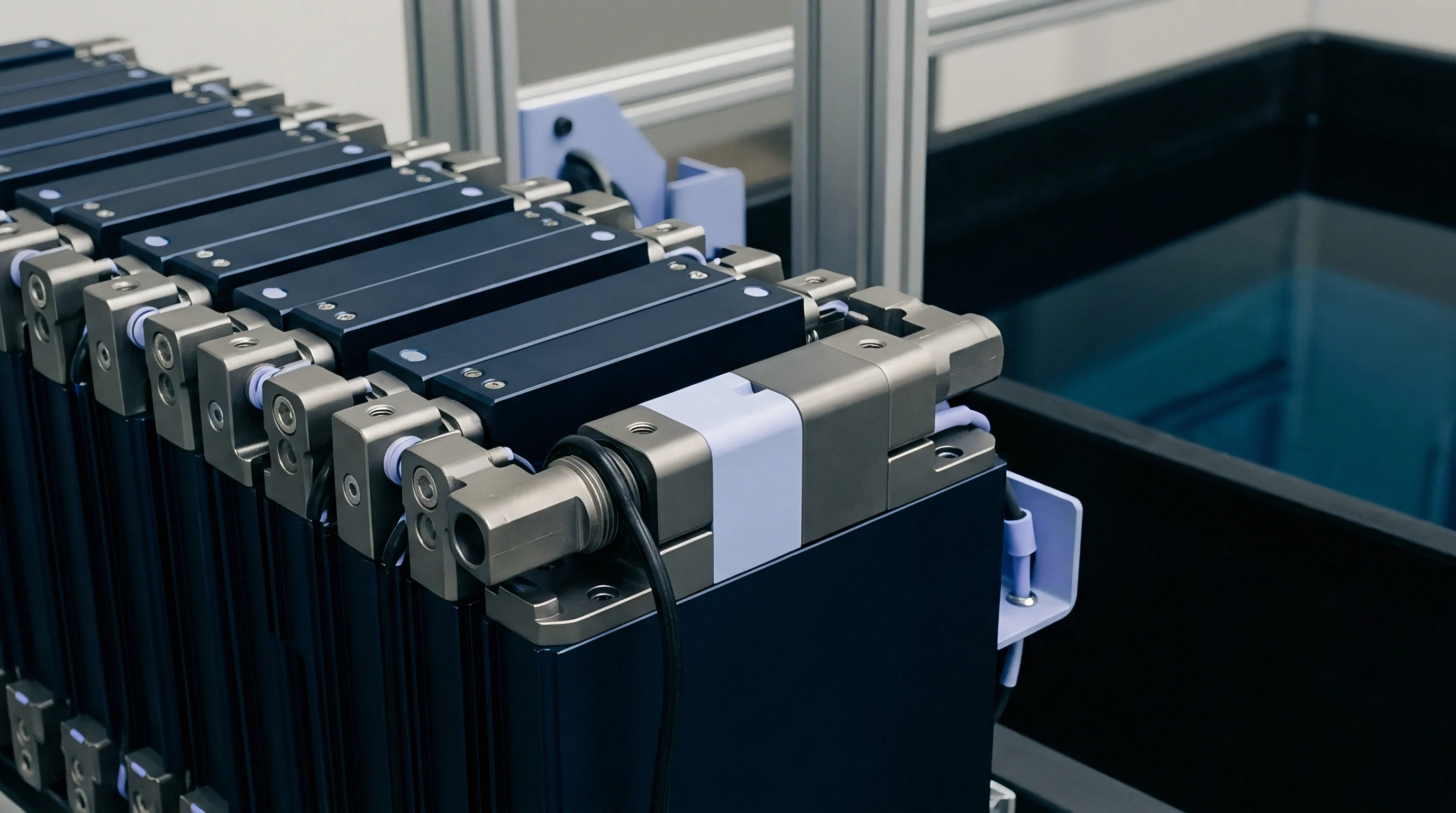
Worked Cargo Rejection Post Mortem
Looking at a real supply chain failure illustrates how quickly financial losses compound. A utility-scale developer ordered 40 containerized battery units (totaling 100 megawatt-hours of capacity) using 314Ah LFP prismatic cells, shipped via ocean freight.
At the destination port, customs inspectors audited the dangerous goods dossier on the entry manifest. The UN 38.3 test summary from the factory named an in-house lab. A search in the ILAC MRA database showed the lab held ISO 9001 certification but lacked ISO/IEC 17025 accreditation for UN 38.3 testing.
Authorities placed an administrative hold on all 40 containers, blocking movement off the terminal.
Financial losses mounted across several categories during a 42-day resolution window:
Port dangerous goods demurrage ran 350 USD per container per day, totaling 588,000 USD over 42 days. Carrier container detention added 150 USD per container per day, coming to 252,000 USD. On top of that, the port authority required offsite sample extraction and expedited re-testing of three complete battery packs at an accredited independent lab, adding 120,000 USD in emergency testing and heavy-haul transport costs.
Direct financial losses reached 960,000 USD, not counting liquidated damages claimed by the engineering procurement contractor (EPC) for commissioning delays. In dangerous goods compliance reviews, non-compliant test summaries appear in roughly 14 percent of incoming dossiers. Because the initial sales contract did not stipulate ISO/IEC 17025 accreditation for UN 38.3 test summaries, the buyer had to absorb these costs upfront while pursuing legal recovery from the factory.
Carriers that discover fake test summaries during cargo inspection reject the entire lot and bill the shipper for specialized hazardous material storage fees.

Exposure
Financial liability following cargo holds or thermal failure lands directly on the importer of record. Cross-border buyers must look at regulatory compliance through legal risk allocation, product liability exposure, and insurance enforceability. Operating with unaccredited test summaries breaks standard commercial risk transfer mechanisms.
Marine cargo policies routinely include warranties requiring full compliance with all statutory dangerous goods transport regulations. Submitting an unaccredited or invalid UN 38.3 test summary breaches policy conditions, giving underwriters solid grounds to deny coverage for loss, damage, or third-party liabilities during transit.

Product Liability Allocations and Insurance Exclusion Clauses
Product liability claims stemming from thermal runaway during transport or field operation turn on documentary proof of design compliance. If a pack goes into thermal runaway during ocean transit or commissioning, forensic investigators scrutinize the original safety file to assign liability.
Underwriting syndicates write explicit exclusions for uncertified or improperly tested hazardous cargo. The standard Marine Cargo Insurance Clause (CL 252) excludes losses, damage, or expenses arising from non-compliant or poorly documented dangerous goods transport. If a failure occurs and the insured cannot provide a valid, ISO/IEC 17025 accredited UN 38.3 test summary executed before shipment, insurers will invoke CL 252 to deny indemnification.
Commercial general liability (CGL) policies covering energy storage projects carry similar exclusions for non-compliant equipment. Operating utility-scale storage packs backed by unaccredited test summaries leaves project owners facing direct corporate liability without insurance coverage.
Compliance Timelines under the EU Battery Regulation
Accessing the European market requires compliance with strict rules governing battery performance, safety, and traceability. Regulation (EU) 2023/1542 of the European Parliament and of the Council (the EU Battery Regulation) replaces older directives, creating mandatory conformity assessment steps across the entire battery lifecycle on the Union market.
Under EU 2023/1542, stationary energy storage systems require CE marking based on formal conformity assessments conducted by designated Notified Bodies. The regulation lays out a progressive timeline for technical documentation compliance:
Starting August 2024, conformity assessment requires comprehensive technical dossiers containing original test reports for safety, durability, and chemistry profiles. Self-declaration options for industrial battery packs over 2 kilowatt-hours are tightly restricted, requiring third-party verification by accredited Notified Bodies under Module A1, D1, or G frameworks.
The regulation mandates an EU Battery Passport by February 2027 for industrial batteries over 2 kilowatt-hours capacity. The passport requires public and restricted digital access to full verification data ~ including carbon footprint declarations, supply chain due diligence, and verifiable UN 38.3 / IEC 62619 safety test summaries. Importing battery packs with unaccredited or self-certified summaries into EU member states after these deadlines will trigger immediate customs entry refusal and market removal orders.

Contractual Indemnity Provisions for Non Compliant Documentation
Strong commercial contracts require explicit risk allocation language around safety dossiers and test summary validity. Standard international sales agreements often rely on generic warranty clauses that offer little protection during a dangerous goods regulatory seizure.
Legal teams drafting supply agreements use targeted clauses to control documentation risk:
- ISO/IEC 17025 Accreditation Warranty obligating the seller to supply test summaries issued exclusively by laboratories holding active ILAC MRA signatory accreditation for UN 38.3 testing.
- Pre-Shipment Dossier Audit Conditions making contract performance and final invoice payment contingent upon buyer approval of the complete dangerous goods safety file.
- Customs Impoundment and Demurrage Indemnity holding the seller financially responsible for all storage, demurrage, legal, and re-testing costs arising from documentary non-compliance.
- Right of Independent Retesting granting the buyer authority to extract sample units from production lots for independent re-testing at an accredited lab at seller expense if documentation gaps surface.
Unverified test summaries transfer all cargo rejection costs directly to the entity identified as the shipper on the bill of lading.
Building clear financial remedies into purchase agreements ensures sellers take immediate financial responsibility for paperwork deficiencies, making explicit re-testing obligations an essential protective term in cell supply agreements.
Standard commercial purchase agreements that include Section 8.4 of the International Clean Energy Sourcing terms shift all customs impoundment costs and secondary storage liabilities back to the supplier if an unaccredited test summary is presented.
Redress
Fixing documentation problems without stranding inventory requires clear contractual pathways. When an audit turns up an unaccredited UN 38.3 test summary for cells or packs already produced or in transit, buyers must follow a structured corrective action protocol. Abandoning inventory at port causes heavy financial losses, while accepting unverified dangerous goods creates unacceptable liability.
The corrective action path depends on whether inventory is still at the factory, sitting in a transshipment warehouse, or stuck in a customs hold at the destination port.

Commercial Protocols for Retesting and Recertification
Resolving an invalid safety dossier means running a formal recertification program through an accredited independent lab. When a carrier or customs agency rejects a supplier’s internal test summary, the buyer has to pause pending shipments until independent re-testing is complete.
The recertification process runs in three main steps:
First, an authorized independent inspector pulls sample units directly from the production lot under strict chain-of-custody controls, bypassing supplier-selected samples. Sample sizes follow UN 38.3 rules: 20 samples for small cells, 10 for large cells, and 4 complete assemblies at specified state-of-charge levels for battery packs sourced from identical cell lots.
Second, samples are shipped via specialized dangerous goods transport (under prototype or testing provisions like Special Provision 310) to an ISO/IEC 17025 accredited lab holding an active ILAC MRA scope for UN Manual Section 38.3. Third, the accredited lab runs the complete T.1 through T.8 testing sequence, generating an official, fully traceable test report and issuing a compliant UN 38.3.5 test summary bearing the ILAC MRA mark.
Emergency re-testing takes four to eight weeks, depending on lab availability and mandatory dwell times for overcharge (T.7) and thermal cycling (T.2) tests. Testing fees, sample transport, and expedited lab surcharges should be charged back to the supplier through contractual set-offs.

Escrow Mechanisms and Pre Shipment Release Milestones
Payment terms offer the strongest leverage for enforcing document compliance. Sourcing contracts should tie disbursements directly to verified safety file approvals rather than physical manufacturing milestones alone.
Under a proper payment structure, the final milestone payment (typically 20 to 30 percent of total contract value) is held in escrow or under a restricted letter of credit. Releasing those funds requires two sign-offs: a physical factory acceptance test (FAT) approval, and verification of the ISO/IEC 17025 accredited UN 38.3 summary and dangerous goods dossier by the buyer’s compliance team.
If an audit uncovers an unaccredited or invalid test summary, the escrow agreement lets the buyer draw funds directly from escrow to pay for independent lab re-testing, port demurrage, and legal fees. This setup removes any incentive for suppliers to push non-compliant paperwork through global freight channels.
Clearing unaccredited test summary issues takes a combination of lab auditing, regulatory compliance, and firm contract enforcement. Establishing clear verification protocols upfront prevents expensive supply chain blocks while ensuring delivered energy storage assets carry defensible safety files across international borders.
Setting up pre-funded escrow accounts tied to third-party lab verification protects capital while making sure delivered storage packs arrive with fully compliant transport paperwork.