Operando Mechanical Dilatometry in High Nickel Prismatic Modules
Operando dilatometry isolates high-nickel lattice strain and swelling forces to prevent module endplate failure and secure transport safety compliance.

Strain
Nickel-rich cathodes experience anisotropic unit cell volume contraction above 4.1 V against metallic lithium or graphitic carbon. In prismatic modules containing chemistries such as LiNi0.8Mn0.1Co0.1O2 or high-nickel NCMA, phase transitions during lithium extraction drive macroscopic dimensional changes. The phase transformation from hexagonal H2 to hexagonal H3 at high state of charge induces an abrupt contraction along the crystallographic c-axis, reducing cell volume.
This lattice contraction pulls the primary oxide particles inward, creating localized internal tension within the secondary agglomerates.
Operando mechanical dilatometry isolates these crystal-level volume changes as they translate into cell-level breathing. In a pouch cell, thickness variation appears directly as free surface displacement. In a prismatic cell encased in a 3003-series aluminum housing, the internal electrode stack transfers anisotropic expansion against rigid case walls.
The jellyroll or stacked electrode assembly exerts mechanical pressure on the broad faces of the enclosure, converting microstructural lattice shifts into measurable surface displacement and swelling forces.
| Cathode Chemistry | Upper Cutoff Voltage (V) | H2 to H3 Transition Potential (V) | c-Axis Contraction (%) | Free Cell Swell at 100% SoC (%) |
|---|---|---|---|---|
| LiNi0.6Mn0.2Co0.2O2 (NMC 622) | 4.25 | 4.18 | -1.2 | +1.8 |
| LiNi0.8Mn0.1Co0.1O2 (NMC 811) | 4.20 | 4.10 | -8.2 | +3.1 |
| LiNi0.9Mn0.05Co0.05O2 (NMC 90) | 4.25 | 4.05 | -10.4 | +4.2 |
| LiNi0.89Co0.05Mn0.04Al0.02O2 (NCMA) | 4.20 | 4.12 | -6.8 | +2.7 |
During graphitic anode intercalation, the carbon lattice expands by approximately 10% as stage-1 LiC6 forms. Cathode crystallographic contraction at high state of charge opposes this expansion, so the net dilatometric signature of a high-nickel prismatic cell reflects the vector sum of both processes. Between 0% and 75% state of charge, graphitic anode expansion dominates overall thickness growth.
Beyond 80% state of charge, acute H3 phase contraction in the cathode counteracts anode swelling, producing a plateau or slight drop in external cell thickness.
The c-axis lattice contraction of LiNi0.9Mn0.05Co0.05O2 cathode material exceeds 10% at potentials above 4.15 V, resulting in a net cell-level displacement reversal near full charge.
High C-rate charge profiles alter this dilatometric signature. Rapid lithium insertion creates steep concentration gradients inside individual cathode particles and graphitic flakes, causing non-uniform localized expansion across the planar dimensions of the casing. Operando dilatometry under high charge currents reveals transient physical warping before bulk thermal equilibrium is reached.
These localized stress concentrations promote microcracking across secondary particle grain boundaries, exposing fresh active surfaces to non-aqueous electrolyte and accelerating continuous solid electrolyte interphase formation alongside irreversible capacity decay.
A persistent problem in evaluating operando dilatometric curves remains whether micro-crack mechanical decoupling within high-nickel secondary particles permanently alters bulk stack strain transmission before capacity degradation becomes visible through electrochemical impedance spectroscopy.

Clamp
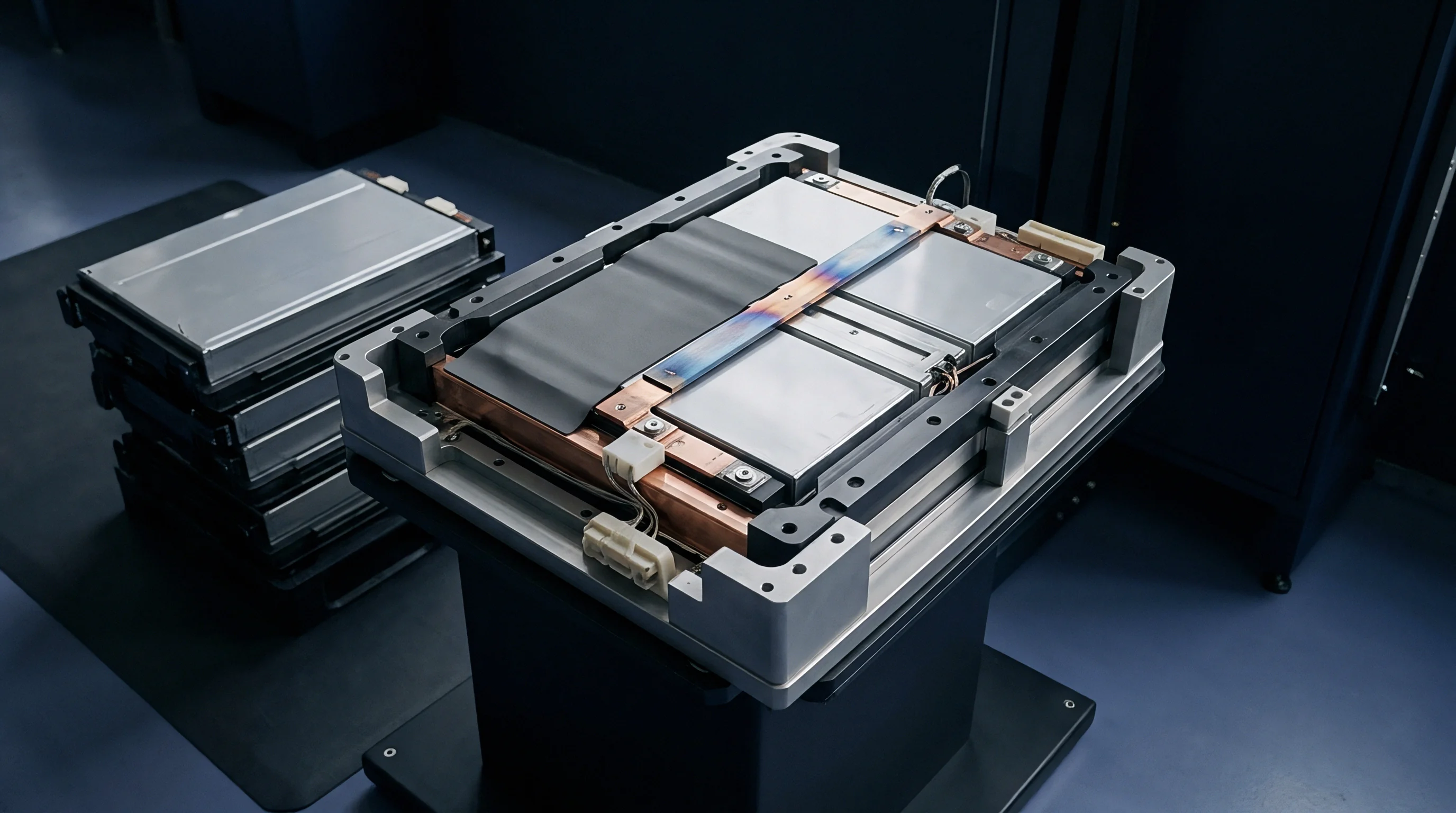
Prismatic cell enclosures demand external mechanical pre-loads to maintain electrical contact and prevent delamination across the electrode stack. Operando dilatometry rigs for prismatic modules utilize rigid constraining plates instrumented with inline load cells and high-resolution displacement sensors. Linear variable differential transformers or optical laser triangulation sensors capture micrometer-scale movements of the module endplates, converting free volumetric expansion into internal breathing forces that peak at full charge.
Because rigid walls convert strain into force, cyclic breathing generates dynamic load variations on structural endplates when a battery module holds six or twelve high-nickel prismatic cells under fixed spatial constraints. Initial pre-load pressures are typically set between 0.3 MPa and 0.5 MPa during fabrication to optimize interfacial contact between separator and electrode layers. As cells charge, breathing force increases non-linearly; a fully charged module under rigid constraint can exhibit endplate thrust forces exceeding 15 kN, altering the stress field inside the jellyroll assembly.
- Load Cell Alignment positioning S-beam or low-profile button load cells along the neutral mechanical axis prevents parasitic bending moments from skewing force telemetry.
- Thermal Compensation integrating temperature-matched dummy reference sensors eliminates frame thermal expansion artefacts during high-temperature operando cycling.
- Compliance Matching inserting calibrated polyurethane or silicone foam pads between adjacent prismatic cells absorbs reversible breathing without exceeding maximum structural pre-load thresholds.
- Multi-Point Laser Calibration positioning dual optical laser heads on opposing broad faces decouples actual cell thickness growth from mounting fixture flexure.
The spring stiffness of the module frame governs the ratio between physical displacement and structural load development. A rigid steel frame permits minimal endplate deflection, forcing internal cell components to absorb electrochemical breathing through microscopic strain. Conversely, a compliant spring-loaded fixture allows controlled linear displacement while keeping mechanical pre-load relatively stable.
This compliance extends cycle life by dampening peak compression on the separator, reducing localized electrolyte squeeze-out and preventing micro-shorting along cell edges.
Module frame stiffness dictates whether lithium intercalation manifests as endplate displacement or internal stack compression.
Separators inside high-nickel prismatic cells undergo severe mechanical stress under elevated pre-load forces. Polyolefin ceramic-coated separators experience creep deformation under continuous compressive loads exceeding 2.0 MPa. Pore closure reduces ionic conductivity through the liquid electrolyte matrix, increasing internal resistance.
Operando dilatometry coupled with electrochemical impedance monitoring reveals that over-constraining high-nickel prismatic cells accelerates impedance growth at high states of charge, counteracting the contact benefits gained from mechanical compression.
Module frame compliance sizing follows the rule that structural deflection must equal the maximum calculated cell breathing displacement at full state of charge divided by the targeted frame spring constant.


Yield
Reversible swelling during lithiation contrasts with irreversible expansion driven by solid electrolyte interphase accumulation, cathode microcracking, and gas evolution. Irreversible swell accumulates continuously over hundreds of charge-discharge cycles, typically reaching 3% to 8% of total cell thickness in high-nickel prismatic cells by end of life. As active lithium is trapped within growing interfacial layers, the graphite anode permanently expands while gas generation inflates prismatic aluminum cans.
Parasitic reactions between high-valence nickel ions (Ni4+) and carbonate solvents produce gaseous species including carbon dioxide, carbon monoxide, and oxygen at upper cut-off voltages. This gas accumulation increases internal pneumatic pressure against the broad faces of the aluminum casing, causing outward bowing. Operando dilatometry differentiates between solid-phase electrochemical swelling and gas-driven casing deformation by tracking thickness decay during prolonged open-circuit relaxation periods.
Does Constrained Breathing Force Accelerate Cathode Microcracking?
Constraining high-nickel prismatic cells under high mechanical pre-loads intensifies intergranular stresses inside secondary cathode particles. As active material particles expand and contract heterogeneously during lithiation cycles, external pressure restricts bulk movement, concentrating shear forces along crystallographic grain boundaries. Intergranular fractures break internal electronic percolation pathways, isolating regions of active material and causing rapid capacity fade.
Take a 100 Ah high-nickel prismatic cell module operating under two structural boundary conditions to evaluate irreversible mechanical growth. In Case A, the module uses a rigid aluminum frame with a mechanical stiffness of 50 kN/mm. In Case B, the module integrates elastomeric springs yielding a compliant stiffness of 5 kN/mm.
Assume an initial assembly pre-load of 2.0 kN at 0% state of charge and a baseline cell thickness of 30.0 mm. Reversible breathing contributes 0.6 mm of free thickness change per cycle, while irreversible degradation adds 0.001 mm per cycle.
Under Case A, the rigid frame restricts physical movement to less than 0.05 mm at full charge. The total breathing force under initial cycling scales according to frame stiffness:
Force (Peak) = Initial Pre-load + (Displacement × Frame Stiffness)
Force (Peak, Cycle 1) = 2.0 kN + (0.55 mm × 50 kN/mm) = 29.5 kN
At cycle 1,000, irreversible swell adds 1.0 mm of permanent stack growth. The baseline pre-load at 0% state of charge increases from 2.0 kN to 52.0 kN. At 100% state of charge on cycle 1,000, total mechanical load reaches 79.5 kN.
Internal pressure on the electrode stack exceeds 5.3 MPa, crushing separator pores and inducing severe lithium plating along anode edges.
Under Case B, the compliant frame yields under expansion, accommodating 0.5 mm of breathing displacement while generating a lower peak force on cycle 1:
Force (Peak, Cycle 1) = 2.0 kN + (0.5 mm × 5 kN/mm) = 4.5 kN
At cycle 1,000, the 1.0 mm of irreversible expansion increases baseline pre-load to 7.0 kN, yielding a peak force at full charge of 9.5 kN. Stack pressure stays below 0.65 MPa, preserving separator porosity and stabilizing cycle life performance, whereas over-constrained cells fail cyclic testing. The mechanical response of the module assembly governs cell life expectations just as directly as operating temperature or voltage limits.
Designing module endplates without factoring in cumulative irreversible swell leads to structural frame rupture, fastener shear failures, or accelerated cell short-circuiting before reaching contractual warranty limits.
Bench
In-situ measurement rigs integrate multi-axis laser displacement arrays with active environmental chambers to isolate thermal expansion from electrochemical swelling. Temperature fluctuations skew dilatometric measurements due to the thermal expansion coefficients of the internal cell materials and external metallic fixtures; aluminum cell cases possess a thermal expansion coefficient of approximately 23 x 10^-6 /K, while copper current collectors expand at 16.5 x 10^-6 /K. Because temperature gradients distort displacement data, accurate operando dilatometry demands real-time thermal compensation algorithms combined with isothermal chamber control held within plus or minus 0.1 °C.
| Sensor Technology | Measurement Range (mm) | Spatial Resolution (µm) | Thermal Drift (µm/°C) | Sampling Rate Limit (Hz) |
|---|---|---|---|---|
| Dual-Head Laser Triangulation | 10.0 | 0.05 | 0.01 | 1000 |
| Linear Variable Differential Transformer (LVDT) | 5.0 | 0.10 | 0.15 | 100 |
| Piezoresistive Strain Gauge Bridge | 2.0 | 0.50 | 0.40 | 500 |
| Capacitive Displacement Sensor | 1.0 | 0.01 | 0.02 | 5000 |
Calibration of high-capacity load cells requires zeroing baseline drift over continuous multi-week testing cycles. Creep within load cell strain gauges introduces signal degradation that mimics continuous cell swell. Utilizing piezoresistive sensors with active quartz thermal isolation barriers reduces baseline drift to under 5 N over 1,000 hours of operando acquisition.
Data collection channels must simultaneously log cell terminal voltage, charge current, surface temperature at multiple locations, endplate force, and linear displacement.
When testing high-nickel prismatic modules under fast-charge protocols, thermal expansion can mask electrochemical breathing as internal joule heating causes temporary cell temperature increases of up to 15 °C. The resulting thermal expansion of the aluminum casing generates a false displacement spike over electrochemically driven lattice swelling. Disentangling thermal expansion from intercalation strain requires mapping the transient thermal transfer function of the cell assembly under non-reactive AC excitation prior to electrochemical testing.
Module-level dimensional growth observed on client test benches can stem from improperly calibrated fixture thermal expansion rather than internal cathode degradation.

Dossier
International dangerous goods shipping regulations evaluate battery safety under mechanical stress and structural integrity requirements. UN 38.3 test requirements apply to all lithium prismatic cells and multi-cell modules intended for transport. Test T.3 (Vibration) and Test T.4 (Shock) subject units to physical accelerations while monitoring internal electrical continuity and physical enclosure integrity.
A high-nickel prismatic cell that has experienced significant irreversible swell during qualification testing presents altered structural resonances, increasing its vulnerability to casing rupture or internal circuit disruption during transit.
- UN 38.3 Test Summary Report validating compliance with mechanical shock, vibration, and thermal exposure standards per section 38.3.5 of the UN Manual of Tests and Criteria.
- UN 3480 / UN 3481 Dangerous Goods Declaration verifying correct shipping classification, packaging group assignments, and state of charge limits below 30% for air transport under IATA Packing Instruction 965.
- EU Battery Regulation 2023/1542 Technical Dossier providing performance and durability documentation including expected cycle life under defined mechanical pre-loads per Annex IV requirements.
- IEC 62619 Industrial Safety Certificate confirming structural shock and thermal runaway propagation resistance within fully constrained module structures.
- Safety Data Sheet (SDS) detailing chemical hazard classifications, fire suppression protocols, and electrolyte breakdown product disclosures under GHS standards.
Carriage of high-nickel prismatic modules by sea freight under IMDG Code provisions mandates that cells maintain casing integrity without physical leakage or venting, and forwarders will hold uncertified shipments. Irreversible thickness growth that distorts cell casing geometry past certified dimensional tolerances invalidates original UN 38.3 test summaries. Re-certification becomes mandatory if cell thickness expands beyond the maximum envelope listed in the manufacturer safety file.
The EU Battery Regulation 2023/1542 mandates that electrochemical performance and durability parameters stored within the digital battery passport must include mechanical degradation metrics, specifically maximum allowed dimensional expansion and mechanical force limits over the projected operational lifespan.

Invoice
Purchasing contracts for high-nickel energy storage units fix maximum allowable thickness growth and module end-of-life pushback force. Landed cost calculations extend beyond initial cell price per kilowatt-hour to include structural warranty reserves and potential recall liabilities caused by mechanical failure. Module designs that underestimate high-nickel breathing force require costly structural over-engineering or premature pack replacements in the field.
| Dilatometric Degradation Stage | Measured Parameter Threshold | Primary Failure Mode | Commercial Liability Allocation |
|---|---|---|---|
| Begin of Life (BOL) | Reversible Force > 5.0 kN | Module endplate deformation | Pack Integrator redesign cost |
| Mid Life (500 Cycles) | Irreversible Swell > 4.0% | Interfacial impedance surge | Shared warranty repair cost |
| End of Life (EOL) | Peak Module Force > 25.0 kN | Separator crush / Internal short | Cell Manufacturer recall liability |
| Thermal Event Trigger | Casing Bowing > 8.0 mm | Venting / Enclosure rupture | Cell Manufacturer full indemnification |
Procurement specifications use operando mechanical dilatometry data to establish clear incoming inspection pass-fail boundaries. Buyers enforce strict limits on baseline cell thickness tolerances upon delivery to ensure compatibility with automated module assembly lines.
- Sample 2% of incoming prismatic cell lots using automated multi-axis optical coordinate measuring machines under a calibrated 0.3 MPa surface clamping load.
- Reject entire shipments if average baseline cell thickness exceeds nominal specification by more than plus or minus 0.3 mm.
- Subject three representative cells per batch to 50 fast-charge operando dilatometry cycles to verify that reversible breathing amplitude stays within baseline cathode specification limits.
- Archive force-displacement curves within the quality management system to defend warranty claims against manufacturers in the event of premature capacity degradation.
Uncontrolled mechanical growth and electrode delamination increase internal cell impedance and reduce active cell life, triggering commercial penalty clauses embedded in supply agreements. Because warranty claims require calibrated baseline data, sourcing high-nickel prismatic cells demands continuous mechanical verification across the supply chain, ensuring physical cell expansion remains locked within structural limits from crate opening to pack disposal.