Subsurface Structural Phase Inversion in High Nickel Cathodes
Subsurface phase inversion transforms active high-nickel cathode surfaces into high-resistance rock-salt layers, driving impedance growth and safety risks.

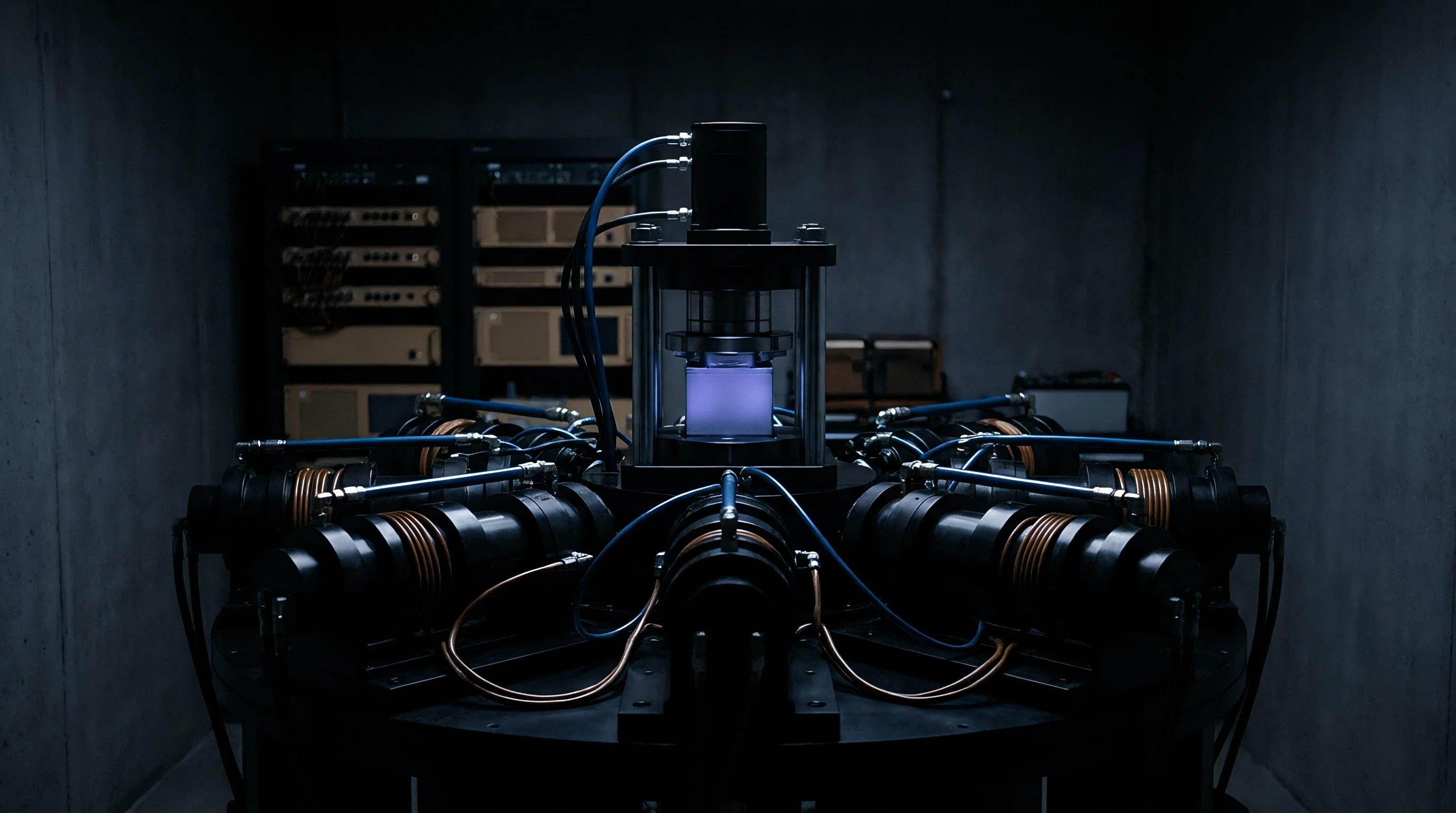
Grain
Delithiation above 4.15 volts versus lithium metal triggers an irreversible crystallographic rearrangement within the outermost ten to fifty nanometers of high-nickel cathode particles. Nickel ions migrate from their native positions in the transition metal layers into vacant lithium slab sites, collapsing local lithium transport pathways. The material transitions along a known structural path: the native layered rhombohedral phase with space group R-3m degrades into a defective spinel-like intermediate phase with space group Fd-3m, ultimately forming a disordered rock-salt phase with space group Fm-3m.
Cells using NMC811 (nickel-manganese-cobalt with an 8:1:1 molar ratio) or NCA (nickel-cobalt-aluminum) lose operable capacity primarily through this surface-pinned reconstruction rather than bulk active mass destruction.
The rate of this structural transition tracks nickel stoichiometry directly. Cathode active materials with nickel content exceeding eighty mole percent release lattice oxygen into the electrolyte when charged past eighty percent state of charge. This is driven by the thermodynamic instability of tetravalent nickel ions at high potential.
Trivalent and tetravalent nickel reduce to divalent nickel, matching the ionic radius of lithium. That size compatibility allows divalent nickel to occupy vacant octahedral sites created during deintercalation. Rock-salt formation pins the surface, creating an electrochemically inactive shell that chokes interfacial lithium ion flux.
Under ambient storage at 4.25 volts, an unwashed NMC811 cathode doubles its charge transfer resistance within thirty days due to spontaneous chemical reduction of surface nickel.
Electrode cross-sections reveal that this lattice reorganization does not remain confined to the outer boundary of secondary agglomerates. Liquid electrolyte penetrates along intergranular boundaries, drawn in by capillary action and anisotropic lattice strain. Primary grains inside the secondary particle undergo identical structural inversions at their individual facet boundaries.
Differential scanning calorimetry traces confirm that particles with advanced surface phase collapse show exothermic oxygen release onset temperatures as low as 195 degrees Celsius, compared to 235 degrees Celsius for pristine materials. The structural decay converts high-capacity cathode material into an internal thermal trigger long before the pack reaches its scheduled retirement age.


Inversion

How Spontaneous Cation Mixing Drives Impedance
Electrochemical extraction of lithium removes the electrostatic shielding between opposing oxygen layers, forcing mechanical collapse along the c-axis of the crystal unit cell. In high-nickel formulations, this lattice contraction reaches approximately three percent between 4.10 and 4.35 volts. Simultaneous expansion along the a-axis and b-axis induces severe intra-granular shear stress.
Micro-cracks generated by these anisotropic dimensional changes expose fresh active facets directly to the non-aqueous liquid electrolyte, where the surface transition begins immediately.
Oxidation of the carbonate solvent accompanies the reduction of surface nickel cations. Ethylene carbonate and dimethyl carbonate undergo hydrogen abstraction at exposed metal centers, generating protons, carbon dioxide, carbon monoxide, and alkyl carbonate radicals. Protons attack the electrolyte salt anion, producing hydrofluoric acid that etches metal cations from the disordered rock-salt skin.
Solubilized nickel, cobalt, and manganese ions migrate across the polyolefin separator, depositing onto the graphite anode. There, they catalyze parasitic electrolyte reduction, consuming inventory lithium while thickening the solid electrolyte interphase.
| Chemistry Designation | Initial Space Group | Transformed Surface Phase | Layer Contraction Along c-Axis | Reconstructed Zone Depth |
|---|---|---|---|---|
| LiNi0.6Mn0.2Co0.2O2 | R-3m | Spinel Fd-3m | 1.2% | 2 to 5 nm |
| LiNi0.8Mn0.1Co0.1O2 | R-3m | Disordered Rock-Salt Fm-3m | 3.1% | 12 to 25 nm |
| LiNi0.85Co0.10Al0.05O2 | R-3m | Disordered Rock-Salt Fm-3m | 3.4% | 15 to 30 nm |
| LiNi0.90Mn0.05Co0.05O2 | R-3m | Disordered Rock-Salt Fm-3m | 4.8% | 35 to 60 nm |
Divalent nickel possesses an octahedral ionic radius of 0.69 angstroms, exceptionally close to the 0.76 angstrom radius of monovalent lithium ions. As monovalent lithium leaves the layered framework, it leaves behind vacant 3b octahedral sites. Divalent nickel leaves its native 3a sites in the transition metal layer, crossing through intermediate tetrahedral voids into the evacuated 3b sites.
Oxygen anions evolve from the surface to balance the loss of cationic charge, yielding a metal-to-oxygen ratio of 1:1 characteristic of nickel monoxide.

Where Interfacial Strain Concentrates Active Oxygen Loss
Surface reconstruction generates mechanical stress between the host rhombohedral bulk and the cubic rock-salt crust. The unit cell volume shrinks by more than eight percent within the transformed zone. This structural disparity prevents epitaxy from maintaining elastic continuity, resulting in localized decohesion at primary grain boundaries.
The rock-salt layer exhibits a lithium-ion diffusion coefficient below 10 to the power of negative sixteen square centimeters per second, roughly four orders of magnitude lower than the bulk rhombohedral phase.
- Electrochemical delithiation drives extraction of lithium ions beyond seventy-five percent state of charge, destabilizing transition metal coordination cages and raising nickel oxidation states to unstable levels.
- Intra-particle microcracking initiates along grain boundaries under severe anisotropic volume contraction, creating pathways for fresh electrolyte percolation into core primary particles.
- Oxygen radical release occurs spontaneously from the destabilized surface lattice, directly oxidizing organic carbonate solvents and generating gaseous byproducts.
- Cation exchange migration relocates divalent nickel into vacated lithium 3b sites, establishing the impenetrable cubic Fm-3m rock-salt passivating layer.
The cubic rock-salt crust thickens as cycling proceeds. High operating temperatures hasten this propagation. At 45 degrees Celsius, the reconstruction depth penetrates three times deeper into the bulk after two hundred charge-discharge cycles than at 25 degrees Celsius.
Oxygen released during this inversion remains unbonded within the hermetic cell enclosure, raising internal pressure and increasing vulnerability to sudden venting.
A surface rock-salt layer measuring thirty nanometers in thickness increases cell overpotential sufficiently to cause premature voltage cut-off during standard 1C constant-current charging.
Chemical analysis of gas extracted from aged cells reveals an initial surge of carbon dioxide, followed by elevated concentrations of oxygen and carbon monoxide. Cathode manufacturers frequently apply metal oxide coatings such as alumina, titanium dioxide, or lithium phosphate to suppress phase inversion. Doping the bulk crystal lattice with tungsten, zirconium, or magnesium stabilizes transition metal layer bonding, decreasing the energetic favorability of nickel relocation.
The passivating effectiveness of these engineering modifications degrades when exposed to rigorous fast-charging regimens that exceed 2C rates.

Impedance
Surface reconstruction drives up internal resistance across the life of the battery. As the electrochemically inert Fm-3m phase spreads over primary particle facets, the real active surface area participating in lithium desolvation and insertion drops systematically. Direct current internal resistance measurements demonstrate that cathode charge-transfer resistance contributes over sixty percent of the total cell impedance rise observed between cycle zero and cycle five hundred.
The rock-salt shell acts as an ohmic and diffusive barrier, increasing polarization during power discharge demands.
Differential capacity analysis (dQ/dV) provides clear signatures of this progressive degradation through compressed and rightward-shifted primary redox peaks. For NMC811, the characteristic phase transitions from hexagonal-1 to monoclinic, and from monoclinic to hexagonal-2, flatten as the outer shell loses its ability to accept lithium at nominal potentials. The hexagonal-2 to hexagonal-3 transition near 4.20 volts exhibits severe voltage hysteresis.
The cell terminal voltage trips the high-voltage protective limit while the bulk grain core remains incompletely charged.
| Cycle Count | Charge Transfer Resistance (Ohms) | Direct Current Internal Resistance Rise | Total Gas Generation (Milliliters per Ampere-hour) | Intergranular Micro-crack Density (Microns per Square Micron) |
|---|---|---|---|---|
| 1 | 0.82 | 0.0% | 0.12 | 0.04 |
| 250 | 1.45 | 18.4% | 0.68 | 0.22 |
| 500 | 2.10 | 41.2% | 1.42 | 0.58 |
| 1000 | 3.85 | 86.7% | 2.95 | 1.14 |
| 2000 | 6.40 | 172.5% | 5.80 | 2.05 |
The accumulation of phase-inverted material produces measurable non-uniformity in current density distribution across the electrode coating. Primary particles near the separator face encounter higher local current densities than those adjacent to the aluminum current collector foil. This localized overcharge accelerates rock-salt conversion non-uniformly, prompting premature lithium plating on opposing sections of the graphite anode during rapid recharge cycles.
Electrochemical impedance spectroscopy uncovers this degradation through a characteristic expansion of the high-to-medium frequency semicircle. Pristine cells exhibit an initial charge-transfer resistance below one ohm per standard twenty-ampere-hour pouch cell. As cycling introduces the rock-salt phase, this semicircle expands along the real axis, indicating increased activation energy for lithium transfer across the film.
The Warburg impedance tail tilts, signaling sluggish solid-state diffusion through the disordered surface layer.
Energy delivery under sub-zero conditions suffers severe degradation from phase inversion. Lithium diffusion through the cubic rock-salt lattice possesses an activation energy nearly double that of the layered rhombohedral bulk. At minus twenty degrees Celsius, an aged cell with an average twenty-nanometer rock-salt layer delivers less than thirty-five percent of its rated nameplate capacity, compared to sixty-five percent for an unaged cell.
Operating aged high-nickel cells under heavy loads generates concentrated Joule heating directly at the high-resistance cathode interface, increasing pack cooling demands.
Thermal breakdown models demonstrate that phase inversion lowers the threshold for catastrophic cell failure. The disordered rock-salt phase is oxygen-deficient relative to the stoichiometric layered parent. When cathode surface particles shed oxygen atoms into the surrounding solvent at high temperature, organic electrolyte ignition occurs without external atmospheric oxygen.
An aged battery pack containing degraded high-nickel cathode material exhibits faster thermal runaway propagation across adjacent modules than a fresh pack subjected to identical nail penetration or external heating stresses.

Testing
Screening incoming cell batches for cathode phase inversion demands high-resolution material characterization combined with targeted electrochemical abuse procedures. Standard incoming receiving checks rely on open-circuit voltage, static direct current internal resistance, and capacity checks at room temperature. These basic factory checks fail to detect nascent subsurface rock-salt layers that have not yet manifested as bulk capacity loss.
Type testing under international safety standards exposes the thermal consequences of this phase transformation directly.
- Transmission electron microscopy coupled with electron energy loss spectroscopy resolves transition metal oxidation states with sub-nanometer spatial resolution, mapping the exact boundary between the R-3m bulk and the Fm-3m surface crust.
- Synchrotron x-ray absorption spectroscopy measures the nickel K-edge absorption energy, quantifying the ratio of divalent to trivalent nickel across primary grains without destroying sample integrity.
- Differential scanning calorimetry on harvested, charged cathode material reveals shifts in exothermic breakdown peak temperatures and calculates total heat release during structural decomposition.
- High-precision coulometry tracks coulombic efficiency variations at the fourth decimal place, identifying parasitic electrolyte oxidation reactions linked to progressive surface reduction.
Regulatory transport testing under the UN Manual of Tests and Criteria, Part III, subsection 38.3 (UN 38.3), evaluates cells across thermal, mechanical, and electrical extremes. Test T.2 (Thermal test) cycles units between minus forty and plus seventy-two degrees Celsius, while Test T.5 (External short circuit) exposes fully charged cells to dead shorts below 0.1 ohms at fifty-five degrees Celsius. In aged cells containing deep subsurface phase inversion, internal gas buildup from liberated lattice oxygen elevates internal pressure, causing rupture of cell vent discs during the thermal shock exposure of Test T.2.
UN 38.3 Test T.5 failure through violent casing rupture frequently traces to exothermic reaction between electrolyte solvent and oxygen shed by subsurface rock-salt layers.
Cell qualification testing under standard IEC 62133-2:2017 imposes overcharge conditions that accelerate phase transformation. Clause 7.3.6 subjects fully discharged cells to constant-current charging at twice the manufacturer-specified maximum charging rate until reaching an extreme voltage cutoff. Cathodes with high nickel content and unpassivated surfaces undergo rapid, runaway rock-salt inversion under this electrical stress, shedding oxygen into the electrolyte and igniting flammable solvent vapors.
The resulting fire constitutes an immediate failure of the certification sequence.
Safety documentation requires rigorous material verification when sourcing cells utilizing NMC811 or higher nickel chemistries. Factory audit checklists must verify whether the supplier applies surface stabilization techniques, such as atomic layer deposition of metal oxides or single-crystal grain engineering. Single-crystal morphologies eliminate intergranular boundaries, preventing liquid electrolyte from accessing the primary core facets.
This microstructural adjustment limits phase inversion to the exterior geometric surface of the secondary particle, suppressing bulk structural collapse and extending operational cycle life under aggressive usage.


Settlement

Who Carries the Financial Burden of Latent Degradation?
Cathode surface phase inversion represents a silent financial risk for pack assemblers, equipment integrators, and importers of record. Cells often satisfy factory acceptance testing and pass type certification under UN 38.3 and IEC 62133 when freshly manufactured. After six to twelve months of storage or field deployment under elevated state of charge, subsurface rock-salt growth degrades high-rate performance, causes swelling from evolved gases, and triggers battery management system overpotential faults.
The resulting warranty claims land on the pack builder unless purchase agreements explicitly link cell degradation to chemical parameters.
Master supply agreements must define allowable impedance growth thresholds tied to specific calendar aging conditions. Standard contracts specify end-of-life as a drop to eighty percent of initial capacity. High-nickel cells afflicted with rapid phase inversion often maintain eighty-two percent capacity under gentle 0.2C reference testing while experiencing a two-hundred-percent surge in charge-transfer impedance.
Under cold operational conditions or high-rate fast charging, these cells fail completely in the field. Legal definitions of non-conforming goods must incorporate maximum allowable internal resistance growth at specified temperature and state-of-charge windows.
When a supply agreement omits direct current internal resistance ceilings from warranty acceptance criteria, the buyer pays for field battery pack replacements caused entirely by cathode phase inversion.
Commercial contracts governing high-nickel cell procurement should incorporate specific diagnostic metrics into their incoming inspection protocols. The agreement clauses set precise operational limits to protect the buying organization from bearing the landed cost of early-life degradation.
- The buyer executes random destructive sampling on two cells per lot of ten thousand units, measuring differential capacity peak shifts following a forty-five-day storage protocol at forty-five degrees Celsius and one hundred percent state of charge.
- The cell supplier submits certified differential scanning calorimetry reports for each electrode coating slurry batch, documenting cathode exothermic onset temperatures above two hundred and twenty degrees Celsius at full charge.
- Total direct current internal resistance rise across five hundred continuous 1C charge and 1C discharge cycles at twenty-five degrees Celsius remains capped at thirty percent over nominal baseline.
- The supplier indemnifies the buyer against all product recall costs, carrier shipping penalties, and regulatory fines stemming from venting or thermal runaway caused by active material phase instability.
Procurement teams negotiating cell purchase orders must verify supplier production data down to the slurry mixing and coating lines. Cell manufacturers pursuing margin improvements occasionally reduce dopant concentrations or eliminate expensive atomic layer deposition washing steps, betting that the resulting phase inversion will take months to trigger visible capacity drops. This cost-cutting shifts the financial exposure to the downstream integrator who provides multi-year warranties to end users.
The regulatory environment imposes additional liability on importers of record under the European Union Battery Regulation 2023/1542. Article 10 mandates strict performance and durability requirements for stationary storage and industrial batteries above two kilowatt-hours, requiring declared verification of state of health and capacity retention. Annex IV specifies testing methodologies for degradation evaluation.
Cathodes that undergo unmitigated subsurface phase inversion will cause whole battery systems to fail mandatory EU digital battery passport durability thresholds, prohibiting their commercial sale across European markets and stranding containerized shipments at customs terminals.
Failure to detect and allocate the financial liability of active material degradation results in sudden operational insolvency when high-volume field returns overwhelm established warranty reserves.