Transition Metal Migration Kinetics through Polyolefin Separators in Storage Aged Cells
Cathode transition metals leach via acid attack during warm storage, migrating through polyolefin separator pores to degrade anode SEI and escalate K-value self-discharge.


Dissolution
When lithium-ion cells charged above four volts sit in storage, chemical breakdown begins at the cathode-electrolyte interface. Trace moisture reacts with the lithium hexafluorophosphate salt in the organic solvent to produce hydrofluoric acid, which attacks the surface active material and strips transition metal cations into the liquid phase. Manganese, nickel, cobalt, and iron cations detach from their octahedral oxide sites, entering the solvent as solvated species.
Storage temperature governs these reaction rates: at room temperature, dissolution proceeds slowly in the background, but sustained storage above forty degrees Celsius accelerates leaching by boosting acid generation and lowering the kinetic barrier for metal oxidation.
Cathode crystal structures differ in how vulnerable they are to acid scission. Manganese-bearing chemistries ~ such as lithium manganese oxide spinels and nickel-manganese-cobalt layered oxides ~ are particularly susceptible. At a high state of charge, trivalent manganese undergoes disproportionation, producing tetravalent manganese that stays in the solid lattice alongside divalent manganese that dissolves immediately into the liquid electrolyte.
As these divalent cations diffuse away from the positive electrode active material, the vacant metal sites left behind destabilize the crystal lattice and reduce active storage capacity.
Cathode degradation during calendar storage directly governs downstream self-discharge rates.
Dissolution kinetics depend heavily on the storage state of charge. Elevated cell potential increases the formal oxidation state of surface transition metals while pulling electron density from adjacent oxygen atoms. These higher potentials weaken transition metal ~ oxygen bond energies, allowing fluorinated acid species to cleave metal centers directly from the active particle surface.

Fluoride Acid Scission at Cathode Surfaces
Acid scission continues during stationary storage even without operational current flow. Trace water contaminants introduced during electrode coating or electrolyte filling hydrolyze salt anions into hydrofluoric acid. The resulting free acid reacts with surface oxide ions to form water molecules that re-enter the hydrolysis cycle, maintaining acid concentrations even inside hermetically sealed cells.
- Hydrofluoric Acid Generation Hydrolysis of hexafluorophosphate anions creates free acid species that attack cathode particle boundaries.
- High Potential Structural Instability Cathodes resting above four point two volts exhibit weakened surface atomic bonds that lower dissolution activation energy.
- Thermal Scission Kinetics Ambient storage temperatures exceeding forty degrees Celsius increase kinetic rate constants for transition metal leaching.
- Jahn-Teller Lattice Distortion Trivalent manganese disproportionates into soluble divalent ions that escape the crystal framework.
The rate of metal detachment scales directly with acid concentration and electrode contact area. Microcracks formed during electrode calendering expand surface exposure, increasing total dissolved cation mass over extended warehouse storage periods.
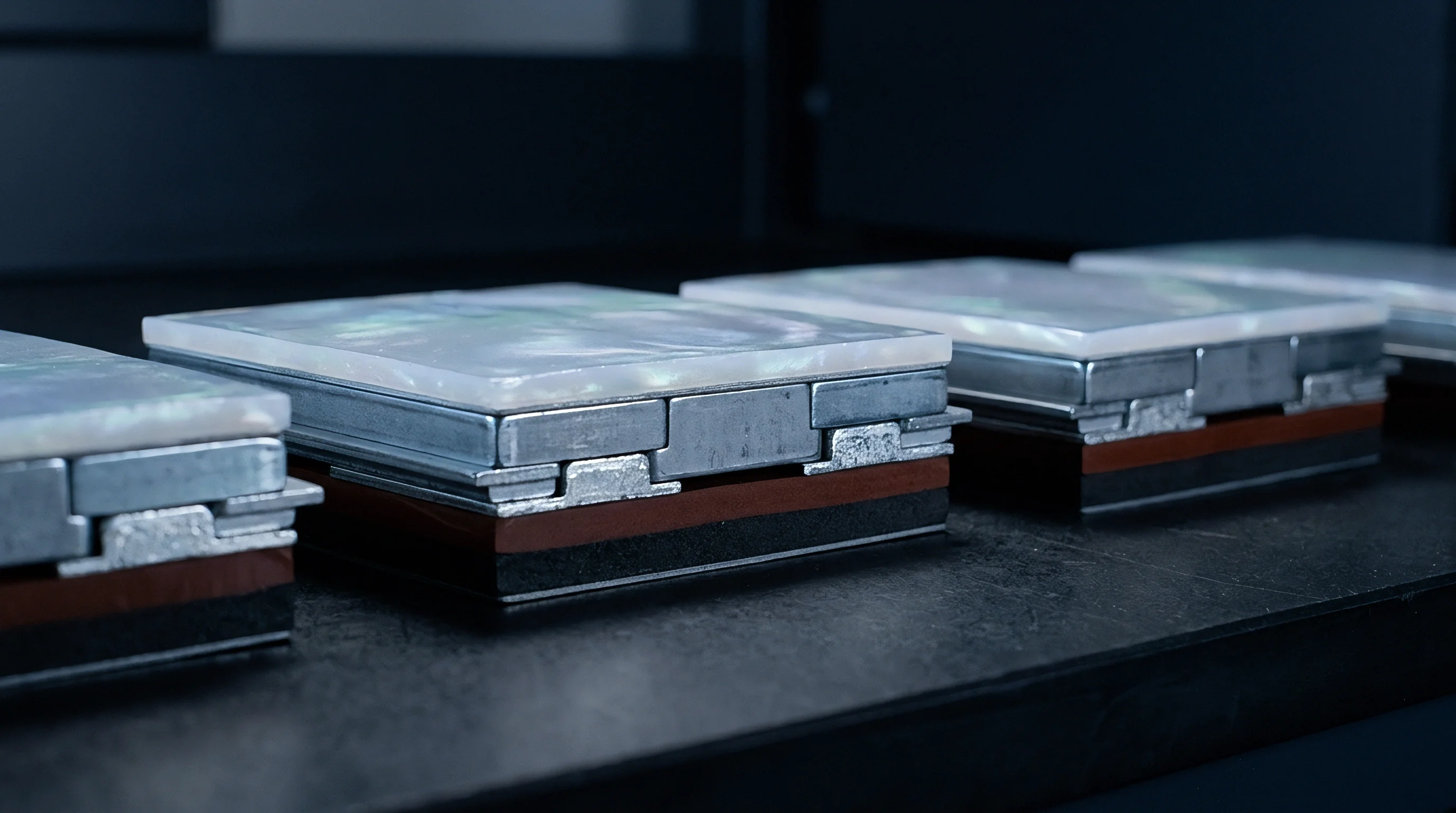
State of Charge Driven Oxidation Dynamics
Extended storage at maximum voltage accelerates transition metal removal. At high potentials, oxygen loss from the lattice accompanies cation dissolution, forming a resistive rock-salt phase on cathode particles. This surface transformation raises internal cell resistance before the battery ever encounters operational current.
Storage without rebalancing shifts thermodynamic equilibrium across the cell stack. Metal cations accumulate in the liquid electrolyte within electrode pores, establishing a concentration gradient toward the separator membrane. A higher initial state of charge expands the thermodynamic driving force for continuous metal dissolution over prolonged storage periods.
Unconditioned warehouse storage accelerates transition metal detachment through combined thermal and potential stress. Keeping cell potential below three point seven volts during storage suppresses surface oxidation kinetics, retaining transition metal ions inside the cathode host matrix.

Pore
Polyolefin separators act as physical barriers between opposing electrodes while offering micro-porous channels for lithium-ion conduction. Polyethylene and polypropylene membranes feature pore structures set by wet or dry stretching processes. Dry-process separators yield slit-like pores with tortuosity values between two and three, whereas wet-process separators produce interconnected elliptical pore networks with lower tortuosity and tighter pore size distributions.
Transport of solvated transition metal cations through these networks relies on concentration-driven diffusion and electro-migrative drift across the self-discharge potential field.
Solvated manganese, nickel, and cobalt cations have larger ionic radii than bare lithium ions because of tight coordination shells formed with cyclic and linear carbonate solvent molecules. Their solvated diameters range from zero point eight to one point two nanometers. Since separator pore diameters typically measure between thirty and eighty nanometers, solvated transition metal complexes move freely through liquid-filled membrane pores without steric exclusion.
| Separator Architecture | Base Polymer | Porosity Percentage | Mean Pore Diameter (nm) | Tortuosity Factor | Manganese Cation Flux Rate (umol/cm2/day) |
|---|---|---|---|---|---|
| Single Layer Dry Process | Polypropylene | 42 | 65 | 2.45 | 0.82 |
| Single Layer Wet Process | Polyethylene | 48 | 38 | 1.75 | 1.14 |
| Trilayer Dry Process | PP / PE / PP | 39 | 55 | 2.80 | 0.54 |
| Ceramic Coated Wet Process | PE + Alumina | 44 | 32 | 2.10 | 0.12 |
| Data measured at fifty-five degrees Celsius using liquid electrolyte containing one molar LiPF6 in EC/DMC solvent mixture. | |||||
Tortuosity serves as the primary geometric constraint on metal ion migration through polyolefin matrices. Higher tortuosity lengthens the effective path across the separator, reducing total flux in line with Fickian diffusion principles. While pore tortuosity delays transition metal arrival at the anode surface during early storage, it cannot prevent transport over months of continuous warehousing.
Physical membrane thickness delays cation transit but cannot stop thermodynamics driving metal ions across liquid channels.
Polyolefin Microstructure and Tortuosity Effects
Membrane thickness directly alters transit times across the cell stack. A sixteen-micrometer separator provides a shorter physical diffusion distance than a twenty-five-micrometer membrane, accelerating cation arrival at the graphite anode. Thinner separators specified for high energy density packs increase vulnerability to storage aging degradation caused by transition metal cross-over.
Polymer morphology influences chemical stability under acidic conditions. Polypropylene demonstrates higher chemical resistance to hydrofluoric acid than polyethylene, maintaining pore structure integrity during long-term storage. Polyethylene softens at lower temperatures, leaving pore dimensions susceptible to local mechanical deformation under internal stack pressure.

Ceramic Coat Barrier Interference
Sub-micron ceramic coatings applied to polyolefin base membranes alter transition metal migration dynamics. Ceramic layers containing alumina or silica particles create dense porous networks that introduce steric hindrance and chemical trapping sites. Acidic species react with functional surface groups on ceramic particles, neutralizing hydrofluoric acid before it can leach cathode metals.
Ceramic coatings also introduce surface charge characteristics that interact with moving cations. Positively charged ceramic surfaces exert electrostatic repulsion against divalent manganese and cobalt ions, retarding their convective and diffusive migration through the separator thickness. This electrostatic effect lowers effective cation flux through the membrane structure.
Cells using uncoated dry-process separators exhibit rapid metal ion breakthrough under high-temperature storage. Non-uniform pore distribution creates localized low-resistance channels where transition metal flux concentrates, leading to localized metal accumulation on corresponding anode areas and accelerating non-uniform degradation of the solid electrolyte interphase layer.
Although baseline polyolefin separators are sometimes assumed to block transition metal cations through mechanical entrapment, micro-porous polymer membranes possess pore diameters two orders of magnitude larger than solvated cation diameters, rendering mechanical exclusion ineffective against dissolved metal transport.
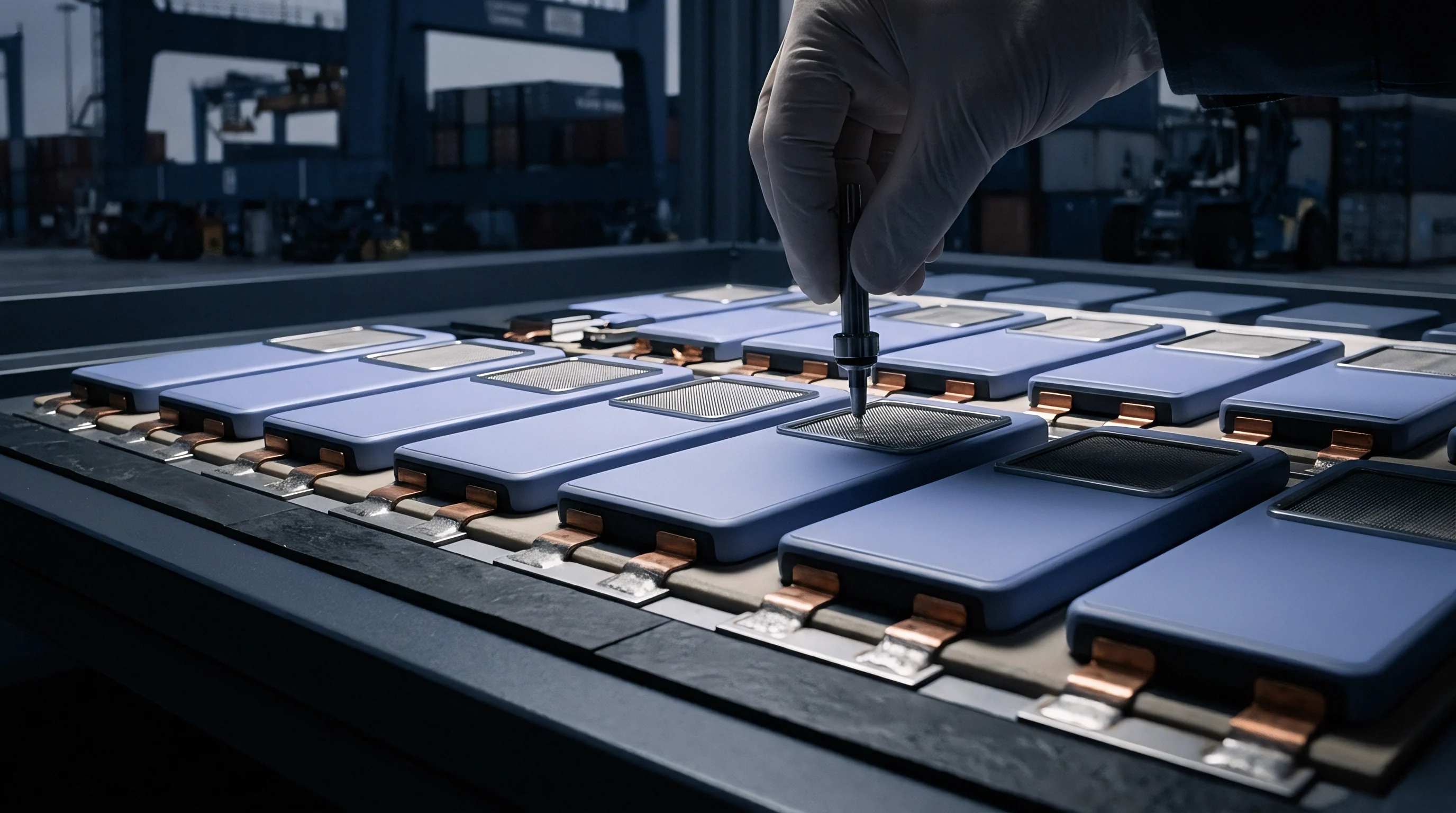
Deposition
Transition metal cations traversing the separator reach the negative electrode, where low operating potentials force immediate electrochemical reduction. Solvated divalent manganese, cobalt, and nickel ions accept electrons from the intercalated graphite structure, reducing to insoluble metallic clusters deposited directly onto the anode surface. Deposition occurs preferentially near separator-electrode contact points before spreading across graphite particle surfaces.
Metallic deposits disrupt the solid electrolyte interphase layer protecting the graphite anode. Transition metal clusters act as electro-catalytic centers that continuously decompose organic carbonate solvents. Catalytic decomposition consumes active lithium ions from the electrolyte, turning reusable lithium into insoluble lithium carbonate, lithium fluoride, and alkyl carbonate salts.
Active lithium loss reduces permanent cell capacity while growing resistive passivation layers on negative electrode surfaces.
Transition metal deposits on graphite convert native passivation layers into active sites for continuous electrolyte breakdown.
Storage duration governs total transition metal accumulation on the anode surface. During warm warehouse storage, continuous metal deposition increases internal impedance and elevates self-discharge rates. Self-discharge acceleration manifests as a progressive decline in open-circuit voltage, designated as K-value escalation.
Cathodic Reduction at Graphite Surfaces
Reduced transition metal particles alter local surface potentials on graphite flakes. Metallic manganese clusters possess high catalytic activity for solvent reduction, initiating localized chemical attack on adjacent passivation films. The broken film reforms through continuous lithium consumption, producing thick, non-uniform surface crusts.
- Ion Migration Across Separator Solvated transition metal cations cross liquid-filled separator pores along concentration gradients.
- Electron Transfer at Anode Surface Lower potential at graphite forces rapid reduction of cations into metallic nanoparticles.
- Catalytic SEI Decomposition Metallic deposits decompose alkyl carbonates, destroying protective passivation properties.
- Impedance Growth and Lithium Consumption Continuous passivation consumes active lithium ions while increasing charge transfer resistance.
Localized metal accumulation creates conductive micro-domains within the insulating interphase layer. Conductive pathways lower electron transfer resistance at the anode surface, accelerating secondary parasitic reactions during storage.

Solid Electrolyte Interphase Breakdown Mechanics
To illustrate storage degradation kinetics, consider a four-ampere-hour pouch cell stored at forty-five degrees Celsius at one hundred percent state of charge. Initial open-circuit voltage measures four point two zero volts, and baseline self-discharge rate without transition metal cross-over equals zero point five millivolts per day. Manganese dissolution introduces zero point zero eight micrograms of manganese per square centimeter of separator area into the electrolyte daily.
After ninety days of storage, cumulative manganese transport delivers six point four8 micrograms of metal per square centimeter to the graphite anode. Reduced manganese nanoparticles destroy localized SEI coverage, elevating the daily self-discharge rate from zero point five millivolts per day to two point two millivolts per day. Total voltage drop over ninety days reaches one hundred and eighty-six millivolts, dropping terminal voltage to four point zero one four volts.
At one hundred and eighty days of warm storage, total manganese accumulation reaches twelve point nine6 micrograms per square centimeter. Self-discharge escalates to five point eight millivolts per day as catalytic SEI decomposition spreads across graphite particle boundaries. Terminal voltage drops to three point five five volts, placing the cell below minimum functional storage limits and risking irreversible copper current collector dissolution if voltage falls below two point five volts.
Elevated self-discharge rates create thermal hazards during subsequent operational charging cycles. Cells suffering heavy transition metal deposition generate excess Joule heat during fast charging due to high anode interphase resistance. Localized micro-shorting risks increase if reduced metal clusters grow into dendritic structures that bridge the anode surface to the separator membrane.
Failing to identify storage-aged cells before pack assembly yields modules susceptible to early thermal degradation and field failures.


Diagnostics
Detecting transition metal migration in storage-aged inventory requires structured analytical methods combining non-destructive electrical screening with destructive chemical profiling. Non-destructive screening relies on precise open-circuit voltage monitoring and electrochemical impedance spectroscopy, while destructive testing isolates specific cell components to quantify metal ion concentrations across the stack thickness.
Electrochemical impedance spectroscopy detects transition metal cross-over through distinct spectral shifts in mid- and low-frequency arcs. Cathode dissolution increases charge transfer resistance at the positive electrode, widening the high-frequency semicircular trace, while transition metal deposition on the graphite anode increases solid interphase resistance, expanding the low-frequency arc. Impedance growth serves as a non-destructive signature of advanced internal chemical aging.
| Diagnostic Technique | Measured Parameter | Detection Threshold | Sample Type | Destructive Status |
|---|---|---|---|---|
| Inductively Coupled Plasma Mass Spectrometry | Elemental Metal Concentration | 0.01 ppm | Extracted Separator / Anode | Destructive |
| X-ray Fluorescence Spectroscopy | Surface Metal Surface Density | 0.5 ug/cm2 | Intact Electrode Sheet | Destructive |
| Electrochemical Impedance Spectroscopy | Interphase Resistance Shift | 5 mOhm change | Sealed Cell Unit | Non-Destructive |
| Precision K-Value Logging | Voltage Decay Rate (dV/dt) | 0.05 mV/day | Sealed Cell Unit | Non-Destructive |
Logging K-value kinetics provides immediate visibility into storage aging severity across cell lots. Standard incoming lot inspections measure voltage decay over a fourteen-day hold period at twenty-five degrees Celsius. Voltage loss exceeding one millivolt per day indicates significant internal transition metal deposition and interphase breakdown.
Inductively Coupled Plasma Mass Spectrometry Profiling
Inductively coupled plasma mass spectrometry provides precise elemental quantification of transition metals trapped inside separator pores or deposited on anode surfaces. Disassembling the cell stack inside an argon-filled glovebox prevents moisture contamination and secondary oxidation, after which chemical digestion of washed separator samples using nitric acid isolates dissolved metal cations for mass analysis.
Sample preparation requires thorough solvent rinsing using dimethyl carbonate to extract unreacted liquid electrolyte prior to acid digestion. Unwashed separators yield artificially high metal counts by measuring background electrolyte salt impurities alongside membrane-bound cations; rinsing ensures that only transition metals electrostatically bound or physically trapped within the polyolefin pore walls are measured.
Electrochemical Impedance Spectroscopy Fingerprints
Standardized diagnostic workflows enforce clear verification sequences during incoming shipment qualification.
- Sample four cells per pallet upon arrival at receiving dock facilities.
- Disassemble selected units under inert argon atmosphere with H2O and O2 levels below zero point one parts per million.
- Extract separator membrane samples from three distinct locations along the jellyroll or stacked sheet.
- Acid-digest sample substrate using ultra-pure nitric acid under microwave heating.
- Measure transition metal concentration using calibrated inductively coupled plasma mass spectrometer equipment.
Inductively coupled plasma analysis revealing manganese surface densities exceeding two point zero micrograms per square centimeter on graphite anodes justifies rejecting the entire shipment lot. High metal densities signal degraded SEI layers that compromise long-term cycle life and operational safety margin.
Contractual procurement specifications incorporate strict acceptance thresholds based on international battery safety standards. Standard IEC 62133-2 clause 7.3.7 mandates internal short-circuit testing for cells stored beyond shelf-life limits. Master purchase agreements state that incoming cell lots exhibiting average K-values above one point two millivolts per day during quarantine verification shall be returned to the manufacturer at supplier expense.

Consignment
Storage-aged cells exhibiting transition metal migration present serious regulatory and commercial challenges during transit and integration. Transport regulations governed by the United Nations Manual of Tests and Criteria Section 38.3 mandate that lithium-ion cells pass rigorous thermal, mechanical, and electrical testing before crossing international borders or boarding cargo aircraft. Extended storage aging with unmitigated metal migration alters internal cell stability, directly impacting compliance with UN 38.3 test requirements.
Safety transport testing evaluates cell response to severe external stress conditions. UN 38.3 Test T.5 subjects cells to external short-circuit conditions at fifty-five degrees Celsius. Transition metal deposition on graphite anodes lowers internal resistance to micro-shorts while reducing thermal stability of the SEI layer.
Aged cells with heavy metal migration experience rapid internal temperature escalation during T.5 testing, risking thermal runaway and transport test failures.
Section 38.3.4.5 requires external short circuit testing where internal interphase degradation converts manageable electrical faults into thermal runaway events.
UN 38.3 Test T.7 evaluates overcharge compliance for rechargeable cell designs. Transition metal deposition on anodes promotes localized metallic lithium plating during sustained overcharge conditions. Plated lithium reacts violently with liquid electrolyte at elevated temperatures, increasing the probability of rupture, venting, or fire during certification testing.
Storage aging invalidates historical UN 38.3 test summaries if fundamental internal chemical composition shifts due to metal migration.

Regulatory Certification under Extended Storage
Air transport authorities operating under IATA Dangerous Goods Regulations Packing Instruction 965 enforce strict safety standards for lithium cell shipments. Ocean freight carriers applying IMDG Code Special Provision 188 demand valid test summaries confirming that shipped lots match certified design specifications. Offering storage-aged cells with high self-discharge rates for commercial transport creates immediate legal liability for freight forwarders and shippers of record.
Quality management standards require re-testing cell lots held in warehouse storage beyond twelve months prior to transport. Standard IEC 61960-3 specifies capacity retention and recovery limits for storage-aged secondary lithium cells. Cells failing to retain eighty-five percent of nominal rated capacity after storage exhibit advanced chemical degradation, making them unfit for air freight transport under standard regulatory declarations.
Transit Compliance and Carrier Refusal Thresholds
Maintaining refrigerated storage conditions between four and ten degrees Celsius slows hydrofluoric acid generation, transition metal dissolution, and porous diffusion kinetics. Warehouse managers failing to maintain climate control accelerate cell degradation, shortening shelf life and creating uninsurable transport risks.
Landed cost calculations must account for potential warehouse scrap rates resulting from transition metal cross-over. A ten-megawatt-hour cell consignment held in unconditioned storage for twelve months can suffer a fifteen percent lot reject rate due to elevated K-values. Scrapped inventory, quarantine testing fees, and logistics demurrage charges increase effective cell unit costs far beyond initial purchase contract estimates.
Commercial contracts must define precise transfer-of-risk terms covering warehouse storage duration. Incorporating strict receiving inspection windows, temperature-logged storage mandates, and explicit K-value rejection limits protects cell buyers from absorbing costs associated with storage-aged chemical degradation.
What structural modifications to polyolefin separator pore geometry effectively suppress transition metal ion migration without reducing baseline lithium-ion ionic conductivity or volumetric energy density during long-term storage?