What a UN 38.3 Test Summary Actually Covers
A valid UN 38.3 test summary documents standardized baseline transport safety survival under ten mandatory fields, without guaranteeing cell life or batch quality.

Paperwork
Every lithium cell or battery offered for international transport carries a mandatory safety document known as the UN 38.3 test summary. Standardized under Clause 38.3.5 of the United Nations Manual of Tests and Criteria, this document condenses laboratory destruction testing into a concise ten-point compliance record. Ground transport authorities, maritime container lines, air cargo acceptance desks, and commercial warehouse operators rely on this single document to verify that a cell design withstands the mechanical, thermal, and electrical stresses of global shipping.
Without it, dangerous goods freight forwarders reject consignments at the origin port, leaving cargo stranded on dock aprons while demurrage charges accumulate.
The ten mandatory fields within a compliant UN 38.3 test summary form a continuous chain of legal and technical accountability across the supply chain. Paragraph 38.3.5 explicitly specifies the required items, creating a standardized template that eliminates ambiguous marketing claims in favor of verifiable test parameters.
Mandatory Structural Elements of Clause 38.3.5
Cell manufacturers and pack assemblers must present complete documentation matching the exact ten-point structure defined by the regulation. Omission of any single item renders the summary invalid during a dangerous goods audit.
- Name and contact details of cell, module, or battery manufacturer including physical street address, phone number, corporate email, and website url where verification can occur.
- Testing laboratory identity containing official laboratory name, complete mailing address, phone contact, email address, and direct URL verifying national or international accreditation scope.
- Unique test report identification number assigned by the testing facility alongside the exact calendar date when the final test report issued.
- Detailed product description specifying lithium ion or lithium metal chemistry, physical form factor, cell or pack model number, exact mass in grams, and gross mass range.
- Watt-hour rating or lithium content stating watt-hours for lithium ion cells and packs or net lithium mass in grams for primary lithium metal chemistries.
- Physical design classification identifying whether the tested unit is a single cell, component cell, module, finished single-cell battery, or multi-cell battery pack.
- List of executed test numbers explicitly confirming completion and pass status for individual sub-tests T.1 through T.8 in the Manual of Tests and Criteria.
- Assembly test status indicating compliance with Clause 38.3.3(f) or 38.3.3(g) when multi-cell assemblies incorporate previously certified component cells.
- Discharge test execution indicator confirming whether test T.8 applied to primary cells or secondary cells under specific cycling conditions.
- Authorized signatory signature containing the printed name, official title, and legal signature of an authorized corporate representative who assumes liability for document accuracy.
A common compliance failure happens when distributors hand over an internal material safety data sheet or a brief certificate of conformity instead of the formal test summary. Safety data sheets outline chemical handling hazards for workplace safety, and certificates of conformity merely state general factory quality compliance. Neither document satisfies international dangerous goods regulations.
Ground inspectors operating under ADR in Europe or DOT regulations in North America treat missing test summaries as an illegal offering of uncertified hazardous materials, leaving shippers exposed to penalties and impounded cargo.
Knowing what the test summary leaves out matters just as much as reading what is on it. The document never discloses internal chemical formulations, specific electrolyte additive ratios, cathode coating thicknesses, or separator porosity profiles. Proprietary electrode designs stay protected trade secrets ~ the UN 38.3 framework evaluates exterior safety margins during transport, not long-term electrochemical performance or cycle degradation.
A valid summary simply confirms that sample units did not catch fire, explode, leak, rupture, or vent during standardized stress tests. It guarantees nothing about operational lifespan, thermal stability under fast charging, or manufacturing consistency across future production runs.
A UN 38.3 test summary confirms transport baseline survival without providing operational cycle life guarantees.
To clarify the distinction between component testing and full pack certification, shippers must distinguish between the physical boundaries evaluated at each assembly level. A cell-level test summary verifies fundamental chemistry and casing integrity under extreme physical stress. A pack-level test summary proves that integrated protective electronics, internal busbars, isolation barriers, and physical enclosures withstand identical transport hazards.
| Document Field | Component Cell Level Summary | Battery Pack Level Summary | Regulatory Reference Scope |
|---|---|---|---|
| Energy Metric | Ampere-hour capacity and nominal voltage | Watt-hour rating calculated at nominal voltage | UN Manual 38.3.5(e) |
| Mass Recording | Exact bare cell weight in grams | Total pack mass including casing and harness | UN Manual 38.3.5(d) |
| Electrical Overcharge | Not applicable to bare cells under T.7 | Mandatory overcharge evaluation under T.7 | UN Manual 38.3.4.7 |
| Assembly Clause | Not applicable for individual cells | Triggers 38.3.3(f) or 38.3.3(g) compliance | UN Manual 38.3.3 |
| Model Identifier | Raw cell manufacturer part number | End-product assembly SKU or part number | UN Manual 38.3.5(d) |
When purchasing pre-certified cells from overseas suppliers, engineering teams often assume cell-level UN 38.3 documentation automatically covers their finished battery pack. That assumption violates transport law. Integrating certified cells into an enclosure creates a new electrical and mechanical system with distinct short-circuit, overcharge, and thermal propagation dynamics.
Unless the finished pack undergoes full UN 38.3 testing as an assembly, shipping the complete unit by air or sea is an illegal dangerous goods movement. Cargo vessels have held entire container shipments of industrial energy storage systems because the freight forwarder discovered cell-level test summaries attached to multi-megawatt storage modules without pack-level test execution records.
Recent updates to international shipping codes, including the ICAO Technical Instructions, IATA Dangerous Goods Regulations, IMDG Code, and ADR, mandate that test summaries be made available throughout the transport chain without delay. Physical paper copies do not need to accompany every individual carton, but the shipper must provide immediate electronic access to the carrier, customs inspector, or emergency authority upon demand. Automated supply chain portals and QR codes printed directly on master cartons now serve as primary distribution mechanisms, allowing logistics operators to validate the ten mandatory fields within seconds of physical cargo inspection.
The legal responsibility for issuing an accurate UN 38.3 test summary rests entirely with the entity offering the goods for transport, regardless of who manufactured the underlying cells. Sourcing contracts with cell suppliers ought to mandate that suppliers provide fully verified, traceable test summaries before the first production lot leaves the factory floor. Inserting a clause into purchasing contracts specifying that payment releases only upon validation of the UN 38.3 test summary against accredited third-party laboratory databases protects buyers from taking ownership of stranded inventory at origin ports.
Customs authorities worldwide routinely check test summary report numbers against accredited test laboratory records to stop counterfeit or unsafe batteries from entering commercial channels. When a summary lists a non-existent laboratory or an expired accreditation scope, border inspectors impound the shipment immediately. Laboratory accreditation under ISO/IEC 17025 specifically for UN 38.3 test procedures forms the baseline requirement for international acceptance.
Shippers relying on unaccredited factory self-certifications risk severe reputational damage, cargo destruction orders, and complete forfeiture of transport insurance coverage in the event of an in-transit thermal incident.
Commercial contracts between cell manufacturers and system integrators must explicitly define document ownership and update obligations. Section 14 of standard international supply contracts establishes that supplier failure to maintain valid transport test summaries constitutes a material breach, authorizing the buyer to withhold payment and reject incoming inventory at supplier expense.
Bench
The physical evaluation of lithium batteries under Section 38.3 occurs within specialized test laboratories equipped to execute eight distinct stress protocols, designated sequentially as tests T.1 through T.8. Each protocol isolates a specific environmental, mechanical, or electrical hazard that cargo experiences during transport. Understanding how laboratory technicians set up test fixtures, calibrate environmental chambers, and measure post-test performance provides crucial insight into the real-world boundaries of cell safety certification.
Test T.1 evaluates low-pressure altitude simulation, mimicking the unpressurized cargo holds of cargo aircraft operating at high elevations. Technicians load fully charged sample cells into a sealed vacuum chamber, reducing absolute internal pressure to 11.6 kilopascals or less. The chamber maintains this near-vacuum environment at an ambient temperature of 20 degrees Celsius for a minimum duration of six hours.
Passing criteria require zero mass loss exceeding established percentage thresholds, no internal fluid leakage, no physical venting, no structural rupture, and no disassembly. Furthermore, post-test open-circuit voltage must remain within 10 percent of the pre-test measurement.

Standardized Test Protocols under UN Manual Section 38.3.4
Each individual sub-test within the UN 38.3 framework targets specific failure mechanisms through precise environmental controls and physical forces.
- Altitude simulation T.1 applies 11.6 kilopascals absolute pressure inside a vacuum chamber for 6 hours at 20 degrees Celsius to evaluate casing seal integrity under external pressure drops.
- Thermal test T.2 subjects samples to thermal shock cycling between minus 40 degrees Celsius and plus 72 degrees Celsius, holding extreme temperatures for 6 hours over 10 consecutive cycles with maximum 30 minutes transfer time between extremes.
- Vibration T.3 delivers a sinusoidal wave sweep from 7 Hertz to 200 Hertz and back to 7 Hertz over 15 minutes, repeating across three mutually perpendicular axes for 3 total hours per axis to simulate vehicle vibration during long-distance transit.
- Shock T.4 imparts half-sine mechanical shocks delivering peak acceleration of 150 acceleration units over 6 milliseconds or 50 acceleration units over 11 milliseconds across six direction vectors to test structural mounting integrity.
- External short circuit T.5 forces an external electrical connection with total resistance below 0.1 ohms at 57 degrees Celsius, maintaining short conditions for 1 hour after cell temperature drops back to 57 degrees Celsius to test internal separator stability.
- Impact and crush T.6 applies a 9.1 kilogram weight drop from 61 centimeters onto a 15.8 millimeter bar positioned over component cells, or applies a hydraulic crush force of 13 kilonewtons to evaluate physical crushing resilience.
- Overcharge T.7 forces twice the maximum continuous charge current at maximum charge voltage onto battery packs for 24 continuous hours to verify overcharge protection circuit cutoffs.
- Forced discharge T.8 forces a fully discharged cell into deep reverse polarity state at 12 amperes or maximum rated discharge current for a duration equal to its rated capacity to test forced reversal endurance.
Thermal test T.2 exposes cells to extreme temperature swings, driving differential expansion across polymer separators, metal casings, and hermetic seal interfaces. Sample units sit inside an environmental chamber at minus 40 degrees Celsius for six hours, followed by rapid transfer within 30 minutes to plus 72 degrees Celsius for another six hours. The testing protocol requires ten uninterrupted cycles.
High-precision analytical balances weigh cells before and after thermal exposure to detect microscopic electrolyte evaporation through degraded seals.
Mechanical vibration test T.3 models long-haul transport vibration profiles across ocean, rail, and road networks. The shaker table applies a logarithmic frequency sweep from 7 Hertz up to 200 Hertz, returning to 7 Hertz within 15 minutes. This continuous sinusoidal motion continues across three mutually perpendicular axes for three hours per axis, yielding nine hours of continuous mechanical fatigue testing.
Technicians monitor cell voltage during vibration to identify intermittent short circuits caused by internal tab movement or separator wear.
Mechanical shock test T.4 subjects cells and packs to severe impact accelerations simulating vehicle collisions or dropped transport crates. Small cells receive a peak acceleration of 150 acceleration units with a pulse duration of 6 milliseconds, while larger heavy battery modules receive 50 acceleration units over 11 milliseconds. The shock apparatus hits the sample three times in the positive direction and three times in the negative direction across three orthogonal axes, totaling 18 shock impulses per test unit.
A single sample failure across any of the eight UN 38.3 test protocols invalidates the entire test lot.
External short circuit test T.5 induces maximum electrical current flow while heating the cell structure. Sample units stabilize inside an oven at 57 degrees Celsius before technicians short the external terminals using a copper circuit with total resistance under 0.1 ohms. The short circuit condition remains active for a full hour after the cell outer surface cools back down to 57 degrees Celsius.
Successful passing requires that cell internal temperature does not trigger thermal runaway, and external temperatures must stay below 170 degrees Celsius during the transient short circuit spike.
| Test Designation | Environmental Parameter | Minimum Sample Count | State of Charge Baseline | Mandatory Pass Criterion |
|---|---|---|---|---|
| T.1 Altitude | 11.6 kPa, 20°C, 6 hours | 10 cells / 4 packs | 100% State of Charge | No mass loss, no leakage, voltage within 10% |
| T.2 Thermal | -40°C to +72°C, 10 cycles | 10 cells / 4 packs | 100% State of Charge | No fire, no explosion, seal integrity maintained |
| T.3 Vibration | 7 Hz to 200 Hz sweep, 9 hours | 10 cells / 4 packs | 100% State of Charge | No short circuit, zero physical structural failure |
| T.4 Shock | 150 g / 6 ms or 50 g / 11 ms | 10 cells / 4 packs | 100% State of Charge | No displacement, voltage stability retained |
| T.5 Short Circuit | External resistance < 0.1 ohm, 57°C | 10 cells / 4 packs | 100% State of Charge | Outer surface temp < 170°C, no fire or explosion |
| T.6 Impact/Crush | 9.1 kg drop / 13 kN crush | 5 cells (small/large) | 50% State of Charge | Temp < 170°C, no internal thermal runaway fire |
| T.7 Overcharge | 2x max current, 24 hours | 4 packs minimum | 100% State of Charge | No fire, no disassembly over 7-day observation |
| T.8 Forced Discharge | Rated continuous current, reverse | 10 cells minimum | 0% State of Charge | No fire, no explosion over 7-day observation |
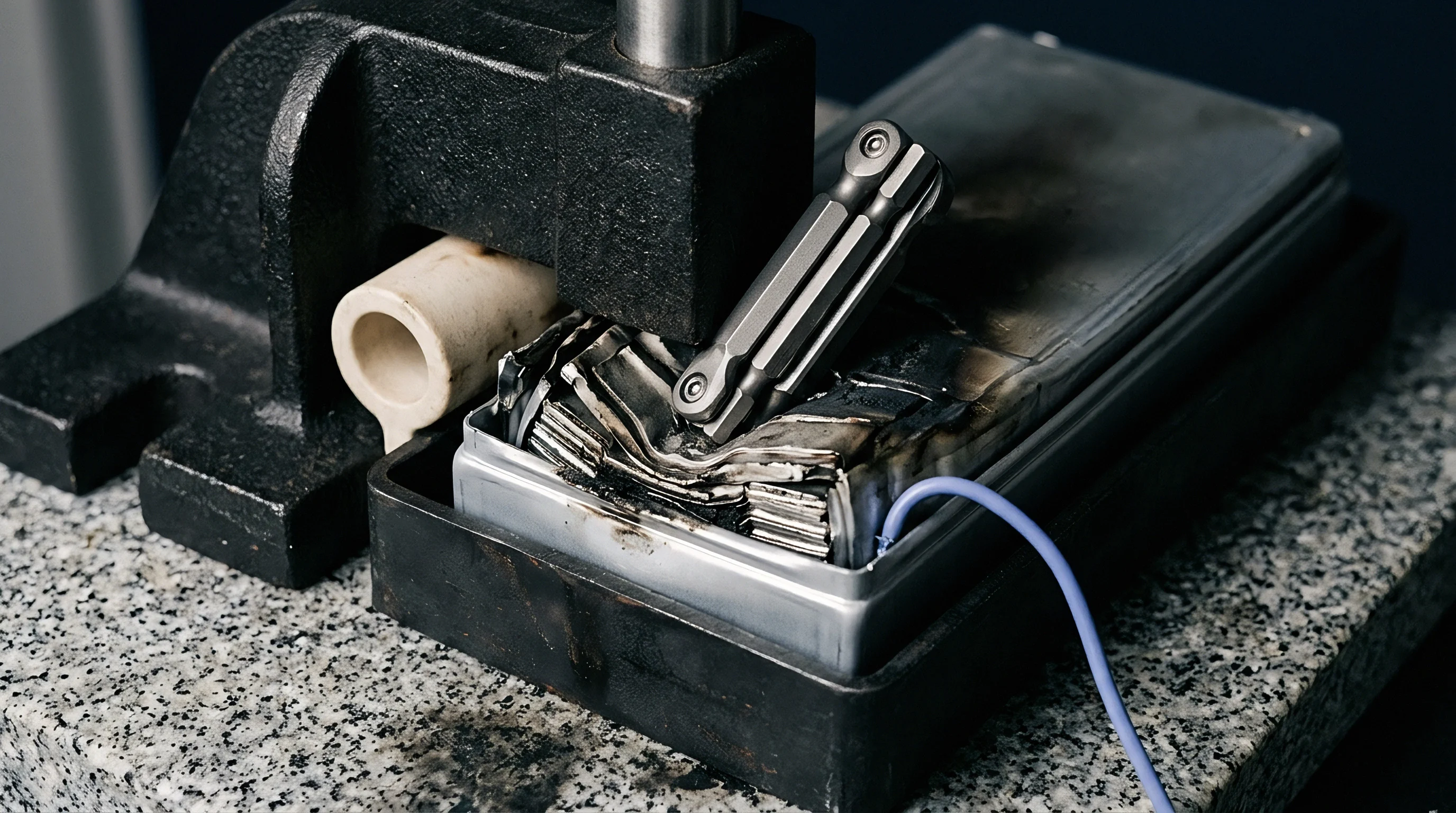
Impact and crush testing under T.6 evaluates internal short circuit resistance under severe localized mechanical damage. Heavy cylindrical cells over 20 millimeters in diameter experience a lateral impact where a 9.1 kilogram steel weight drops from a height of 61 centimeters onto a 15.8 millimeter diameter steel bar resting across the cell center. Prismatic and pouch formats undergo direct hydraulic crush testing, where flat steel plates apply 13 kilonewtons of force until internal shorting or physical deformation limits are reached.
Thermocouples attached directly to the cell casing track peak temperatures, which must remain under 170 degrees Celsius without fire or explosion.
Overcharge test T.7 applies exclusively to complete battery pack assemblies fitted with integrated electronic protection circuits. Test systems inject twice the manufacturer recommended maximum continuous charging current while suppressing voltage limits for 24 continuous hours. The protective electronics must interrupt current flow or safely dissipate energy without allowing the assembly to ignite, rupture, or catch fire during testing or during a seven-day post-test monitoring period.
Forced discharge test T.8 subjects individual cells to severe electrical stress by forcing current through a fully discharged unit in reverse polarity. Technicians connect a fully depleted cell to an external power supply set to deliver maximum rated discharge current into deep reverse charge. The forced reverse current exposes internal collector foils and separator materials to extreme electrochemical stress.
Passing requires that the inverted cell does not ignite or explode during the test or during the subsequent seven-day post-test observation window.
Laboratory engineers record baseline data for every test lot, tracking parameters including mass before and after testing, open-circuit voltage retention, internal AC impedance at 1 kilohertz, surface temperature transients, and mechanical casing dimensions. Any deviation exceeding specified tolerances constitutes an immediate test failure, requiring complete lot rejection and mandatory root-cause analysis before fresh samples can be submitted for re-testing.
Unscrupulous battery vendors sometimes attempt to circumvent testing costs by submitting hand-built prototype samples crafted with oversized casing walls and reinforced separators for UN 38.3 certification, while utilizing lower-cost automated construction processes for high-volume mass production. This discrepancy between certified prototype build standard and shipped commercial product represents a critical quality risk. Production engineering changes involving separator suppliers, cathode binding chemistry, or current collector thickness invalidate original transport test summaries, mandating fresh qualification testing under international transport rules.
Differences between test report sample weights and volume production weights are sometimes framed as minor component substitutions falling within normal manufacturing variances, even though any uncertified design shift compromises underlying transport safety compliance.

Audit
Verification of UN 38.3 test summaries requires systematic cross-examination of documentary evidence against physical lot attributes and independent laboratory accreditation databases. Compliance managers, quality engineers, and freight inspectors conduct thorough document audits to prevent counterfeit, uncertified, or invalid safety documentation from masking transportation hazards. A rigorous audit process moves systematically through every mandatory field of the test summary, validating internal consistency, dates, and physical test parameters against master laboratory records.
Document verification begins by cross-referencing the unique test report number and testing facility details printed on the summary against official ISO/IEC 17025 accreditation directories. Legitimate test summaries list accredited laboratories whose scope specifically includes UN Manual of Tests and Criteria Section 38.3. Compliance officers contact issuing test houses directly or query digital verification portals to confirm that the report number exists, belongs to the exact cell or pack model offered, and bears authentic digital signatures matching authorized personnel.
Step-by-Step Document Verification Protocol
Incoming inspection procedures require strict adherence to a verification workflow designed to uncover invalid or fraudulent compliance paperwork before shipments leave supplier warehouses.
- Step 1 Validate laboratory accreditation scope by checking issuing testing facility credentials on national accreditation body online databases for active ISO/IEC 17025 status covering UN 38.3 protocols.
- Step 2 Cross-reference model part numbers on the test summary against physical product labels, incoming purchase orders, cell casing laser etchings, and master technical datasheets.
- Step 3 Match physical mass parameters by placing random production sample cells on precision balances to verify weight aligns within plus or minus 2 percent of the mass listed on the summary.
- Step 4 Audit watt-hour capacity calculations by multiplying nominal cell voltage by rated ampere-hour capacity to confirm mathematical precision matching the printed watt-hour entry.
- Step 5 Verify test report execution dates ensuring that test completion preceded current production lot manufacturing dates without uncertified design modifications.
- Step 6 Confirm signatory authorization by verifying the named individual occupies a recognized legal management role within the manufacturing corporate structure.
Evaluating mass production consistency against certified prototype parameters reveals whether production batches retain transport compliance. In one audited container shipment of high-capacity energy storage cells, production units weighed 485 grams per cell, whereas the attached UN 38.3 test summary recorded a tested unit mass of 440 grams. This 45-gram mass variance indicated a substantial internal redesign ~ including thicker active electrode material coatings and modified separator geometries ~ executed after initial transport certification testing.
That uncertified modification rendered the existing test summary legally invalid for the production lot.
Mass variances exceeding two percent between test summary metrics and physical shipment units indicate uncertified internal design modifications.
Audit procedures must thoroughly scrutinize watt-hour calculations printed on pack-level test summaries. For secondary lithium ion assemblies, watt-hour ratings determine whether shipments qualify for simplified packing instructions under PI 965 or PI 968 Section II, or require full Class 9 hazardous materials handling, rigid UN-rated packaging, and certified dangerous goods shipper declarations. Calculating watt-hours requires multiplying nominal cell voltage by rated ampere-hour capacity.
Discrepancies between printed watt-hour entries and baseline electrical calculations signal sloppy documentation practices or deliberate attempts to misclassify cargo to reduce air freight shipping costs.
Physical inspection of incoming battery consignments involves inspecting individual cell laser etchings, lot codes, and outer master carton dangerous goods labels. Every physical cell casing must carry clear, indelible markings displaying part numbers, polarity, chemical system identifiers, and lot manufacturing codes. Compliance inspectors compare physical cell model etchings directly to product description entries listed under Item 4 of the UN 38.3 test summary.
Mismatched model designations or unreadable, hand-printed serial numbers warrant immediate quarantine of the entire delivery.
A valid test summary alone does not guarantee transit clearance.
A valid, authentic test summary represents only one required component of international shipping compliance. Dangerous goods acceptance agents at airlines, shipping lines, and port terminals evaluate the total transport package, which includes specialized UN-certified outer packaging, proper hazard class labels, state of charge declarations, and fully completed Dangerous Goods Declarations signed by certified personnel. A valid test summary proves the design standard survived baseline safety testing, but poor master carton packing, damaged outer boxes, or shipping lithium ion batteries above the mandatory 30 percent state of charge limit for air freight will result in immediate cargo rejection at the cargo acceptance desk.
Air transport regulations enforced by ICAO and IATA mandate that standalone lithium ion cells and batteries (UN 3480) ship at a state of charge not exceeding 30 percent of their rated capacity, unless specific approval has been granted by the State of Origin and the State of the Operator. UN 38.3 test summaries do not certify state of charge compliance for individual shipments; state of charge verification occurs through incoming batch sampling using calibrated battery management system diagnostics or resting open-circuit voltage measurements before cargo packing takes place.
Logistics audit managers must track regulatory updates across international dangerous goods codes, which update on rigid two-year cycles. Changes to UN Manual testing procedures, packaging instruction options, or summary formatting guidelines require supply chain compliance teams to review existing documentation archives continuously. Relying on five-year-old test summaries without confirming that the underlying cell design remains unchanged and compliant with current modal regulations opens importers to regulatory compliance penalties and customs delays.
When custom clearance delays occur due to mismatched test summary entries, foreign freight brokers often attempt to resolve the issue by providing updated, re-signed test summaries generated internally within 24 hours. Accepting broker-modified test summaries without third-party laboratory verification exposes importers to legal liability for fraudulent dangerous goods declarations under federal aviation safety acts.
Legal responsibility for incorrect dangerous goods classification rests squarely on the importer of record who signs the customs declaration and transport documentation. Establishing an internal compliance file that contains the original ISO/IEC 17025 laboratory test report, the verified UN 38.3 test summary, batch-level factory quality inspection reports, and state of charge verification logs provides full defensibility during official dangerous goods audits.
Contractual agreements with logistics service providers must explicitly state that cargo rejection resulting from unverified or missing UN 38.3 documentation triggers immediate financial indemnification, requiring the forwarder or supplier to absorb all re-packaging, demurrage, and alternative routing costs without financial cap.
Subtle variations in cell chemical composition across high-volume production years directly impact the ongoing validity of an existing UN 38.3 test summary.

Ledger
The financial consequences of uncompliant or missing UN 38.3 test summaries impact landed product costs, freight shipping quotes, corporate balance sheets, and warranty risk profiles. Sourcing teams that evaluate cell suppliers solely on FOB unit price without accounting for compliance documentation costs face severe financial exposure when non-compliant shipments encounter port holds, customs seizures, or carrier rejections. Complete dangerous goods compliance accounting integrates regulatory testing, document retrieval, sample destruction, and freight buffer logistics into the true total cost of ownership.
Laboratory testing fees for full UN 38.3 qualification represent a major upfront capital expense during product development. Accredited third-party testing facilities charge between $4,500 and $12,000 to execute the full T.1 through T.8 test suite on a single cell or small battery pack model. This cost includes specialized environmental chamber runtime, shaker table usage, high-current short-circuit testing setups, and technician labor hours.
Large industrial or automotive battery modules requiring high-capacity electrical loading and heavy structural shock fixtures incur testing fees ranging from $15,000 to $35,000 per module configuration.
Beyond direct laboratory testing fees, sample destruction costs represent a hidden financial drain on engineering budgets. Standard UN 38.3 qualification protocols require testing up to 38 individual cells or 8 complete battery pack assemblies across various states of charge and cycling conditions. During T.6 impact testing, T.7 overcharge testing, and T.8 forced discharge testing, sample units experience catastrophic physical deformation or internal thermal degradation, rendering them unusable for commercial sale.
For high-voltage industrial battery modules valued at $5,000 per unit, sample destruction adds $40,000 in raw material losses to the testing invoice.
Financial Breakdown of Transport Compliance and Failure Costs
Calculating the true financial impact of dangerous goods transport compliance requires modeling both planned testing expenditure and potential non-compliance failure penalties.
| Cost Component | Low-Range Budget Allocation | High-Range Budget Allocation | Financial Risk Trigger Condition |
|---|---|---|---|
| Cell UN 38.3 Testing Fee | $4,500 flat lab fee | $12,000 complex cell fee | New cell design qualification |
| Pack UN 38.3 Testing Fee | $8,000 standard pack | $35,000 high-voltage module | New pack assembly qualification |
| Sample Material Loss | $500 bare cell samples | $40,000 high-cost modules | Destructive testing consumption |
| Port Demurrage Charges | $250 per container per day | $850 per container per day | Missing paperwork customs hold |
| Air Freight Express Hold | $1,200 administrative fee | $5,000 carrier re-packing fee | Incomplete summary documentation |
| Administrative Fine | $10,000 local regulatory penalty | $275,000 federal transport fine | Illegal dangerous goods shipment |
When cargo sits stranded at ocean container terminals due to missing or invalid UN 38.3 test summaries, port demurrage and container storage charges accrue rapidly. Ocean container terminals allow a standard free time window of three to five days before imposing daily storage fees. Port demurrage rates for hazardous cargo range from $250 to $850 per container per day, depending on port congestion and dangerous goods terminal hazard classifications.
A container of energy storage units delayed for three weeks while engineers scramble to acquire valid factory testing records accumulates over $15,000 in non-refundable port penalties.
Air cargo carriers enforce severe administrative penalty surcharges when dangerous goods inspectors identify fraudulent or improperly completed UN 38.3 documentation. Airlines reject non-compliant cargo instantly, placing the pallet into secure hazardous goods storage holds at charges exceeding $1,200 per day. Shippers must then pay certified dangerous goods handling personnel to repackage or transport cargo to local accredited facilities for inspection.
If the carrier reports the non-compliant documentation to national aviation enforcement bodies, civil penalties for offering uncertified hazardous materials for air transport can reach $275,000 per violation under regulatory enforcement guidelines.
Uncertified hazardous material air transport offerings carry civil enforcement penalties reaching $275,000 per violation.
Landed cost calculations must account for the substantial insurance premium differentials associated with compliant versus uncompliant supply chains. Marine cargo underwriters explicitly require policyholders to maintain verified dangerous goods compliance files, including valid UN 38.3 test summaries, for all shipped energy storage inventory. In the event of an in-transit cargo fire or container vessel casualty, insurance adjusters conduct immediate forensic document audits.
Discovering that a shipped battery model lacked valid transport certification voids marine insurance coverage completely, leaving the importer fully liable for multi-million dollar vessel damage claims and salvage contributions under general average maritime law.
Supply chain contracts should establish clear financial liability assignment for compliance failures through structured warranty and indemnity clauses. Sourcing agreements must stipulate that cell suppliers pay liquid damages covering all demurrage, re-testing, administrative fines, and customer line-stoppage costs caused by invalid transport documentation. Furthermore, payment terms should hold back a minimum 10 percent contract value retainer until incoming shipment document audits verify complete compliance with UN Manual Clause 38.3.5 requirements.
Invalid, self-issued test summaries from unaccredited internal factory labs can force project teams to pull incoming cargo into a bonded warehouse, re-sample production lots, and execute emergency third-party laboratory re-testing under tight deadlines ~ resulting in financial losses reaching $42,000 on a single fast-track job.