UN 38.3 Test Summary Requirements for Lithium Ion Cell Cargoes
Mandatory UN 38.3 test summaries must link cell serial numbers to verified lab results across ten required data fields before cargo enters transport networks.
Mandate

Regulatory Origin and Statutory Application
Cross-border transport of lithium ion cells and batteries operates under strict compliance rules. Under Subsection 38.3.5 of the United Nations Manual of Tests and Criteria, manufacturers and distributors of lithium cells or batteries produced after 1 January 2020 must make available the test summary specified in the Manual. The mandate applies throughout the supply chain, extending well past the cell manufacturer to put direct legal responsibility on freight forwarders, customs brokers, pack assemblers, and logistics integrators to produce the document when requested by carriers or national authorities.
Modal transport rules embed this requirement directly. The International Air Transport Association dangerous goods regulations under subsection 3.9.2.6, the International Maritime Dangerous Goods Code under Special Provision 230 and section 2.9.4.7, and the Agreement Concerning the International Carriage of Dangerous Goods by Road under section 2.2.9.1.7 all treat non-compliant shipments as unauthorized for transport. Without a valid test summary, cargo stops immediately at airport freight terminals or port container facilities.
In practice, the UN 38.3 Test Summary must not be confused with a material safety data sheet or a full laboratory report. A safety data sheet covers chemical hazards and spill responses, but offers no proof of mechanical or electrical abuse testing. A full UN 38.3 test report runs fifty to eighty pages of raw temperature curves, voltage logs, and shock waveforms ~ data laboratories routinely restrict as proprietary.
The UN 38.3 Test Summary condenses those records into a clean two-page document designed to move freely through commercial supply channels.
A compliant cell transport file links every shipped serial number to a verified laboratory test summary before cargo enters a freight terminal.
Entity Scope and Chain of Custody
The manufacturer of a cell or pack design generates the original test summary. When an original equipment manufacturer buys cells from a primary supplier to build a custom battery pack, that assembler must produce a second, distinct test summary for the finished pack. Testing individual cells under UN 38.3 does not exempt the assembled pack from the full test sequence unless specific conditions under paragraph 38.3.3 apply.
Distributors buying finished packs do not re-test them, but they remain legally responsible for holding and forwarding the manufacturer’s summary to carriers and downstream buyers.
Downstream sellers may not alter technical parameters or test references from the original document. Re-branding a cell under a secondary part number requires the test summary to list both the original manufacturer’s model name and the secondary trade code. Omitting the original source breaks the chain of custody, giving port inspectors cause to impound the shipment as uncertified cargo.
Commercial invoices and transport dossiers retain the summary so it is immediately available for audit. Standard freight agreements increasingly include compliance terms requiring suppliers to supply valid test summaries before shipments leave the factory. Contracts often define a failure to deliver the document as a material breach, giving the buyer authority to withhold payment and charge landed demurrage fees back to the vendor.

Dossier
Required Technical Elements
The UN Manual of Tests and Criteria sets out ten mandatory data fields for every valid test summary sheet. Omitting any field invalidates the document during customs checks or carrier audits. To pass cross-border inspections, the layout must be clear, legible, and unambiguous.
Under UN 38.3.5, the required data fields follow a specific structure:
- Name and Contact Details of Cell or Battery Manufacturer includes the full legal corporate name, physical address, direct contact phone number, official corporate email, and website link.
- Name and Contact Details of Testing Laboratory covers the full name, facility address, phone number, email address, and website of the third-party or internal laboratory that ran the tests.
- Unique Test Report Identification Number provides the serial or file reference number assigned by the testing laboratory to the master log.
- Date of Test Report states the exact day, month, and year the laboratory issued the final report.
- Detailed Description of Cell or Battery specifies lithium ion or lithium metal chemistry, form factor, total mass in grams, nominal watt-hour rating for lithium ion, or lithium content in grams for lithium metal.
- List of Tests Completed and Results indicates pass or fail outcomes for each sub-test from T.1 through T.8.
- Reference to Assembled Battery Testing Requirements states applicability under paragraph 38.3.3 f or 38.3.3 g when multi-cell assemblies use previously certified components.
- Reference to the Revised Edition of the Manual of Tests and Criteria cites the edition and amendment number of the UN Manual used during testing.
- Signature with Name and Title of Signatory displays a physical or validated digital signature with the printed name and title of the authorized representative.
- Validation Statement confirms in writing that the tested design meets all applicable requirements of Part III, sub-section 38.3.

Watt-Hour Thresholds and Mass Metrics
Numerical metrics determine transport classification and packaging allowances under air and sea dangerous goods rules. For lithium ion cells, the nominal watt-hour rating is nominal voltage multiplied by rated capacity in ampere-hours ~ a 3.6 volt, 3.0 ampere-hour cell yields 10.8 watt-hours. Cells at or below 20 watt-hours and packs at or below 100 watt-hours qualify for simplified packaging under specific transport rules, as long as a valid test summary accompanies the consignment.
Calculating watt-hour ratings depends directly on nameplate specifications. For a high-energy NMC 21700 cylindrical cell with a nominal voltage of 3.65 volts and a minimum rated capacity of 4.80 ampere-hours, multiplying 3.65 volts by 4.80 ampere-hours gives 17.52 watt-hours. Because 17.52 watt-hours falls below the 20 watt-hour threshold, the cell qualifies for Section IB or Section II packaging under IATA Packing Instruction 965, subject to state-of-charge limits and proper summary paperwork.
Technical descriptions must match actual cargo markings during transit checks. Where internal factory model numbers differ from external container labels under private-label arrangements, customs inspectors hold the cargo until a revised test summary explicitly lists both identifiers.
Execution

Mechanical and Environmental Testing Sequence
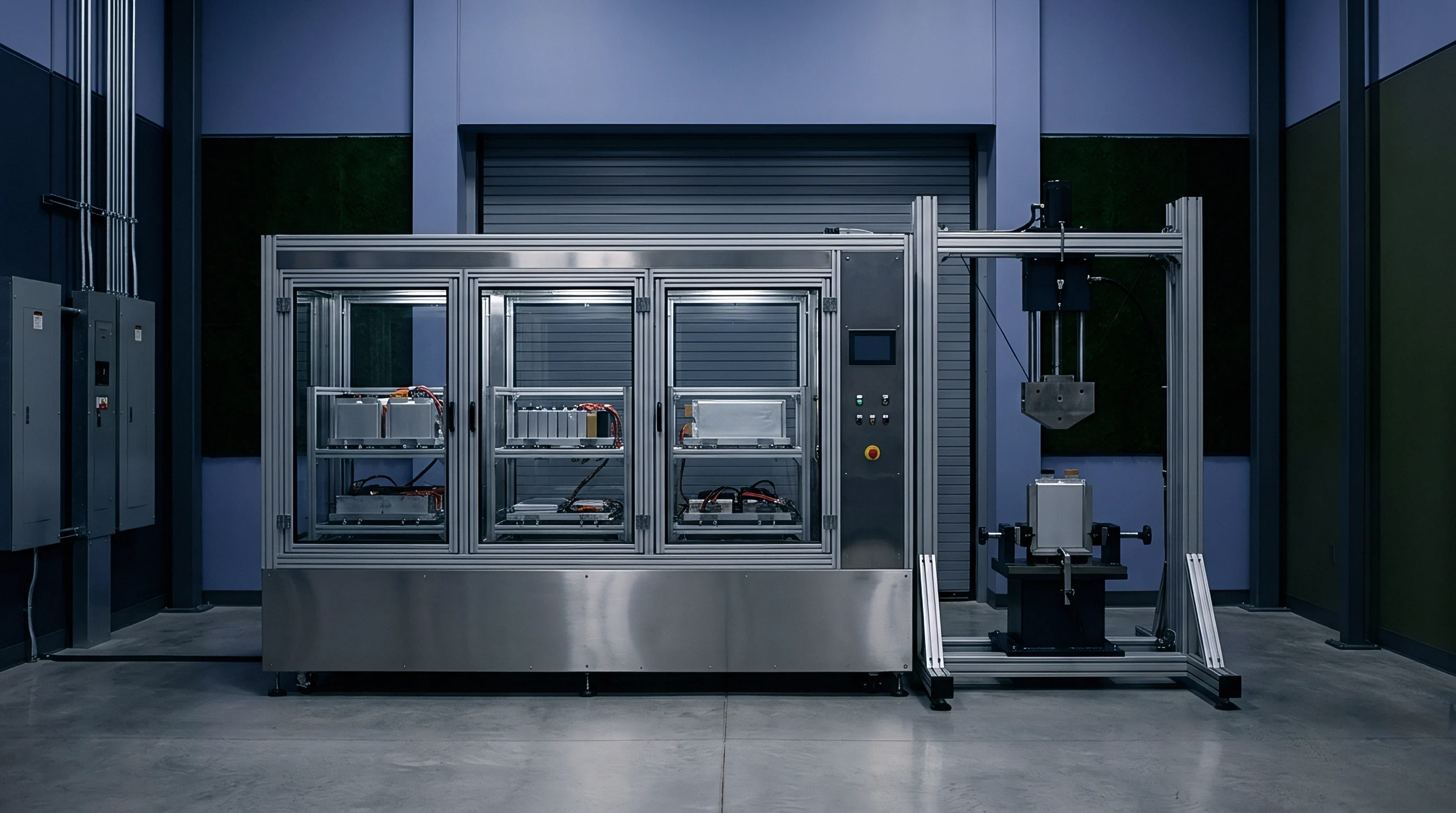
Cell safety verification subjects samples to severe thermal, mechanical, and electrical stress. The UN 38.3 test sequence consists of eight protocols, T.1 through T.8, evaluating failure modes common in transit: cargo hold depressurization, extreme temperature swings, engine vibration, rail car impact shock, and electrical short circuits.
The testing order is specific. Altitude, thermal, vibration, and shock tests run sequentially on the same sample set, as applying consecutive stresses exposes cumulative structural defects or seal wear that isolated testing would fail to detect.
- Altitude simulation (T.1) holds fully charged cells at an ambient pressure of 11.6 kilopascals or lower for at least six hours at 20 degrees Celsius, simulating an unpressurized cargo hold at 15,000 meters.
- Thermal testing (T.2) subjects the T.1 sample set to ten consecutive cycles between -40 degrees Celsius and +72 degrees Celsius, with six-hour dwell times at each extreme and a maximum transition time of thirty minutes.
- Vibration testing (T.3) runs a logarithmic sinusoidal sweep from 7 hertz to 200 hertz and back to 7 hertz over fifteen minutes across three perpendicular axes, totaling three hours per axis.
- Mechanical shock (T.4) applies a half-sine pulse at a peak acceleration of 150 g and 6 milliseconds duration, repeated three times in positive and negative directions across three orthogonal axes.
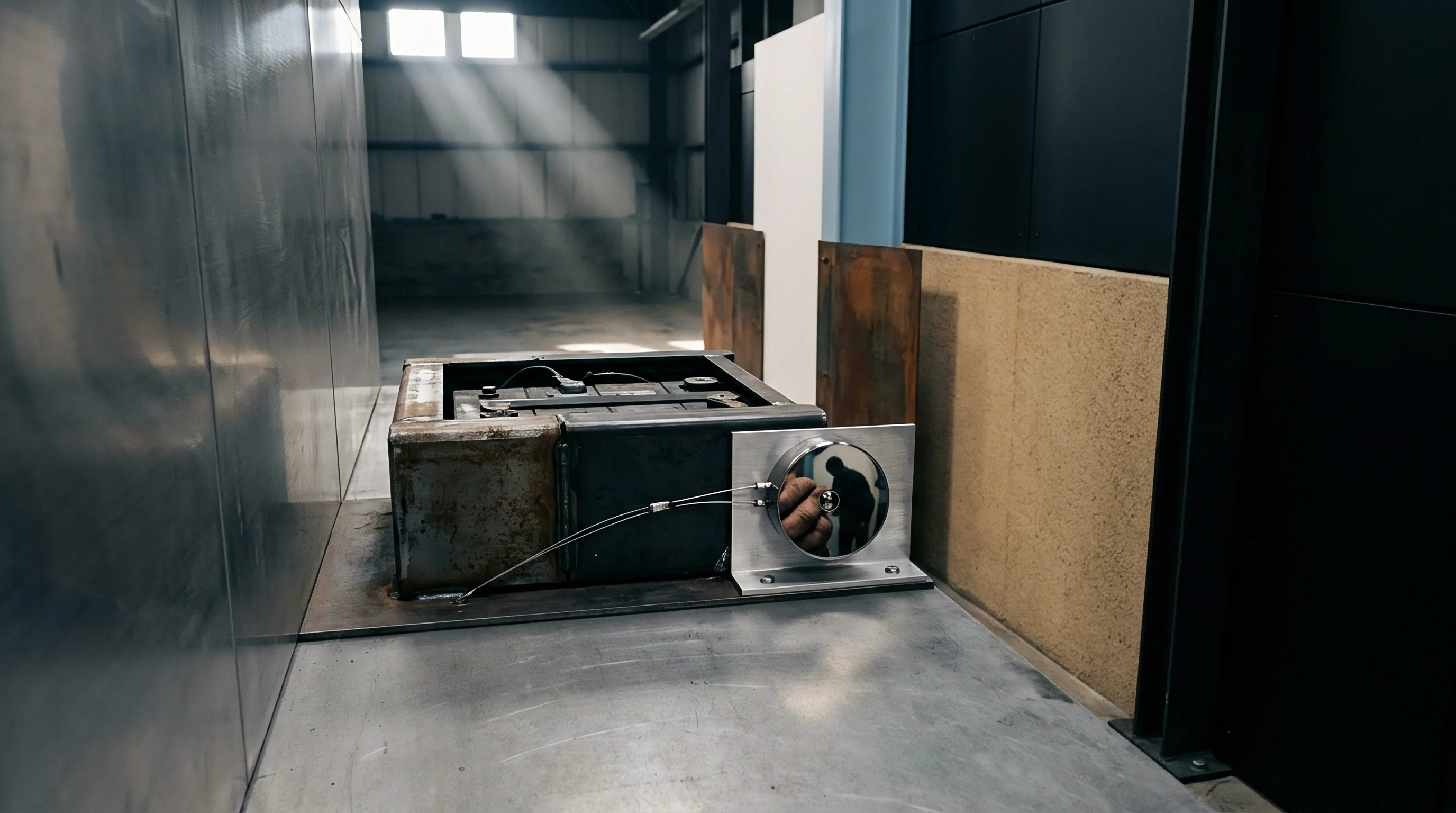
- External short circuit (T.5) heats cells to 55 degrees Celsius before applying an external resistance under 0.1 ohms across the terminals, maintaining the short for one hour after the cell casing returns to 55 degrees Celsius.
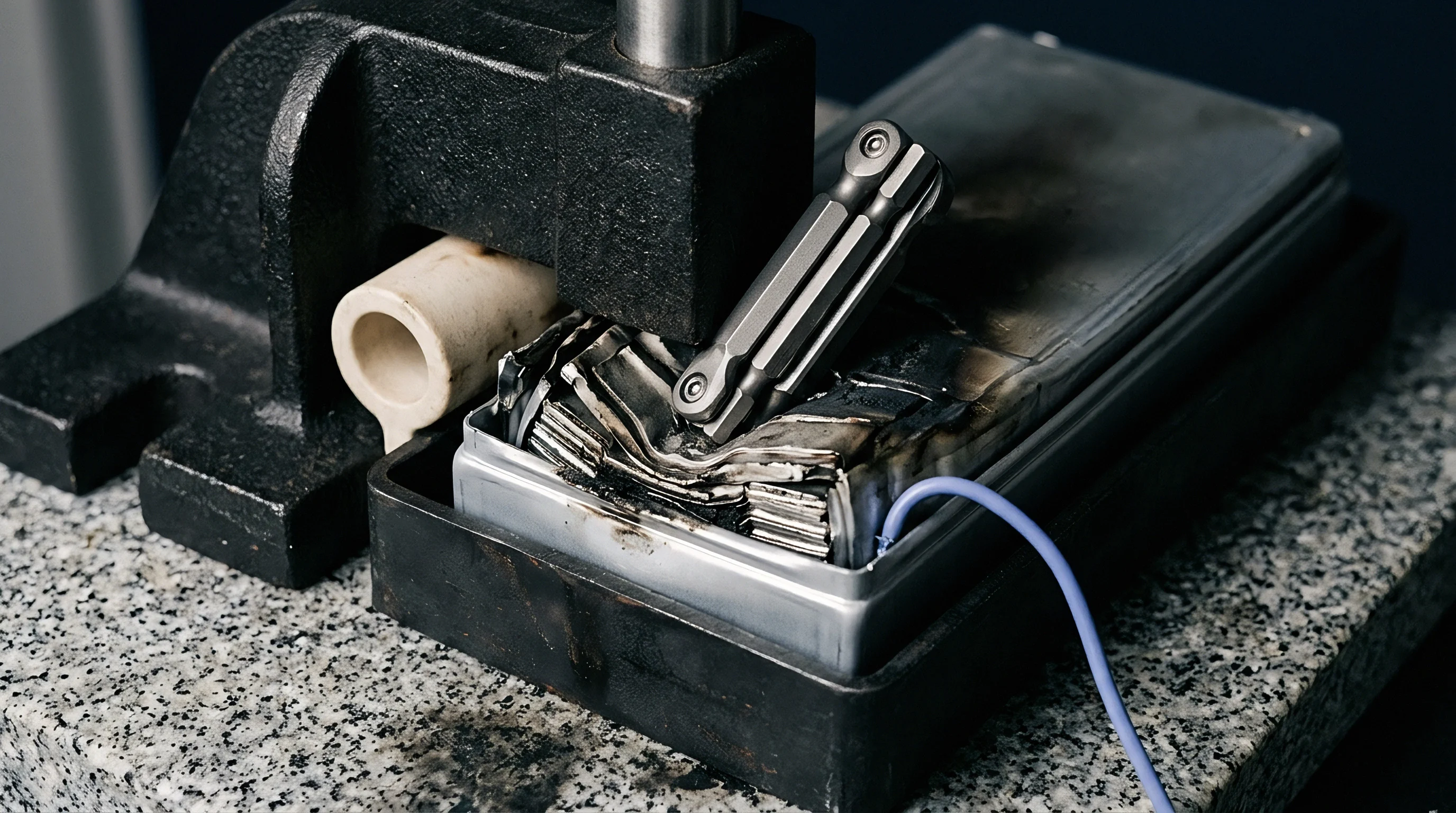
- Impact and crush testing (T.6) drops a 9.1 kilogram weight from 61 centimeters onto cylindrical cells, or applies a 13 kilonewton hydraulic crush force to pouch and prismatic cells to check separator integrity.
- Overcharge testing (T.7) applies twice the maximum continuous charge current to a rechargeable pack for twenty-four hours to evaluate protection circuitry.
- Forced discharge (T.8) drives a fully discharged cell into reverse charge using a 12-volt direct current supply at maximum continuous discharge current for a duration set by chemistry.
Quantitative Pass Criteria
Compliance across T.1 through T.8 depends on mass loss measurements, open-circuit voltage retention, and physical casing integrity. A cell fails if mass loss exceeds weight-based limits, open-circuit voltage drops below 90 percent of its pre-test level, or the unit vents, leaks, ruptures, disassembles, or catches fire during or after testing.
| Test Identifier | Applied Environmental / Mechanical Stress | Test Duration / Cycles | Sample State of Charge | Primary Pass Criterion |
|---|---|---|---|---|
| T.1 Altitude | Pressure drop to 11.6 kPa at 20°C | 6 hours minimum | 100% SoC | No mass loss, no leakage, OCV >= 90% |
| T.2 Thermal | Thermal cycling -40°C to +72°C | 10 cycles (120 hours total) | 100% SoC | No seal rupture, mass loss < 0.2% |
| T.3 Vibration | Sinusoidal sweep 7 Hz to 200 Hz | 3 hours per axis (9 hours total) | 100% SoC | No mass loss, stable internal impedance |
| T.4 Shock | 150 g peak acceleration, 6 ms pulse | 18 shocks total across 3 axes | 100% SoC | No disassembly, no internal shorting |
| T.5 External Short | External resistance < 0.1 ohm at 55°C | 1 hour post temperature peak | 100% SoC | External temp < 170°C, no fire |
| T.6 Impact / Crush | 9.1 kg drop / 13 kN hydraulic crush | Single impact or crush force | 50% SoC | External temp < 170°C, no disassembly |
| T.7 Overcharge | 2x max continuous charge current | 24 hours continuous | 100% SoC (Packs) | No fire, no disassembly during 7 days |
| T.8 Forced Discharge | Forced discharge with 12V DC source | Rated discharge time | 0% SoC (Cells) | No fire, no disassembly during 7 days |
Mass loss limits scale with initial cell weight. For cells up to 1 gram, allowable loss is capped at 0.5 percent; between 1 gram and 75 grams, the cap is 0.2 percent; above 75 grams, maximum loss drops to 0.1 percent. Higher loss figures indicate electrolyte leakage through crimp seals or pouch welds, failing the test summary.
Cells undergoing mechanical shock testing must retain ninety percent of their pre-test voltage to maintain valid transport certification.
A test report applies strictly to the tested cell design; alterations to active material formulation, casing wall thickness, or electrode winding geometry require complete re-testing of the modified design.

Discrepancy
How Do Auditors Verify Unaccredited Test Laboratory Certificates?
Freight compliance auditors and dangerous goods inspectors rely on cross-checking routines to spot unverified or altered test summaries. Testing facilities operating without ISO/IEC 17025 accreditation remain a known vulnerability in battery supply chains. Auditors verify the laboratory name in field two against international accreditation databases like the International Laboratory Accreditation Cooperation network.
If the facility lacks an active ISO/IEC 17025 scope for UN 38.3 protocols, the summary is flagged as invalid.
Discrepancies often emerge when comparing physical cell markings with summary parameters. Inspectors measure cell dimensions, confirm chemistry, and weigh samples straight from shipping crates. If a pouch cell marked at 18.5 watt-hours arrives with a summary stating 14.2 watt-hours, the entire lot is detained on the spot.
Audit Checklist and Red Flag Indicators
Sourcing teams audit compliance dossiers before issuing purchase orders, catching discrepancies before freight pickup to avoid customs holds and transit delays.
- Outdated Standard Revision References cite older editions of the UN Manual of Tests and Criteria ~ such as Revision 5 ~ when Revision 7 or Revision 8 applies to the transit date.
- Unmatched Product Model Identifiers appear when the model number etched on the cell casing differs from the product name in field five of the summary.
- Missing Signatory Corporate Credentials show a signature line without the printed name, title, or contact details of an authorized officer.
- Incomplete Test Matrix Records record pass results for T.1 through T.5 but leave out T.6 impact or T.8 forced discharge testing entirely.
- Inconsistent Mass Metrics list a cell mass that varies by more than 0.2 percent from physical sample weights measured at cargo intake.
- Generic Laboratory Reference Numbers give vague tracking codes that yield no matching test logs when checked directly with the test house.
Finding an invalid test summary during carrier acceptance stops the entire consignment at the terminal, incurring daily storage fees, mandatory repacking, and possible fines for the shipper of record.
Crate

Dangerous Goods Packaging and Modal Rules
Shipping lithium ion cells requires coordinating test summary compliance with dangerous goods packaging rules. The UN framework classifies standalone cells under UN 3480, and cells packed with or inside equipment under UN 3481. Under IATA Dangerous Goods Regulations, air shipments of standalone cells (UN 3480, Packing Instruction 965) face a strict state-of-charge cap of 30 percent of rated capacity.
The test summary must be in the dossier to confirm UN 38.3 compliance before these air transport allowances apply.
Maritime transport under the IMDG Code permits standalone cells under Special Provision 188 if cell ratings remain at or below 20 watt-hours and outer packaging survives a 1.2-meter drop test without damage or leakage. Outer packages shipped under Special Provision 188 must bear the lithium battery mark with the UN number, emergency telephone contact, and batch numbers linking to the verified test summary.
| Transport Mode | UN Identifier | Packing Instruction / Provision | State of Charge Limit | Mandatory Document Package |
|---|---|---|---|---|
| Air Freight (Standalone) | UN 3480 | IATA PI 965 Section IA / IB | 30% Maximum SoC | Dangerous Goods Declaration, UN 38.3 Test Summary, Air Waybill |
| Air Freight (In Equipment) | UN 3481 | IATA PI 967 Section I / II | Operating Level Permitted | UN 38.3 Test Summary, Master Air Waybill, Lithium Battery Mark |
| Ocean Freight (Standalone) | UN 3480 | IMDG SP 188 / Packing Instruction P903 | No State Cap (SP 188) | Container Packing Certificate, UN 38.3 Test Summary, Sea Waybill |
| Road / Rail Cargo | UN 3480 | ADR SP 188 / Packing Instruction P903 | Transport State Permitted | ADR Transport Document, UN 38.3 Test Summary, UN Markings |
Air cargo desks reject shipments where the test summary report date is later than the manufacture date stamped on the cells, checking the timeline to ensure testing was completed before assembly.
Air cargo provisions require standalone lithium ion cells to ship at or below thirty percent state of charge alongside a verified test summary.
Logistics operators face the likelihood that port state authorities will introduce digital repository portals requiring automated validation of test summaries before vessel loading.

Liability

Enforcement Mechanisms and Financial Exposure
Filing dangerous goods declarations without a valid UN 38.3 Test Summary opens companies to swift legal action and severe financial penalties. Under Title 49 of the Code of Federal Regulations, the US Pipeline and Hazardous Materials Safety Administration can impose civil fines up to $96,624 per day per violation for shipping hazardous materials without verified summaries. If non-compliant cargo causes property damage, injury, or a thermal runaway fire, maximum statutory penalties exceed $225,000 per incident, alongside potential criminal charges for officers signing false declarations.
In Europe, ADR road enforcement officers can impound non-compliant vehicles, assess administrative fines, and suspend transport licenses. Marine insurers regularly disclaim coverage for container fires if forensic investigation reveals uncertified cells lacking test summaries, treating missing summaries as non-compliance that invalidates standard property and hull policies.
| Regulatory Authority | Statutory Reference | Maximum Civil Penalty per Violation | Primary Enforcement Action |
|---|---|---|---|
| US DOT PHMSA | 49 CFR § 107.329 / § 173.185 | $96,624 per day per violation | Cargo seizure, civil penalty assessment, order of stop-movement |
| EU Member State Authorities | ADR Chapter 1.8 / National Law | Varies by jurisdiction (€10,000 to €100,000+) | Vehicle impoundment, driver license suspension, administrative fines |
| ICAO / National Aviation Regulators | ICAO Annex 18 / National Civil Aviation Code | $110,000+ per air transport violation | Airline carrier ban, revocation of dangerous goods shipping rights |

Contractual Risk Allocation
Purchase agreements manage regulatory exposure by building indemnification requirements directly into procurement specifications. Sourcing contracts often require sellers to provide an authenticated UN 38.3 Test Summary before authorizing shipment, making formal acceptance contingent on verifying the dossier.
Standard indemnity clauses require sellers to hold buyers harmless from fines, legal fees, demurrage, and property damage stemming from incomplete, inaccurate, or falsified test summaries. If authorities detain cargo over documentation flaws, these terms allow buyers to draw directly against the seller’s letter of credit to cover government penalties and storage charges.
Buyers frequently enforce these documentation standards during factory audits prior to releasing tooling payments. Embedding summary verification into quality management workflows helps shipments clear customs smoothly while protecting organizations against enforcement actions and severe supply chain delays.