Meaning
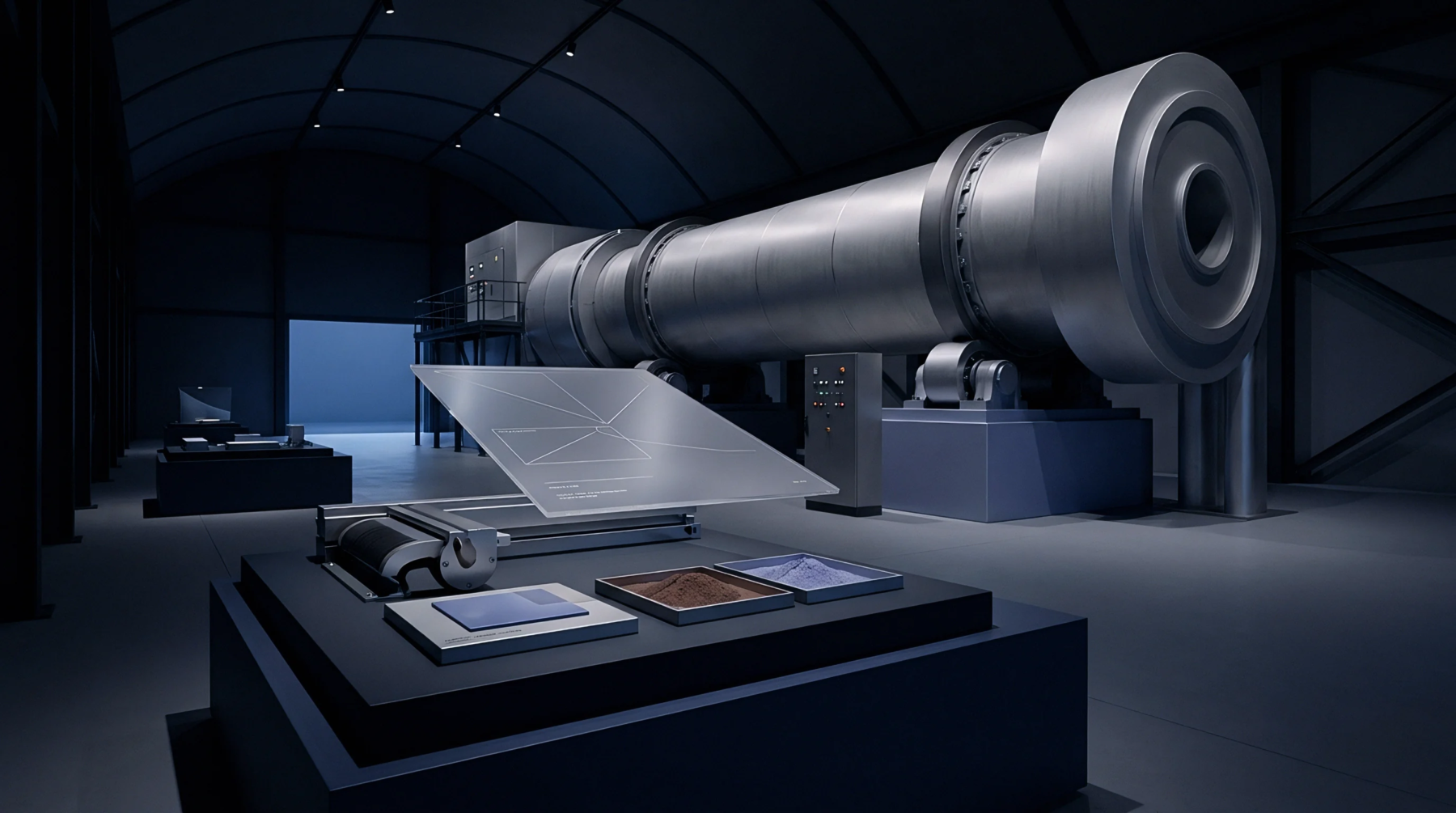
Cylindrical heating vessel that rotates about its longitudinal axis to continuously process bulk solid materials at elevated temperatures. Utilizing a rotary kiln for anode manufacturing ensures uniform heating and consistent material quality through continuous mixing. This equipment is commonly used for the calcination and carbonization of carbon precursors.
Mechanical Design
The metal cylinder is lined with refractory bricks and mounted at a slight angle to allow gravity to move the material along its length. Inside the rotary kiln, the rotation speed and the incline angle control the residence time of the precursor. These mechanical settings must be adjusted to match the required thermal profile of the carbonization process, which is critical for ensuring that the precursor is fully converted without being overheated.
Heat Exchange
Burners or electric heating elements supply the thermal energy required to heat the moving material. In a rotary kiln, the continuous tumbling action ensures that all particles are exposed to the same temperature. This uniform heat transfer is difficult to achieve in static batch furnaces, where temperature gradients are common.
Throughput Level
Continuous operation allows for much higher production rates compared to batch processes. This makes the rotary kiln a cost-effective choice for large-scale battery material manufacturing. The high throughput reduces the cost per kilogram of the active material, which lowers the overall cost of the battery pack.