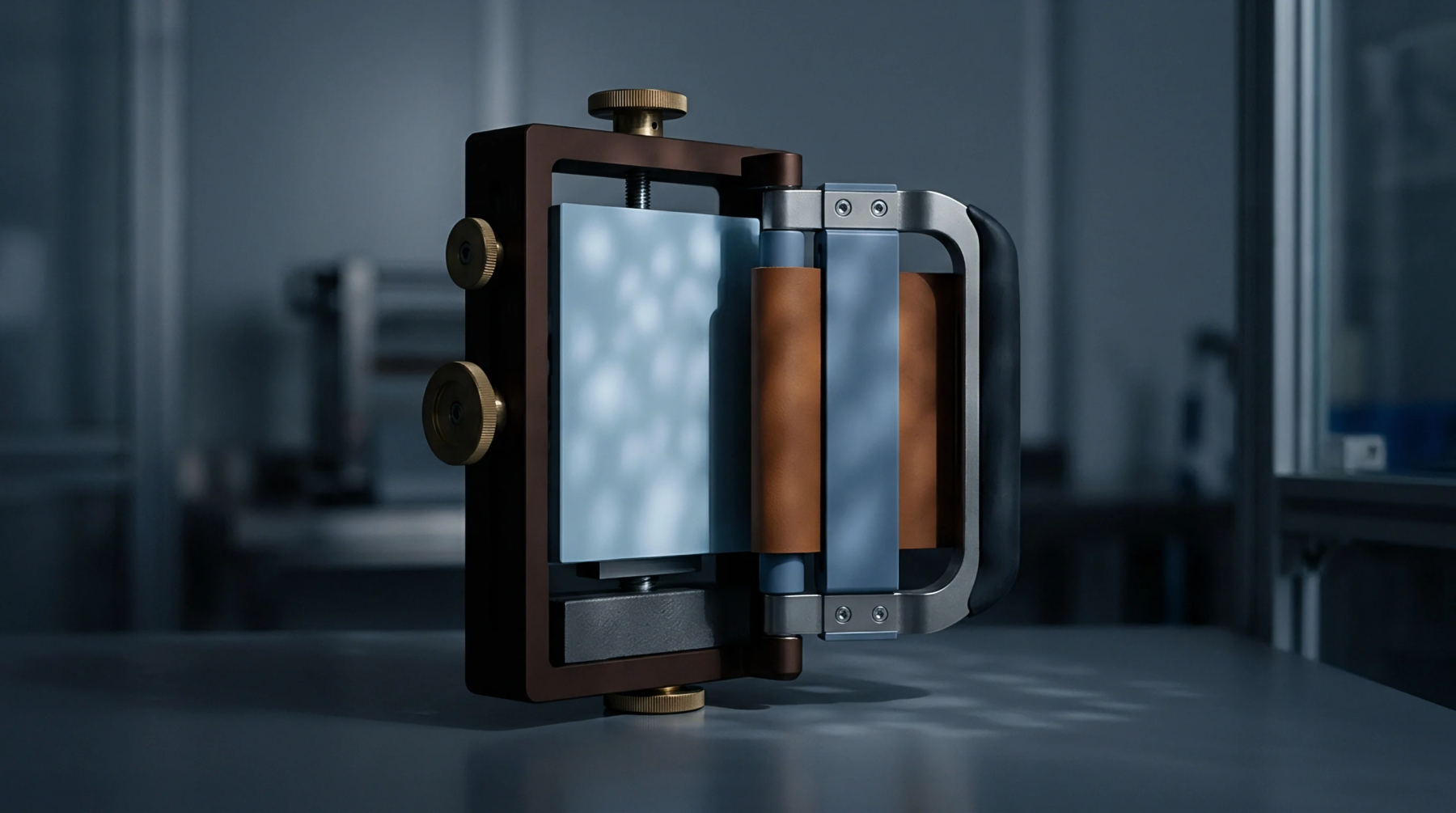
Mechanical Fixture Thermal Strain Deconvolution in Cell Thickness Metrology Baseline
Deconvoluting fixture thermal strain from battery metrology requires baseline transfer matrix subtraction to isolate true electrochemical cell breathing.
Algorithmic adjustment applied to battery measurement data to account for the time dependent deformation of polymeric components under sustained mechanical pressure. Viscoelastic creep compensation is a necessary tool for laboratories measuring the thickness of pouch cells that are compressed between foam pads or plastic plates. Because these materials do not react instantly to changes in force and continue to deform over time, the raw sensor data can show a slow drift that is not related to the battery’s behavior.
This drift, known as creep, can be mistaken for the expansion of the electrodes if it is not correctly identified and removed. The compensation algorithm uses a mathematical model of the material’s time-dependent response to subtract this mechanical noise from the final result. This process is essential for ensuring that the recorded swelling data reflects only the electrochemical changes occurring within the cell.
Understanding the physical properties of polymers and elastomers is the basis for creating an accurate compensation model. Unlike metals, which deform linearly and instantly under load, materials like silicone foam exhibit a combination of viscous and elastic characteristics. When a force is first applied, the foam compresses quickly, but it then continues to shrink slowly as the polymer chains rearrange themselves.
This behavior, called viscoelastic creep, is influenced by both the magnitude of the pressure and the temperature of the environment. In a battery module, this means that the internal pressure will gradually decrease even if the state of charge remains constant. If the metrology system does not account for this movement, the thickness measurement will appear to decrease over time.
Researchers use standardized creep tests to characterize the material’s behavior across a wide range of conditions.
Implementation of a compensation algorithm requires a detailed set of parameters that describe the specific materials used in the test fixture. The viscoelastic creep compensation software typically uses a series of exponential or power-law equations to simulate the time-dependent deformation. By knowing the exact time when the pressure was applied and the current temperature, the program can calculate the expected amount of creep at any moment.
This value is then subtracted from the raw displacement reading to reveal the true expansion of the battery cell. This digital correction is a requirement for high-precision studies where the measurement target is a few microns over several days. The accuracy of the compensation depends on the quality of the initial material characterization and the stability of the environmental controls in the lab.
Proper data handling ensures that the insights gained from the experiment are based on physical reality rather than mechanical artifacts.
Long-term reliability of battery characterization data depends on the ability to maintain a consistent baseline over hundreds of hours of testing. Viscoelastic creep compensation provides a way to handle the inevitable settling of the test rig without having to stop the experiment. This capability is vital for aging studies where the battery is cycled for many months and small drifts can accumulate into major errors.
By isolating the battery’s movement from the fixture’s movement, the lab can provide a much clearer picture of the degradation process. This level of data integrity is a requirement for manufacturers who must guarantee the life of their cells to automotive customers. The use of advanced algorithmic corrections is a mark of professional practice in the field of electrochemical metrology.
High-quality measurement data is the foundation of a safe and reliable energy storage industry.
Deconvoluting fixture thermal strain from battery metrology requires baseline transfer matrix subtraction to isolate true electrochemical cell breathing.
Expertise is a utility, not a secret. sentiention™ publishes its working knowledge as open reference: intelligence layer covering the materials it sources, the markets it enters, and the reference that serves both.