Electrochemical Interfacial Impedance and Solid Electrolyte Interphase Degradation in Subzero Storage
Subzero storage increases charge transfer resistance and fractures the solid electrolyte interphase, requiring low SoC levels and post-storage equilibration.

Chill
Subzero temperature exposure alters the physical structure and electrochemical equilibrium of the solid electrolyte interphase during unpowered cell storage. Non-operating storage beneath zero degrees Celsius is frequently assumed to suspend chemical degradation by reducing reaction kinetics, yet physical changes within the liquid electrolyte and stress across the electrode interface continue without external current flow.
Thermodynamic Stabilities across Cold Storage States
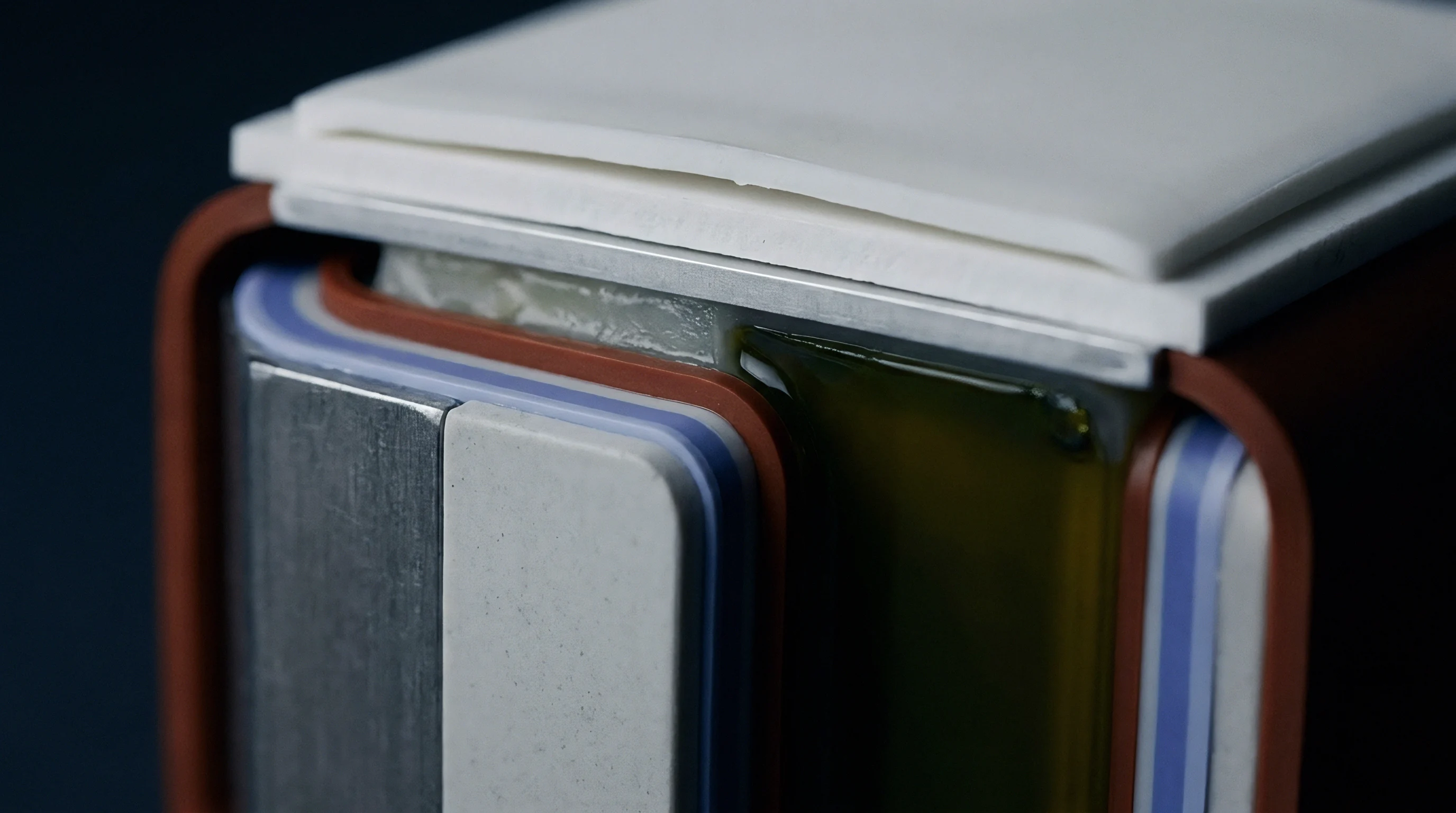
At non-operating ambient conditions dropping from zero down to minus forty degrees Celsius, liquid electrolyte components undergo rapid changes in dielectric permittivity and dynamic viscosity. Standard carbonate solvents, including ethylene carbonate, ethyl methyl carbonate, and dimethyl carbonate, exhibit differential freezing points and distinct temperature-dependent solvation behavior. Ethylene carbonate possesses a high freezing point near thirty-six degrees Celsius in pure form, relying on binary or ternary mixing with linear carbonates to remain fluid at low temperatures.
As temperatures decline toward subzero regimes, local solvent phase separation and localized crystallization occur within the micropores of the porous electrode and the thin passivation film. Solvation shell dynamics shift as the thermal energy drops below the desolvation threshold. Lithium ions retain tighter coordination with organic solvent molecules, raising the activation energy barrier for ion stripping at the graphite surface.
This energy barrier forces un-solvated species to aggregate, altering the local salt concentration at the interface.
Storage beneath the electrolyte solvent freezing threshold triggers phase separation that stresses the physical integrity of the passivation layer.

Interfacial Solvent Restructuring and Viscosity Escalation
Liquid transport properties collapse as thermal energy drops, reducing the ionic conductivity of commercial carbonate mixtures by more than an order of magnitude. At minus twenty degrees Celsius, electrolyte viscosity jumps by over three hundred percent relative to room temperature baselines, restricting fluid motion within dense secondary particle networks.
Zero-current storage under cold conditions allows time-dependent chemical reorganization of the passivation layer. Organic alkyl carbonate breakdown products, such as lithium ethylene dicarbonate, undergo physical contraction at rates different from inorganic components like lithium fluoride and lithium carbonate. Differential contraction generates localized mechanical strain across the interface, forcing micro-cracks to form along the outer organic shell while the cell sits unpowered in cold storage facilities.
Post-storage impedance growth is often mistaken for transient thermal lag rather than permanent passivation layer modification.

Spectra
Electrochemical impedance measurements recorded across subzero temperature regimes reveal distinct physical phenomena isolated by frequency domain analysis. Deconvolution of spectrum data permits exact separation between bulk transport resistance, passivation layer film resistance, charge transfer kinetics, and solid-state diffusion phenomena.
Deconvolution of Subzero Resistance Components
High-frequency intercepts on Nyquist plots track bulk electrolyte conductivity, whereas mid-frequency arcs isolate lithium ion transport through passivating films. As environmental temperatures decrease from twenty-five degrees Celsius down to minus thirty degrees Celsius, the total internal resistance shifts from being charge-transfer limited to being dominated by both charge transfer and film transport barriers.
Separating the solid electrolyte interphase resistance from the charge transfer resistance demands wideband frequency interrogation. The high-to-mid frequency arc corresponds to ion migration through the solid inorganic-organic passivation layer, while the mid-to-low frequency arc captures double-layer capacitive charging and chemical desolvation at the particle surface.
Consider the impedance transformation of a high-energy fifty ampere-hour pouch cell evaluated at fifty percent state of charge across declining thermal thresholds. The table below details the progressive expansion of isolated resistance parameters derived from equivalent circuit fitting.
| Temperature (°C) | Ohmic Resistance R_omega (mOhm) | Passivation Resistance R_sei (mOhm) | Charge Transfer Resistance R_ct (mOhm) | Warburg Diffusion Coefficient (Ohm/s^0.5) |
|---|---|---|---|---|
| 25 | 0.62 | 0.35 | 0.85 | 0.12 |
| 0 | 0.98 | 0.82 | 3.40 | 0.45 |
| -10 | 1.45 | 1.65 | 12.20 | 1.85 |
| -20 | 2.30 | 3.90 | 48.50 | 6.70 |
| -30 | 4.10 | 9.20 | 185.00 | 24.30 |
The parameter progression demonstrates that while ohmic resistance increases roughly sevenfold across a fifty-five degree drop, charge transfer resistance expands by more than two hundredfold. The physical origin of this non-linear growth lies in the high activation energy governing the ion desolvation step prior to insertion into the host lattice.
- Bulk electrolyte resistance shifts reflect fluid viscosity changes and ion-pair aggregation inside separator pores.
- Passivation film transport barriers grow as organic alkyl carbonate species contract faster than inorganic lithium fluoride compounds.
- Double layer charge transfer arcs expand exponentially due to the high activation energy needed for ion desolvation.
- Solid state diffusion tails lengthen as solid diffusion coefficients inside graphite particles drop below ten to the minus fourteen square centimeters per second.
A fifty ampere hour cell stored at minus twenty degrees Celsius exhibits charge transfer resistance expansion from four milliohms to one hundred forty milliohms.
Activation Energy Disparities and Arrhenius Behavior
Plotting resistance terms against reciprocal absolute temperature yields distinct linear slopes that define the kinetic barriers of individual interfacial processes. Passivation film ion transport typically exhibits an activation energy between twenty-two and thirty-one kilojoules per mole.
Charge transfer reactions show a higher activation energy, ranging between fifty-five and sixty-eight kilojoules per mole depending on cathode chemistry and electrolyte additives. High activation energy causes charge transfer impedance to overtake film resistance as the thermal environment drops below zero degrees Celsius, masking subtle changes in film thickness during impedance sweeps conducted at subzero temperatures. The precise physical transition that separates fully reversible interfacial impedance growth from permanent solid electrolyte interphase restructuring during extended cold exposure remains an open research topic.

Decay
Microstructural degradation within the solid electrolyte interphase accelerates when chemical stability gives way to mechanical shear under prolonged cold storage. Unpowered storage under subzero conditions induces mechanical micro-fracturing along boundary lines separating inorganic lithium fluoride clusters from flexible organic poly-carbonate domains.

Mechanical Fracture and Chemical Restructuring Mechanics
Differential thermal contraction coefficients between inorganic lithium salts and organic polycarbonate matrices generate internal strain along the graphite surface. As thermal energy decreases, the outer organic layer becomes brittle, losing its elastic compliance until shear forces exceed the tensile strength of the organic matrix and expose raw graphite to liquid electrolyte.
When raw graphite contacts electrolyte solvents without external current flow, chemical reduction occurs slowly. Lithium ions from the intercalated graphite react spontaneously with surrounding carbonate molecules to repair the damaged film, consuming active lithium inventory and driving unrecoverable capacity fade.
Standard UN 38.3 thermal exposure testing mandates environmental cycling between minus forty and seventy five degrees Celsius without tracking post-storage interfacial impedance shifts.

When Does Subzero Storage Accelerate Interfacial Resistance Growth?
Unpowered storage at state-of-charge levels above seventy percent produces rapid chemical breakdown of organic passivation layers below minus ten degrees Celsius. High state of charge elevates the chemical potential gradient across the anode interface, providing thermodynamic energy for solvent reduction at fresh crack sites while transition metal dissolution from cathode active materials further accelerates deterioration.
Trace moisture in the electrolyte generates hydrofluoric acid, which dissolves manganese, nickel, or cobalt ions from cathode particles. Dissolved transition metal cations migrate through the separator during cold storage, depositing as metallic micro-clusters within the anode passivation layer that act as catalytic sites for continuous solvent decomposition and permanently elevated film resistance.
- Transfer the cell lot into a temperature-controlled stabilization chamber maintained at zero degrees Celsius for two hours.
- Discharge the pack to forty percent state of charge using a pulse current not exceeding zero point one C.
- Lower ambient storage temperature to the desired subzero threshold while holding humidity below ten percent relative.
- Perform baseline electrochemical impedance spectroscopy sweeps from ten kilohertz down to ten millihertz every thirty days.
- Equilibrate the cells to twenty five degrees Celsius for six hours prior to executing functional capacity test cycles.
Recharging a cell immediately following subzero storage without thermal equilibration introduces severe operational risk. Massive charge transfer impedance forces the negative electrode potential below zero volts against lithium metal reference during current injection, triggering dendrite formation even at tiny C-rates. Disregarding subzero storage thermal limits triggers rapid lithium plating during early recharge cycles, destroying cell capacity and voiding system reliability models.


Audit
Incoming quality inspection of cell lots stored under subzero conditions requires controlled equilibration protocols to separate transient thermal effects from permanent damage. Standard cell screening channels often misinterpret cold-induced impedance spikes as permanent manufacturing defects when thermal stabilization steps are omitted.
Thermal Equilibrium Requirements and EIS Baseline Verification
Internal temperature gradients inside large-format pouch or prismatic cells corrupt resistance measurements if testing occurs before complete core stabilization, as dense electrode stacks limit thermal conductivity across the core.
Establishing accurate electrochemical baseline measurements demands a strict temperature recovery sequence. Placing a cold cell onto an impedance test bench immediately yields falsely elevated resistance figures dominated by localized charge transfer resistance, though Kelvin sensing eliminates test fixture contact errors.
Core surface temperature sensors confirm isothermal equilibrium before laboratory channels record impedance spectrum baselines on large cell formats.
Non-Destructive Diagnostic Workflows versus Physical Cell Teardowns
Differential voltage curves derived from low-current cycling identify active lithium loss without destroying cell hardware. Peak shifts within differential capacity plots track the offset between positive and negative electrode utilization windows, revealing how much cyclable lithium was consumed during subzero storage by chemical repair processes.
Non-destructive diagnosis using electrochemical impedance spectroscopy isolates irreversible film growth by evaluating the high-frequency arc recovery after thermal normalization. If the mid-frequency arc remains broader than baseline values after twenty-four hours at twenty-five degrees Celsius, permanent interphase thickening has occurred.
- Core thermal stabilization confirmation prevents false impedance readings caused by internal electrolyte temperature variations.
- Four-wire Kelvin connection checks eliminate test fixture contact resistance from high-frequency ohmic intercept calculations.
- Low-current differential capacity logging detects electrode material degradation and active lithium inventory loss following cold storage.
- Post-storage pulse relaxation scoring isolates charge transfer recovery rates from permanent solid electrolyte interphase thickeners.
Physical cell teardowns confirm non-destructive findings by evaluating harvested anode surfaces using scanning electron microscopy and X-ray photoelectron spectroscopy. Fluorine-to-carbon ratio increases on harvested graphite surfaces validate chemical repair activity following storage-induced interfacial cracking. Incorporating IEC 62660-1 storage condition clauses into cell procurement agreements obligates suppliers to warrant post-storage impedance growth limits below fifteen percent after six months at subzero temperatures.

Liability
Commercial exposure arising from subzero cell storage scales directly with unrecoverable capacity loss and warranty dispute processing. Unplanned exposure to cold logistics routes during winter transit can compromise entire shipments before cells reach module integration lines.
State-of-Charge Optimization for Cold Warehousing Routines
Setting storage energy levels around thirty percent minimizes the chemical driving force for passivation layer growth while maintaining a buffer against self-discharge. Storing cells at high state of charge magnifies interfacial stress, driving up warranty reserve costs for pack integrators.
Maintaining unheated warehousing in cold regions reduces short-term facility energy expense, but introduces substantial long-term financial liabilities through cell degradation. The table below compares technical metrics and commercial consequences across variable subzero warehousing conditions for high-nickel lithium-ion cells over a twelve-month hold period.
| Storage Temperature (°C) | Storage SoC (%) | 12-Month Impedance Rise (%) | Irreversible Capacity Loss (%) | Warranty Claim Exposure | Facility Cost Index |
|---|---|---|---|---|---|
| -20 | 80 | +42.5 | 4.85 | High Risk (Claim Denied) | 1.00 |
| -20 | 30 | +11.2 | 1.20 | Low Risk (Covered) | 1.00 |
| -10 | 30 | +8.4 | 0.92 | Low Risk (Covered) | 1.15 |
| 5 | 30 | +4.1 | 0.38 | Negligible | 1.40 |
| Data normalized across 50 Ah NMC811 pouch cell batches under standard industrial storage conditions. | |||||

Landed Capacity Fade Valuation and Warranty Structure
Financial models for stationary energy storage and fleet electric vehicles calculate the net present value of lost cycle life resulting from improper thermal logistics. Accelerated capacity fade occurring during cold storage shifts the degradation curve forward, causing premature warranty threshold breaches within the first two years of field operation.
Procurement agreements must include precise thermal history logging mandates using calibrated data loggers inside transport crates. Demonstrating that cells experienced un-equilibrated charging after subzero transit allows manufacturers to reject warranty claims, leaving the system integrator responsible for cell replacement costs. Storing lithium-ion cells at reduced state of charge under controlled cool temperatures preserves long-term electrochemical capacity far better than allowing fully charged packs to sit in unheated northern warehouses.