Resolving Overlapping Solid Electrolyte Interphase Resistance Arcs in Fast Production Cell Sorting
Resolving overlapping SEI and charge transfer arcs requires multi-sine excitation and DRT deconvolution to prevent latent low-temperature plating failures.

Contact
Pneumatic indexers push a 21700 cylindrical cell into the gold-plated contact block at forty units per minute. A standard commercial milliohm meter injects a one-kilohertz alternating current, reads a scalar magnitude of 13.8 milliohms, and signals the sorting gate to pass the unit into the tier-one module bin, missing severe electrochemical variance in the process. One kilohertz sits directly within the inductive-to-resistive transition zone for wound cylindrical hardware, recording pure ohmic electrolyte resistance mixed with an indeterminate fraction of the solid electrolyte interphase.
The actual charge transfer resistance of the graphite negative electrode, which governs low-temperature lithium plating onset and high-rate capability, remains completely invisible at this single frequency. Sorting cells on 1 kHz AC-IR alone groups cells with pristine thin passivation layers alongside units containing defective, over-grown interphases that will fail within two hundred cycles.
The electrochemical interface of a commercial lithium-ion cell comprises multiple physical processes that respond across overlapping frequency domains. The primary passivating film, termed the solid electrolyte interphase, coats the active particle surfaces of the negative electrode during initial formation charging. This layer conducts lithium ions while blocking electrons, presenting a distinct resistance to ionic transport alongside a dielectric capacitance across its physical thickness.
Directly beneath this layer lies the electrochemical double layer, where charge transfer occurs as lithium ions desolvate from the alkyl carbonate solvent sheath and accept electrons to enter the graphite interstitial matrix. Both phenomena exhibit resistive and capacitive behavior, creating two separate semicircular arcs on a Nyquist plot.
Single-frequency milliohm meters record an arbitrary chord across two intersecting electrochemical mechanisms.
Production sorting lines compress measurement time to less than one second per cell to maintain throughput rates above thirty thousand units per shift per lane. At twenty-five degrees Celsius, the characteristic relaxation time constant of the passivation layer on modern high-nickel automotive cells sits between 0.08 milliseconds and 1.5 milliseconds, matching a frequency range between 100 Hz and 2 kHz. The charge transfer relaxation time constant for the graphite anode typically occupies the band between 1.5 milliseconds and 150 milliseconds, corresponding to frequencies between 1 Hz and 100 Hz. When the ratio of these two time constants drops below ten, the individual semicircles merge into a single depressed arc.
Standard equivalent circuit algorithms fail to separate them without multi-frequency excitation.
| Interface Phenomenon | Frequency Window | Relaxation Time Constant | Capacitance Range | Activation Energy |
|---|---|---|---|---|
| Ohmic Bulk Electrolyte | 10 kHz to 100 kHz | 0.001 ms to 0.01 ms | 0.01 uF to 0.1 uF | 8 kJ/mol to 12 kJ/mol |
| Negative Solid Electrolyte Interphase | 200 Hz to 5 kHz | 0.08 ms to 1.5 ms | 10 uF to 80 uF | 22 kJ/mol to 38 kJ/mol |
| Negative Charge Transfer | 1 Hz to 200 Hz | 1.5 ms to 150 ms | 0.5 mF to 8 mF | 52 kJ/mol to 68 kJ/mol |
| Positive Surface Film | 500 Hz to 8 kHz | 0.05 ms to 0.8 ms | 5 uF to 40 uF | 18 kJ/mol to 28 kJ/mol |
| Solid-State Lithium Diffusion | 0.001 Hz to 1 Hz | 1000 ms to 100000 ms | 10 F to 500 F | 15 kJ/mol to 25 kJ/mol |
Overlapping Time Constants in Production Screening
The physical proximity of the two process frequencies creates mathematical indeterminacy during rapid extraction, masking the charge transfer dynamics that dictate power delivery. When an automotive pack builder integrates cells sorted solely on gross internal resistance, variations in the underlying passivation resistance remain hidden. Cells exhibiting identical gross impedance can possess inverse proportions of film resistance and desolvation resistance.
A cell bearing an unusually thick, porous passivation layer displays elevated film resistance alongside an artificially depressed charge transfer resistance caused by high surface area fracturing during formation. Subjected to fast charging at zero degrees Celsius, that cell undergoes immediate localized lithium plating while its neighboring cells accept current uniformly. Uncontrolled plating triggers internal micro-shorts, gas generation, and rapid capacity fade across the entire series string.
Production equipment builders address this challenge by deploying multi-sine electrochemical impedance spectroscopy. Instead of sweeping single sine waves sequentially across tens of seconds, modern signal generators sum six to twelve prime-harmonic frequencies into a composite excitation signal injected over an eight-hundred-millisecond duration. Fast Fourier transform processors convert the resulting voltage response into real and imaginary impedance components across the target frequency band.
Resolving the distinct contributions of the passivating film and the charge transfer step requires clean acquisition down to at least 2 Hz. Pushing below 2 Hz extends measurement time beyond the cycle limits of automated cell handling equipment. Cell sorting lines that bypass multi-frequency separation release heterogeneous packs into the field, causing premature warranty returns that consume the entire operating margin of the assembly contract.
Probe
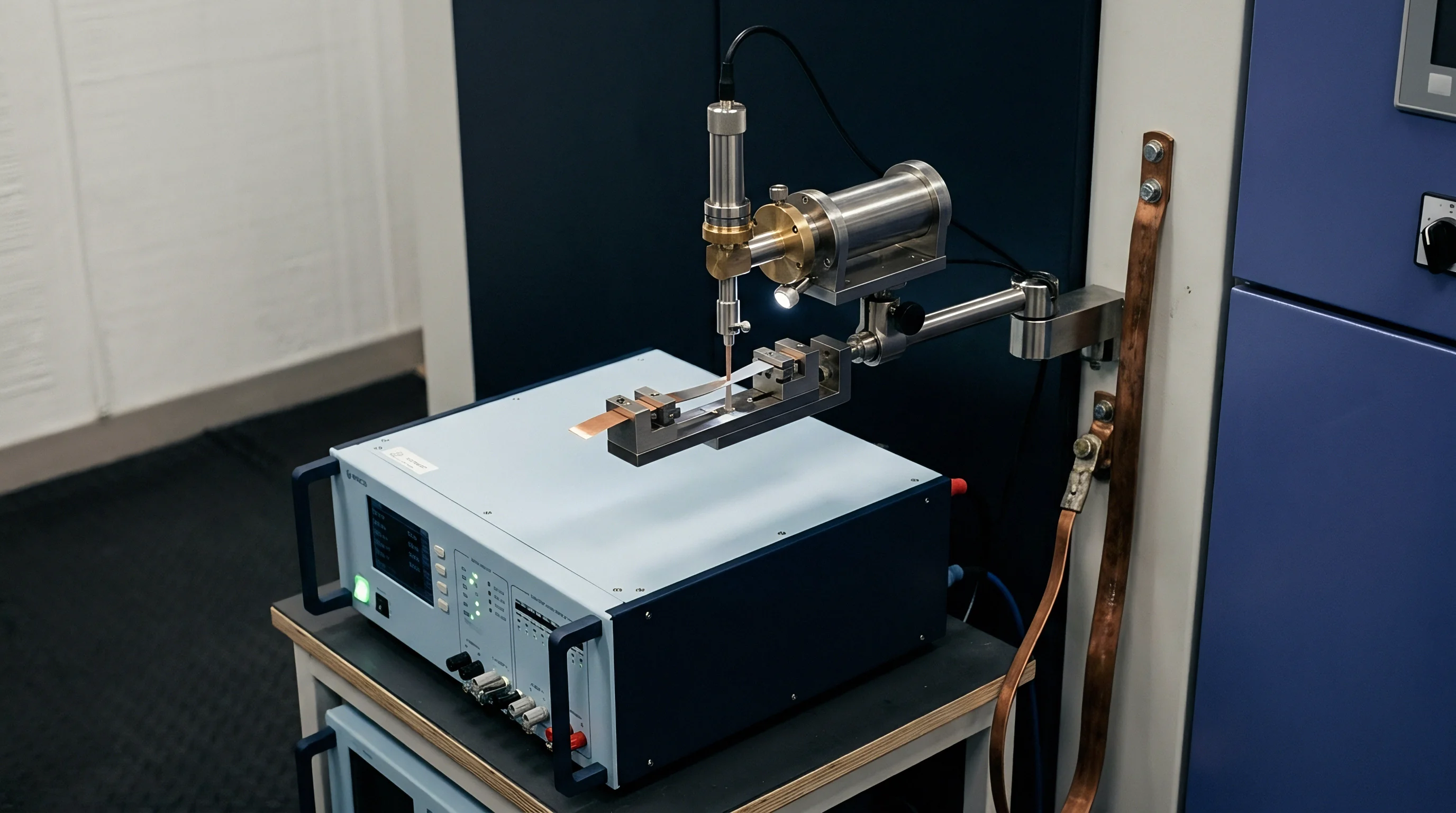
Kelvin four-terminal gold-plated contact pins compress against the nickel-plated terminal caps under twenty newtons of pneumatic force. The physical interface between the sorting machine and the cell housing introduces substantial parasitic impedance that masks the high-frequency response of the cell. At frequencies between 1 kHz and 10 kHz, where the passivating interphase arc initiates, inductive loops from unshielded sensor wiring generate positive imaginary impedance that pulls the measurement into the upper inductive quadrant of the complex plane.
Coaxial cable routing right up to the probe tips eliminates mutual inductive coupling between the excitation current loop and the voltage sensing pair.
Contact geometry dictates measurement repeatability on high-speed conveyors. Cylindrical cell terminals present varying degrees of surface oxidation, residual drawing oil, and laser-weld spatter from current collector attachment. Crown-point probe heads pierce through surface contamination films to establish direct metallic contact with the terminal substrate.
Serrated ring contacts distribute contact current across three hundred and sixty degrees, reducing current crowding artifacts that distort high-frequency phase angles. A difference of two milliohms in contact resistance across the voltage sensing leads shifts the apparent real-axis intercept, displacing the entire impedance spectrum along the horizontal coordinate.
- Parasitic loop inductance generates positive imaginary reactance above 500 Hz, obscuring the high-frequency touchdown point of the interphase semicircle and shifting apparent ohmic resistance values upward.
- Contact surface oxidation creates an external RC parallel pair in series with the cell terminals, superimposing a parasitic arc directly over the genuine solid electrolyte interphase spectrum.
- Thermal gradient transfer occurs through heavy copper probe shafts, draining heat from the cell headers and altering local interfacial kinetics during the measurement window.
- Electromagnetic interference from servo drives introduces wideband noise spikes across unshielded sensing cables, corrupting the low-amplitude voltage signals returned during low-frequency multi-sine excitation.

Fixturing Artifacts and Phase Distortion
When the sorting machine actuates, electromagnetic radiation from variable-frequency conveyor drives couples into high-impedance instrumentation channels, where inductive loops corrupt high-frequency readings. The resulting phase jitter alters the calculated imaginary impedance component, flattening the measured arc and mimicking a high constant phase element exponent. Instrumentation engineers counteract this distortion through twisted-pair shielded lines, copper-beryllium spring probes with gold-over-nickel plating, and active ground plane isolation built directly into the pneumatic clamp nest.
Unshielded test leads convert conveyor motor pulses into artificial interphase dispersion.
The mechanical clamping force must remain constant across all channels in a multi-lane sorting line. Pneumatic cylinder pressure drops during simultaneous actuation cause contact resistance fluctuations between parallel test stations. A five-percent drop in contact force increases interface contact impedance by up to 0.4 milliohms on nickel-plated steel cans.
Automated pressure transducers monitor air line manifolds at each station, halting the sorting indexer whenever clamp pressure deviates beyond three percent of nominal calibration. While contact variations can average out across thirty thousand cells per day, this mechanical variance completely swamps the subtle differences in interphase thickness that the inspection line seeks to isolate.

Dispersion
Numerical deconvolution separates convolved physical processes through mathematical inversion of the Fredholm integral equation of the first kind. On an impedance spectrum where the time constants of the passivating layer and charge transfer sit within a single decade, standard complex non-linear least squares fitting produces unstable parameter values. Equivalent circuit models such as the standard Randles circuit modified with two parallel resistance-constant phase element branches demonstrate extreme parameter correlation.
The optimization algorithm freely trades resistance between the interphase branch and the charge transfer branch while maintaining an identical aggregate mathematical fit. The calculated values become non-physical artifacts of the initial guessing vector.
The distribution of relaxation times converts continuous impedance spectra into a one-dimensional distribution function without assuming an arbitrary equivalent circuit topology. The measured impedance equals the sum of the ohmic resistance, the inductive contribution, and the convolution of a distribution function over all possible relaxation times. Tikhonov regularization resolves the ill-posed mathematical nature of this Fredholm inversion by penalizing wild oscillations in the calculated distribution curve.
The regularization parameter balances fidelity to the raw measurement points against smoothness of the resulting peaks. Calculating the inversion matrix through pre-computed singular value decomposition allows industrial sorting computers to extract resolved peaks within eighty milliseconds of data acquisition.
At twenty-five degrees Celsius, an anode interphase time constant separated from charge transfer by less than a factor of four generates thirty percent parameter cross-talk in unconstrained circuit models.
Because the mathematical inversion remains ill-posed, regularization parameters selected too aggressively merge genuine twin peaks into a single broad distribution envelope, obscuring the physical boundary between interphase resistance and charge transfer resistance. Regularization parameters set too low generate phantom peaks caused by high-frequency instrumentation noise. Production lines stabilize the inversion by fixing the regularization parameter against a reference spectrum acquired from golden calibration cells maintained at twenty-five degrees Celsius inside precision liquid thermal baths.
| Deconvolution Algorithm | Execution Time per Cell | Parameter Correlation Risk | Convergence Failure Rate | Hardware Requirement |
|---|---|---|---|---|
| Complex Non-Linear Least Squares | 180 ms to 450 ms | High: R_sei and R_ct cross-talk | 2.8% to 6.5% | Standard Industrial PC |
| Ridge-Regularized DRT Matrix Solver | 45 ms to 85 ms | Zero: non-parametric output | < 0.01% | Multi-Core CPU with AVX2 |
| Fixed-Tau Discrete Basis Extraction | 12 ms to 25 ms | Low: fixed relaxation grid | 0.00% | Embedded DSP / FPGA |
| Differential Phase Multi-Sine Ratio | 4 ms to 8 ms | Moderate: empirical mapping | 0.00% | Direct Microcontroller |

Deconvolution Algorithms under Millisecond Constraints
Because execution speed decides commercial viability, an industrial FPGA executing a fixed-tau discrete basis extraction processes eight multi-sine frequencies simultaneously using pre-loaded inversion matrices. The algorithm calculates the amplitude of the distribution function across twenty logarithmically spaced time constants ranging from 0.01 milliseconds to 100 milliseconds. The local minimum between the primary peak near 0.5 milliseconds and the secondary peak near 20 milliseconds defines the mathematical demarcation line between film resistance and charge transfer resistance.
Summing the area beneath each respective peak yields the separated ohmic resistance values for each physical interface.
Because temperature swings skew the distribution, both interfaces follow Arrhenius temperature dependencies, though their activation energies differ substantially. The activation energy for lithium-ion transport across the passivating solid electrolyte interphase spans 25 to 35 kJ/mol. The desolvation and charge transfer step demands an activation energy between 55 and 68 kJ/mol.
An ambient temperature drift of three degrees Celsius across the sorting conveyor shifts the charge transfer peak along the frequency axis by nearly forty percent while moving the interphase peak by less than fifteen percent. Sorting software that does not incorporate real-time infrared surface temperature measurement and temperature compensation lookup tables misallocates cells based entirely on factory thermal stratification. Does any industrial deconvolution routine maintain numerical stability when electrolyte additive variations simultaneously alter both activation energies across a single production lot?


Screening
Sorting gates drop suspect units into designated rejection bins based on separated interface metrics rather than aggregate resistance. Incoming cells from formation aging tunnels carry varying degrees of electrolyte wetting completion and passivating layer stability. Units displaying elevated film resistance alongside normal charge transfer resistance indicate excessive formation temperature, improper formation current density, or incomplete degassing prior to final pouch sealing.
Conversely, cells exhibiting elevated charge transfer resistance with normal film resistance reveal microstructural issues within the active cathode material, transition metal dissolution from the positive electrode, or localized electrolyte dry-out caused by insufficient electrolyte injection volume.
Impedance traces reveal wetting deficiencies in high-capacity prismatic cells utilizing thick calendered electrodes, where electrolyte penetration into the microscopic pore structure of the negative electrode requires prolonged elevated-temperature soaking. If a cell enters the sorting line with dry active areas inside the core of the jelly roll, the effective electrochemically active surface area drops. Reduced active area elevates both charge transfer resistance and double layer capacitance while leaving the bulk foil resistance and outer film resistance unaffected.
Single-frequency tests at 1 kHz cannot detect this condition because the outer surface of the electrode conducts alternating current, giving the false appearance of a fully wetted, compliant unit.
- Thermal equilibration validation verifies that incoming cell surface temperature sits between 24.5 and 25.5 degrees Celsius using dual-spot infrared pyrometers prior to probe engagement.
- High-frequency zero-crossing detection extracts the pure ohmic resistance at the exact frequency where imaginary impedance equals zero, separating casing and electrolyte conduction from surface films.
- Multi-sine spectral deconvolution resolves the distinct interphase resistance and charge transfer resistance using pre-calculated distribution of relaxation time matrices.
- Kinetic ratio evaluation divides charge transfer resistance by interphase resistance to confirm that the desolvation step falls within three standard deviations of the production lot median.

Sorting Criteria for Pack Allocation
Automotive battery packs demand rigorous cell matching to avoid module balancing bottlenecks. If parallel-connected cells within a module possess divergent charge transfer resistances, dynamic current splits during regenerative braking become severely unbalanced. The cell with lower charge transfer resistance absorbs the initial high-rate current pulse, experiencing elevated Joule heating and rapid degradation.
Sorting algorithms for parallel cell groups must maintain a charge transfer resistance variance below four percent across all units mapped to the same parallel block.
| Bin Allocation | Ohmic Resistance (10 kHz) | Interphase Resistance (DRT) | Charge Transfer Resistance (DRT) | Physical Lot Disposition |
|---|---|---|---|---|
| Grade A1: Premium High-Rate | 0.42 mOhm +/- 0.02 | 0.18 mOhm +/- 0.02 | 0.31 mOhm +/- 0.03 | Direct Module Integration |
| Grade A2: Standard Energy | 0.44 mOhm +/- 0.03 | 0.22 mOhm +/- 0.03 | 0.36 mOhm +/- 0.04 | Stationary Storage Strings |
| Grade B: Formation Variance | 0.45 mOhm +/- 0.04 | 0.32 mOhm +/- 0.05 | 0.38 mOhm +/- 0.05 | Secondary Low-Rate Applications |
| Grade C: Wetting Defect | 0.43 mOhm +/- 0.03 | 0.19 mOhm +/- 0.03 | 0.58 mOhm +/- 0.08 | Quarantine for Re-Soaking |
| Reject: Defective Interface | > 0.52 mOhm | > 0.40 mOhm | > 0.70 mOhm | Scrap and Materials Recovery |
Because cold cells resist current flow, the sorting floor must maintain strict environmental enclosures over the test fixtures. When conveyor lines run adjacent to exterior warehouse loading docks, winter drafts alter cell temperatures by five degrees Celsius between morning and afternoon shifts. Because charge transfer resistance doubles for every ten-degree drop in cell core temperature, thermal drift creates artificial sorting bins that do not reflect genuine cell quality.
Enclosed climatic testing tunnels positioned directly over the conveyor indexers hold ambient air temperatures within a half-degree band. Sorting rules fail whenever mechanical fixture maintenance lapses.
Settlement
Procurement agreements for commercial battery cells frequently disguise production yield fallout through loose internal resistance specifications. Cell manufacturers quote aggregate 1 kHz AC-IR tolerances of plus or minus fifteen percent on published technical datasheets. This broad window allows factories to ship cells bearing degraded formation chemistry without breaching contract terms.
When buyers specify multi-frequency impedance screening and separate the interphase resistance from charge transfer resistance, incoming lot rejection rates routinely jump from 0.8 percent to over 5.2 percent on initial deliveries.
Landed costs reflect interface verification: a high-speed multi-frequency sorting machine integrating multi-channel digital signal processors costs approximately 220,000 USD per four-lane conveyor line, compared to 45,000 USD for basic single-frequency 1 kHz sorting hardware. For an assembly facility processing five million cells annually, amortizing this capital expenditure over three years adds less than two cents per cell to total packaging cost. Conversely, a single field recall of twenty thousand defective modules caused by low-temperature lithium plating from unseparated interphase resistance costs millions of dollars in warranty settlements and freight penalties.
Delivery specifications referencing factory standard AC-IR permit thirty percent swings in charge transfer impedance without triggering lot rejection.
Late rejection inflates landed cost when an importer discovers unseparated interphase defects at a domestic destination port and finds return logistics under dangerous goods regulations to be cost-prohibitive. Maritime carriers classify defective or non-compliant lithium-ion cells under Class 9 UN 3480 waste carriage regulations, demanding specialized explosion-containment packaging that costs more than the residual value of the cells. The commercial contract must establish destination acceptance rights linked directly to multi-frequency impedance thresholds rather than factory-gate shipping logs.
Warranty reserves cover field burnouts if an original equipment manufacturer signs cell procurement terms that define internal resistance solely through standard milliohm values at one kilohertz, leaving the supplier with zero financial liability for field degradation stemming from mismatched passivation layers. Under International Electrotechnical Commission standard IEC 62660-1 section 6.2, capacity and power testing protocols allow manufacturers to condition cells under benign laboratory temperatures that mask severe charge transfer dispersion. Sourcing teams protect their capital by inserting explicit clauses into the purchase contract requiring delivery lot distributions to maintain a maximum standard deviation of 0.04 milliohms on resolved charge transfer resistance, rejecting entire production master lots whenever deconvolution reveals bimodal interphase growth.