Hard Carbon Pore Structure Analysis for Battery Anodes
Maximizing closed micro-voids while capping open surface area below 5 m²/g is mandatory to secure initial coulombic efficiency above 88 percent in sodium anodes.

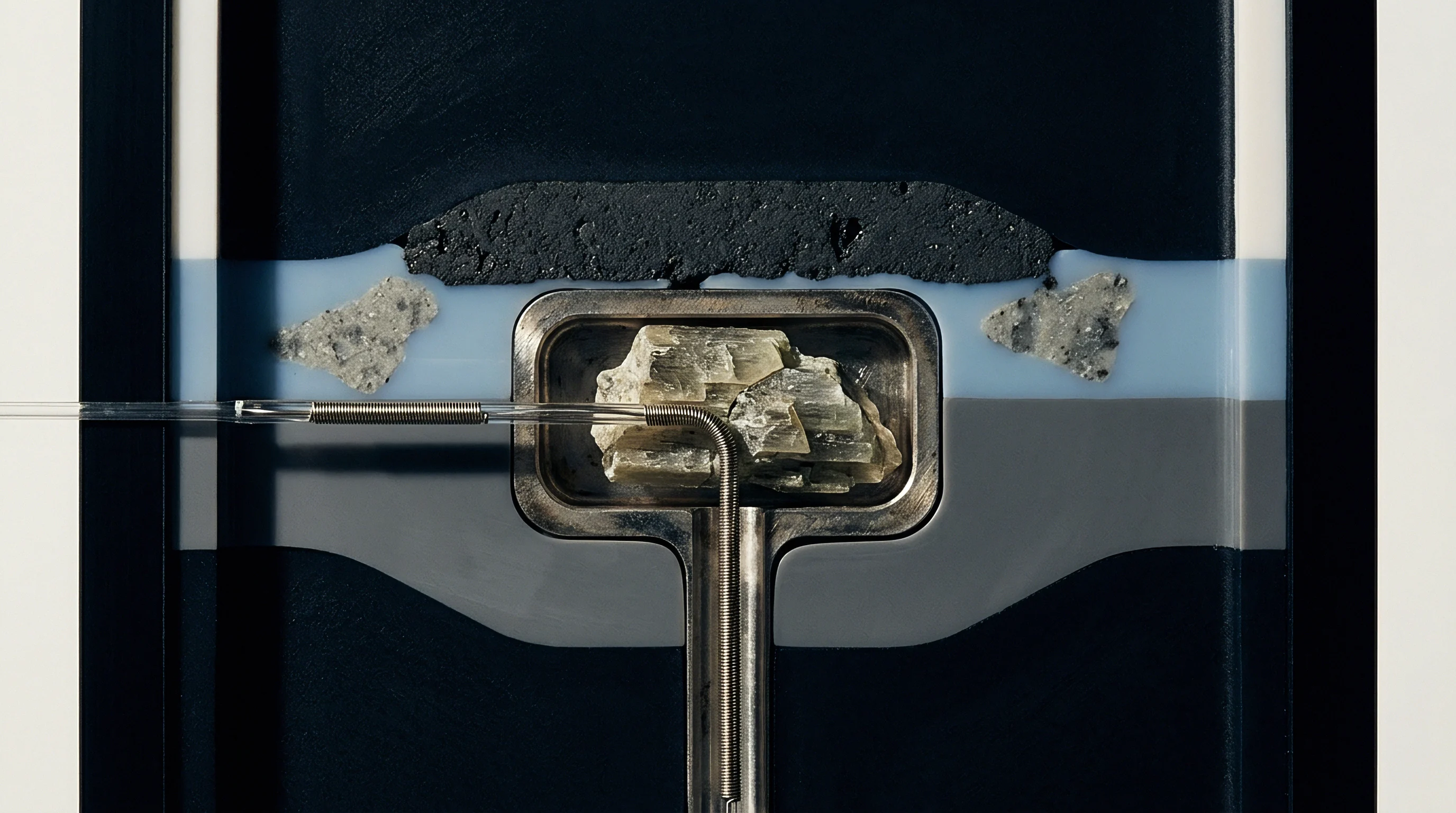
Void
Hard carbon anodes rely on disordered, non-graphitizable structures where short-range aromatic fragments frame sub-nanometer cavities. These internal voids divide by accessibility: open micro-, meso-, and macropores connected to the particle surface, and closed pores isolated inside the sp2 carbon framework. In sodium-ion and fast-charging lithium-ion cells, the ratio between open and closed micro-cavities dictates initial coulombic efficiency, high-rate diffusion kinetics, and structural stability over extended cycling.
Open pores wider than two nanometers allow liquid electrolyte to penetrate the particle interior, driving continuous decomposition of carbonate solvents and sodium salts into a thick solid electrolyte interphase. Consequently, higher specific surface area drives up irreversible capacity loss during the first charge cycle. Closed cavities, by contrast, stay isolated from solvated ions and electrolyte solvents.
Neutral alkali metal atoms cluster within these closed voids along the low-voltage plateau of the galvanostatic curve, delivering high storage capacity without further breaking down the electrolyte.
Closed pores store neutral alkali metal clusters without exposing liquid electrolyte to continuous decomposition.
Sodium storage in hard carbon follows a two-step mechanism. The sloping region above 0.1 volts reflects ion adsorption at surface edges and heteroatom defects. Below 0.1 volts, the flat plateau corresponds to intercalation between expanded graphene layers together with pore-filling inside closed micro-cavities.
Optimizing material performance therefore comes down to minimizing open surface area while maximizing internal closed volume.
- Open Pore Electrolyte Trapping causes continuous solvent reduction, depleting active alkali ions and driving up cell impedance during early cycling.
- Excess Surface Defect Density increases first-cycle capacity loss, pulling initial coulombic efficiency below acceptable commercial thresholds.
- Macropore Structural Collapse destabilizes the electrode matrix during calendar aging, causing localized exfoliation of the coated anode layer.
- Insufficient Internal Pore Volume restricts low-voltage plateau capacity, capping total energy density in sodium-ion cells.
Controlling internal geometry remains the primary lever for carbon anode synthesis.
Balancing surface passivation against closed cavity volume ultimately sets the upper limit for achievable cell-level energy density.

Adsorption
Gas physisorption measurements quantify accessible surface area and pore size distributions across open carbon networks. Standard nitrogen sorption at liquid nitrogen temperatures, however, often distorts the true structural profile of hard carbon. Constriction effects and kinetic barriers at 77 Kelvin prevent nitrogen molecules from diffusing into micropores smaller than 0.7 nanometers within practical analytical timescales.
Nitrogen adsorption at 77 Kelvin underestimates ultra-micropore volume below 0.7 nanometers by up to 80 percent due to kinetic diffusion limits.
Carbon dioxide adsorption at 273 Kelvin resolves these sub-nanometer channels. At 0 degrees Celsius, higher kinetic energy enables carbon dioxide molecules to pass narrow pore necks and fill ultra-micropores down to 0.35 nanometers. Complete evaluation of hard carbon surface profiles requires combining high-pressure carbon dioxide isotherms with low-pressure nitrogen or argon datasets analyzed through non-local density functional theory models.
| Probe Molecule | Analysis Temperature (K) | Kinetic Diameter (nm) | Accessible Pore Range (nm) | Primary Kinetic Limitation |
|---|---|---|---|---|
| 77 | 0.364 | > 0.70 | Diffusion slow at low thermal energy | |
| 273 | 0.330 | 0.35 to 1.50 | Limited to micropore region under atmospheric pressure | |
| 87 | 0.340 | > 0.40 | Requires specialized cryostat temperature control |
Inadequate degassing distorts physisorption isotherms. Moisture and residual organic volatiles block narrow pore throats, yielding artificially low surface area readings. Standard sample preparation protocols therefore require thermal treatment under high vacuum before gas dosing.
- Load a representative three-gram sample of hard carbon powder into a clean quartz analysis tube.
- Evacuate the sample chamber to a base pressure below 0.001 Pascal while ramping temperature at 10 Kelvin per minute up to 300 degrees Celsius.
- Hold the thermal soak at 300 degrees Celsius for six hours to drive off surface hydroxyls and physisorbed water vapor.
- Cool the tube under vacuum to ambient room temperature before transferring it to the cryogenic analytical station.
- Run high-resolution gas dosing, allowing at least 45 seconds of equilibration per pressure point across the ultra-low relative pressure region.
Relying exclusively on nitrogen physisorption leads to miscalculated active surface areas, producing incorrect binder ratios and solvent additions during slurry preparation that ultimately cause thick electrode coatings to crack.


Beam
Small-angle X-ray scattering directly quantifies closed porosity without depending on probe gas penetration. Photons scatter off electron density fluctuations between the solid carbon matrix and internal voids. Because X-rays penetrate the entire bulk sample, small-angle scattering captures surface-connected pores and isolated internal cavities alike.

How Does Small Angle Scattering Resolve Closed Porosity?
Deriving pore volumes analytically relies on the electron density contrast between carbon walls and empty internal domains. Integrating scattering intensity across momentum transfer space yields the invariant parameter. Combining this invariant with true skeletal density measurements decouples total void volume into accessible open porosity and isolated closed porosity.
High-temperature pyrolysis above 1200 degrees Celsius drives the consolidation of small disordered voids into closed spherical micro-cavities, shifting the scattering curve toward lower scattering angles.
Small-angle X-ray scattering measures internal enclosed void volume without relying on probe gas accessibility or pore surface wetting.
| Technique | Measured Parameter | Pore Size Sensitivity | Measures Closed Pores | Sample Preparation State |
|---|---|---|---|---|
| > 0.7 nm | No | |||
| 0.35 nm to 1.5 nm | No | |||
| 1.0 nm to 50 nm | Yes | |||
| All open voids accessible to He | Indirectly (via theoretical density delta) | |||
| > 3.6 nm | No |
Wide-angle X-ray diffraction complements small-angle scattering by evaluating crystallite domains. Bragg reflections from the 002 crystallographic plane give the average interlayer distance between turbostratic carbon sheets. Spacing values above 0.37 nanometers promote rapid sodium-ion transport while reducing structural strain during high-rate charging.
Analytical questions remain as to whether sub-nanometer closed pores undergo reversible structural compression under prolonged high-voltage exposure.

Defect
Disordered graphitic crystallites contain dangling bonds, sp3 hybridized carbon, and heteroatom substitutions that govern local sodium binding energies. Edge defects serve as high-energy sites for initial ion adsorption, but uncontrolled defect concentrations accelerate secondary electrolyte decomposition and lower overall cell efficiency.
Raman spectroscopy quantifies structural disorder through the intensity ratio of the defect-induced D-band near 1350 inverse centimeters to the in-plane graphitic G-band near 1580 inverse centimeters. An elevated D-to-G peak ratio reflects a dense concentration of aromatic edge boundaries and lattice vacancies. Thermal annealing above 1300 degrees Celsius reduces these edge defects while promoting the curvature and closure of graphitic ribbons around internal micro-cavities.
Doping hard carbon networks with heteroatoms alters localized charge distributions. Nitrogen incorporation introduces pyridinic and pyrrolic structures that boost low-voltage electronic conductivity, while phosphorus doping expands graphitic interlayer gaps and stabilizes closed pore walls against collapse during sodium insertion.
- Interlayer Spacing Control maintains d002 dimensions above 0.37 nanometers, preventing lattice distortion and transport bottlenecks during rapid cycling.
- Turbostratic Domain Height caps crystalline stack height Lc below two nanometers to maximize flexible amorphous boundaries capable of accommodating volume shifts.
- Heteroatom Content Calibration restricts surface oxygen content below one weight percent to minimize irreversible side reactions with non-aqueous liquid electrolytes.
- Raman Disorder Index bounds the ID to IG ratio within structured limits to balance initial adsorption capacity against solid electrolyte interphase consumption.
While high initial surface defect density can provide target high-rate pulse discharge capabilities, lowering defect density while maintaining accessible short-range diffusion pathways offers a more viable route to long-term capacity retention.

Receipt
Procuring commercial hard carbon powders requires strict verification metrics to eliminate lot-to-lot capacity drift and drops in initial coulombic efficiency. Quality control specifications must define clear acceptable windows for skeletal density, surface area, and particle size distribution. Relying strictly on raw material carbon purity certificates leaves cell manufacturers vulnerable to substantial yield losses during electrode coating and cell formation.
True skeletal density measured by helium pycnometry serves as a direct proxy for closed porosity when benchmarked against graphite’s theoretical density of 2.26 grams per cubic centimeter. A hard carbon powder with a helium skeletal density of 1.50 grams per cubic centimeter contains substantial closed void volume off-limits even to helium atoms. Values approaching 2.10 grams per cubic centimeter signal a dense, open framework that delivers poor low-voltage plateau capacity in sodium cells.
| Metric | High-Capacity Na-Ion Grade | High-Rate Fast-Charge Grade | Test Protocol Standard |
|---|---|---|---|
| < 5.0 m²/g | 8.0 to 15.0 m²/g | ISO 9277 Nitrogen Physisorption | |
| 1.45 to 1.60 g/cm³ | 1.65 to 1.80 g/cm³ | ISO 12154 Pycnometry | |
| > 0.375 nm | 0.365 to 0.375 nm | XRD Profile Fitting | |
| > 88.0 % | > 83.0 % | Half-cell vs Na/Na+ at C/20 rate | |
| > 0.85 g/cm³ | > 0.70 g/cm³ | USP 616 Mechanical Tapping |
Unreacted organic volatiles register as mass loss during quality checks. Consider a 40-tonne hard carbon procurement lot evaluated for sodium-ion pack assembly: if the delivered batch exhibits a BET surface area shift from 3.5 to 8.2 meters squared per gram, initial coulombic efficiency drops from 87 percent to 79 percent. Restoring cell capacity balance requires adding ten percent extra cathode mass, increasing raw material landed costs by approximately $1.40 per kilowatt-hour across the finished pack run.
- Batch Traceability Certificate requires furnace run logs, pyrolytic peak soak durations, and post-milling particle classification curves for every shipped lot.
- Moisture Exposure Limits mandate sealed aluminum-barrier packaging guaranteeing water content below 300 parts per million upon arrival at the coating line.
- Impurity Boundaries cap iron and nickel metallic inclusions below 10 parts per million to prevent internal short circuits and micro-self-discharge failures.
- Slurry Rheology Criteria define pH and binder adsorption limits to prevent viscosity drift during high-speed roll-to-roll electrode slurry mixing.
A contract clause specifying maximum BET surface area tolerances of plus or minus 1.0 meter squared per gram prevents uncompensated cathode active material consumption during cell formation.
Every commercial delivery contract should explicitly stipulate that any lot exceeding a BET surface area of 5.0 meters squared per gram or a helium skeletal density above 1.70 grams per cubic centimeter triggers immediate rejection at incoming inspection before slurry mixing.