Recycled Cathode Material Entering the Supply Stream
Recycled cathode precursors match virgin cell performance when hydrometallurgical refining limits trace iron and copper contaminants below 10 and 5 ppm respectively.
Feedstock
Black mass arriving at a refinery carries the chemical signature of its origin. Cell manufacturing scrap provides a consistent feed of clean edge trimmings, rejected foils, and calendered ribbons. Spent battery packs introduce far more complexity, mixed with structural adhesives, polyolefin separator films, casing shards, copper foil, and degraded electrolyte salts.
Refiners process both streams through hydrometallurgical or pyrometallurgical circuits to recover cobalt, nickel, manganese, and lithium. Precursor purity ultimately governs whether recovered salts return to high-nickel cathode lines or get downgraded to industrial applications.
Hydrometallurgical processing relies on sequential dissolution and solvent extraction. Shredding operates under an inert argon or nitrogen blanket to prevent thermal runaway as scrap is reduced. Air classifiers separate separator films and light plastics from the heavier metallics, while magnetic separators pull ferrous casing fragments before the material enters leach tanks.
In the tanks, sulfuric acid and hydrogen peroxide convert insoluble transition metal oxides into soluble sulfates. Leaching efficiency depends on temperature, acid concentration, solid-to-liquid ratio, and reductant dosing; maintaining 80 degrees Celsius with 2.0 molar sulfuric acid and 6 percent hydrogen peroxide by volume dissolves more than 98 percent of target transition metals in under two hours.
Solvent extraction isolates copper, iron, aluminum, nickel, cobalt, and manganese into dedicated product streams. Organophosphorus extractants bind specific cations as circuit pH is raised across successive stages. Copper extracts first at low pH using reagents such as LIX 984N, leaving nickel and cobalt in the aqueous raffinate.
Adjusting the pH to 3.5 with sodium hydroxide or ammonia precipitates iron and aluminum as hydroxides or basic sulfates. If pH control wavers, cobalt precipitates prematurely or residual iron slips through into downstream crystallization circuits, where it causes lattice defects during cathode synthesis.
Precursor nickel-cobalt-manganese hydroxide precipitation requires precise control over pH, ammonia concentration, temperature, and agitation inside continuous stirred-tank reactors. Metal sulfates, sodium hydroxide, and ammonium hydroxide enter under a nitrogen blanket. Dissolved oxygen oxidizes divalent manganese to trivalent manganese prematurely, causing uncontrolled nucleation and irregular particle shapes.
Operating at pH 11.2 and 60 degrees Celsius with an ammonium hydroxide concentration of 0.6 moles per liter yields dense, spherical particles with tap densities exceeding 2.0 grams per cubic centimeter.
Inconsistent particle size distributions in recycled precursor lots alter slurry viscosity and cause uneven mass loading across coating lines.
Direct recycling bypasses chemical dissolution to preserve the intact cathode crystal structure. Washing recovered powder with dimethyl carbonate or supercritical carbon dioxide strips away residual electrolyte and polymeric binders. Solid-state calcination or hydrothermal processing then restores depleted lithium in the lattice.
In the hydrothermal route, lithium-deficient powder reacts with aqueous lithium hydroxide at 180 degrees Celsius under autogenous pressure, followed by thermal annealing at 800 degrees Celsius in oxygen to reintegrate lithium and heal structural vacancies.
While direct recycling consumes less energy than hydrometallurgical separation, it tolerates minimal feed contamination. Mixed cathode chemistries undermine direct recovery; blends of nickel-manganese-cobalt oxides and lithium iron phosphate cannot yield uniform product through single-route hydrothermal processing. Sorting systems using laser-induced breakdown spectroscopy or magnetic density separation must segregate chemistries prior to delamination.
Cross-chemistry contamination exceeding 0.5 percent renders the processed material unusable for battery production.
Coating and calendering scrap remains the highest-quality feed for precursor synthesis. Edge trimmings from slot-die coating lines contain known proportions of active material, PVDF binder, and conductive carbon on aluminum foil. Solvent washing with N-methyl-2-pyrrolidone dissolves the binder to release the cathode powder without altering its crystal structure.
Hydrothermal recovery of coating scrap retains native nickel, cobalt, and manganese stoichiometry, minimizing chemical adjustments prior to resynthesis.
Spent electric vehicle packs introduce significant chemical variability. Cycling degradation alters bulk and surface composition, generating lithium carbonate crusts, transition metal reduction products, and rock-salt phase restructuring at particle boundaries. Compositional analysis of black mass derived from mixed automotive packs shows wide fluctuations in copper and aluminum contamination, tied directly to screen mesh sizing at primary shredding facilities.
| Feedstock Category | Nickel Content (% wt) | Cobalt Content (% wt) | Lithium Content (% wt) | Copper Impurity (% wt) | Recovery Yield (% wt) |
|---|---|---|---|---|---|
| Cell Manufacturing Scrap (NMC-811) | 48.2 | 6.1 | 7.2 | 0.04 | 96.5 |
| Mixed EV Module Black Mass (NMC/LFP) | 28.5 | 4.2 | 4.8 | 1.12 | 88.2 |
| Consumer Electronics Black Mass (LCO) | 1.2 | 54.0 | 6.1 | 1.85 | 91.0 |
| Industrial LFP Pack Black Mass | 0.1 | 0.0 | 3.1 | 0.78 | 84.5 |
Blending recycled metal sulfates into virgin stock requires strict limits on trace contaminants. Virgin battery-grade nickel sulfate exceeds 99.9 percent purity, keeping individual metal impurities like iron, copper, zinc, and calcium below 10 parts per million. Recycled solutions often contain residual ions that bypass solvent extraction circuits.
Entrained sodium or potassium acts as a flux during calcination, altering crystal growth kinetics and inducing local lattice strain.
Hydroxide precursor precipitation requires real-time monitoring of crystal growth. In-line laser diffraction tracks volume median diameter, span, and fines within the crystallization vessel. Narrow particle size distributions ensure uniform lithium diffusion lengths during calcination and consistent packing density during electrode calendering.
Sudden fluctuations in feed concentration trigger secondary nucleation, generating bimodal distributions that disrupt slurry rheology during high-speed coating.
Thermal decomposition converts precursor hydroxides to mixed transition metal oxides prior to lithiation. Rotary kilns operating between 450 and 600 degrees Celsius strip moisture and structural hydroxyl groups under counter-current airflow. Full conversion to the oxide phase prevents steam evolution during subsequent high-temperature lithiation, which would fracture primary particles.
Kiln thermal profiles must align with precursor stoichiometry to achieve target tap density and specific surface area.
Process economics depend on water treatment efficiency and chemical recovery loops. Neutralization and precipitation generate sodium sulfate, which crystallizers evaporate to produce industrial-grade byproduct. Closed-loop water recycling keeps freshwater intake below 3.5 cubic meters per metric ton of processed black mass.
Reagent consumption ~ particularly sulfuric acid and make-up organic extractants ~ represents the primary operating cost in commercial hydrometallurgical refining.
Procuring recycled precursor requires lot-by-lot elemental and morphological verification. ICP-OES confirms transition metal ratios to sub-ppm precision, and certificates of analysis must detail residual contaminants alongside D10, D50, and D90 particle size metrics. Misaligned screening equipment during primary shredding remains a common root cause of out-of-spec copper contamination in delivered lots.

Impurity
Trace impurities in recycled cathode stock degrade electrochemical interfaces and accelerate cell aging. Extraneous transition metals, alkali residues, copper particles, and halides alter lattice formation during calcination and promote parasitic reactions during cycling. Tolerance levels depend on cathode chemistry, particle morphology, and upper cutoff voltages.
High-nickel layered oxides show acute sensitivity to iron and copper, whereas lithium iron phosphate tolerates higher contaminant thresholds without rapid structural breakdown.
Iron represents a severe contaminant in cell systems. Under the operational electric field, oxidized iron ions migrate across the separator and reduce onto the graphite anode as metallic iron. These deposits catalyze continuous decomposition of the solid electrolyte interphase, driving irreversible capacity loss.
Over extended cycling, metallic iron dendrites penetrate separator pores, creating micro-shorts that cause localized heating and risk thermal runaway.
Copper behaves similarly to iron within the cell environment. Particulate copper originates from shredded current collector foils remaining in black mass. During high-voltage holds or over-discharge below 1.5 volts versus lithium metal, metallic copper oxidizes into the electrolyte and deposits on the anode as dendritic structures during recharge.
ICP analysis of aged anodes indicates that copper levels exceeding 15 parts per million in starting cathode powder accelerate capacity fade by 300 percent over 500 equivalent full cycles.

How Do Trace Metals Disrupt Cathode Crystal Lattice Integrity?
Foreign cations substituting into the crystal framework compromise structural integrity under cycling. Divalent iron can occupy nickel or lithium sites in NMC lattices during calcination. Because Fe2+ differs in ionic radius from Ni3+ and Li+, substitution generates localized lattice strain.
Repeated lithium deintercalation amplifies this stress, promoting microcrack formation along grain boundaries in polycrystalline particles.
Intergranular cracks expose unpassivated particle surfaces to the liquid electrolyte. At operating potentials above 4.2 volts, electrolyte oxidizes against these exposed facets, consuming active lithium and releasing carbon dioxide and carbon monoxide. Microcracking also isolates primary grains from the conductive matrix, disrupting electronic transport.
Electrochemical impedance spectroscopy shows charge-transfer resistance rising in direct correlation with internal particle fracture density.
Trace copper deposits on the anode surface lower charge-transfer resistance initially but accelerate continuous lithium consumption through catalyzed electrolyte breakdown.
Residual sodium and potassium from precipitation reagents present distinct operational challenges. These alkali ions obstruct lithium diffusion pathways in layered oxides, impairing rate performance. Due to their larger ionic radii, sodium ions residing in lithium planes cause adjacent transport channels to contract.
Cells manufactured with precursor containing 250 parts per million residual sodium exhibit a 14 percent reduction in discharge capacity at 2C compared to virgin material baselines.
Halides ~ particularly chloride residues from hydrometallurgical processing ~ induce severe degradation. Entrained chloride reacts with trace moisture to produce hydrochloric acid, corroding aluminum foil current collectors and accelerating transition metal dissolution from the active material. Residual moisture simultaneously hydrolyzes LiPF6 to form hydrofluoric acid.
Chloride ions catalyze metal dissolution, significantly increasing manganese egress into the electrolyte.
Dissolved manganese from layered or spinel cathodes destabilizes the graphite anode. Solvated manganese ions migrate across the separator and incorporate into the solid electrolyte interphase, raising the electronic conductivity of the passivation layer. This promotes continuous electrolyte reduction and depletes inventory lithium.
ICP-MS data shows that manganese dissolution rates double when chloride levels in recycled cathode material exceed 50 parts per million.
| Impurity Species | Maximum Tolerance Limit (ppm) | Primary Degradation Mechanism | Impact on Cell Performance |
|---|---|---|---|
| Iron (Fe) | 10 | Dissolution, anode reduction, dendrite formation | Internal micro-shorts, high self-discharge |
| Copper (Cu) | 5 | Anode plating, catalytic electrolyte breakdown | Accelerated capacity fade, impedance growth |
| Sodium (Na) | 50 | Lithium channel blockage, local lattice distortion | Reduced rate capability, poor low-temp output |
| Chloride (Cl) | 20 | Acid generation, current collector corrosion | Transition metal leaching, gas formation |
| Calcium (Ca) | 30 | Insoluble salt precipitation, pore clogging | Increased ohmic resistance, separator fouling |
Aluminum contamination arises from foil fragments surviving mechanical separation. Controlled trivalent aluminum doping can stabilize the crystal structure at high states of charge, but uncontrolled, particulate aluminum forms electrochemically inactive phases like lithium aluminate. These inclusions reduce specific energy and act as mechanical stress concentrators that induce electrode delamination during calendering.
Silicon enters recycling streams through silicone sealants, packaging materials, and module glass. During high-temperature calcination, silicon forms resistive silicate phases across cathode particle surfaces. These layers elevate interfacial charge-transfer resistance and lower initial coulombic efficiency.
XPS analysis confirms surface silicate coverage impedes lithium-ion transport, reducing first-cycle efficiency from 88.5 percent to 83.2 percent.
High-gradient magnetic separation is required prior to slurry preparation. Dry powder streams pass through magnetized matrix grids operating above 10,000 Gauss to capture ferromagnetic particulates ~ including metallic iron, nickel, and cobalt debris ~ while non-magnetic active material flows through. Ineffective magnetic separation leaves metallic particles in coated electrodes, resulting in early dielectric breakdown during cell formation.
Detecting trace impurities requires rigorous digestion protocols paired with spectroscopic analysis. Microwave-assisted acid digestion using concentrated nitric and hydrochloric acids converts cathode samples into homogeneous solutions. ICP-MS quantifies contaminant elements down to parts-per-billion levels for lot release testing.
Certified reference materials ensure calibration accuracy across testing facilities.
Lot-to-lot chemical variations complicate electrode manufacturing. Elevated copper levels often force adjustments to binder ratios, mixing protocols, or calendering parameters to manage coating stability. Procurement contracts establish rigid maximum concentration thresholds for metallic and non-metallic contaminants to protect cycle life over multi-thousand-cycle warranties.
Sinter
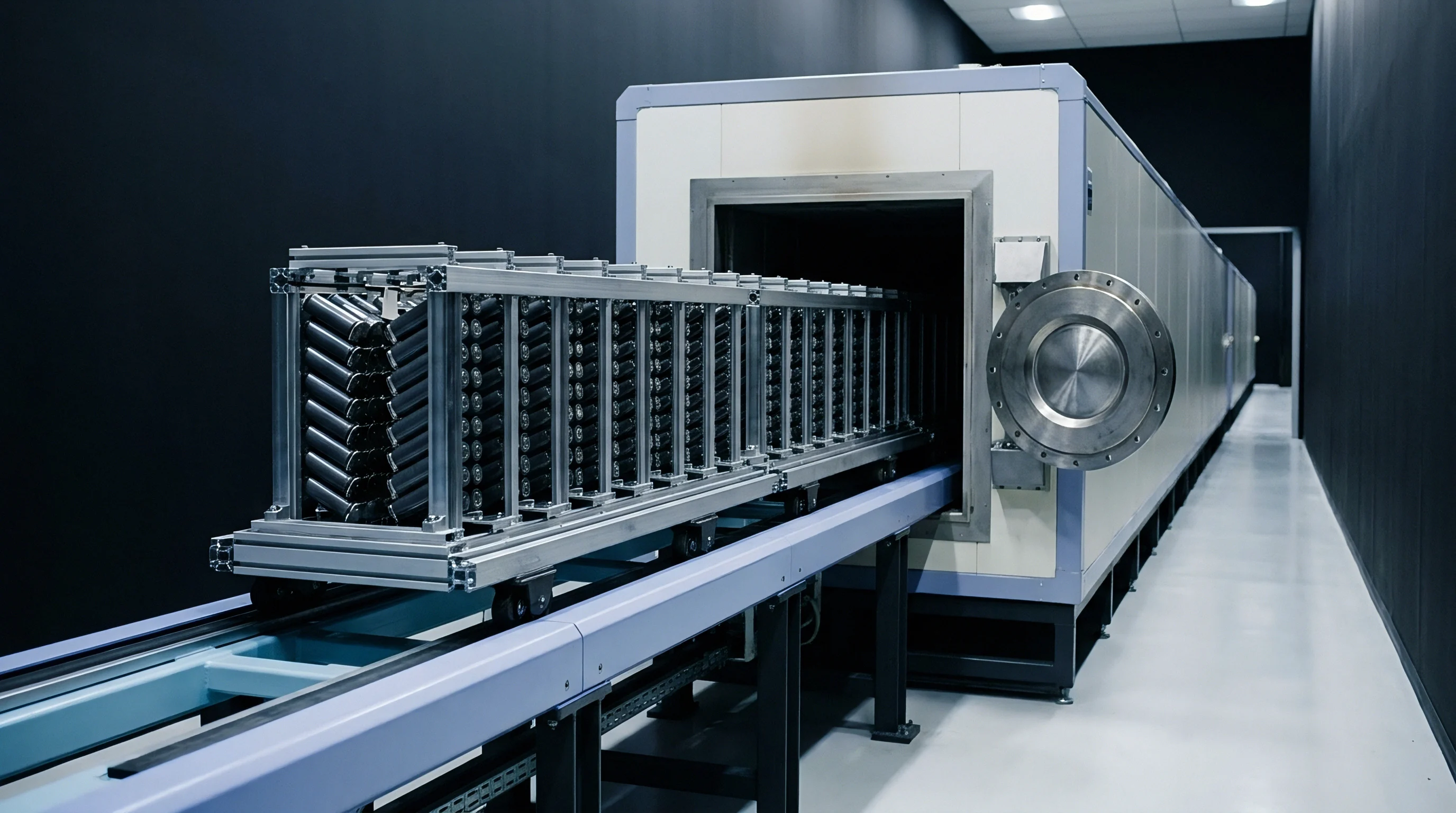
Solid-state calcination transforms precursor hydroxides or oxides into crystalline active material through thermal reaction. Precursor powders are blended with lithium carbonate or lithium hydroxide at tight stoichiometric ratios and processed in continuous roller hearth kilns. Controlled heating profiles and dwell times eliminate volatile species, promote lithium diffusion into transition metal layers, and establish target crystallinity, primary particle size, and surface chemistry.
The transition metal ratio dictates the appropriate lithium salt for calcination. High-nickel precursors require lithium hydroxide monohydrate to allow complete reaction at lower temperatures. Synthesis temperatures for high-nickel materials must remain below 800 degrees Celsius to avoid the reduction of trivalent nickel to divalent nickel.
Because Ni2+ shares a similar ionic radius with Li+, it readily migrates into lithium sites; this cation mixing obstructs lithium transport channels and impairs rate performance.
Recycled precursors often exhibit slight stoichiometric shifts that disrupt the target lithium-to-metal ratio. Excess lithium produces residual surface species, predominantly lithium carbonate and lithium hydroxide. These alkaline residues absorb ambient moisture during storage, forming insulating surface layers.
During high-voltage cell formation, surface carbonates decompose into gas, causing pouch cell swelling or prismatic can venting.
Under-lithiation leaves vacant sites in the crystal lattice, diminishing specific capacity and cycling stability. Because solid-state synthesis depends on intimate particle contact, high-shear acoustic or mechanical blending is required to disperse lithium salts through recycled precursor batches. Inadequate mixing on the sub-micron scale leads to phase separation and the formation of inactive rock-salt domains during firing.
- Load the blended precursor and lithium hydroxide into high-purity alumina saggers to prevent refractory contamination.
- Feed saggers into a continuous roller hearth kiln with gas-tight heating zones and independent temperature controls.
- Ramp the temperature at 3 degrees Celsius per minute to 450 degrees Celsius under pure oxygen to drive off structural water.
- Raise the temperature to 760 degrees Celsius and hold for 12 hours to drive lithium intercalation into the crystal lattice.
- Cool the material at 2 degrees Celsius per minute down to 200 degrees Celsius under continuous oxygen to prevent lattice defects.
- Run calcined aggregate through jet mills under dry room air to deagglomerate powder to the target D50 size without fracturing primary grains.
Atmospheric composition within the kiln governs phase purity in high-nickel cathodes. Calcination of Ni-rich materials requires high-purity oxygen with a dew point below minus 40 degrees Celsius. An oxygen-rich atmosphere maintains nickel in the trivalent state, suppressing cation disorder.
Insufficient oxygen partial pressure produces oxygen vacancies in the lattice, destabilizing the cathode structure during cycling above 4.3 volts versus lithium metal.
Elemental doping during calcination mitigates structural degradation in recycled cathode streams. Dopants such as aluminum, zirconium, magnesium, and titanium integrate into transition metal sites within the lattice. Zirconium substitution suppresses the hexagonal-to-monoclinic phase transition at deep states of charge, reducing anisotropic lattice volume changes and intergranular cracking.
Uniform dopant dispersion across all particles is required to prevent localized stress accumulation.
Applying an ultrathin coating of aluminum oxide via atomic layer deposition isolates recycled cathode particles from direct electrolyte contact and suppresses transition metal dissolution.
Synthesis conditions determine whether material forms single-crystal particles or polycrystalline aggregates. Polycrystalline particles consist of agglomerated primary grains that microcrack along internal boundaries under anisotropic cycling stress. Single-crystal processing uses higher calcination temperatures and molten flux additives to produce discrete, micron-scale crystals without internal boundaries.
Single-crystal NMC synthesized from recycled feedstock displays superior structural stability at high operating voltages.
Post-calcination washing passivates residual reactive lithium on particle surfaces. Aqueous washing removes lithium carbonate and hydroxide coatings, though wash temperature and residence time require tight regulation to prevent bulk lithium deintercalation. Immediate post-wash reheating to 500 degrees Celsius eliminates surface hydroxyl groups and establishes a thin protective oxide layer when combined with boron or cobalt surface treatments.
X-ray diffraction confirms phase purity and quantifies cation disorder in calcined active material. The intensity ratio of the (003) to (104) diffraction peaks indicates the degree of Ni/Li site exchange, with values above 1.2 reflecting low cation mixing and high structural order. Rietveld refinement of XRD spectra determines precise unit cell dimensions, lattice parameters, and phase fractions prior to lot acceptance.
Scanning electron microscopy with energy-dispersive X-ray spectroscopy evaluates particle morphology, grain sizing, and compositional uniformity. Deagglomeration milling must preserve primary particle morphology; fractured surfaces accelerate electrolyte decomposition during cycling. EDX mapping verifies uniform spatial distribution of primary metals and dopants across the particle volume without elemental segregation.
Compliance standards including IEC 62660-1 require validation of thermal safety thresholds for traction battery materials. Differential scanning calorimetry measures the exothermic onset temperature and total heat release of delithiated cathode material in contact with carbonate electrolyte. Active materials derived from recycled sources must match virgin baseline profiles in decomposition onset and enthalpy release to achieve automotive qualification.
Calcination kilns represent the most energy-intensive stage of cathode production, driving a large portion of conversion costs. Modern roller hearth systems incorporate heat exchangers on cooling zones to preheat incoming process air. Final cathode quality depends on reagent purity, thermal uniformity, and atmosphere control; variations in precursor particle size distributions inevitably cause non-uniform lithiation depth across the kiln load.
Audit
Recycled cathode supply chains require verifiable audit protocols across all processing tiers. Mass balance accounting tracks material throughput from black mass intake through hydrometallurgical refining, precursor synthesis, and calcination. Traceability systems pair batch identifiers with certified laboratory test reports, documenting elemental purity, physical properties, and feed origin.
Facility audits verify environmental permitting, instrument calibration records, and contamination control procedures.
Receiving inspection follows statistical sampling plans outlined in ISO 2859-1. Technicians sample drums or bulk containers using multi-zone zone samplers across top, middle, and bottom strata. Composite samples undergo chemical and physical testing, while retain portions are sealed under dry argon for dispute resolution.
Initial lot qualification assesses tap density, moisture loss on drying, and particle size distribution before authorizing chemical dissolution for spectroscopy.
Compositional verification uses complementary analytical techniques. ICP-OES quantifies nickel, cobalt, manganese, and lithium concentrations within 0.1 percent relative accuracy, while ICP-MS detects trace metallic contaminants at sub-ppm thresholds. Energy-dispersive X-ray fluorescence provides rapid initial screening of bulk composition and macro-impurities upon arrival at the receiving dock.
Traceability documentation must accompany every delivered lot. Digital dossiers link physical lot codes to upstream extraction run parameters, intermediate refining data, and third-party assay results. Chain-of-custody controls prevent off-spec or uncertified materials from entering active production lines, and auditable transaction logs verify recycled content percentages to satisfy regulatory mandates.
- Mass balance ledger matching confirms that incoming raw black mass quantities match refined precursor output volumes without unexplained yield losses.
- Analytical method validation verifies that laboratory testing procedures follow ASTM E1479 standards for ICP-OES analysis.
- Contamination containment evaluation checks cleanroom positive pressure differentials, HEPA filtration efficiency, and magnetic separator maintenance logs in processing zones.
- Calibration record verification inspects reference material traceability records for lab balances, particle size analyzers, and atomic spectroscopy instruments.
- Retain sample archive inspection checks climate-controlled storage conditions, seal integrity, and chain-of-custody documentation for archived samples.
Operational audits assess plant cleanliness and material handling practices. Production dry rooms require positive air pressure differentials to exclude ambient particulates and moisture from exposed powder lines. Auditors inspect maintenance records for high-gradient magnetic separators, verifying that field strength measurements meet operational specifications to prevent ferrous contamination in finished powder.
Discrepancies between supplier certificates of analysis and incoming audit assays typically stem from matrix effects, incomplete digestion, or non-representative sampling. High-pressure microwave digestion in closed vessels ensures complete dissolution of refractory species, including silicates and refractory oxides, ensuring accurate trace element quantification.
Exceeding specified concentration limits for iron, copper, or sodium triggers mandatory quarantine. Quarantined lots undergo secondary verification at an independent ISO 17025 accredited laboratory. Confirmed non-compliant material is rejected and returned to the refiner to prevent contamination of downstream cathode manufacturing lines.
| Test Parameter | Analytical Methodology | Sampling Standard | Target Specification | Rejection Action |
|---|---|---|---|---|
| Transition Metal Ratio | ICP-OES | ISO 2859-1 Level II | Target +/- 0.5 mol % | Immediate Lot Quarantine |
| Trace Metal Impurities | ICP-MS | ASTM E1479 | Fe < 10 ppm, Cu < 5 ppm | Supplier Return / Rejection |
| Particle Size (D50) | Laser Diffraction | ISO 13320 | 10.5 +/- 0.8 microns | Blend Adjustment or Reject |
| Surface Alkalinity | Potentiometric Titration | Internal Standard | Total Base < 0.3 % wt | Re-calcination or Reject |
| Crystal Phase Purity | X-Ray Diffraction (XRD) | ASTM E915 | I(003)/I(104) > 1.25 | Process Line Rejection |
Supplier qualification entails comprehensive on-site technical and environmental audits. Evaluation criteria include process capability, standard operating procedures, quality control systems, and EHS compliance. Processing facilities must demonstrate verified changeover protocols between production campaigns to avoid cross-contamination when switching between different precursor formulations, such as NMC-622 and NMC-811.
Environmental compliance audits review wastewater treatment, solid waste management, and gas scrubbing systems. Hydrometallurgical operations generate acidic effluents, heavy metal residues, and sulfur oxide emissions that require continuous abatement. Refiners operating without certified zero-liquid-discharge systems or compliant emission scrubbers face permitting risks that could interrupt material delivery schedules.
Audit findings drive corrective action requirements under commercial supply agreements. Identified quality non-conformances trigger formal CAPA protocols requiring root-cause determination and verified corrective implementation within 30 days. Periodic facility re-audits ensure operational adjustments remain effective over long-term production contracts.
Commercial supply contracts define non-conformance penalties, testing protocols, and legal liabilities. Master agreements establish sample retention durations, technical arbitration frameworks, and liability caps for cell scrap resulting from latent raw material defects. Standard contractual terms, such as Clause 14.2, enforce immediate lot rejection if metallic copper exceeds 5 parts per million, assigning teardown and system decontamination costs to the material supplier.
Ledger
Commercial adoption of recycled cathode materials is governed by landed unit economics. Sourcing evaluations extend beyond the raw purchase price of precursor powder, incorporating total cost models that account for black mass market pricing, process yield losses, reagent consumption, transport classifications, and analytical compliance overhead. Clear accounting across these cost drivers enables procurement teams to structure viable contracts while securing strict purity baselines.
Precursor pricing is structured around index-linked payable rates tied to metals exchange benchmarks. Refiners buy black mass based on agreed payable percentages of LME or SMM spot prices for contained nickel, cobalt, and lithium. Payable terms fluctuate with market supply and scrap quality.
During periods of tight feed supply, payable rates for nickel and cobalt can reach 75 to 80 percent of underlying metal value, compressing refiner conversion margins.
Tolling and conversion fees reflect the processing cost to transform raw black mass into battery-grade precursors or calcined active material. This fee encompasses energy consumption, chemical inputs like sodium hydroxide and sulfuric acid, operational labor, plant depreciation, and hazardous waste disposal. High-temperature calcination, requiring 12-hour dwell times at 800 degrees Celsius, represents the single largest energy cost in the conversion sequence.
Yield losses directly influence net production economics. Cumulative losses occur across shredding, solvent extraction separation, chemical precipitation, calcination, and jet milling. Complete hydrometallurgical recovery circuits typically achieve overall metal yields between 88 and 94 percent.
Refiners incorporate unrecovered metal into baseline pricing models, adjusting product markups to protect operating margins.
- Index price volatility exposure shifts raw material input costs rapidly, eroding refiner margins during periods of metal market instability.
- Off-spec material quarantine penalties trigger expensive downtime and force emergency spot purchases of virgin precursor alternatives.
- Regulatory compliance surcharges add administrative overhead for verifying material origin under international traceability rules.
- Dangerous goods freight premiums push up shipping costs for hazardous black mass and reagent loads.
- Yield loss escalation drives unit costs higher when processing low-grade or heavily contaminated battery scrap.
Landed cost modeling shows recycled NMC-811 precursor hydroxide delivers a 4.2 percent savings per kilowatt-hour compared to virgin material, assuming incoming lot rejection rates stay below 1.5 percent after factoring in metal payables, conversion fees, shipping, customs duties, and audit overhead.
Regulatory requirements are driving procurement targets across major markets. The EU Battery Regulation mandates minimum recycled content thresholds for industrial and electric vehicle batteries: 16 percent cobalt, 6 percent lithium, and 6 percent nickel by 2031, rising to 26 percent cobalt, 12 percent lithium, and 15 percent nickel by 2036. Battery manufacturers are securing long-term contracts for verified recycled precursor to maintain regulatory compliance.
Embodied carbon accounting increasingly influences precursor selection. Life cycle assessments indicate hydrometallurgical recycling reduces greenhouse gas emissions by 35 to 50 percent relative to virgin metal extraction and refining. Direct recycling processes offer reductions up to 70 percent by eliminating primary chemical dissolution and precipitation.
Automotive manufacturers leverage these reductions to meet Scope 3 decarbonization commitments.
Contractual penalty structures protect cell manufacturers against non-compliant feedstock deliveries. Agreements establish liquidated damages covering laboratory re-testing costs, facility downtime, scrapped cell inventory, and expedited shipping for replacement material. Clear liability clauses ensure refiners maintain rigorous process controls during hydrometallurgical separation and calcination.
Green financing mechanisms offer favorable borrowing terms for battery production facilities with certified circular supply chains. ESG-linked credit facilities lower debt financing costs for projects that demonstrate verified recycled content and closed-loop material agreements, offsetting the technical qualification costs of onboarding recycled material refiners.
Scaling recycled cathode utilization requires technical validation aligned with commercial risk management. Systematic plant audits, tight elemental specifications, robust batch traceability, and index-linked contracts enable buyers to secure high-quality recycled supply. Strict qualification protocols ensure that modeled material cost reductions translate into reliable cell manufacturing performance.