Anisotropic Lattice Contraction and Intergranular Cracking Mechanics in Recycled High Nickel Cathodes
Anisotropic c-axis contraction in recycled high-nickel cathodes accelerates intergranular microcracking, requiring impurity controls and stress screening.


Mechanics
High-nickel layered oxides operating above 4.1 V vs Li/Li+ undergo pronounced crystal lattice distortion. In stoichiometries like NMC811 or NMC90, deep delithiation extracts most lithium ions from the interstitial slabs, changing the electrostatic repulsion between oxygen sheets. Past sixty percent delithiation, the crystallographic unit cell distorts unevenly: the a and b axes contract slightly, while the hexagonal c-axis expands initially before collapsing abruptly at high states of charge.

Phase Transitions and Unit Cell Volume Contraction
Extracting lithium past sixty percent state of charge drives the layered host through successive phase changes: hexagonal H1 shifts to monoclinic M, then to hexagonal H2, and finally to hexagonal H3 above 4.15 V. The H2 to H3 transition causes sudden contraction along the c-axis. In virgin nickel-manganese-cobalt oxides with ninety percent nickel content, this contraction reaches up to eight percent along the c-axis, driving overall unit cell volume shrinkage beyond seven percent across a narrow voltage window.
At a charge cutoff voltage of 4.35 V vs Li/Li+, high-nickel NMC811 exhibits a c-axis lattice contraction of 7.2 percent, driving severe localized internal strain.
Because secondary cathode particles are agglomerates of densely packed, randomly oriented primary crystallites, lattice contraction is strongly anisotropic. Mismatched contraction between adjacent grains sets up severe shear and tensile stresses at primary particle boundaries, frequently exceeding grain boundary fracture strength and opening cracks inside the secondary agglomerate.
| Cathode Composition | Synthesis Route | c-Axis Contraction (%) | a-Axis Contraction (%) | Unit Cell Volume Collapse (%) | H2 to H3 Onset Voltage (V) |
|---|---|---|---|---|---|
| NMC811 (Virgin) | Co-precipitation | 7.2 | 1.1 | 6.8 | 4.18 |
| NMC811 (Recycled Direct) | Re-lithiation / Anneal | 7.6 | 1.2 | 7.3 | 4.15 |
| NMC90 (Virgin) | Co-precipitation | 8.1 | 0.9 | 7.9 | 4.12 |
| NMC90 (Recycled Hydro) | Precursor Resynthesis | 8.4 | 1.0 | 8.2 | 4.10 |
Lattice distortion drives mechanical degradation, leaving recycled cathode active materials especially vulnerable when crystallographic defects and recovery residues remain in the structure.


Impurity
Hydrometallurgical recycling routes for end-of-life batteries can carry foreign chemical species through to precursor precipitation. Residual sodium, iron, copper, aluminum, and sulfate in refined nickel-cobalt-manganese sulfate solutions alter crystal growth during precipitation. During calcination, these remnants disturb crystallographic symmetry and form localized strain centers that worsen lattice anisotropy during cycling.

Precursor Contaminants and Localized Strain Centers
Impurities in recycled sulfate solutions modify calcination kinetics during cathode synthesis. Sodium incorporated into transition metal layers shifts local metal-oxygen bond lengths; because its ionic radius exceeds that of lithium, it induces lattice strain and drives cation mixing, causing nickel ions to occupy vacant lithium sites. Nickel in these diffusion channels acts as a structural pin, impeding two-dimensional lithium transport and setting up local concentration gradients during fast charging.
- Ni/Li anti-site occupation disrupts two-dimensional lithium diffusion pathways, causing localized over-charging pockets that trigger premature c-axis lattice collapse.
- Residual sodium sulfate inclusions weaken grain boundary cohesion during thermal annealing, creating brittle internal interfaces prone to fracture.
- Iron and copper inclusions form localized electrochemically inactive domains that concentrate mechanical stresses during high-rate cycling.
These defects shift the onset voltage of the H2 to H3 phase transition. In recycled cathodes with off-target stoichiometry or trace impurities, lattice collapse occurs at lower states of charge than in virgin material, subjecting secondary agglomerates to severe intergranular strain over a wider operating window.
| Impurity Species | Upper Threshold Limit (ppm) | Primary Defect Mechanism | Impact on Lattice Mechanics |
|---|---|---|---|
| Sodium (Na+) | 50 | Interlayer site substitution | Increases Ni/Li cation mixing and localized strain |
| Sulfate (SO4 2-) | 100 | Grain boundary segregation | Lowers intergranular fracture toughness |
| Iron (Fe3+) | 30 | Inactive phase formation | Concentrates mechanical stress during volume changes |
| Copper (Cu2+) | 20 | Surface metallic deposition | Promotes localized impedance growth and particle cracking |
Standard bulk elemental purity of ninety-nine point nine percent does not guarantee that recycled powder will match the mechanical performance of virgin crystal structures.


Cleave
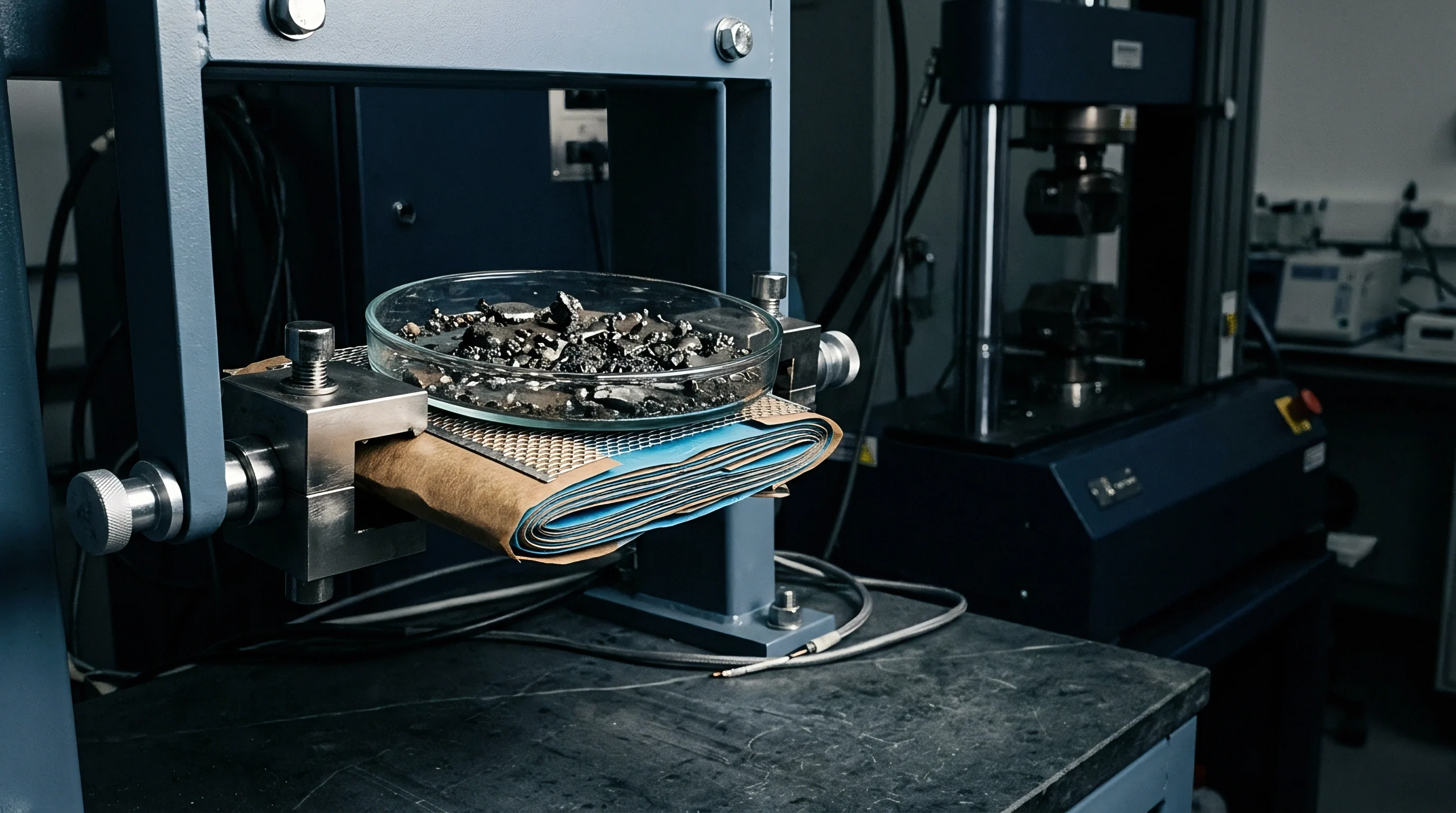
Microstructural degradation in high-nickel secondary particles appears as separation along primary grain boundaries. Accumulated anisotropic stress from repeated lithium cycling generates microcrack networks throughout the spherical agglomerates, degrading particle integrity and accelerating capacity fade.
Microcrack Propagation in Agglomerated Secondary Particles
Stress concentrated at anisotropic grain junctions quickly exceeds the fracture resistance of adjacent primary crystal faces. Cracks nucleate near the particle core, where radial crystallite packing concentrates stress most densely, and propagate outward under cycling. As these fissures open, liquid electrolyte draws into the interior by capillary action, contacting fresh primary particle surfaces.
- Anisotropic lattice contraction induces concentrated shear stresses along primary particle grain boundaries above 4.15 V.
- Intergranular tension exceeds boundary adhesion energy, initiating microscopic separation at internal primary grain junctions.
- Cracks propagate radially outward toward the secondary particle exterior under repeated electrochemical cycling.
- Liquid electrolyte penetrates deep into internal voids, triggering parasitic chemical reactions with reactive tetravalent nickel ions.
- Thick resistive solid electrolyte interphase films grow inside particle interiors, causing rapid capacity decay.
Reducing primary particle size below three hundred nanometers distributes anisotropic strain and prevents intergranular microcracking.
Direct contact between internal primary grains and electrolyte triggers immediate surface reconstruction, converting active layered oxide into electrochemically inactive rock-salt phases. This parasitic reaction consumes active lithium, releases oxygen gas into internal voids, and forms resistive surface films inside the core.

Does Doping Suppress Grain Boundary Fracture in Recycled Stock?
Introducing zirconium, titanium, or aluminum during precursor synthesis creates strong metal-oxygen bonds that stabilize the lattice framework. Cation dopants adjust the electronic structure, easing c-axis collapse during high-voltage charging. Grain boundary engineering can also coat primary crystallites with fast-ion conducting interphases to increase fracture toughness, though whether these coatings and passivating agents prevent cracking in recycled material above 4.3 V remains unsettled.


Inspection
Evaluating internal mechanical breakdown without opening cells requires diagnostic workflows that connect microscale lattice strain to macroscale cell fade. Quality control programs combine high-resolution imaging with differential capacity tracking.

Diagnostic Screening of Recycled Cathode Lots
Acoustic emission sensors attached to test cells capture stress waves released when internal grain boundaries separate during formation cycles, while differential capacity analysis turns standard charge curves into clear electrochemical markers of phase shifts caused by non-uniform lattice strain.
- Differential capacity analysis tracks the evolution of the H2-H3 redox peak voltage shift to identify early lattice strain accumulation.
- Focused ion beam cross-sectioning exposes internal particle porosity and microcrack volume fractions across fifty representative secondary agglomerates per batch.
- Electrochemical impedance spectroscopy monitors high-frequency charge transfer resistance growth associated with internal solid electrolyte interphase buildup.
Under IEC 62660-3 qualification rules, cell lots exhibiting charge transfer impedance growth exceeding twenty percent over one hundred cycles face immediate shipment rejection.
Cross-sectional void fraction analysis offers direct physical evidence of damage, using automated imaging to measure fractured grain boundary length against total intact boundary area to produce a standardized microcrack index for lot screening.
Material procurement contracts set a ceiling of two percent internal crack volume fraction after fifty formation cycles, placing the financial risk of particle failure on the recycler.

Tolerance
Economic assessments weigh the initial purchase discount of recycled powders against long-term warranty exposure. Although recycled high-nickel cathode sells five to twelve percent below virgin pricing, greater vulnerability to intergranular cracking creates substantial commercial exposure for cell integrators and storage operators.

Commercial Impact and Landed Cost Arithmetic
Determining the levelized cost of storage requires translating mechanical lattice degradation directly into warranty reserve requirements, as illustrated by a fifty metric tonne procurement of recycled NMC811 cathode active material for commercial energy storage.
At a powder price of twenty-eight dollars per kilogram, the initial material outlay is one million four hundred thousand dollars, yielding roughly twenty-eight megawatt-hours of nominal storage capacity. Baseline models for virgin NMC811 project an operating lifespan of two thousand two hundred cycles before capacity drops to eighty percent of its initial rating.
Grade A recycled cathode with controlled impurities (under fifty ppm sodium, under one hundred ppm sulfate) shows minimal strain amplification, delivering two thousand fifty cycles to eighty percent state of health. Unscreened Grade B powder with higher residual contamination undergoes earlier c-axis collapse and severe microcracking, reaching eighty percent state of health after only one thousand two hundred fifty cycles.
| Material Parameter | Virgin NMC811 | Grade A Recycled NMC811 | Grade B Recycled NMC811 |
|---|---|---|---|
| Powder Cost ($/kg) | 31.50 | 28.00 | 25.00 |
| Initial Batch Investment ($) | 1,575,000 | 1,400,000 | 1,250,000 |
| Cycles to 80% SoH (100% DoD) | 2,200 | 2,050 | 1,250 |
| Lifetime Delivered Energy (MWh/tonne) | 1,120 | 1,040 | 635 |
| Levelized Cost of Storage ($/kWh-cycle) | 0.048 | 0.046 | 0.067 |
| Warranty Reserve Penalty ($/kWh) | 0.00 | 4.50 | 22.00 |
Electrochemical capacity retention curves stay flat until internal particle cracking reaches a critical void fraction threshold.
Buying unverified recycled high-nickel cathode without binding microstructural strain limits risks premature capacity fade, elevated warranty reserves, and reduced operating returns across storage installations.