Spatial Salt Precipitation and Polarization Gradients in High Mass Anodes under Extreme Sub-Zero Charging
Sub-zero charging of high mass anodes causes localized salt precipitation and lithium plating, demanding strict mass loading caps and pre-heating protocols.
Choke
Below minus twenty degrees Celsius, solvent viscosity in standard carbonate electrolytes jumps by over an order of magnitude, pulling liquid-phase ionic conductivity down from around ten millisiemens per centimeter at room temperature to under zero point five. In anodes loaded beyond three point five milliamp-hours per square centimeter, this collapse imposes severe transport limits across the porous electrode matrix, further complicated by the high activation energy needed for lithium-ion desolvation at the particle surface.
During low-temperature charging, liquid-phase diffusion cannot keep ion availability uniform across the depth of the pores. Current flow rapidly consumes lithium ions at particle surfaces near the separator, but mass transfer through the narrow, tortuous pore channels fails to replenish them from the bulk solution quickly enough. Consequently, electrolyte concentration near the copper current collector falls toward zero while the solution near the separator becomes hypersaturated.
As liquid diffusion collapses, rising viscosity increases transport drag until local pore saturation halts ionic movement altogether.
| Temperature (°C) | Ionic Conductivity (mS/cm) | Viscosity (mPa·s) | LiPF6 Solubility Limit (M) | Diffusion Coefficient (cm²/s) |
|---|---|---|---|---|
| 25 | 10.8 | 4.2 | 2.8 | 3.2 × 10⁻⁶ |
| -10 | 3.1 | 12.6 | 2.1 | 8.4 × 10⁻⁷ |
| -20 | 1.2 | 28.4 | 1.6 | 2.1 × 10⁻⁷ |
| -30 | 0.3 | 64.1 | 1.1 | 4.5 × 10⁻⁸ |
| -40 | 0.08 | 142.0 | 0.7 | 8.2 × 10⁻⁹ |
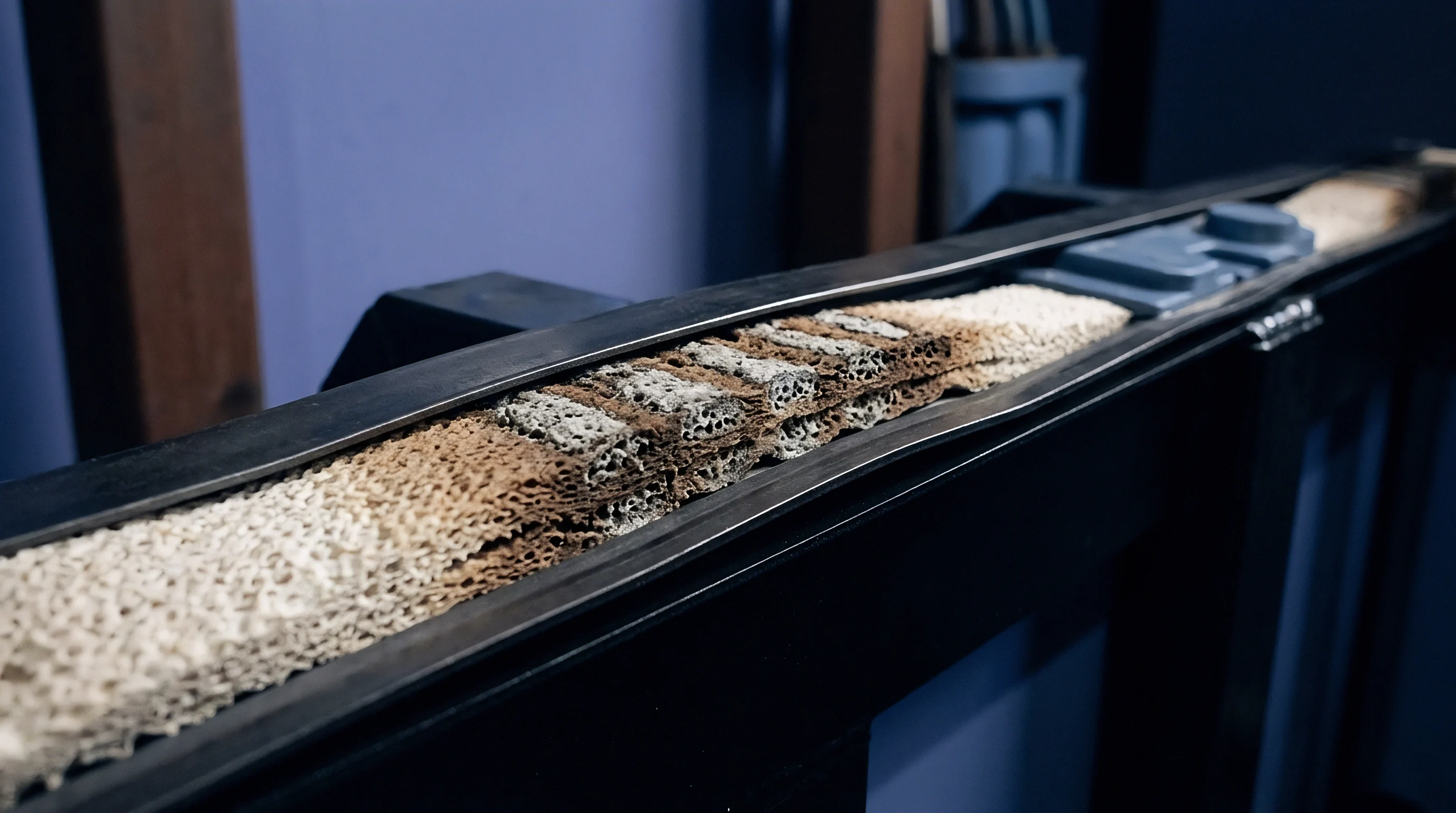
Decreasing temperatures also lower salt solubility. Once local salt concentration exceeds the temperature-dependent saturation threshold, lithium salt crystals precipitate inside the inter-particle pores. This solid precipitate cuts effective porosity and raises tortuosity, establishing a self-reinforcing transport bottleneck where occluded pores force current density to spike through the few remaining liquid channels.
Mass transfer through electrolyte pores controls sub-zero charge acceptance long before charge-transfer kinetics limit the intercalation reaction.
Cold-weather charging failures are frequently attributed to battery management system programming errors rather than established pore saturation limits.
Lithiation
During sub-zero charging, thick graphite electrodes with areal capacities above three point five milliamp-hours per square centimeter develop severe potential drops through their thickness. Although electronic conductivity through the graphite matrix and copper collector stays high, ionic resistance in the liquid phase dominates total cell impedance, shifting the primary reaction zone almost entirely to the front face of the electrode near the separator.
Local state of charge diverges sharply through the depth of a high-mass anode. Particles at the separator interface experience rapid lithium insertion and reach local saturation, while deeper particles near the current collector stay largely unreacted. These spatial polarization gradients drive uneven lattice expansion, generating steep mechanical stress across the coating thickness.
Thick anode architectures compound these spatial gradients, accelerating salt precipitation directly at the separator interface.
- Local pore clogging occurs when salt crystallization at the separator interface completely blocks liquid transport pathways into the deeper electrode structure.
- Interfacial interphase growth accelerates due to continuous parasitic reactions with localized hyper-concentrated salt complexes under high overpotential.
- Collector foil shear develops from extreme differential volumetric expansion between the fully lithiated surface layer and the unreacted base layer.
- Separator compression results from localized active material swelling against the rigid cell casing under asymmetric spatial expansion.
Solid-state diffusion inside individual graphite particles slows by two orders of magnitude at minus twenty degrees Celsius. Lithium builds up at particle surfaces faster than it can diffuse into bulk intercalation sites, driving up the surface state of charge and elevating local surface potential. This surface saturation diminishes the thermodynamic driving force for continued intercalation, driving local potential down toward zero volts relative to metallic lithium.
Electrode thickness governs sub-zero charge acceptance far more than adjustments to nominal rate capability.
Plating
When localized liquid-phase potential drops below zero volts relative to metallic lithium, metallic deposition competes directly with intercalation. High polarization gradients in thick electrodes drive the front-face potential into negative values while deeper regions stay well above zero, causing metallic lithium to nucleate on the graphite surface near the separator as dendrites and mossy metallic deposits.
As intercalation kinetics stall near zero volts, metallic deposition takes over as the primary reaction path.
Salt precipitation and metallic deposition reinforce one another in a degradation loop. Precipitated crystals narrow local ionic pathways, driving up overpotential and pushing adjacent graphite surfaces below the deposition threshold. At the same time, growing metallic deposits consume active lithium, lower coulombic efficiency, and physically disrupt the solid electrolyte interphase layer.
At minus twenty degrees Celsius, an anode mass loading of four milliamp-hours per square centimeter exhibits metallic deposition within four minutes of initiating a zero point two C charge step.
Three charging scenarios for a four milliamp-hour per square centimeter anode at minus twenty degrees Celsius illustrate the operational boundary. At zero point zero five C, local liquid-phase polarization stays bounded at positive forty millivolts, preventing metallic deposition. Raising the rate to zero point one C drives surface potential to negative fifteen millivolts within twelve minutes, causing a two point three percent capacity loss per hundred cycles through active lithium isolation.
At zero point two C, surface potential drops to negative one hundred twenty millivolts almost immediately, causing an eighteen percent permanent capacity loss over ten cycles and creating a risk of localized short circuits.
Uncontrolled metallic deposition leads to internal short circuits, creating severe thermal runaway hazards and major financial losses for pack integrators.

Diagnosis
Electrochemical impedance spectroscopy across variable temperature sweeps separates liquid diffusion resistance from solid-state charge transfer. Low-frequency arcs expand rapidly at sub-zero temperatures, reflecting combined salt diffusion limits and pore occlusion, while sudden jumps in the high-frequency ohmic intercept signal the onset of salt precipitation in the bulk electrolyte.
What Diagnostic Signal Separates Salt Precipitation from Lithium Plating?
Voltage relaxation curves after cold charging provide distinct signatures for each mechanism. Dissolving salt produces a smooth, single-exponential voltage recovery driven by concentration gradient dissipation, whereas metallic lithium plating produces an inflection point or voltage plateau during open-circuit rest as deposited metal chemically intercalates into the graphite matrix.
Sharp spikes in cell impedance mark these internal transitions, which voltage relaxation measurements can resolve.
- Transfer the degraded cell into an argon-filled glovebox operating below zero point one parts per million moisture and oxygen content.
- Discharge the cell slowly to zero volts at ambient temperature to stabilize mobile ionic species prior to structural teardown.
- Extract cross-sectional anode samples from separator-adjacent and foil-adjacent zones using a cryogenic microtome to prevent thermal structural alterations.
- Measure fluorine and phosphorus elemental ratios across the sample depth using energy-dispersive X-ray spectroscopy to map salt precipitation zones.
Whether high-frequency AC voltage pulsation can dissolve localized salt precipitates before permanent metallic nucleation takes place remains an open technical question across testing facilities.
Thermalization
Active self-heating uses high-frequency alternating current to generate internal ohmic heat without altering net chemical state. Frequencies above one kilohertz prevent sustained directional ion migration, eliminating mass transfer gradients while heating the electrolyte and active particle network uniformly. This rapid internal warming lowers viscosity and redissolves precipitated salts before high DC charging currents are applied.
While cold charging rapidly degrades cell capacity, targeted active heating bypasses these transport limitations.
| Mitigation Strategy | Heating Rate (°C/min) | Energy Overhead (%) | Plating Risk Profile | Implementation Cost ($/kWh) |
|---|---|---|---|---|
| Direct DC Pre-Heating | 0.4 | 8.5 | High | 2.10 |
| High-Frequency AC Internal | 3.2 | 3.1 | Minimal | 14.50 |
| Step-Down DC Profile | 0.0 | 0.0 | Moderate | 0.00 |
| External PTC Blanket | 0.8 | 12.0 | Low | 22.00 |
Dynamic step-down profiles adjust incoming current based on real-time temperature and estimated surface ion concentrations. Matching current input to calculated diffusion limits prevents surface potential from dropping below zero volts while maximizing charge intake, though implementation requires accurate onboard electrochemical models that calculate localized overpotentials under changing ambient conditions.
Compliance with UN 38.3 transport testing demands non-destructive verification following sub-zero charge cycles to confirm structural electrode stability.
Standard procurement agreements specify explicit warranty coverage for cell capacity retention down to minus thirty degrees Celsius, provided operation stays strictly within approved internal heating profiles.
Constraints
Selecting cells for cold-climate industrial energy storage requires balancing initial gravimetric density against sub-zero operating life to protect financial returns. High mass-loading electrodes show high volumetric energy density on datasheets, but impose severe limits in cold conditions. Meanwhile, oversizing thermal management systems or adding active heating circuits lowers net system energy density and adds substantial capital cost.
Fluctuating tariff adjustments further alter landed costs across supply lines.
Landed cost calculations must account for field replacement risks tied to cold-temperature degradation. Choosing lower areal mass loading requires more active foil, separator area, and casing material per kilowatt-hour, raising upfront cell costs by seven to twelve percent. However, that higher initial spend lowers internal transport impedance, avoiding expensive high-frequency heating electronics and preventing premature warranty replacements in sub-zero field deployments.
Sub-zero energy retention claims on cell technical datasheets frequently omit the severe cycle life degradation caused by localized electrolyte depletion.
- Areal capacity capping restricts electrode design parameters to three milliamp-hours per square centimeter for unheated low-temperature systems.
- Electrolyte formulation audit verifies the inclusion of low-viscosity ester co-solvents and specialized low-temperature lithium salts.
- Separator porosity specification establishes strict tortuosity limits to prevent localized overpotential concentration spikes.
- Warranty penalty alignment links cell replacement cost obligations directly to recorded sub-zero charging histories extracted from system logs.
Overall landed costs for sub-zero energy storage favor electrode designs that preserve transport margins over those that optimize ambient density metrics. Effective procurement frameworks evaluate transport impedance curves at minimum operating temperatures rather than relying on room-temperature baseline ratings.