Viscoelastic Stress Relaxation and Pore Closure Kinetics in Sub-Seven Micron Polyolefin Separators under Continuous Dynamic Compression
Dynamic stack pressure induces irreversible viscoelastic pore collapse in sub-seven micron separators, doubling ionic resistance and accelerating lithium plating.
Squeeze
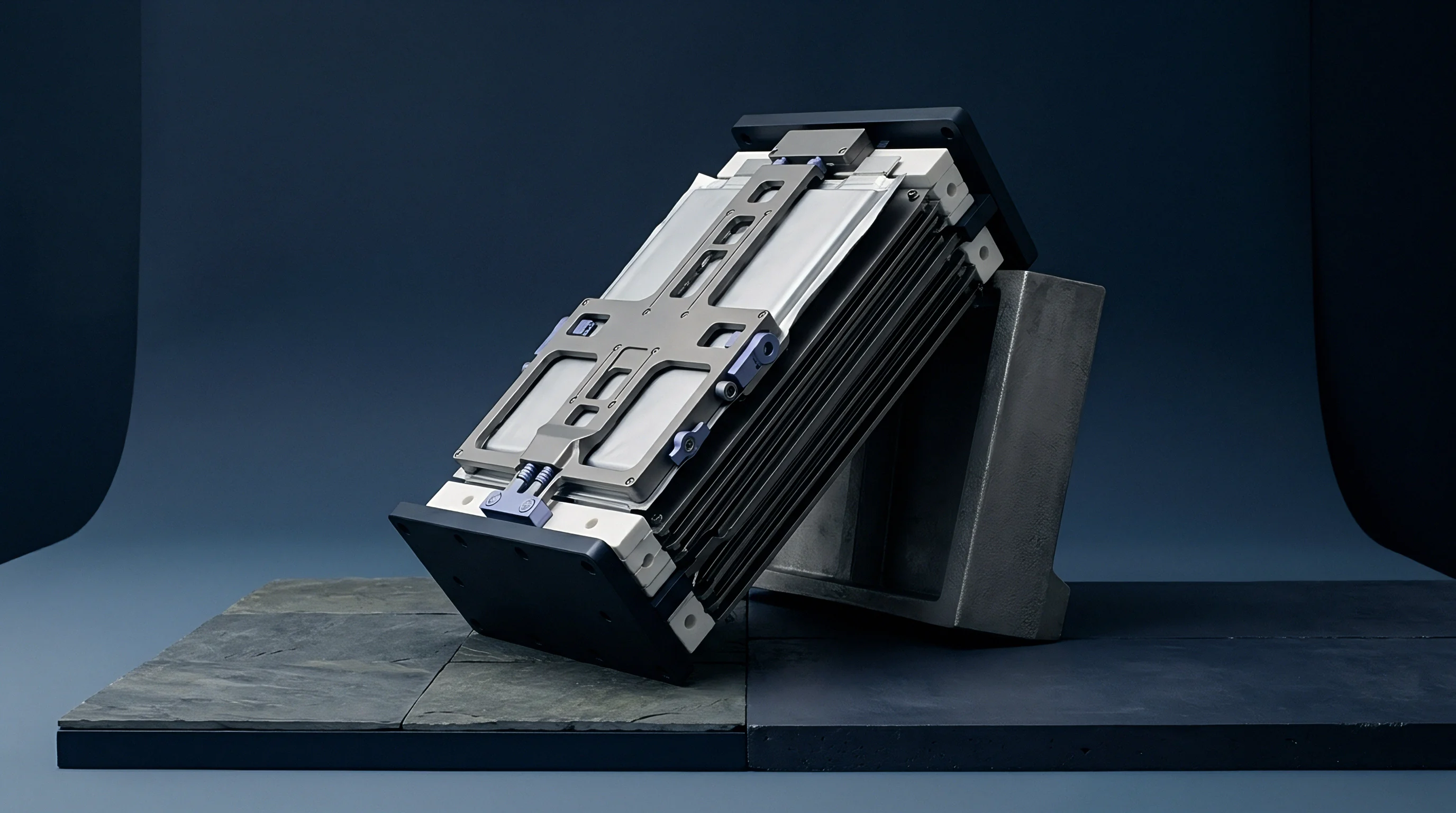
Fresh incoming cells using five-micron wet-process polyethylene membranes enter receiving inspection with nominal thicknesses specified to tolerances of plus or minus 0.5 microns. Pouch and prismatic cell designs pack dozens of alternating electrode layers into tightly constrained enclosures where anode breathing exerts sustained mechanical force. Silicon-blended graphite anodes expand between eight and twenty-five percent during charge cycles, driving cell-internal stack pressures from an initial assembly clamp level of 0.2 Megapascals to peaks exceeding 1.5 Megapascals.
Thin polyolefin membranes cushion this expansion directly between rigid active material faces. Thin separators afford little margin.
The separator layer functions as both the electronic insulator and the ion-permeable path between working electrodes. Commercial sub-seven micron membranes rely on biaxially stretched ultra-high molecular weight polyethylene or polypropylene networks, featuring initial porosities between thirty-six and forty-eight percent and mean pore diameters between twenty-five and forty-five nanometers. Compressive stress drives instantaneous elastic deformation across the porous web, followed by time-dependent plastic strain as oriented polymeric fibrils slide and rotate under transverse loading.
Silicon swells during lithiation. Stack pressure climbs immediately.
A wet-process five-micron polyethylene separator retains barely eighty-two percent of its original thickness after one thousand full cycles under two Megapascals of restraining pressure.
Continuous dynamic compression generates structural shifts across the separator bulk, altering the transport pathways that support high-rate lithium-ion transfer. When the cell stack cycles between lithiated and delithiated states, mechanical work converts into microstructural distortion. Unchecked mechanical compaction creates distinct failure pathways within the active stack:
- MacMullin number escalation restricts lithium-ion transport through narrowed tortuous channels, elevating cell overpotentials during fast-charge steps.
- Pin-point creep indentation develops where oversized active material secondary agglomerates penetrate the compressed sub-seven micron membrane.
- Localized transverse fibril rupture exposes direct electronic conduction paths between opposing electrode coatings, initiating soft short circuits.
Underestimating the viscoelastic yield point of ultra-thin membranes results in premature capacity termination when accelerating ionic resistance trips the lower discharge voltage cutoff during nominal operation.
Modulus
Dynamic mechanical thermal analysis reveals pronounced time-temperature-stress superposition in sub-seven micron separator grades. The oriented crystallites of high-density polyethylene undergo alpha-relaxation processes between forty and sixty degrees Celsius, precisely matching the upper operational boundary of automotive and consumer electronics duty cycles. Viscoelastic stress relaxation follows a generalized Maxwell-Wiechert configuration, wherein an initial instantaneous modulus degrades through parallel spring-dashpot elements toward an equilibrium plateau.
Yield begins at microvoid junctions. Over continuous cycling, the membrane loses mechanical resistance to localized active material penetration.
Will Cyclic Compression Accelerate Microstructural Pore Collapse?
Mechanical stress cycles amplify the relaxation rate relative to static dwell conditions. Alternating stress waveforms induce micro-scale mechanical fatigue across individual polymer fibrils spanning adjacent voids. At twenty-five degrees Celsius, a pristine six-micron wet-process polyethylene separator exhibits an initial transverse compressive modulus of one hundred forty Megapascals under rapid indentation rates.
As cyclic loading accumulates over hundreds of hours, stress relaxation dissipates sixty percent of the initial restraining counter-force within the first two hundred hours of continuous alternating load. Pores collapse irreversibly.
| Separator Grade and Architecture | Initial Thickness (microns) | Equilibrium Modulus Retention (%) | Relaxation Time Constant Tau (hours) | Irreversible Plastic Strain (%) |
|---|---|---|---|---|
| Wet-Process UHMWPE Monolayer | 5.0 +/- 0.3 | 38.4 | 42.1 | 14.8 |
| Wet-Process UHMWPE with 1.0 micron Al2O3 Coating | 6.0 +/- 0.4 | 54.2 | 88.6 | 9.1 |
| Dry-Process PP/PE/PP Trilaminate | 6.5 +/- 0.5 | 44.7 | 51.3 | 12.6 |
| Wet-Process UHMWPE with Boehmite Double Coating | 7.0 +/- 0.4 | 62.1 | 112.4 | 6.5 |
Oriented molecular chains within dry-process membranes slip under transverse loads due to slit-like pore geometries formed by uniaxial cold and hot drawing. Wet-process membranes exhibit interconnected sponge morphologies that distribute compressive stresses across multidirectional tie molecules, extending the relaxation time constant. Ceramic surface coatings act as stress-distributing mechanical skins, absorbing local shear forces from active material facings before compressive deformation reaches the polyolefin base sheet.
Datasheet tensile modulus figures measured along the machine direction provide zero correlation to transverse compressive creep under cyclic stack loading.
Material suppliers defend membrane thinning claims by asserting that standard puncture strength values satisfy all applicable separator specifications without acknowledging that static puncturing ignores cyclic viscoelastic flow.
Permeability
Ionic conduction through the separator depends on the Carman-Kozeny relationship between fluid flow, internal porosity, and path tortuosity. As viscoelastic deformation flattens pore throats, the effective ionic conductivity of the liquid electrolyte trapped within the separator drops in direct proportion to the square of the tortuosity increase. Air permeability tests, recorded as Gurley values representing the time in seconds for one hundred cubic centimeters of air to pass through a square inch of membrane under fixed pressure, serve as the primary incoming verification metric for separator microstructure.
Gurley seconds rise systematically as cyclic compression densifies the polymer matrix.
| Cycling Duration (Equiv. Cycles) | Baseline Gurley Value (sec/100cc) | Compressed Gurley Value (sec/100cc) | MacMullin Number (Dimensionless) | Areal Ionic Resistance (Ohm-cm2) |
|---|---|---|---|---|
| 0 (Uncycled Pristine) | 115 +/- 8 | 115 +/- 8 | 4.2 | 0.78 |
| 250 Cycles | 115 +/- 8 | 148 +/- 11 | 5.6 | 1.04 |
| 500 Cycles | 115 +/- 8 | 186 +/- 14 | 7.1 | 1.32 |
| 1000 Cycles | 115 +/- 8 | 242 +/- 19 | 9.4 | 1.75 |
The MacMullin number characterizes the ratio of electrolyte-filled separator resistance to the resistance of the pure electrolyte occupying identical geometric boundaries. Sub-seven micron separators display baseline MacMullin numbers between 3.8 and 4.5. Following one thousand full discharge and charge cycles under dynamic compression, pore closure pushes this metric past 9.0.
Resistance spikes across the stack.
A doubling of separator MacMullin number during cyclic operation cuts the permissible continuous fast-charge C-rate by forty percent.
Polymer flow shrinks sub-micron void necks while leaving larger inner cavities relatively uncompressed, creating a funnel geometry that restricts ion migration without showing equivalent bulk volume reduction. This non-uniform closure generates profound localized current density variations across the electrode face, encouraging accelerated lithium dendrite growth directly adjacent to compacted zones. The baseline shifts permanently.
Whether microstructural pore closure reaches an absolute mechanical equilibrium state before localized transport choke triggers surface lithium deposition remains an open engineering question.
Fatigue
Repeated swelling cycles generate localized micro-fibril buckling at the interfaces between crystalline lamellae and amorphous tie regions. Dynamic loads induce cyclic plastic strain even when maximum stack stress remains below the nominal static yield threshold of the polyolefin resin. Ceramic nanoparticle coatings mitigate this fatigue by spreading contact points across hundreds of micro-scale contact sites.
Heat accelerates the mechanical collapse. At elevated operating temperatures, polymer chain mobility increases, hastening fibril rotation and pore neck narrowing under oscillating compressive vectors.
Are Plastic Strains Reversible during Extended Rest?
Extended storage without compressive load allows minimal elastic recovery of the original membrane thickness, leaving over eighty percent of compressive deformation intact as permanent plastic set. Rest periods allow trapped viscoelastic stress to relax, reducing internal counter-force without restoring collapsed pore channels. Anode expansion continues to crush the membrane with every subsequent charge step.
Verification of separator durability under cyclic mechanical loading proceeds through a defined mechanical sequence:
- Mount pristine separator discs between polished twenty-millimeter stainless steel compression platens within an environmental test chamber set to forty-five degrees Celsius.
- Apply a baseline static preload of 0.2 Megapascals for sixty minutes to allow initial thermal and mechanical equilibrium across the test fixture.
- Superimpose a sinusoidal compressive stress cycling between 0.3 Megapascals and 1.8 Megapascals at a test frequency of 0.1 Hertz for fifty thousand continuous cycles.
- Extract the separator disc and measure immediate post-test thickness using a micro-force digital dial gauge applying 0.05 Newtons of contact force.
- Perform Gurley air permeability verification in accordance with standard ASTM D726 test parameters to quantify permanent pore restriction.
- Measure high-frequency electrochemical impedance spectroscopy across the frequency band from one hundred kilohertz to ten millihertz using symmetrical coin cell fixtures filled with standard LP57 electrolyte.
Fibrils buckle under shear. When ceramic particles debond from the polyolefin substrate during cyclic flexure, loose mineral fragments migrate into open pore channels, producing localized ionic blockades. Mechanical compliance settles the dispute.
Separator fatigue lives shorten by half for every ten-degree Celsius increase in pack operational temperature above thirty degrees.
Settlement
Cell pack enclosures contain internal stack dilation through rigid perimeter structures, tensioned steel tie bands, or integrated elastomeric spring pads. Mechanical engineers select compressible polyurethane or silicone foams to balance the trade-off between minimum clamp pressure to prevent layer delamination and maximum peak pressure to protect thin separators from crushing. Thin sub-seven micron separators compress by twelve to twenty percent over life, shifting the internal dimension stack-up and relaxing the tension maintained by the external pack enclosure.
| Pack Restraint Mechanism | Nominal Cell Count in Stack | Initial Bolted Clamp Pressure (MPa) | Separator Thickness Loss Stack-up (microns) | End-of-Life Stack Pressure (MPa) |
|---|---|---|---|---|
| Rigid Aluminum Endplates with Steel Tie Rods | 24 | 0.30 +/- 0.05 | 28.8 +/- 4.2 | 0.08 +/- 0.03 |
| Microcellular Polyurethane Foam Pads (0.8 mm) | 24 | 0.30 +/- 0.05 | 26.4 +/- 3.8 | 0.22 +/- 0.04 |
| High-Damping Silicone Elastomer Sheets (1.0 mm) | 24 | 0.35 +/- 0.05 | 24.0 +/- 3.5 | 0.26 +/- 0.03 |
Rigid containment architectures experience substantial pressure loss as separators creep, leaving individual cell pouches free to shift, vibrate, and wear during vehicle movement. Elastomeric cushioning absorbs the volumetric growth of swelling anodes while sustaining necessary baseline clamp forces across the entire operating life of the pack. Foam springs govern stack expansion.
Lithium plating follows localized choke.
Master purchase agreements must link cell end-of-life internal resistance guarantees to a strict maximum pack restraint stiffness specification.
Standard incoming cell supply agreements specify separator puncture strength under ASTM F1306 conditions, but omitting an explicit dynamic creep retention clause leaves the pack integrator financially liable for cell end-of-life impedance rise driven entirely by separator pore collapse.