Actuarial Evaluation of Lithium Battery Manufacturing Defect Probability Models
Actuarial defect models price tail-risk exposures by replacing zero-defect assumptions with compound Poisson-Weibull distributions and contractual escrow sizing.


Incidence
Commercial-volume cell production lines generate a quantifiable baseline of latent defects. Even when factories set zero-defect goals, automated winding, coating, and slitting operations produce physical irregularities at measurable parts-per-million rates. Actuarial evaluation models treat these anomalies as stochastic occurrences described by discrete probability distributions, using the Poisson distribution as the baseline frequency model for rare, independent defect events across massive batch volumes.
When evaluating large multi-megawatt-hour shipments containing hundreds of thousands of individual cylindrical or prismatic units, the probability P of finding k defective cells in a production lot of size N follows mathematical rules determined by the mean defect rate lambda.
Defect occurrence rates in Tier 1 automated manufacturing facilities historically settle between 0.1 and 1.0 parts per million for critical safety defects capable of inducing internal short circuits. Tier 2 and Tier 3 facilities often operate with defect frequencies ranging between 5 and 25 parts per million. These differences alter warranty claim exposures, field recall likelihoods, and loss reserves.
Latent flaws escape detection during factory acceptance screening because inline dry testing, open-circuit voltage tracking, and room-temperature aging isolate only gross defects.
Cell populations demonstrating a Weibull shape parameter below 0.6 exhibit ninety percent of manufacturing-induced short circuits within the initial two hundred equivalent full cycles.
Statistical validation of defect rates below one part per million presents physical verification challenges. Verifying a 0.5 part-per-million defect frequency with a ninety-five percent statistical confidence level demands destructive testing of approximately six million consecutive units without a single observed failure. Manufacturers rely instead on surrogate metrology, inline machine vision, and accelerated screening on sampled coupons.
Actuarial models adjust for this empirical gap by applying Bayesian updating techniques, merging historical line capability data with lot-specific process metrics.

Poisson Distribution Limits in High Volume Production
Factory acceptance tests apply sampling tables from ISO 2859-1 to verify batch quality, but these standard acceptance sampling plans define acceptable quality limits that fail to protect buyers of high-energy battery installations. An acceptance quality limit of 0.065 percent permits hundreds of defective cells per million to enter the commercial supply channel. Utility-scale battery energy storage systems aggregate tens of thousands of series-connected cells into unified containers, where a single cell thermal runaway event threatens the entire financial asset.
Actuarial risk pricing structures cell defect probability through zero-truncated Poisson models when modeling compound loss scenarios. When a single latent cell flaw triggers adjacent cell propagation, the commercial loss is non-linear. The Poisson parameter lambda scales directly with total energy deployed.
A 100-megawatt-hour installation built from 100-ampere-hour prismatic cells contains roughly 270,000 cells. At a defect incidence rate of one part per million, the mathematical expectation indicates a twenty-four percent probability that at least one critical internal defect exists within the operational pack array.

Weibull Slope Parameters for Latent Flaws
Statistical life data separates infant mortality from random operational failures through power-law trend lines. The two-parameter Weibull distribution models the time-to-failure metric of battery populations under operational stress. The shape parameter, beta, dictates the failure mechanism classification.
Manufacturing-induced defects manifest as early-life failures characterized by beta values strictly below 1.0, frequently grouping between 0.35 and 0.65. Wear-out mechanisms, including solid electrolyte interphase growth and lithium inventory loss, exhibit beta values ranging from 2.5 to 4.5.
Latent manufacturing anomalies do not trigger failure at time zero. Particle contaminants, foil tears, and separator pinholes require environmental and electro-chemo-mechanical excitation before bridging the cathode and anode. As cells undergo charge-discharge cycling, volumetric expansion and contraction of active materials exert cyclical mechanical stress across the internal stack.
This progressive mechanical degradation drives the latent manufacturing defect to catastrophic failure, generating a distinct infant mortality signature during the initial eighteen months of field operation.
| Defect Mechanism | Physical Scale | Baseline Rate (PPM) | Inline Detection Mechanism | Weibull Shape Beta |
|---|---|---|---|---|
| Metallic Burrs from Slitting | 15 to 45 micrometers | 0.45 | Automated Optical Inspection | 0.42 |
| Foreign Particle Contamination | 5 to 25 micrometers | 0.80 | Magnetic Separation, Vision | 0.55 |
| Active Material Delamination | 0.5 to 2.0 millimeters | 1.20 | Inline Laser Thickness Scanning | 0.78 |
| Separator Crease or Pinholes | 10 to 80 micrometers | 0.25 | High-Voltage Spark Testing | 0.38 |
| Tab Weld Spatter Ejection | 20 to 60 micrometers | 0.60 | X-ray Radiography | 0.48 |
| Data derived from cross-checked Tier 1 production metrology audits and published cell reliability failure analyses under normal operational temperatures. | ||||
Actuaries construct compound hazard functions combining infant mortality Weibull distributions with wear-out distributions. The resulting bathtub hazard curve establishes warranty reserve requirements across each year of operational life. Early financial exposure concentrates within the initial two hundred equivalent full cycles, where the low-beta manufacturing defect subpopulation clears the system.


Burr
Electrode slitting with mechanical shear cutters generates micro-scale metallic debris. Over millions of cut meters, tungsten carbide slitting knives experience progressive edge degradation, micro-chipping, and wear. As knife edges dull, clean shearing gives way to ductile tearing, creating projecting metal burrs along the foil edge and liberating detached conductive flakes.
Cathode slitting creates aluminum burrs, while anode slitting creates copper burrs. These metallic intrusions penetrate the porous polyolefin separator over time under mechanical stack pressure.
Physical particle dimensions dictate internal short-circuit probability. Separator membranes typically exhibit thicknesses between 9 and 16 micrometers in energy-dense cells. A metallic slitting burr or detached copper particle exceeding 15 micrometers presents an immediate threat to dielectric insulation.
The localized stack pressure exerted by pouch cell vacuum packaging or prismatic cell can winding forces the hard metallic particle through the polymer matrix. When the burr contacts the opposing electrode, an electrical bridge forms, initiating self-discharge.
Inline optical scanners capture planar foil blemishes while failing to detect particles embedded between wound electrode turns.
Inline high-speed optical inspection systems resolve planar surface defects down to approximately 20 micrometers at production line speeds of 60 to 90 meters per minute, but embedded particles sitting beneath the active material coating layer evade optical cameras entirely. Inline X-ray inspection checks tab welds and jelly roll alignment but lacks spatial resolution to identify 10-micrometer conductive particles distributed across extensive electrode areas.

Why Do Factory Inline Tests Miss Flaws?
Production line speeds exceeding eighty meters per minute constrain optical scanner exposure windows. Camera integration times must drop to fractions of a millisecond, raising image noise thresholds and preventing reliable detection of microscopic metallic specks. High-voltage spark testing applies an electrostatic potential between bare foil and coated surfaces prior to electrolyte filling to detect dielectric breakdowns.
This test identifies existing physical voids or complete punctures in the separator, but leaves partial penetrations and embedded inclusions unaffected because the breakdown voltage of the intact separator margin exceeds the applied test potential.
Electrolyte wetting adds another layer of metrology opacity. Once electrolyte fills the cell cavity and wetting completes, high-voltage dry testing becomes impossible. End-of-line quality verification relies on short-duration open-circuit voltage drop measurements during room-temperature and elevated-temperature aging.
A microscopic metallic inclusion encased in passive binder material often exhibits minimal initial electrical leakage, generating a voltage drop indistinguishable from normal self-discharge variations. The cell passes end-of-line grading criteria, receives a Class A certificate, and departs the factory.

Separator Puncture Mechanics and Overhang Deficits
Geometric misalignment between positive and negative active coatings exposes raw foil borders to dendrite formation. Automated assembly tools must maintain electrode positioning tolerances within plus or minus 0.5 millimeters. Anode overhang ensures that the negative electrode overhangs the positive electrode boundary across all dimensions.
If mechanical guidance drift reduces the anode overhang margin below design limits, lithium ions migrating from the cathode during high-rate charging find no unoccupied anode host sites. These unaccommodated ions deposit as metallic lithium plating along the edge border.
- Slitting burr displacement occurs under continuous internal pressure when the jelly roll expands during initial formation, driving metal points directly into the separator structure.
- Conductive particle migration proceeds under intense localized electrostatic gradients, pulling loose copper fragments toward pinhole sites within the porous separator.
- Cathode overhang deficit creates unaligned edge zones where high current density fields precipitate localized lithium plating and dendrite growth.
- Ceramic coating fracture takes place along tight mandrel winding radii, peeling alumina nanoparticles away from the polymer backing and eliminating the secondary heat shield.
Suppliers routinely dismiss low-level self-discharge anomalies identified during container integration, attributing elevated millivolt drops to incomplete thermal stabilization after transit rather than separator compromise.

Strain
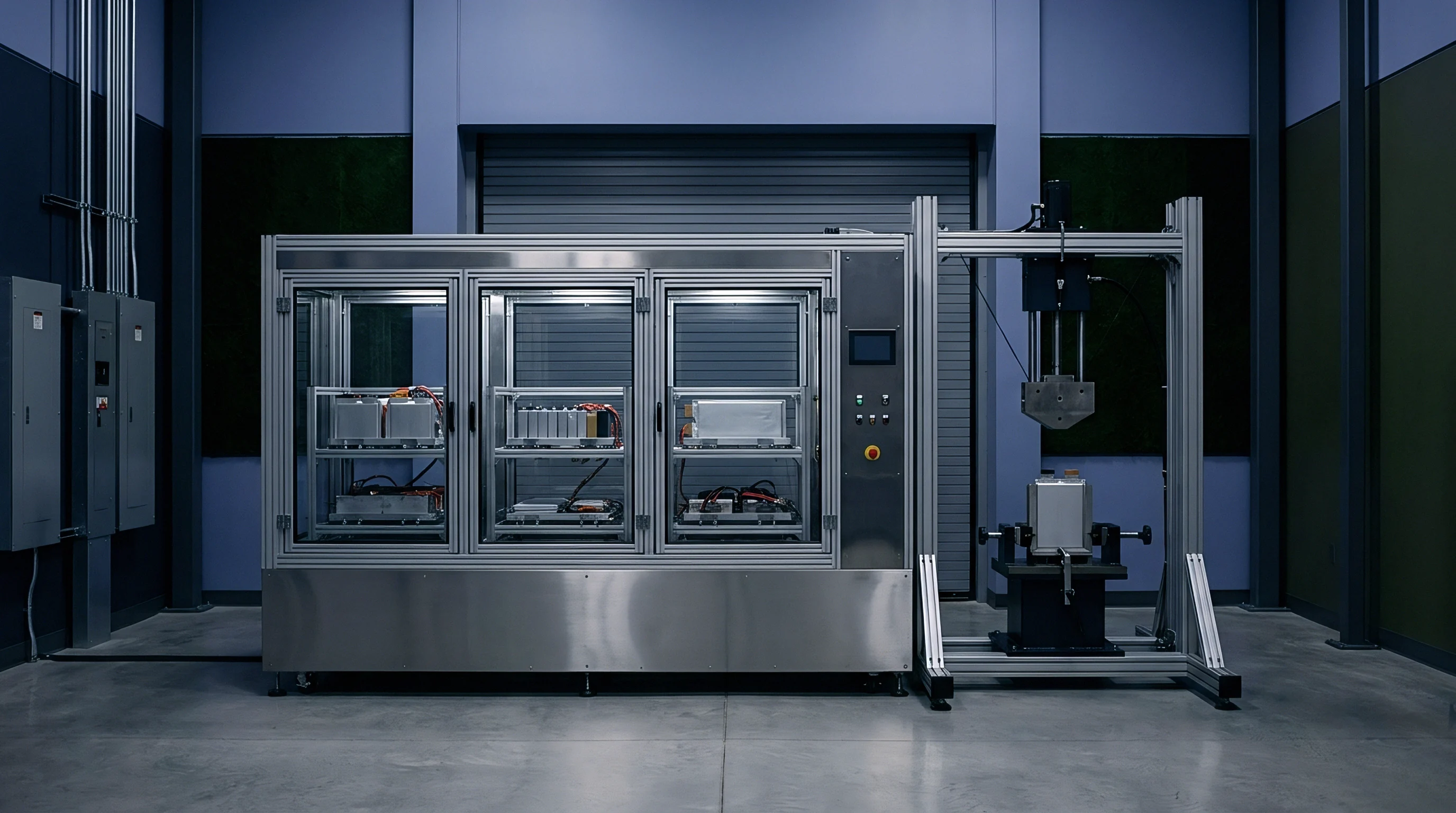
Operational cycling generates alternating mechanical pressures against cell containment walls. Graphite anode particles undergo roughly ten percent volumetric swelling during full lithiation, while silicon-doped anodes expand by thirty to eighty percent depending on silicon blending ratios. This continuous cyclic expansion generates internal mechanical stress exceeding 0.5 megapascals within constrained cell modules.
These cyclical loads act as a physical amplifier, pressing latent inclusions into the opposing separator barrier.
Vibrational profiles encountered during intermodal container freight and field operation induce dynamic strain. International transport regulations mandate verification against mechanical vibration and shock via the United Nations Manual of Tests and Criteria, Part III, sub-section 38.3. UN 38.3 Test T.3 applies sinusoidal vibrations sweeping between 7 Hertz and 200 Hertz across three mutually perpendicular axes for a total of nine hours per test orientation.
Test T.4 delivers half-sine shocks of 150 times gravity acceleration for small cells or 50 times gravity acceleration for large cells.
Vibrational harmonic excitation during freight transport converts benign separator thinning into hard internal shorts.
Passing UN 38.3 type testing demonstrates that a pristine design survives standard mechanical excitation. Type testing does not certify that production lots containing latent slitting burrs or loose metallic debris will survive long-distance transit. When transport vibrations align with module internal structural resonance frequencies, micro-motion within the jelly roll shifts embedded particles.
A particle held safely in place by winding tension can pierce the separator during road transport over rough terrain, initiating internal degradation before the container arrives at the installation site.

Will Field Telemetry Detect Internal Cell Heating?
Pack monitoring systems record surface temperature sensor values spaced across modules. Battery management system telemetry reads temperature data from thermistors positioned on external busbars or cell casings. Internal short circuits initiated by micro-particulate penetration initially develop across microscopic contact areas measuring less than one square millimeter.
The initial short-circuit current generates localized Joule heating within a confined core zone, while total cell surface temperature displays an elevation of less than 0.5 degrees Celsius.
Thermal dissipation into module aluminum heat sinks masks the internal flaw signature. Localized hotspots can exceed 150 degrees Celsius, triggering local separator breakdown and solid electrolyte interphase decomposition, while the management system registers temperature values within safe operational parameters. Automated safety shutdown triggers remain inactive until the internal short propagates across multiple layer turns.
By the time module telemetry flags a rapid temperature rise or abnormal voltage differential, catastrophic thermal escalation has become inevitable.

Transport Shocks and Latent Fault Activation
The transition from a manufacturing flaw to an active hazard follows a distinct physical escalation sequence under transport and early operational stresses:
- Mechanical dislocation shifts embedded particles under multi-axis vibration during ocean transit, embedding sharp edges into the separator matrix.
- Dielectric degradation occurs through cyclical polymer creep under ambient temperature swings, thinning the insulating membrane margin.
- Micro-short initiation produces micro-ampere leakage currents that create localized voltage depressions during rest periods.
- Ohmic hotspot escalation accelerates localized transition-metal dissolution, depositing copper bridges across the damaged zone.
- Catastrophic separator collapse takes place as local temperatures breach 130 degrees Celsius, releasing chemical energy into uncontrollable thermal runaway.
Field failures cluster nonlinearly. The question remains whether standard electrochemical impedance spectroscopy screening applied at container arrival can isolate these partially compromised separator interfaces before field installation.


Reserves
Actuarial loss forecasts govern the financial escrow accounts established between cell buyers and cell vendors. System integrators and project developers face massive financial liabilities when field fires or broad product recalls disrupt operational energy storage facilities. Traditional standard warranties provide simple repair-or-replace remedies, which fail to cover ancillary costs including business interruption, structural property damage, emergency response fees, hazardous waste remediation, and product recall campaigns.
Loss reserve engineering quantifies these systemic exposures using actuarial capital modeling.
The European Union Battery Regulation, Regulation EU 2023/1542, imposes strict carbon footprint, recycled material, and supply chain due diligence requirements alongside expanded producer responsibility. Articles 56 and 77 establish mandatory conformity assessments and corrective obligations for economic operators placing battery systems on the market. If a systematic manufacturing defect induces fire risks, market surveillance authorities enforce region-wide product recalls.
In the United States, the Consumer Product Safety Act under Section 15 mandates immediate reporting of substantial product hazards, triggering federal recall protocols that halt operations.
Actuaries apply Extreme Value Theory to evaluate tail-risk exposures from low-probability, high-consequence battery failures. Standard Gaussian probability curves collapse when evaluating catastrophic thermal events because defect clustering and cascading module propagation create heavy-tailed failure distributions. The Generalized Pareto Distribution models excess losses beyond a defined retention threshold.
Sizing warranty reserves based on mean failure expectations creates massive capital deficits when an early-life manufacturing defect batch surfaces in the field.

Actuarial Loss Distributions and Sizing Methods
Capital allocation models rely on heavy-tailed statistical curves to forecast maximum probable recalls. Value at Risk and Conditional Value at Risk metrics define the capital reserves required to survive ninety-nine-point-nine percent of failure scenarios. Conditional Value at Risk quantifies the expected loss given that the loss exceeds the Value at Risk threshold, capturing the extreme fiscal impact of cascading container fires.
When calculating reserves for a 1-gigawatt-hour deployment, the mean expected warranty cost might indicate 1.5 million dollars, whereas the ninety-nine percent Conditional Value at Risk calculation demands a reserve allocation exceeding 28 million dollars.
Batch contamination drives this reserve inflation. Manufacturing defects do not distribute uniformly across annual production; they concentrate in distinct production lots corresponding to worn cutter blades, contaminated slurry batches, or malfunctioning winding machines. If a defective slitting knife operates undetected for three shifts, it contaminates roughly twenty thousand cells.
If those units disperse across multiple energy storage projects, containment requires comprehensive recalls of every installed container housing that production window.
| Risk Model Scenario | Defect Rate (PPM) | Batch Correlation Factor | Modeled Loss Reserve | Capital at Risk Ratio |
|---|---|---|---|---|
| Baseline Actuarial Model | 0.50 | 0.05 | $1,250,000 | 1.0x |
| Poisson Non-Correlated | 1.20 | 0.10 | $3,800,000 | 3.0x |
| Negative Binomial Clustered | 4.50 | 0.35 | $14,200,000 | 11.4x |
| Extreme Value Theory GPD | 12.00 | 0.70 | $38,500,000 | 30.8x |

Warranty Escrow Formulas and Defect Multipliers
Commercial agreements mandate liquidated damage percentages tied to field failure trigger rates. Buyers require cell vendors to deposit cash or letters of credit into dedicated warranty escrow funds. A standard defect multiplier formula scales the required financial reserve based on verified parts-per-million failure thresholds during the operating warranty term:
- Lot traceability verification verifies continuous laser-etched DataMatrix serial codes linking each individual cell to electrode roll batch numbers, slitting blade machine IDs, and slurry mixing logs.
- Batch quarantine trigger criteria identify statistically abnormal open-circuit voltage drift within thirty days of delivery, freezing vendor warranty release payments immediately.
- Liquidated damage escalation schedules double the escrow withholding percentage when verified field defect rates breach two parts per million across any single manufacturing quarter.
- Ancillary cost inclusion clauses expand vendor indemnity obligations to cover transport charges, civil works dismantling, and site remediation expenses.
Relying on bare manufacturer product warranties without dedicated financial escrow leaves project developers fully exposed when systemic manufacturing flaws force complete asset shutdowns.


Underwriting
Risk transfer contracts govern commercial exposure when manufacturing errors cause property damage or bodily harm. Property and casualty insurers, marine cargo underwriters, and warranty indemnity providers conduct forensic technical reviews of cell manufacturing data before binding coverage. Underwriters evaluate factory audit scores, inline inspection metrology, and defect probability models to set policy deductibles, sub-limits, and premium rates.
When a developer fails to demonstrate rigorous defect verification controls, insurers impose catastrophic thermal runaway exclusions, stripping coverage for fire damage.
Marine transport of lithium-ion energy storage systems falls under the International Maritime Dangerous Goods Code. Fully certified cells travel as Class 9 dangerous goods under UN 3480 or UN 3481. Shipping containers carrying production batches suspected of housing critical manufacturing flaws face severe legal hurdles under IMDG Special Provision 376.
This regulatory provision dictates the handling of damaged or defective cells liable to rapidly disassemble, react dangerously, produce a flame, or generate a dangerous evolution of heat.
Underwriters invoke maritime cargo exclusions when cell shippers fail to present signed UN 38.3 test summaries matching production lot identifiers.
Cells deemed defective under Special Provision 376 cannot travel via standard maritime container shipping. They demand dedicated explosion-proof packaging, continuous temperature monitoring, or total carriage prohibition, inflating return logistics expenses by tenfold. If an unverified batch experiences a thermal event aboard a vessel, the shipper faces immense maritime liabilities under carrier contracts of affreightment, including vessel salvage charges and general average declarations.

Contractual Indemnity Caps and Defect Thresholds
Purchase terms allocate fiscal accountability through tiered liability schedules. Standard vendor master supply agreements cap total liability at one hundred percent of the purchase order value, while explicitly disclaiming consequential, indirect, and special damages. This liability cap is completely inadequate for utility-scale energy projects.
A defective cell costing seventy dollars can initiate a module fire that destroys a two-million-dollar energy storage enclosure, contaminates adjoining transformers, and triggers twenty million dollars in electrical grid downtime penalties.
Sophisticated buyers negotiate super-cap carve-outs for manufacturing defects that induce safety hazards. These contractual clauses remove liability limitations for gross negligence, willful misconduct, and breach of defined product safety warranties. The contract establishes a parts-per-million defect threshold.
If field operations document defect occurrences exceeding this agreed benchmark, the manufacturer indemnifies the buyer for all downstream consequential losses, including third-party property damage, environmental clean-up costs, and regulatory fines.

Carriage Liability under Special Provision 376
Transport authorities enforce strict packaging rules for cells identified as damaged or prone to thermal escalation. When a factory defect notification flags an in-transit cargo lot, the shipper must reclassify the cargo under Special Provision 376 packaging instruction P911 or LP906. These packaging standards dictate container designs capable of containing blast overpressures, gas emissions, and external surface temperatures exceeding one hundred degrees Celsius.
Failure to execute this reclassification exposes the logistics coordinator to criminal prosecution under international dangerous goods transport statutes.
Sourcing agreements require precise legal wording to allocate carriage risk when factory quality escapes manifest after container dispatch. Under the standard warranty dispute resolution clause, the cell supplier warrants that every delivered unit complies with certified UN 38.3 manufacturing records, and any batch demonstrating latent defect rates above three parts per million automatically obligates the supplier to assume full importer of record duties and financial liability for return carriage under hazardous materials protocols.