Analytical Testing Methods for Battery Electrolyte Solvent Headspace Gas Leakage
Electrolyte solvent headspace gas leakage testing uses GC-MS and SPME to quantify linear carbonate vapor loss, preventing cell degradation and transport rejections.


Volatility
Commercial lithium-ion electrolytes rely on binary or ternary solvent mixtures balanced for ionic conductivity, viscosity, operating temperature window, and solid electrolyte interphase formation. High-conductivity linear alkyl carbonates ~ specifically dimethyl carbonate, ethyl methyl carbonate, and diethyl carbonate ~ exhibit substantial partial vapor pressures at standard transport and storage temperatures. Cyclic carbonates such as ethylene carbonate and propylene carbonate possess significantly higher boiling points and lower vapor pressures, leaving linear carbonates as the primary source of internal cell pressure and headspace gas accumulation.
When seals face mechanical stress, thermal spikes, or manufacturing defects, linear carbonate vapors escape into the environment or seal interface long before liquid electrolyte leaks become visible to optical inspection.
Inside a sealed cell, the equilibrium partial pressure of each solvent component roughly follows Raoult’s Law, adjusted for activity coefficients from salt solvation dynamics. Dissolved lithium hexafluorophosphate lowers the effective vapor pressure of individual solvent species through strong ion-dipole interactions between lithium cations and carbonyl oxygen atoms. Higher temperatures shift this equilibrium upward following the Clausius-Clapeyron relation.
At 60°C, the partial vapor pressure of pure dimethyl carbonate reaches 28.4 kilopascals, while ethyl methyl carbonate reaches 11.2 kilopascals. These vapor fractions exert continuous mechanical pressure against pouch cell heat seals, cylindrical cell crimps, and prismatic laser welds.

Thermodynamics of Linear Carbonate Vapor Pressure
Liquid solvent evaporation within the closed volume of a cell establishes a vapor-liquid equilibrium dictated by internal void volume, state of charge, and local temperature gradients. When total internal pressure exceeds external atmospheric pressure, the resulting cell swelling alters structural tension along seal perimeters. Dimethyl carbonate exhibits the highest vapor pressure among standard linear carbonates, with a boiling point of 90.3°C and a vapor pressure of 7.4 kilopascals at 20°C. Ethyl methyl carbonate boils at 107.5°C with a vapor pressure of 3.6 kilopascals at 20°C, while diethyl carbonate boils at 126.8°C with a vapor pressure of 1.4 kilopascals at the same temperature.
Thermal management failures or unconditioned freight transit can expose cells to temperatures up to 65°C, where solvent volatility increases exponentially. At 65°C, dimethyl carbonate vapor pressure rises to 35.1 kilopascals, creating a persistent driving force for solvent transport through microscopic leak paths. Cyclic additives like fluoroethylene carbonate or vinylene carbonate generate much lower vapor pressures than linear species, but losing them through micro-leaks destabilizes interphase maintenance during extended cycling.
As solvent vapors outgas, lower solvation capacity can trigger local salt crystallization and increase internal cell resistance.
| Solvent Compound | Molecular Weight (g/mol) | Boiling Point (°C) | Vapor Pressure at 20°C (kPa) | Vapor Pressure at 65°C (kPa) | CPP Permeation Coefficient at 23°C (g·mm/m²·day) |
|---|---|---|---|---|---|
| Dimethyl Carbonate (DMC) | 90.08 | 90.3 | 7.40 | 35.10 | 0.85 |
| Ethyl Methyl Carbonate (EMC) | 104.10 | 107.5 | 3.60 | 18.40 | 0.42 |
| Diethyl Carbonate (DEC) | 118.13 | 126.8 | 1.40 | 8.20 | 0.19 |
| Ethylene Carbonate (EC) | 88.06 | 244.0 | 0.001 | 0.08 | 0.01 |
| Propylene Carbonate (PC) | 102.09 | 242.0 | 0.004 | 0.11 | 0.02 |
| Fluoroethylene Carbonate (FEC) | 106.05 | 212.0 | 0.030 | 0.45 | 0.03 |
Solvent loss alters bulk electrolyte stoichiometry over time. Depleting low-viscosity linear carbonates increases overall viscosity, reducing ionic mobility and high-rate discharge capability. In particular, losing dimethyl carbonate increases the relative concentration of ethylene carbonate, raising the liquidus temperature of the electrolyte and making the cell prone to low-temperature salt precipitation.

Permeation Routes across Polymeric and Metallic Enclosures
Containment designs vary across cell formats, producing distinct failure modes under internal vapor pressure. Pouch cells use multi-layer laminated aluminum foils with heat-sealed cast polypropylene edges, where thermal stress during sealing can leave micro-voids or thinned spots. Linear carbonate vapors diffuse through the cast polypropylene via standard solution-diffusion driven by the concentration gradient between the internal headspace and outside air.
Where micro-cracks fall below the mean free path of solvent molecules, Knudsen diffusion takes over.
Polymer seal width and heat-seal compression density govern long-term solvent vapor transmission rates across pouch enclosures.
Cylindrical cells use metallic cans crimped around synthetic rubber or fluoropolymer gaskets. Over extended thermal cycling, creep in polybutylene terephthalate or fluoroelastomer gaskets reduces sealing pressure. Solvents dissolve into the polymer, swelling the gasket and altering compression forces.
This swelling opens micro-channels along the metal-to-polymer interface, allowing volatile carbonates to escape without obvious seal rupture. Prismatic cells rely on laser-welded aluminum headers with glass-to-metal or polymer feedthroughs. Micro-porosity in weld beads ~ often caused by trapped surface contaminants or improper laser power during assembly ~ creates direct escape paths for vapor.
Mechanical stress, thermal cycles, and pressure differentials accelerate seal degradation during transit and storage. As solvent vapor leaks into secondary packaging, it accumulates until reaching equilibrium within outer containment. Detecting these trace emissions requires analytical gas sampling tuned to linear carbonate chemistry.
Small molecular leaks bypass visual inspection and dye penetrants because escaping vapors evaporate instantly at atmospheric pressure. Headspace sampling offers the only reliable way to catch early enclosure leaks before gross liquid electrolyte venting occurs.
Hermetic integrity degrades predictably when thermal stress and pressure differentials coincide with the glass transition temperatures of seal polymers.

Trap
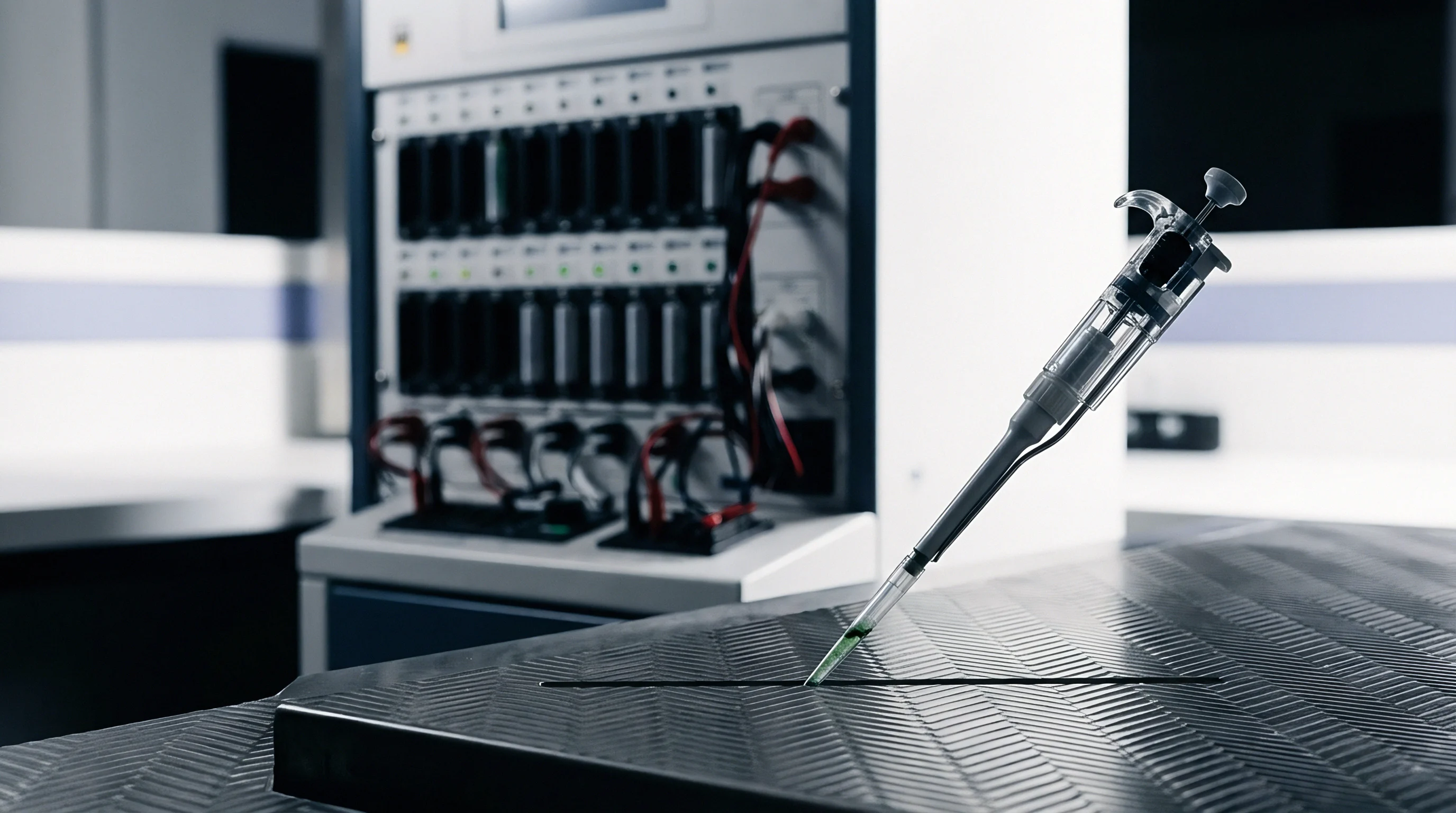
Sampling solvent vapors from battery enclosures requires preparation methods that capture trace volatile organic compounds without introducing ambient contaminants or heat-induced degradation products. Solid-Phase Microextraction uses coated fused silica fibers to collect target solvents from container headspace. The stationary phase coating governs extraction efficiency, recovery kinetics, and selectivity for linear versus cyclic alkyl carbonates.
Coatings combining non-polar polydimethylsiloxane with porous divinylbenzene balance absorption and adsorption for alkyl carbonate blends. Polydimethylsiloxane retains low-boiling linear carbonates like dimethyl carbonate, while divinylbenzene traps polar traces and higher-boiling cyclic species by molecular sieving. Carbon wide-range coatings offer an alternative when measuring trace outgassing down to single-digit parts-per-billion levels.
Sorbent Phase Selection and Extraction Kinetics
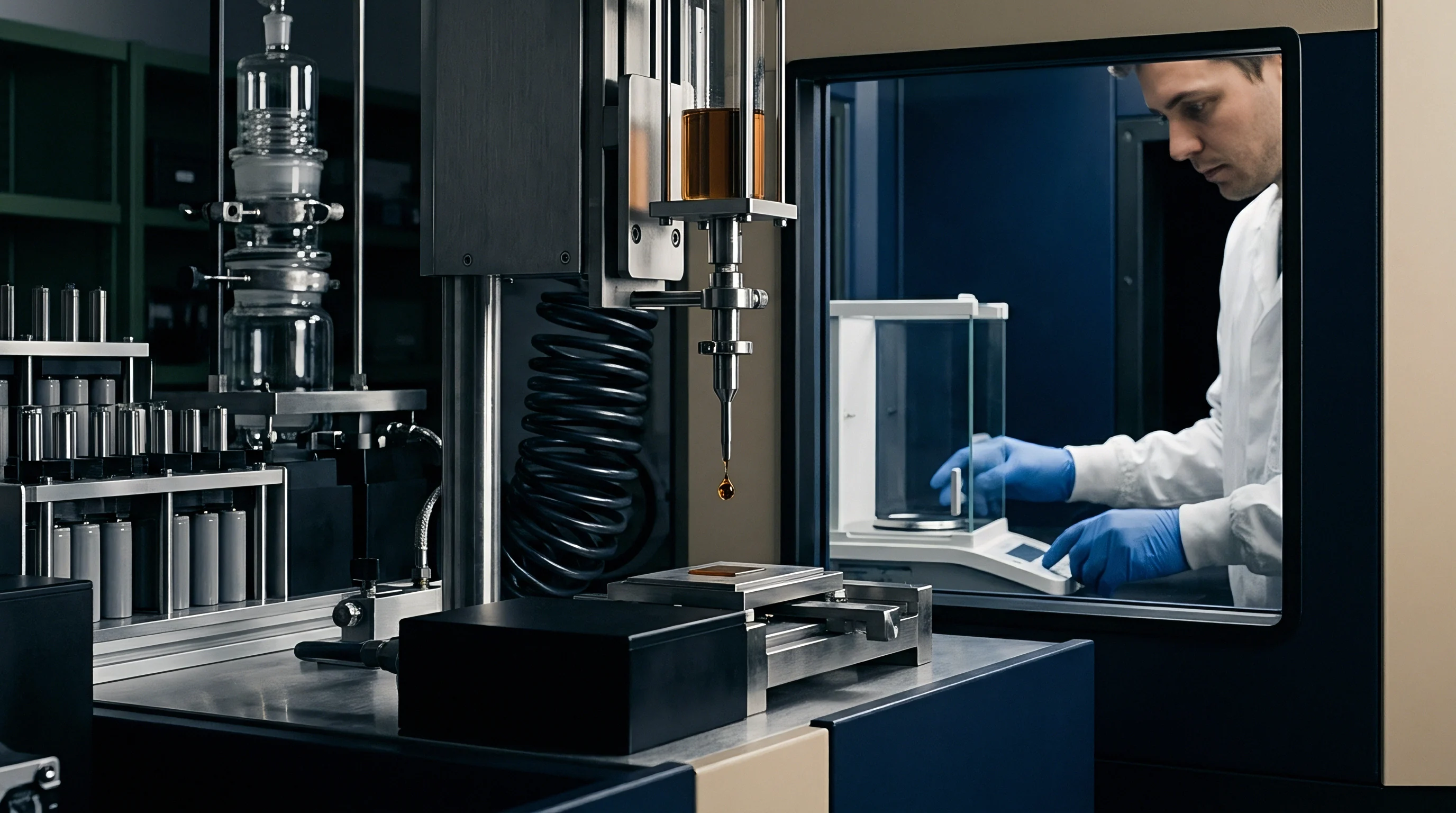
Extraction kinetics in solid-phase microextraction depend on sample temperature, exposure time, agitation, and fiber depth in the test container. In static headspace extraction, the sealed cell sits in an inert chamber purged with high-purity nitrogen. As solvent vapors accumulate, they reach equilibrium between the gas phase and fiber coating based on their distribution coefficients.
Heating the chamber to 40°C increases vapor pressure and speeds extraction, though excessive heat risks degrading sensitive additives or inflating leak rates beyond realistic storage conditions.
Phase ratio calculations dictate the mass of analyte absorbed onto the fiber at equilibrium, which depends on initial headspace concentration, fiber volume, and partition coefficients. For dimethyl carbonate, equilibrium sampling with a 65-micrometer polydimethylsiloxane-divinylbenzene fiber takes 15 to 30 minutes at 25°C. Dynamic headspace sampling sweeps carrier gas across the cell surface and through sorbent tubes packed with Tenax TA or Carbotrap. These tubes collect larger analyte masses over longer runs, avoiding the saturation limits of fibers in high-leak scenarios.
Testing sealed pouch cells at 45°C inside dynamic purge chambers achieves detection thresholds of 0.02 micrograms per hour for dimethyl carbonate leakage.
Background contamination quickly hides low-level leaks if purge gas purity or chamber cleanliness drops. Siloxanes from room-temperature vulcanizing silicone gaskets, plasticizers from vinyl tubing, and residual solvents in manifolds can create false positives during gas chromatography. System qualification therefore requires running blank purge cycles before loading cell samples.
Pre-conditioning sampling chambers under high vacuum at 100°C for two hours eliminates phantom chromatographic peak interference across all target retention windows during pouch cell qualification.

Dynamic Headspace Purge and Thermal Desorption Workflows
Quantitative extraction demands tight control over carrier gas flow rates, desorption temperatures, and split ratios. Thermal desorption units heat sorbent tubes rapidly to 280°C under reverse gas flow, sweeping trapped solvents into a cryo-focused trap cooled to -30°C. Rapidly reheating the cryo-trap injects narrow sample bands onto the column, improving peak resolution for volatile linear carbonates.
Choosing an extraction method involves balancing analytical sensitivity against required throughput on manufacturing lines or receiving docks.
- Fiber Coating Matrix Selection matches sorbent polarity to target solvent species, using dual-coated fibers to capture volatile linear carbonates and low-volatility cyclic additives without phase saturation.
- Equilibrium Extraction Timing balances adsorption limits with total analysis cycle time, ensuring reproducible mass loading across successive test batches.
- Chamber Outgassing Baseline Characterization establishes blank contamination limits for test fixtures so structural seal materials do not generate false positive hydrocarbon signals.
- Thermal Desorption Cryo-Trap Transfer Protocols concentrate large sample gas volumes into narrow chromatographic injection bands, preventing peak broadening during trace vapor analysis.
- Sample Line Passivation Treatments use inert sulf inert-coated stainless steel tubing to prevent polar solvent adsorption along internal transfer walls during dynamic purge operations.
While polymer creep degrades crimp tension and static headspace testing isolates background VOCs, direct headspace extraction workflows isolate target analyte signals from complex background profiles, preparing sample streams for qualitative identification and quantitative mass spectral analysis.
Minor solvent vapor permeation is often treated as baseline material breathability rather than joint failure, though the resulting cumulative loss degrades cell capacity over time.

Spectrometry
Gas chromatography-mass spectrometry (GC-MS) remains the benchmark separation and detection platform for identifying electrolyte solvent leaks. Linear and cyclic alkyl carbonates separate on non-polar or mid-polar capillary columns, such as 5% phenyl-arylene methylpolysiloxane stationary phases. Helium carrier gas sweeps desorbed solvent vapors through the column under programmed temperature gradients, resolving dimethyl carbonate, ethyl methyl carbonate, diethyl carbonate, and fluorinated additives by boiling point and partition characteristics.
Electron ionization at 70 electronvolts fragments eluted carbonate molecules into characteristic ion spectra. Dimethyl carbonate exhibits primary fragment ions at mass-to-charge ratios of 90 (molecular ion), 59 (methoxycarbonyl fragment), and 45. Ethyl methyl carbonate yields main fragments at 75, 59, and 45, while diethyl carbonate fragments at 91, 63, and 45.
Flame ionization detectors provide an alternative for quantification, giving a linear response proportional to carbon count over five orders of magnitude.
Chromatographic Separation and Detector Sensitivity Thresholds
Quantitative analysis relies on internal calibration using deuterated or fluorinated solvent analogues, such as deuterated dimethyl carbonate or d6-diethyl carbonate. Calibration curves from 0.05 to 50 parts per million yield linear regression correlation coefficients exceeding 0.998. Selected ion monitoring enhances sensitivity by focusing detector dwell time on specific fragment ions, pushing detection limits for linear carbonate vapors down to sub-part-per-billion levels inside sealed testing enclosures.
Selected Ion Flow Tube Mass Spectrometry (SIFT-MS) and Atmospheric Pressure Chemical Ionization Mass Spectrometry allow real-time quantitative monitoring without prior chromatographic separation. SIFT-MS uses hydronium, oxygen cation, or nitrosonium precursor ions to react with solvent vapors in a flow tube, measuring linear carbonates within seconds. This rapid reaction monitoring suits high-throughput inline leak detection on automated assembly streams, catching micro-leaks before cells reach final pack integration.
| Technique | Detection Limit (ppm) | Sample Analysis Time | Nondestructive Status | Inline Qualification Suitability | Primary Target Species |
|---|---|---|---|---|---|
| GC-MS (Selected Ion Monitoring) | 0.001 | 15-30 minutes | Yes (Headspace only) | Low (Laboratory audit) | Linear and cyclic carbonates, additives |
| GC-FID | 0.010 | 10-20 minutes | Yes (Headspace only) | Medium (Batch qualification) | Total volatile hydrocarbons, linear carbonates |
| SIFT-MS | 0.005 | 2-5 seconds | Yes (Direct purge) | High (Automated inline screening) | DMC, EMC, DEC vapor traces |
| TDLAS | 0.050 | 0.5-1 second | Yes (Optical cell path) | High (100% inline check) | Specific linear carbonate vapor lines |
| Helium Mass Spectrometry | 0.0001 (Helium equiv.) | 10-60 seconds | Yes (Pre-fill bombing) | High (Dry cell seal check) | Helium tracer gas only |
Optoelectronic methods like Tunable Diode Laser Absorption Spectroscopy measure infrared absorption bands characteristic of carbonyl stretch vibrations near 1750 wavenumbers. Laser absorption offers sub-second response times for non-destructive inline scanning of pouch cell seals on conveyors. However, higher detection limits compared to mass spectrometry restrict optical methods to medium and gross leak detection tiers.

Helium Equivalent Leak Calibration and Gas Mass Transfer
Correlating solvent vapor loss to standardized helium leak rates requires fluid dynamic conversions based on molecular weight, viscosity, and diffusion regimes. Helium leak detection evaluates dry enclosures by pressurizing the internal volume with helium gas or placing evacuated cells inside helium-charged chambers. Standard leak rates express helium flow in millibar-liters per second under standard temperature and pressure conditions.
Molecular flow dominates when leak dimensions remain smaller than the gas mean free path, occurring at leak rates below 10-5 millibar-liters per second. Converting a measured helium leak rate to an equivalent solvent vapor leak rate involves multiplying by the square root of the inverse molecular weight ratio, adjusted for vapor viscosity differentials. Dimethyl carbonate vapor has a molecular weight of 90.08 grams per mole compared to helium at 4.00 grams per mole, yielding a molecular flow conversion factor of approximately 0.21 times the helium leak rate under identical pressure gradients.
Contractual compliance with UN 38.3 transport standards requires non-destructive verification that cell seal integrity prevents solvent vapor loss exceeding 10 to the minus 5 millibar liters per second equivalent helium leak rate.
Viscous laminar flow governs mass transfer through larger seam defects, where flow rates depend inversely on dynamic gas viscosity. Solvent vapors differ significantly in viscosity from inert helium; dimethyl carbonate vapor exhibits a dynamic viscosity of roughly 9.6 micropascal-seconds at 25°C, compared to helium at 19.8 micropascal-seconds. Converting viscous flow rates requires Poiseuille flow equations incorporating specific gas viscosity values and local temperatures.

Worked Model of Linear Carbonate Outgassing Rates
Estimating total mass loss from micro-leaking pouch cells over multi-year warranty periods requires numerical integration of daily outgassing models. Consider a pouch cell filled with 45 grams of electrolyte consisting of a 1:1 molar ratio of dimethyl carbonate and ethylene carbonate with 1.2 M lithium hexafluorophosphate. The cell has an internal void volume of 3.5 cubic centimeters, and internal headspace pressure reaches 18.5 kilopascals at an operating baseline of 45°C.
Total solvent mass loss rates reach 4.2 milligrams per day at 65 degrees Celsius during altitude chamber simulation. Applying GC-MS calibration data to this outgassing profile establishes the relative loss rates of individual solvent components over time.
Under a constant micro-leak rate of 1.5 × 10⁻⁵ millibar-liters per second helium equivalent, the calculated dimethyl carbonate loss rate equals 0.11 milligrams per day at 25°C. Over a 5-year operating lifespan at standard room storage, cumulative dimethyl carbonate mass loss reaches 200.75 milligrams ~ roughly 0.89% of the initial linear carbonate mass in the cell.
Raising the continuous ambient temperature to 45°C increases dimethyl carbonate partial vapor pressure by a factor of 2.8, driving calculated daily mass loss to 0.308 milligrams per day. Cumulative 5-year mass loss under continuous 45°C exposure reaches 562.1 milligrams, representing 2.50% of the original linear solvent mass.
Choosing among solvent analytical methodologies requires weighing trade-offs between measurement speed, sample destruction, capital expenditure, and detection limits across manufacturing stages.
- Mass Spectrometric Detection Limit Superiority identifies incipient seal micro-cracks weeks before physical electrolyte crystallizes outside container seams.
- Helium Mass Flow Equivalent Conversions translate mechanical leak rate specifications into solvent mass loss predictions over operational cell lifespans.
- Real-Time Optical Absorption Monitoring provides conveyor-speed screening capability, though at higher detection limits than mass spectrometry.
- Selected Ion Monitoring Calibration Curves isolate target alkyl carbonate fragment peaks from complex background matrix outgassing components.
Because linear carbonates migrate faster than cyclic compounds, liquid solvent loss degrades cell capacity through active mass depletion and higher internal impedance; routine data audits prevent transport delays caused by unexpected outgassing.
Miscalibrating mass spectrometer split ratios during lot safety clearance testing leads directly to freight rejection penalties when borderline lots fail transport verification.


Diffusivity
Transport safety regulations classify lithium-ion cells as Class 9 dangerous goods under UN numbers 3480 and 3481. Testing defined in the United Nations Manual of Tests and Criteria, Section 38.3, dictates mandatory physical stress exposures designed to simulate conditions encountered during air, ocean, and ground transport. Solvent vapor micro-leakage represents a direct failure criterion under specific UN 38.3 test modules, specifically Altitude Simulation (Test T.1) and Thermal Test (Test T.2).
Test T.1 subjects cells to ambient pressures of 11.6 kilopascals or less for at least six hours at 20°C. This pressure reduction creates a positive differential pressure across cell enclosures, driving headspace vapors outward through micro-voids or weak seal seams. Passing Test T.1 requires that units show no mass loss exceeding 0.1% of original cell mass, no leakage, no venting, no disassembly, no rupture, and no fire. Measuring mass loss to 0.1% accuracy on a 50-gram cell requires weighing precision within 0.05 grams ~ far too coarse to detect microgram solvent vapor leaks that compromise long-term shelf performance.

Vacuum Transit Stress and Altitude Test Boundaries
Unpressurized aircraft cargo holds experience ambient pressures dropping to 11.6 kilopascals at high altitudes, elevating mechanical strain along pouch cell heat seals. Internal headspace vapors, expanding against external vacuum conditions, exert outward forces that expand existing polymer micro-channels. Linear carbonate vapor permeation rates increase significantly under these differential pressure conditions, accelerating solvent loss into outer transport packaging.
Test T.2 subjects cells to thermal cycling between -40°C and +72°C, holding units at temperature extremes for at least six hours across ten continuous cycles. Differential thermal expansion between metallic header components, glass-to-metal seals, polymer gaskets, and aluminum pouch laminates creates transient gap openings. Gasket compression set occurring at +72°C reduces sealing forces when the cell contracts at -40°C, establishing micro-leak paths through which volatile carbonates escape during subsequent altitude pressure changes.
Standard UN 38.3 mass loss thresholds fail to capture trace solvent outgassing rates that degrade electrolyte stoichiometry over extended shipping timelines.
Air transport regulations enforced under ICAO Technical Instructions and IATA Dangerous Goods Regulations (Packing Instruction 965) mandate strict containment standards for cells shipped via air freight. If air exchange rates inside crates remain low, solvent outgassing inside sealed outer fiberboard boxes creates flammable vapor concentrations. Dimethyl carbonate possesses a lower explosive limit of 4.2% by volume in air, presenting fire hazards if gross outgassing occurs across multiple cells within tightly sealed overpacks.
Shippers trace air freight consignments back to the original laboratory test report to verify that altitude vacuum testing included gas chromatographic headspace analysis alongside baseline mass measurements.

Documentation Integrity across International Carriage Standards
Dangerous goods regulatory compliance requires an unbroken chain of documented test evidence before shipments cross international borders or board commercial aircraft. The UN 38.3 Test Summary document, standardized under clause 38.3.5, requires shippers to make verifiable safety evidence available across the supply chain. Acceptance desks reject shipments lacking compliant test summaries, stranding cargo at port facilities and incurring costly demurrage fees.
Implementing continuous headspace leak verification protocols requires adhering to standardized laboratory routines prior to issuing dangerous goods transportation certificates.
- Pre-test cell conditioning at standard temperature and humidity for twenty-four hours to stabilize internal liquid-vapor equilibrium.
- Initial mass determination using a calibrated analytical balance possessing five-decimal-place gram resolution.
- Baseline headspace gas sampling inside a sealed clean chamber using solid-phase microextraction paired with GC-MS.
- Exposure to UN 38.3 Test T.1 altitude simulation chamber conditions at 11.6 kilopascals for six continuous hours.
- Post-exposure mass determination and secondary headspace gas sampling inside the clean extraction chamber within thirty minutes of vacuum release.
- Thermal cycling under UN 38.3 Test T.2 protocols across ten temperature steps between minus forty degrees Celsius and seventy-two degrees Celsius.
- Final headspace gas chromatographic quantification to confirm target linear carbonate vapor accumulation remains below established qualification thresholds.
Because pinholes in aluminum pouch foil and subtle seal flaws lead to solvent loss that degrades cycle life, transport safety files must document non-leakage compliance using analytical methods capable of detecting trace outgassing well below standard gross mass loss measurement limits, with helium trace gas providing reference calibration.
While the regulatory threshold for transport safety clearance remains fixed at 0.1% total mass loss, this gross metric fails to protect high-energy density cells from silent performance loss caused by long-term solvent micro-permeation during global transport cycles.

Exposure
Financial risk allocation in cell procurement contracts depends heavily on defining explicit technical limits for acceptable seal integrity, outgassing rates, and shelf-life degradation. Cell failure caused by solvent vapor leakage introduces complex liability disputes between cell manufacturers, pack integrators, and original equipment manufacturers. When solvent outgassing reduces electrolyte volume prior to pack assembly, cell capacity fades prematurely, internal impedance spikes, and warranty costs escalate.
The European Union Battery Regulation (EU 2023/1542) imposes extensive supply chain due diligence, carbon footprint reporting, and battery passport requirements that extend commercial liability across cell lifespans. Importers of record within the European Union carry legal responsibility for compliance, including verifying cell safety, durability, and hermetic seal integrity. Defective cell batches that experience solvent outgassing during transit fail battery passport durability benchmarks, exposing importers to regulatory sales bans, mandatory product recalls, and strict environmental liability penalties.
Quality Control Protocols for Cell Receiving Inspections
Receiving dock inspection routines relying solely on visual checks or open-circuit voltage screening fail to identify cells carrying latent micro-seal defects. Solvent micro-leaks deplete linear carbonate volume slowly, leaving open-circuit voltage unchanged during early storage phases while quietly destroying high-rate discharge performance and cycle longevity. Implementing analytical headspace screening during Incoming Quality Control (IQC) acceptance sampling isolates compromised lots before cells enter automated pack manufacturing lines.
Acceptance Sampling Plans governed by ISO 2859-1 define Acceptable Quality Level (AQL) limits for incoming cell batches. Incorporating gas chromatographic headspace analysis into IQC protocols requires establishing specific parts-per-billion outgassing thresholds for target linear carbonates inside sealed sampling totes. A lot failing headspace solvent vapor limits triggers immediate quarantine, protecting pack builders from assembling defective units into high-voltage energy storage systems.
Supply agreements shift outgassing warranty risks directly to the cell manufacturer by incorporating specific headspace solvent accumulation limits into raw material supply specifications.
Contractual Risk Allocation for Hermetic Seal Degradation
Procurement contracts must bridge the gap between regulatory transport compliance standards and real-world operational warranty requirements. Standard cell warranties cover catastrophic structural failure and gross liquid leakage, but routinely exclude slow solvent vapor permeation under broad normal degradation disclaimers. Drafting precise contractual terms forces cell suppliers to guarantee specific hermetic leak rates verified by analytical gas chromatography standards.
Because cell seal integrity determines shelf longevity, verifying outgassing requires analytical discipline. Constructing legally binding procurement terms mandates inclusion of explicit test protocols, sampling frequencies, and financial indemnification clauses addressing latent seal defects.
- Hermetic Leak Rate Guarantee Clauses specify maximum allowable helium equivalent leak rates measured by solid-phase microextraction GC-MS at factory gate handover points.
- Batch Quarantine and Audit Rights grant buyers legal authority to freeze incoming cell shipments pending independent laboratory headspace outgassing verification.
- Latent Defect Indemnification Frameworks assign financial responsibility to the seller for downstream pack disassembly and cell replacement costs resulting from micro-seal degradation.
- Chain of Custody Environmental Logging mandates continuous temperature and pressure logging during transit to prevent suppliers from invalidating seal warranties based on claimed transit abuse.
Supply contracts containing Section 8.4 clause amendments stipulate that any cell lot exhibiting dimethyl carbonate outgassing exceeding 0.05 micrograms per liter of container headspace during receiving inspection shall be deemed non-conforming, triggering immediate full-lot replacement at the seller’s sole expense.