Auditing UN 38.3 Test Reports and Cell Design Modification Thresholds
Auditing UN 38.3 test reports demands checking T.1-T.8 raw parameters, verifying UN 38.3.2.2 design modification thresholds, and validating ISO 17025 test summaries.
Criteria
Auditing dangerous goods documentation for lithium batteries requires reviewing raw test profiles instead of taking pass certificates at face value. A certificate shows only that test samples survived specific environmental, mechanical, and electrical stresses in a laboratory. Confirming compliance means checking raw channel logs, state of charge assignments, and sample sizes directly against UN Manual of Tests and Criteria Section 38.3.
Test Protocol Conditions and Baseline Verification
UN Manual Section 38.3 outlines eight environmental, mechanical, and electrical stress tests to evaluate cell safety in transit, with each channel targeting failure modes that can surface during transport. Test T.1 simulates unpressurized cargo holds by keeping cells at an absolute pressure of 11.6 kPa or less for at least six hours at 20°C. Test T.2 measures thermal integrity across ten cycles, shifting units between -40°C and +72°C with soak times up to six hours at each extreme and transfers under twenty minutes.
Mechanical testing relies on Test T.3 and Test T.4. Test T.3 runs a sinusoidal vibration sweep from 7 Hz to 200 Hz and back over fifteen minutes, repeated twelve times across three perpendicular axes for nine hours total. Test T.4 applies half-sine shocks at 150 gn peak acceleration for 6 milliseconds ~ or 50 gn for large cells ~ executing three shocks per direction across three orthogonal axes.
Electrical channels target short circuit and overcharge vulnerabilities. Test T.5 applies an external resistance under 0.1 ohm at 55°C, holding the short for at least one hour after casing temperatures cool back to 55°C. Test T.6 tests impact or crush tolerance by dropping a 9.1 kg weight from 61 cm onto a 15.8 mm bar across the cell, or applying a 13 kN hydraulic crush. Test T.7 overcharges batteries at double their maximum continuous charge current for twenty-four hours, while Test T.8 forces deep discharge on primary or secondary cells using a 12V DC power source at maximum rated discharge current.
| Test Identifier | Physical Mechanism | State of Charge Parameter | Sample Quantity Required | Primary Acceptance Threshold |
|---|---|---|---|---|
| T.1 Altitude | Hypobaric pressure differential | 100% state of charge | 10 small cells / 4 large cells | No mass loss, no leakage, OCV over 90% |
| T.2 Thermal | Extreme thermal expansion cycling | 100% state of charge | 10 small cells / 4 large cells | No venting, no fire, OCV over 90% |
| T.3 Vibration | Sinusoidal resonance fatigue | 100% state of charge | 10 small cells / 4 large cells | No rupture, no disassembly, no fire |
| T.4 Shock | High acceleration mechanical shock | 100% state of charge | 10 small cells / 4 large cells | No mass loss, no drop in voltage |
| T.5 External Short | High current Joule heating at 55°C | 100% state of charge | 10 small cells / 4 large cells | Case temperature stays under 170°C |
| T.6 Impact/Crush | Localized physical casing deformation | 50% state of charge | 5 small cells / 2 large cells | External temperature under 170°C, no fire |
| T.7 Overcharge | Forced current overvoltage stress | 100% state of charge | 4 batteries or packs | No disassembly, no fire within 7 days |
| T.8 Forced Discharge | Current inversion polarity stress | 0% state of charge | 10 small cells / 4 large cells | No disassembly, no fire within 7 days |

State of Charge and Sample Matrix Validation
Sample matrices split allocations across cycling history and charge states to expose latent flaws. Testing small cells requires ten units at first cycle fully charged, ten at fifty cycles fully charged, five at first cycle half-charged, and ten at first cycle fully discharged. Large cells require four units at first cycle and four units at fifty or one hundred cycles.
Mass loss limits govern enclosure integrity through tests T.1 to T.4 based on starting weight: mass loss cannot exceed 0.5 percent for cells under 1 gram, 0.2 percent for cells between 1 gram and 5 grams, and 0.1 percent for cells over 5 grams. Post-test open circuit voltage must also stay above 90 percent of the pre-test baseline.
Open circuit voltage retention below ninety percent following thermal conditioning indicates internal structural disruption or electrolyte leakage.
Auditors check raw data sheets for unexpected voltage drops between test steps. A cell dropping from 4.20V to 3.82V after T.2 thermal cycling fails the 90 percent retention threshold even without visible electrolyte leakage. Batches passed by a laboratory without physical deformation checks often trigger rejections during terminal inspections.
Revision
Changes to cell dimensions, active chemistry, or electrical operating limits invalidate transport authorizations unless re-evaluated under classification rules. Manufacturers often adjust cell designs to cut costs, improve cycle life, or handle component shortages, but those shifts alter thermal and mechanical behavior under stress.

Which Cell Modifications Compel Full UN 383 Retesting?
Section 38.3.2.2 sets four triggers where design changes alter safety margins past allowed limits. Crossing any of these thresholds invalidates existing UN 38.3 test certificates for newly manufactured units.
- Baseline Report Extraction mapping the exact cell bill of materials, cathode active chemistry, internal tab thickness, and total structural weight against the proposed manufacturing change.
- Variance Calculation comparing energy capacity, operating voltage window, and overall envelope against the threshold triggers in UN Section 38.3.2.2.
- Testing Scope Assignment identifying whether the design delta demands a full T.1 through T.8 battery evaluation or targeted mechanical vibration and thermal testing.
- Laboratory Re-qualification submitting modified cell units from first production runs to an ISO 17025 accredited facility for execution of designated test channels.
- Dossier Modification issuing an updated UN 38.3.5 test summary matching the current cell part number, production facility, and revised structural specification.
| Parameter Change Vector | Baseline Variance Trigger | Required Retesting Scope | Regulatory Consequence |
|---|---|---|---|
| Cathode Active Material Shift | Any change in active formulation or precursor ratio | Full retesting T.1 through T.8 | Complete dossier invalidation |
| Total Cell Mass Modification | Delta exceeding 0.1 gram or 20 percent total mass | Partial T.3, T.4, T.5, T.6 testing | Dossier amendment mandatory |
| Maximum Charge Voltage Elevation | Delta exceeding 0.1V per cell nominal upper limit | Retesting T.5, T.7, T.8 channels | Retest certificate mandatory |
| Dimensional Outer Housing Shift | Delta exceeding 2.0 mm in any physical axis | Retesting T.3, T.4, T.6 channels | Mechanical baseline voided |
| Separator Material Thickness Delta | Thickness reduction exceeding 10 percent nominal | Retesting T.5, T.6 channels | Thermal short risk elevated |
Mass and Energy Density Threshold Boundaries
Scaling production can introduce weight variations across prismatic or cylindrical cells. Section 38.3.2.2 sets a mass variance trigger of 0.1 gram or 20 percent of total cell mass, whichever is greater. For a 45-gram 18650 cell, 20 percent equals 9.0 grams, making 9.0 grams the limit.
For a 0.3-gram button cell, 20 percent is 0.06 grams, so the 0.1-gram threshold applies.
Cathode chemistry changes require full re-testing regardless of cell weight. Moving from High-Nickel NMC 811 to NMC 622 alters thermal runaway temperatures, gas generation, and short-circuit peak current. Even if outer cell dimensions remain unchanged, altering active materials shifts internal heat generation during Test T.5 short circuit and Test T.6 impact testing.
Cell design alterations exceeding physical specification limits invalidate transport certifications regardless of prior safety history.
Anode changes carry the same re-testing requirements. Swapping synthetic graphite for a silicon-graphite composite increases volumetric expansion during cycling by fifteen to thirty percent. This expansion puts pressure on separator layers, changing cell response during T.3 vibration and T.4 shock tests.
Section 38.3.2.2 specifies that altering cathode active formulations revokes transport clearance until the complete test suite is repeated.

Vent
Cell stability under severe thermal and mechanical stress depends heavily on internal pressure relief vents in caps and headers. These vents act as the primary defense against rupture during internal shorts or overcharging. Modifying vent positioning, score depth, or burst thresholds affects performance across all UN 38.3 mechanical and electrical channels.

Internal Pressure Mechanics and Burst Disc Modifications
Pouch seals and steel cap assemblies act as relief valves if temperatures spike. Take a 50 Ah NMC 622 prismatic cell weighing 850 grams with a vent threshold of 0.8 MPa. With a 0.8 mm aluminum casing, the baseline cell completes UN 38.3 testing with T.5 peak short-circuit temperatures hitting 128°C without leakage or rupture.
If the casing thickness is reduced to 0.6 mm to cut 18 grams while keeping the electrode roll identical, performance changes under stress. During Test T.5 short-circuit testing at 55°C ambient with a 0.08-ohm loop resistance, discharge current spikes to 1,200 A. Rapid Joule heating drives core temperature to 115°C within 45 seconds, vaporizing carbonate solvents and building internal pressure to 0.6 MPa.
While the 0.8 mm casing holds its shape until the vent opens cleanly at 0.8 MPa, the 0.6 mm wall yields at 0.5 MPa. This causes seam buckling and side-wall tearing before internal pressure reaches the 0.8 MPa vent threshold. Electrolyte spills onto test equipment, leading to fire and cell destruction ~ failing Test T.5 clause 38.3.4.5.3 criteria despite using the same cathode slurry.
- Discrepant Laboratory Accreditation showing test reports issued by facilities lacking ISO 17025 scope for UN Manual section 38.3 procedures.
- Mismatched Cell Weights indicating physical differences between tested reference units and commercial batch specification sheets.
- Inconsistent Report Dates displaying test execution dates that precede the formal manufacturing facility establishment or cell release date.
- Missing State of Charge Records omitting pre-test voltage readings and charge state logs for T.5 and T.7 test sequences.
- Generic Test Summaries lacking mandatory manufacturer contact details, signatory names, or unique report identification numbers.
Mechanical Shock and Short Circuit Thermal Dynamics
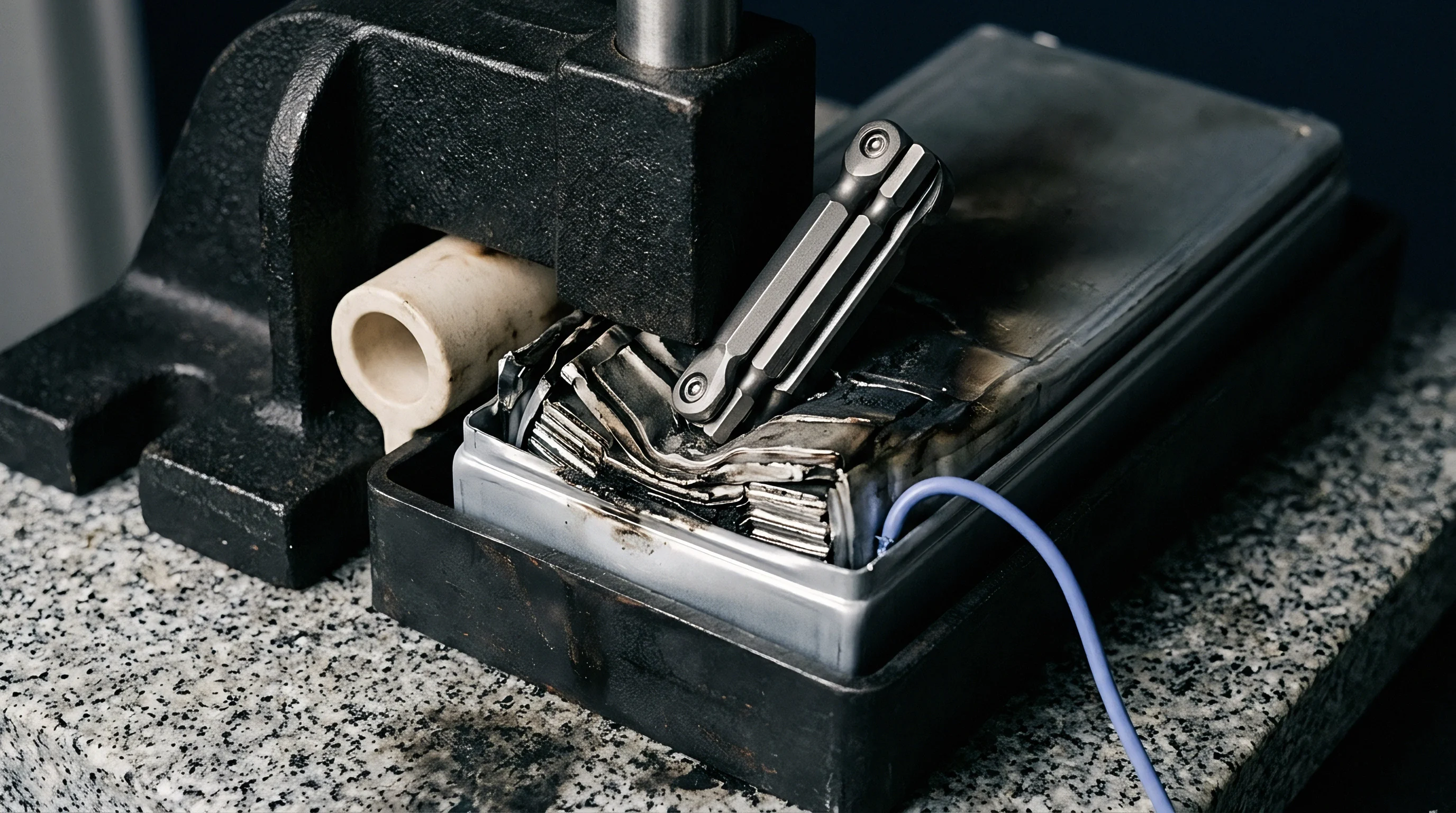
Physical deformation from drops or impact can shift internal current collectors and separators. Tab modifications carry risks during Test T.4 shock and Test T.3 vibration: reducing copper or aluminum tab thickness to cut material costs increases electrical resistance at terminal welds.
Under Test T.5 short circuit conditions, current flowing through thinner tabs creates localized hot spots. This heat transfers to separator edges, melting polyethylene layers before core temperature sensors detect a rise.
Purchase contracts incorporating clause 14.2 automatically reject cell shipments supported by UN 38.3 reports older than five years without design continuity affidavits.
Minor reductions in internal separator thickness alter short-circuit response even when active slurry chemistry remains identical.
Summary
Air and sea transit compliance depends on standardized reports from accredited facilities. Since January 1, 2020, regulations have required a standardized UN 38.3.5 Test Summary across the supply chain, with forwarders, carriers, and customs inspectors checking these filings before clearing cargo.
Mandatory Test Summary Data Elements
Subsection 38.3.5 lists ten required fields for compliance documents accompanying battery shipments. Auditing supplier files requires checking each entry against packaging marks and bill of materials records.
- Obtain the official UN 38.3.5 document directly from the cell manufacturer or authorized distributor.
- Locate the unique test report identification number and laboratory name printed on the document header.
- Access the relevant national accreditation body portal to check the ISO/IEC 17025 accreditation scope of the testing facility.
- Verify that the laboratory scope explicitly encompasses UN Manual of Tests and Criteria Section 38.3 for the specific cell format.
- Cross-check cell mass, nominal energy in watt-hours, and active chemistry on the test document against the technical specification sheet.
- Request the underlying T.1 through T.8 raw data logs from the seller to confirm individual sample voltage and mass measurements.
Laboratory Accreditation and Traceability Verification
Verifying compliance documentation involves checking accreditation databases to confirm testing lab scopes. Reports from unaccredited labs or facilities whose ISO/IEC 17025 scope omits UN 38.3 tests are rejected by authorities. Labs must maintain active credentials with bodies such as CNAS, A2LA, NVLAP, or DAkkS.
Traceability checks confirm that serial numbers, batch codes, and model designations match across packaging, manifests, sleeves, and summary forms. Minor mismatches in part numbers ~ like shipping cell model INR18650-35E when the test report covers INR18650-35D ~ can stop cargo at entry ports.
Whether freight forwarders will adopt automated screening tools to flag expired test summaries across logistics channels remains an open question.

Cargo
Port and air hub delays often stem from dangerous goods filings failing carrier reviews. Acceptance desks enforce strict standards under IATA Dangerous Goods Regulations and ICAOTI guidelines, with misdeclared or uncertified shipments risking rejection, carrier blacklisting, and administrative fines.
Carrier Refusal and Documentation Screening
Acceptance clerks compare dangerous goods manifests against Packing Instructions 965 through 970. Under PI 965 Section IA and IB for standalone lithium ion cells, carriers verify that the UN 38.3 test summary connects directly to the shipper declaration.
Airlines reject shipments carrying test reports based on superseded editions of the UN Manual. When the UN Committee of Experts issues revisions or amendments, active cell models must align with updated standards. Shipments tied to outdated Rev.
5 filings face holds when carriers mandate Rev. 7 or Rev. 8 compliance.
Landed Risk and Insurer Subrogation Exposure
Thermal incidents involving uncertified cells trigger policy exclusions and statutory claims. Marine and air cargo insurers require strict compliance with dangerous goods regulations as a condition of coverage.
Air freight acceptance desks routinely reject cell shipments accompanied by test summaries that lack traceable ISO 17025 laboratory credentials.
If an uncertified cell batch causes shipboard fire damage, maritime law holds the shipper of record strictly liable. Insurers covering vessel losses routinely pursue subrogation against importers who accept invalid UN 38.3 documentation.