Cross Referencing Battery Test Summaries with Freight Dangerous Goods Manifests
Cross referencing battery test summaries with freight manifests verifies watt-hour limits, state of charge compliance, and lot trace numbers before cargo tender.


Dock
Receiving freight containers packed with energy storage components requires exact alignment between physical cargo tags and dangerous goods documentation. Air carriers, shipping lines, and trucking fleets enforce strict acceptance criteria at terminals. Ground handlers cross-check the Dangerous Goods Declaration, Bill of Lading, and Air Waybill against the UN 38.3 Test Summary required by international transport regulations.
Any discrepancy halts freight movement, places shipments in port quarantine, and triggers administrative review.
Evaluating cross-border battery shipments requires comparing the physical cell nameplate against the test summary serial range before accepting carrier manifest tenders. Dangerous goods manifests detail operational safety parameters, state-of-charge declarations, gross mass values, and emergency response procedures. The UN 38.3 Test Summary verifies that a specific cell, module, or pack architecture passed environmental and mechanical stress simulations.
Matching these files demands a clear working knowledge of dangerous goods classifications, packing instructions, and modal transport rules.
Discrepancies between documented ratings and physical cargo bring freight movements to an immediate halt.
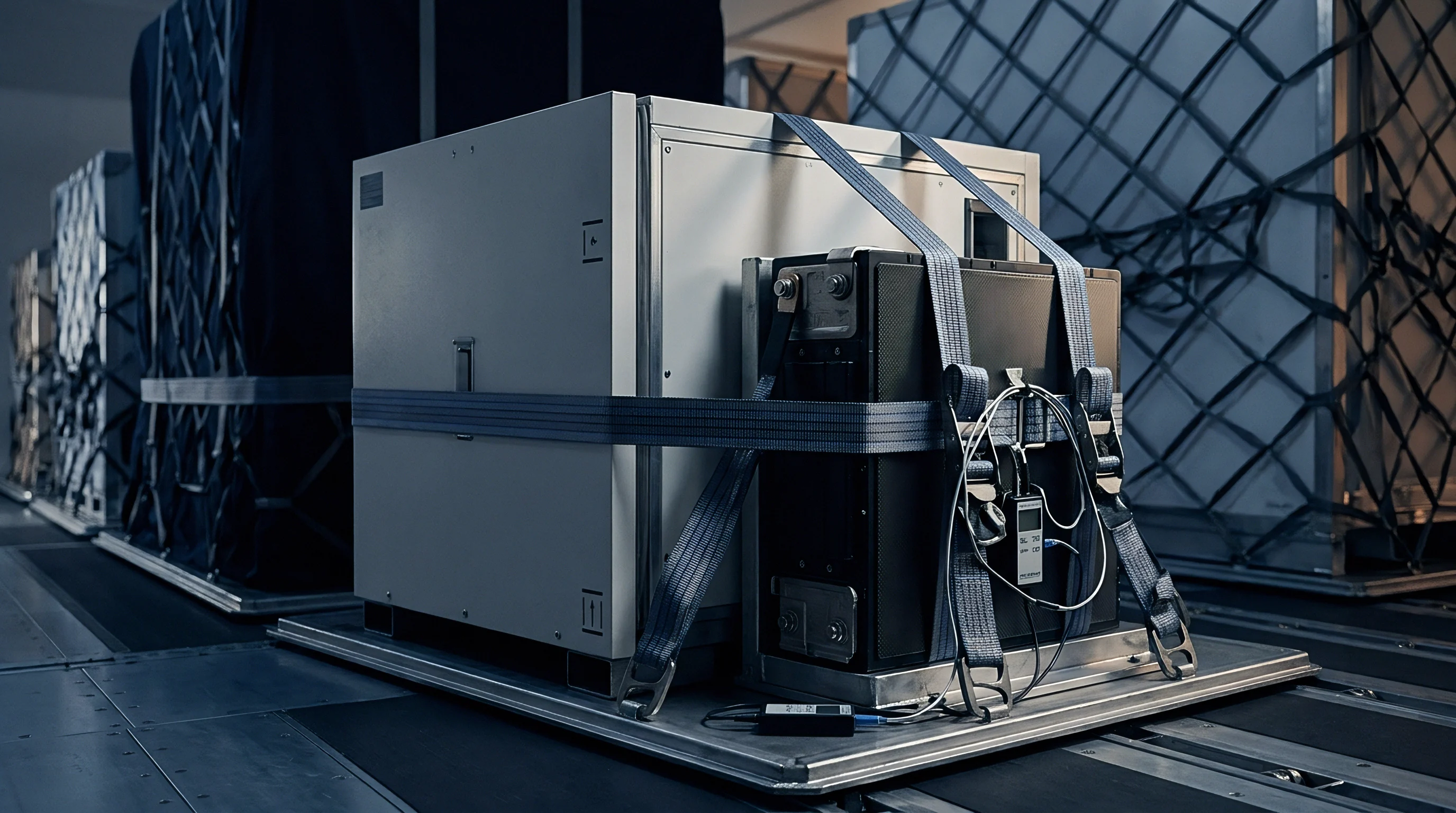
Carrier Acceptance Requirements and Paperwork Matching
Freight forwarders operating under international dangerous goods protocols reject cargo tenders whenever document details diverge. Receiving personnel verify four core parameters on the dock: proper shipping name, assigned UN identification number, net battery mass, and maximum watt-hour rating. For standalone lithium ion cells or batteries shipped under UN 3480, IATA Packing Instruction 965 Section IA and Section IB set a maximum State of Charge limit of 30 percent nominal capacity.
Ground handlers verify this declaration against the shipper summary before loading cargo onto air pallets.
Air transport manifests for UN 3480 shipments must explicitly record the State of Charge compliance statement alongside total net explosive mass. Acceptance agents inspect Air Waybill house entries to confirm that the shipper reference number on the dangerous goods declaration matches a valid UN 38.3.5 test summary. For ocean transport under the International Maritime Dangerous Goods Code, UN 3480 and UN 3481 shipments travel in containers subject to strict segregation rules.
Maritime inspectors cross-check container packing certificates against cell test summaries to confirm that thermal stability testing covers the actual payload configuration inside the container.
Missing signatures on test documentation invalidate the entire clearance dossier at customs.
| UN Identification Number | Proper Shipping Name | Transport Modality Limits | Packing Instruction Authority | Manifest Declaration Mandate |
|---|---|---|---|---|
| UN 3480 | Lithium ion batteries | Cargo Aircraft Only max 35 kg net mass per package, 30% SoC limit | IATA PI 965 / IMDG P903 | State of Charge declaration, watt-hour rating, UN 38.3 summary availability statement |
| UN 3481 | Lithium ion batteries contained in equipment | Passenger and Cargo Aircraft max 35 kg net battery mass | IATA PI 967 / IMDG P903 | Equipment integration record, watt-hour rating, test summary reference number |
| UN 3090 | Lithium metal batteries | Cargo Aircraft Only, passenger aircraft prohibition | IATA PI 968 / IMDG P903 | Aggregate lithium metal content in grams, UN 38.3 compliance record |
| UN 3091 | Lithium metal batteries packed with equipment | Passenger and Cargo Aircraft max 5 kg net metal mass | IATA PI 969 / IMDG P903 | Lithium content per cell and pack, outer packaging structural rating |

Mandatory Elements of the UN Test Summary
Subsection 38.3.5 establishes a ten-point compliance dossier for cell and pack designs. Shipper declarations are legally invalid unless backed by a test summary containing every mandatory field required by the United Nations Manual of Tests and Criteria. This document provides traceable proof that representative sample sets passed altitude simulation, thermal cycling, vibration, mechanical shock, external short circuit, impact or crush, overcharge, and forced discharge testing.
Receiving agents verify that the test summary lists the exact cell or battery model designation shown on the commercial invoice. Generic product descriptions render clearance files invalid. The record must include complete manufacturer details, accredited laboratory credentials, test report numbers, and completion dates, alongside physical specifications such as cell chemistry, gross mass, nominal voltage, and watt-hour energy ratings.
A lithium ion cargo shipment operating under IATA PI 965 Section IA exceeds allowable transport limits when state of charge surpasses 30 percent nominal capacity during air tender.
Port verification workflows focus heavily on the document signature line. Under the UN 38.3.5 revision framework, the test summary must feature the printed name and title of an authorized corporate signatory. Anonymous certificates or summaries lacking verifiable corporate authorship fail compliance checks, leading to hold orders and customs rejections.
- Name of cell, module, or battery manufacturer including physical corporate address, website, direct telephone contact, and corporate email domain.
- Testing laboratory identity specifying full testing facility name, laboratory address, phone number, email address, and accreditation registration details.
- Unique test report identification number with matching issuance date corresponding directly to the master laboratory test dossier.
- Detailed product description listing cell chemistry, physical format, model number, nominal voltage, and exact watt-hour rating for lithium ion or lithium content mass for lithium metal.
- List of completed tests confirming individual pass results for UN 38.3 tests T.1 through T.8 with specific standard revision levels indicated.
- Disclaimers or assembly testing parameters stating whether sub-assembly testing applies or if completed battery assemblies satisfy aggregate qualification rules.
- Authorized signatory credentials containing the full printed name, corporate title, and digital or physical signature of the compliance manager.
If physical cargo details diverge from the test summary at terminal gates, port authorities issue dangerous goods holds that trigger demurrage fees, mandatory inspection costs, and daily administrative fines until the payload is re-exported or destroyed.


Mismatch
Divergence between certified design figures and active shipping paperwork creates immediate exposure at cargo terminals. Mismatches across cell datasheets, outer package labels, manifests, and test summaries remain the primary cause of clearance delays. Forwarders and terminal operators rely on automated screening that flags even minor numerical variances across documentation, so resolving discrepancies requires auditing electrochemical values and mass records before signing freight tenders.
Direct cross-referencing of dangerous goods manifests against cell test records frequently uncovers mismatches in registered watt-hour calculations. Manufacturers often adjust chemistry formulations to boost nominal capacity without updating transport documentation. A cell certified at 3.0 Ampere-hours operating at 3.6 Volts nominal carries a 10.8 Watt-hour rating; if manufacturing revisions push capacity to 3.2 Ampere-hours, energy content increases to 11.52 Watt-hours, invalidating the legacy UN 38.3 test summary for that batch.
Discrepancies in declared mass values halt customs clearance at the port.

Watt Hour Rating and Mass Divergence
Capacity discrepancies directly alter transport classification under hazardous materials regulations. For lithium ion cargo, thresholds of 20 Watt-hours per cell and 100 Watt-hours per battery determine whether a shipment qualifies for simplified packing under Section II or requires fully regulated Class 9 procedures under Section IA or IB. Declaring a pack rating of 98 Watt-hours on a manifest when the test summary records 102 Watt-hours violates shipping law.
Physical mass variances trigger similar audit failures during dock handling. Manifests list net battery weight alongside gross package weight, and ground crews weigh pallets upon arrival. When measured net mass departs from the value on the UN 38.3 test summary beyond standard packing tolerances, customs officers flag the consignment.
Such variations usually point to inaccurate cell counts inside outer packaging or uncertified cell swaps within the enclosure.
Mismatched lot numbers between bills of lading and quality files create immediate customs holds.

Assembly Level Hierarchy and Subcontracted Cells
Traceability gaps appear when multi-cell systems incorporate components certified under separate documentation. Integrators often build large packs using off-the-shelf cylindrical or prismatic cells from external suppliers. Transport rules allow pre-certified cells to be integrated into larger pack structures, but the completed assembly requires independent UN 38.3 testing if total mass or capacity crosses regulatory thresholds.
A common compliance failure occurs when a manifest lists a finished energy storage pack under UN 3480 while the supporting test summary covers only the individual internal cell. Section 38.3.3 of the UN Manual of Tests and Criteria defines when cell-level testing applies to module or pack assemblies. Presenting cell summaries for completed pack shipments results in immediate rejection unless formal assembly exemptions apply and are documented.
Section 38.3.5 of the UN Manual of Tests and Criteria obligates cell distributors to make test summaries available throughout the supply chain or face freight embargoes at port terminals.
Auditing the paperwork trail requires a structured process to isolate variances across commercial, electrochemical, and physical data fields.
- Compare the physical cell model designation printed on the outer battery casing against the exact product identifier stated on the UN 38.3.5 test summary.
- Recalculate the aggregate watt-hour energy rating by multiplying the nominal voltage by the rated capacity in ampere-hours, ensuring the result matches both the test summary line item and the dangerous goods declaration.
- Verify the net battery mass stated on the shipper declaration against the certified mass value listed in section 4 of the UN test summary document.
- Confirm that the laboratory test report number cited on the summary resolves to a verified testing facility with valid accreditation credentials.
- Inspect the date of testing completion on the summary to ensure compliance with the active edition of the applicable transport regulations.
- Match the serial batch numbers listed on the ocean bill of lading or air waybill against the manufacturing lot numbers detailed within the quality assurance release records.
- Validate the state of charge percentage declared on the air carriage manifest against physical open-circuit voltage measurements recorded during package sealing.
Missing assembly-level test reports for integrated pack shipments cannot be justified by assuming that cell-level safety certification automatically extends to finished multi-series module architectures without independent physical testing.

Bench
Qualifying lithium chemistries under international standards requires rigorous environmental and mechanical stress testing. The UN 38.3 series subjects cells and battery assemblies to conditions engineered to simulate international transit. Understanding the precise parameters, pass criteria, and execution of tests T.1 through T.8 enables logistics managers to verify whether a test summary provides valid legal coverage for a shipment.
Testing protocols run sequentially on designated sample sets, where subtle discrepancies between cell mass and packaging weight frequently trigger airside holds. Test T.1 simulates unpressurized aircraft cargo holds up to 15,000 meters by subjecting fully charged units to an absolute pressure of 11.6 kilopascals for at least six hours. Test T.2 imposes extreme thermal cycling, alternating ambient temperatures between negative 40 degrees Celsius and positive 72 degrees Celsius over six-hour intervals for ten complete cycles.
Passing both phases requires zero mass loss, leakage, venting, disassembly, rupture, or fire, while maintaining open-circuit voltage within 10 percent of pre-test values.
Documentary discrepancies discovered during intake result in immediate airside cargo holds.

When Can Module Testing Substitute for Pack Clearance?
Pack architecture dictates whether sub-assembly certification can cover complete battery enclosures. Subsection 38.3.3 states that an assembly incorporating pre-tested cells with an aggregate rating over 6200 Watt-hours does not require full UN 38.3 re-testing if the constituent modules passed all applicable tests and the pack includes certified overcharge protection. However, modifying internal busbars, altering external structural framing, or updating battery management system firmware after module testing forfeits that exemption.
Logistics planners cross-referencing sub-assembly summaries against manifests must verify that design modifications remain within strict limits. If finished pack weight increases by more than 20 percent over the tested module baseline, or if internal cell mounting changes, testing authorities require complete assembly re-qualification. Submitting a module-level summary for a modified system without supporting structural impact data leads to cargo seizure by transport inspectors.
| Test Designation | Simulated Transport Condition | Test Execution Parameters | Required Sample Quantity | Mandatory Pass Criteria |
|---|---|---|---|---|
| T.1 Altitude | Unpressurized aircraft cargo hold | 11.6 kPa absolute pressure for 6 hours at 20°C | 10 cells / 4 small packs / 2 large packs | No mass loss, no leakage, no venting, voltage within 10% |
| T.2 Thermal | Extreme ambient temperature shifts | -40°C to +72°C thermal shocks, 10 cycles, 12h dwell time | 10 cells / 4 small packs / 2 large packs | No mass loss, no leakage, no disassembly, no rupture, no fire |
| T.3 Vibration | Transport vehicle motion and turbulence | Sinusoidal sweep 7 Hz to 200 Hz back to 7 Hz over 15 min, 3 axes | 10 cells / 4 small packs / 2 large packs | No mass loss, no venting, no voltage drop, structural stability |
| T.4 Shock | Rough cargo handling and drop impact | Half-sine shock 150 gn / 6 ms or 50 gn / 11 ms, 18 total shocks | 10 cells / 4 small packs / 2 large packs | No mass loss, no physical degradation, internal circuit stability |
| T.5 External Short Circuit | Terminal shorting during handling | External resistance < 0.1 ohm at 57°C for 1 hour post-temp peak | 10 cells / 4 small packs / 2 large packs | Case temperature < 170°C, no disassembly, no rupture, no fire |
| T.6 Impact / Crush | Severe mechanical crushing or puncture | 9.1 kg mass drop from 61 cm or 13 kN crush force across axis | 5 cells (undischarged) / 5 cells (fully discharged) | External temperature < 170°C, no disassembly, no fire within 6 hours |
| T.7 Overcharge | Charger malfunction or voltage spike | 2x max continuous charge current at max charge voltage for 24 hours | 4 small packs / 2 large packs (fully charged) | No disassembly, no fire, continuous monitoring for 7 days post-test |
| T.8 Forced Discharge | Reverse polarity connection in series | 1x max continuous discharge current forced reversed for set duration | 10 cells (fully discharged) | No disassembly, no fire within 7 days post-test monitoring |

Thermal and Mechanical Test Boundary Conditions
Simulated altitude, thermal shock, and vibration sequences test structural integrity under extreme transport conditions. Test T.3 subjects units to logarithmic frequency sweeps from 7 Hertz to 200 Hertz and back to 7 Hertz across 15-minute intervals, repeated 12 times along three perpendicular axes. Test T.4 applies mechanical shocks using half-sine waveforms, subjecting small cells to peak accelerations of 150 gn over 6 milliseconds and large packs to 50 gn over 11 milliseconds.
Dynamic mechanical impact testing under Test T.6 evaluates internal short-circuit resistance during severe deformation. Crush procedures apply a 13-kilonewton compressive force using a flat 15-centimeter bar across the cell casing until internal voltage drops by 100 millivolts or the load limit is met. External short-circuit testing under Test T.5 connects positive and negative terminals through a load resistance below 0.1 ohms at 57 degrees Celsius; internal temperatures must remain below 170 degrees Celsius without triggering thermal runaway or case rupture.
Module clearance valid for small battery assemblies loses regulatory standing when structural framing modifications alter cell restraint mechanics during impact testing.
Test T.7 evaluates overcharge protection systems by applying twice the manufacturer’s maximum continuous charging current at peak voltage for 24 continuous hours. Test T.8 forces deep discharge by connecting a discharged cell in series with an external direct-current supply to drive reverse-polarity current. Both protocols require seven days of thermal observation following exposure to ensure no latent thermal runaway occurs.
How do logistics authorities effectively reconcile regional test certificate validity when international laboratories perform qualification testing under older UN Manual revision levels while active modal dangerous goods regulations enforce updated test criteria?

Reconciliation
Systematic validation across dangerous goods manifests and testing summaries prevents costly terminal detentions. Verification requires cross-checking commercial shipping documents, transport declarations, customs invoices, and safety dossiers. Establishing a formal review process ensures that battery orders moving through global networks carry compliant, defensible paperwork before arriving at port gates.
Aligning supplier quality files directly with bill of lading entries isolates non-compliant shipments before customs declaration. Multimodal shipping chains involving sea, air, and highway freight operate under distinct regulatory regimes: the International Civil Aviation Organization governs air carriage, the International Maritime Organization enforces sea transit under the IMDG Code, and the United Nations Economic Commission for Europe oversees road transport under ADR rules. While all three reference the UN Manual of Tests and Criteria, individual carriers and local customs authorities enforce distinct presentation standards that require careful cross-referencing.
Air carriers rigorously enforce state-of-charge limits during cargo acceptance.

Cross Referencing Protocol for Multi Modal Manifests
Transferring freight between ocean vessels, aircraft, and trucks involves distinct document requirements across jurisdictions. An air manifest tendered under UN 3480 IATA PI 965 Section IA requires an explicit State of Charge statement on the Shipper’s Declaration for Dangerous Goods. If that container transfers to sea transport under IMDG P903, the ocean bill of lading does not mandate the 30 percent charge limit, but requires an emergency response contact statement and container packing certificate.
Cross-referencing across modalities requires verifying that proper shipping names remain consistent on all paperwork. A consignment listed as UN 3480 Lithium Ion Batteries on an air waybill cannot switch to UN 3481 Lithium Ion Batteries Contained in Equipment on a sea bill of lading without triggering an immediate review. Inconsistent shipping names often indicate improper declarations designed to bypass passenger aircraft prohibitions or lower freight insurance premiums.
Carrier acceptance rules are strictly enforced across all transport hubs.

Automated Tracing across Supply Chain Documents
Digital validation tools compare bill of lading line items against certified databases to identify numerical errors. Compliance software extracts key fields from UN 38.3.5 test summaries via optical character recognition and checks them against active manifest records. These automated systems confirm that nominal voltage multiplied by capacity equals the declared watt-hour rating, that net mass falls within design tolerances, and that signatory dates remain valid.
Supply chain integration links physical cell serial numbers directly to digital product passports and shipping files. Scanning a 2D matrix code etched onto a cell casing pulls up the corresponding UN 38.3 test summary, lot release record, and bill of lading line item. This traceability helps prevent grey-market cell substitutions, where substandard units are packaged under legitimate labels and moved using copied compliance records.
- Document Identity Matching ensuring the shipper name, consignee name, model numbers, and product descriptions match identical entries across the invoice, packing list, dangerous goods declaration, and UN 38.3 test summary.
- Energy and Voltage Cross Calculation multiplying nominal voltage by rated ampere-hour capacity to verify that declared watt-hour values match certified test summary limits across all manifest lines.
- Mass and Quantity Alignment summing individual cell net weights to confirm that total manifest net mass accurately reflects physical cargo payload weight without unexplained variance.
- Classification Consistency Verification verifying that UN identification numbers and packing instruction references remain aligned across air, sea, and highway transport manifests.
- Laboratory Accreditation Audit cross-checking testing laboratory registration details against active international accreditation databases to confirm testing authority legitimacy.
- State of Charge Declaration Check confirming that air transport manifests for standalone lithium ion cells carry explicit 30 percent State of Charge compliance verifications signed by authorized personnel.
Completing a cross-referencing audit before tendering cargo to freight forwarders keeps dangerous goods shipments moving through international transport hubs without delay.


Fine
Legal and financial risks escalate rapidly when non-compliant dangerous goods documentation enters transport networks. Failing to follow battery shipping regulations exposes shippers, integrators, and forwarders to administrative fines, cargo forfeiture, vessel delays, and civil litigation. Regulators view incomplete or mismatched manifests as severe safety violations, applying strict liability regardless of whether documentation errors led to a physical thermal incident.
Under Title 49 of the United States Code of Federal Regulations, the Pipeline and Hazardous Materials Safety Administration enforces civil penalties exceeding 80,000 United States dollars per day for individual documentation violations. If non-compliant paperwork contributes to cargo fires, injuries, or environmental damage, enforcement escalates to criminal prosecution under federal transportation safety statutes. International aviation and maritime agencies operate parallel enforcement mechanisms, placing non-compliant shippers on carrier watchlists that freeze future freight movements.
Legal responsibility for transport compliance rests entirely with the shipper of record.

Regulatory Enforcement Mechanics and Carrier Rejections
Aviation and maritime authorities conduct routine physical audits at air terminals and seaports. Inspectors perform random dockside checks, pulling containers to verify cargo against dangerous goods declarations and UN 38.3 test summaries. Finding mismatched model numbers, missing test summaries, or undeclared state-of-charge overages results in immediate hold orders that lock freight in port storage facilities.
Carrier rejections generate immediate secondary costs. Forwarders bill mandatory hazardous material handling fees, re-labeling charges, port demurrage, and inspection expenses back to the shipper of record. If a carrier rejects cargo airside due to a missing or mismatched UN 38.3.5 test summary, the forwarder must re-route the shipment by sea or return it to its origin at the shipper’s expense, substantially increasing landed logistics costs.
| Jurisdiction / Modality | Regulatory Enforcement Authority | Maximum Civil Penalty per Violation | Primary Cause of Cargo Detention |
|---|---|---|---|
| United States / All Modes | PHMSA / US DOT (49 CFR) | Up to 89,678 USD per day per violation | Mismatched UN summary model numbers, undeclared lithium content |
| European Union / Road | ADR National Competent Authorities | Up to 50,000 EUR per non-compliant vehicle load | Missing dangerous goods driver transport cards, invalid pack documentation |
| Global Air Cargo | IATA / ICAO Dangerous Goods Panel | Carrier bans, airside seizure, civil prosecution | Exceeding 30% State of Charge limit under PI 965, missing test summaries |
| Global Maritime Cargo | IMO / Port State Control (IMDG) | Container seizure, vessel delay damages, port fines | Improper container segregation, invalid container packing certificates |

Contractual Risk Transfer for Transport Non Compliance
Commercial agreements allocate financial liability among cell manufacturers, integrators, and buyers through indemnification clauses. Procurement contracts should explicitly state that vendors bear responsibility for providing accurate UN 38.3 test summaries corresponding to delivered production lots. Without clear contractual allocation, buyers remain exposed as the importer or shipper of record when customs flags non-compliant shipping files.
Insurance coverage for international battery transit often excludes losses resulting from regulatory non-compliance. Marine underwriters include explicit exclusion clauses that void coverage if a transit fire involves cargo shipped under inaccurate or mismatched dangerous goods declarations. Direct cross-referencing between UN 38.3 test summaries and manifests protects insurance enforceability, safeguarding capital against catastrophic transport losses.
Freight forwarders hold no legal obligation to correct conflicting mass figures between dangerous goods declarations and cell specification documents.
Standard supply chain indemnification clauses stipulate that the cell vendor will defend, indemnify, and hold harmless the buyer from administrative fines, demurrage costs, carrier penalties, and legal fees resulting directly from inaccurate, incomplete, or invalid UN 38.3 test summary submissions.