Helium Leak Rate Conversion for Pouch Cell Seals
Convert helium leak rates to air and moisture ingress rates by identifying the microchannel flow regime using Knudsen numbers to calculate 10-year cell degradation.
Seam
Pouch cell chemistries are encased in laminated aluminum barrier foil, using a fused thermoplastic perimeter to isolate volatile organic carbonates from ambient air. The metal layer ~ typically 30 to 40 micrometers of cold-rolled aluminum ~ serves as an impermeable barrier against gas diffusion. Hermetic integrity depends on the cast polypropylene bonding zone formed during thermal impulse sealing.
Nickel-plated copper and pure aluminum tab leads interrupt this polymer bond, introducing potential leak paths along the metal-sealant interface where micro-gaps, polymer thinning, and localized shoulder delamination allow electrolyte vapors to escape and moisture to enter.
When atmospheric water enters through sub-micron channels, it reacts with lithium hexafluorophosphate to produce hydrofluoric acid, degrading the active cathode material while solvent loss dries out separator pores. Quantitative gas detection measures the dimensions of these defect channels before liquid electrolyte wets the inner perimeter. Once electrolyte reaches a micro-capillary, capillary pressure and solvent crystallization alter the channel geometry, blocking tracer gas transport and hiding defective bonds during screening.
- Tab Shoulder Voids develop where the cast polypropylene adhesive fails to wet the stepped transition between the metallic lead and the pouch foil, leaving open micro-capillaries.
- Sealant Squeeze Out occurs under excessive thermal sealing pressure, thinning the polymer dielectric barrier down to less than 10 micrometers and generating micro-fissures along the inner edge.
- Interfacial Delamination stems from surface contamination or insufficient corona treatment of the aluminum substrate, producing non-bonded planar creep pathways across the perimeter.
- Pinholes originate from excessive mechanical draw depth during the cold-forming of the aluminum pouch pocket, creating micro-fractures in the aluminum core layer.
Polypropylene tab sealant film remains the primary permeation pathway in laminated pouch packaging.
Quantifying these leakage pathways requires injecting or bombing a light tracer gas through the seal interface. Helium serves as the standard tracer molecule due to its small kinetic diameter of 0.26 nanometers and low ambient concentration of roughly 5 parts per million. Establishing rigorous conversion mathematics from measured helium flux to real-world solvent loss and moisture ingress forms the technical basis for setting pouch cell quality limits.
Microchannel geometry shifts under mechanical pack compression, altering baseline permeation rates determined on unconstrained individual cells.

Equivalence
Mathematical translation of tracer flow rates into real-world gas and liquid permeation rates relies on the Knudsen number, defined as the ratio of the molecular mean free path to the characteristic channel diameter. Gas transport across micro-defects falls into three distinct regimes: viscous laminar flow (dictated by viscosity), molecular effusion (governed by molecular mass), and transitional Knudsen flow. Accurate correlation requires establishing the precise transport regime active inside the micro-defect under the applied test pressure differential.

Which Flow Regime Governs Microchannel Leak Paths?
When defect diameters exceed 10 micrometers at atmospheric pressure, the mean free path of gas molecules is substantially smaller than the channel width, causing intermolecular collisions to dominate. In this laminar viscous regime, described by the Hagen-Poiseuille equation, flow rate scales inversely with dynamic gas viscosity and proportionally to the difference of the squares of absolute pressures. Helium has a dynamic viscosity of 19.6 micropascal-seconds at 20 degrees Celsius, compared to 18.2 micropascal-seconds for dry air.
Converting a measured laminar helium leak rate to an equivalent air leak rate involves the inverse ratio of their dynamic viscosities alongside pressure differential corrections.
In narrow micro-defects with diameters below 0.1 micrometers, or under high-vacuum test conditions where the mean free path expands, molecular flow governs transport. Gas molecules collide primarily with channel walls rather than with one another. Knudsen molecular flow rates scale inversely with the square root of the gas molecular weight, governed by Graham’s law of effusion.
Helium, with a molar mass of 4.003 grams per mole, effuses 2.69 times faster than dry air at 28.97 grams per mole under identical temperature and partial pressure gradients.
| Gas or Vapor Species | Molar Mass (g/mol) | Dynamic Viscosity (µPa·s) | Molecular Flow Ratio relative to Helium | Laminar Viscous Ratio relative to Helium |
|---|---|---|---|---|
| Helium (He) | 4.003 | 19.6 | 1.000 | 1.000 |
| Dry Air | 28.970 | 18.2 | 0.372 | 1.077 |
| Water Vapor (H2O) | 18.015 | 12.6 | 0.471 | 1.556 |
| Dimethyl Carbonate (DMC) | 90.080 | 9.8 | 0.211 | 2.000 |
| Ethyl Methyl Carbonate (EMC) | 104.100 | 9.1 | 0.196 | 2.154 |
Transitional flow occurs when the Knudsen number falls between 0.01 and 1.0, requiring combined formulations that incorporate both viscosity-driven momentum transfer and mass-dependent molecular diffusion. Real channel geometries in lithium-ion pouch seals consist of tortuous, non-circular fissures along polymer boundaries. Applying pure molecular conversion models to channels dominated by transitional flow overstates standard air leak rates by up to 40 percent.
Contractual test specifications referencing ASTM E493 reject any battery lot exhibiting helium emission exceeding 5.0e-6 mbar liters per second under hard vacuum.
Converting a standard helium leak rate, expressed in millibar-liters per second, into a water vapor ingress rate requires accounting for external relative humidity driving forces and internal chemical gettering. Liquid electrolyte components inside the cell maintain an internal water vapor partial pressure near zero. External atmospheric water vapor at 25 degrees Celsius and 60 percent relative humidity exerts a partial pressure of approximately 19 millibars.
In contrast, helium leak tests typically apply a full 1013 millibar pressure differential across the seal during vacuum chamber evaluation.
Procurement agreements referencing DIN EN 1779 Annex B establish that leak rate equivalence conversions must declare the assumed channel diameter and flow regime, invalidating supplier certificates that apply molecular square-root conversions across uncharacterized defect regimes.

Chamber
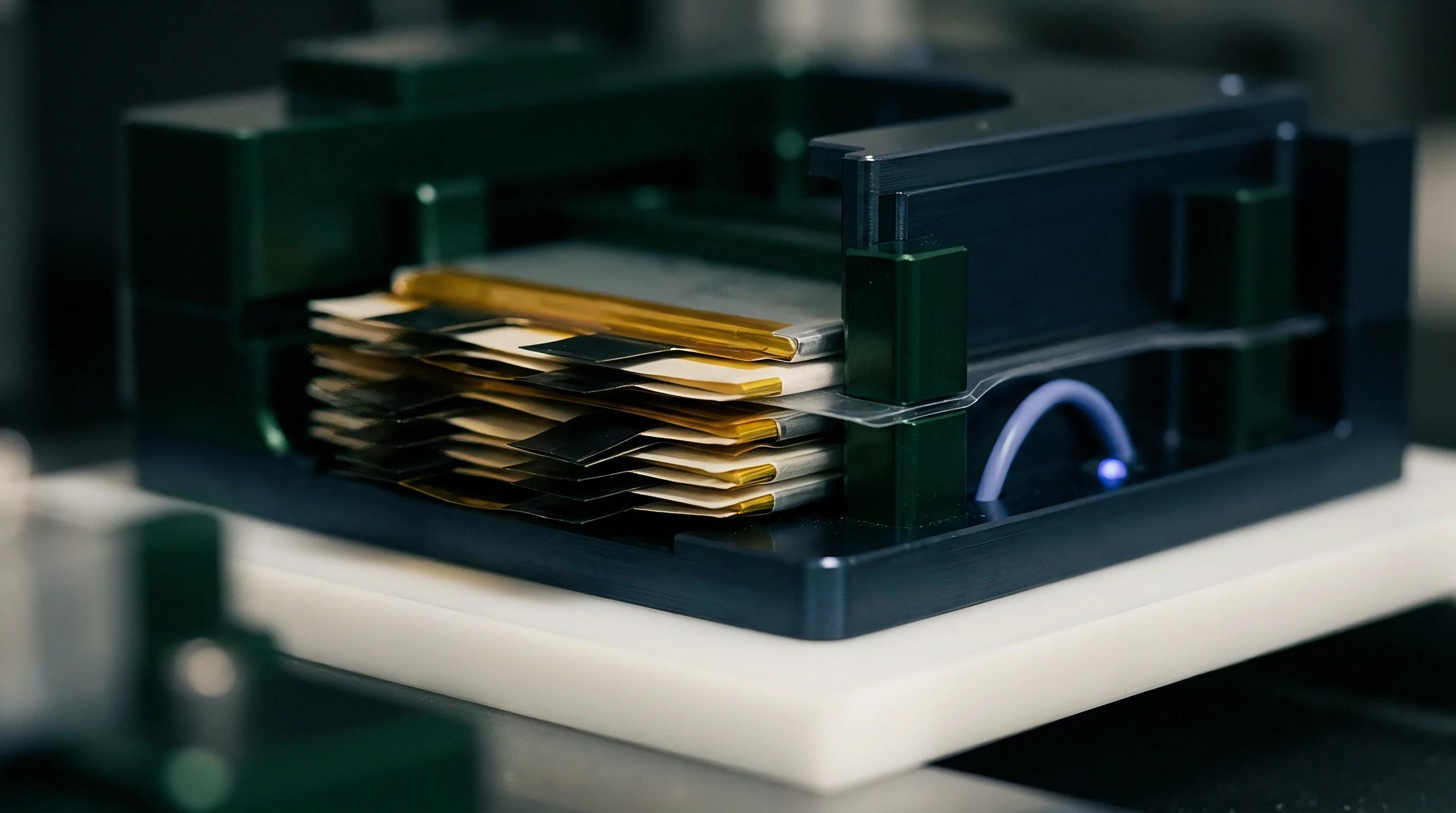
Vacuum test tooling designs determine the signal resolution and measurement repeatability for pouch cell envelopes. Because flexible pouch packaging presents mechanical challenges during gross depressurization ~ where a hard vacuum collapses pouches ~ evacuating a rigid test fixture containing a sealed cell creates internal overpressure that balloons the foil package, risking mechanical seam failure if tooling cavity clearances exceed allowable limits. Custom rigid fixtures must incorporate contoured cavity inserts that support the pouch faces while leaving perimeter seals and tab areas exposed to the vacuum sensing volume.

Where Does Background Outgassing Obscure True Permeation?
Outer protective layers of pouch laminates, typically composed of oriented polyamide or polyethylene terephthalate, absorb environmental moisture and atmospheric helium. When placed inside a high-vacuum chamber connected to a mass spectrometer, these outer polymer films desorb trapped gases and create a substantial background signal. Because tooling cavity volume dictates sensitivity and background helium causes signal drift, distinguishing true interfacial leakage from outer film desorption requires strict chamber evacuation profiles and baseline tare subtraction.
- Chamber Evacuation drops the tooling interior pressure below 0.1 millibar to clear atmospheric helium and establish laminar pump-down kinetics.
- Baseline Measurement monitors background outgassing drift until the mass spectrometer ion current stabilizes below 1.0e-9 mbar liters per second.
- Tracer Gas Accumulation collects permeating tracer atoms over a dwell period ranging from 10 to 60 seconds.
- Signal Integration records the calibrated helium peak at mass-to-charge ratio 4, subtracting the baseline tare value to determine true leak rate.
| Test Method | Tracer Dosing Mechanism | Pressure Differential (mbar) | Detection Limit (mbar·L/s) | Primary Risk Factor |
|---|---|---|---|---|
| Hard Vacuum Extraction | Internal He dosing during final seal | 1000 (Internal to External) | 1.0e-10 | Pouch ballooning and seam rupture |
| Helium Bombing Chamber | External pressurization pre-soak | 2000 to 5000 (External) | 1.0e-7 | Helium absorption in outer nylon film |
| Atmospheric Sniffer Probe | Internal He dosing or bombing | 0 (Ambient pressure) | 1.0e-5 | Operator speed and tip distance variance |
| Accumulation Chamber | Internal He dosing | 0 (Constant volume ambient) | 1.0e-6 | Long cycle times and thermal drift |
Because gross leaks allow the entire internal tracer volume to escape during initial chamber roughing, no detectable helium remains during the high-vacuum analytical phase. Quality protocols therefore incorporate a secondary gross leak check, such as a vacuum decay sensor or optical deflection gauge, before exposing the test volume to the mass spectrometer source.
Elevated background helium signals may stem from ambient humidity in the testing room rather than unsealed tab corners.
Threshold
Permissible leak rate limits derive from the maximum allowable moisture ingress over the target operational lifespan of the battery system, as water ingress triggers cell swelling. For automotive and stationary energy storage applications demanding a 10 to 15 year service life, total accumulated moisture inside the cell must remain below 50 parts per million relative to the total electrolyte mass. A standard 50 ampere-hour pouch cell containing 120 grams of carbonate electrolyte tolerates a maximum lifetime water accumulation of 6.0 milligrams.
Converting this moisture ingress budget into a room-temperature helium leak rate requires calculating the equivalent flux across the seal boundary. Assuming molecular flow through micro-defects, an annual water ingress budget of 0.40 milligrams per year under 50 percent relative humidity at 20 degrees Celsius corresponds to a continuous water vapor leak rate of 5.6e-10 mbar liters per second. Correcting for the partial pressure differential and the molecular weight ratio yields an equivalent standard helium rejection limit of 3.2e-8 mbar liters per second under a 1.0 bar differential.
A measured helium leak rate of 1.0e-7 mbar liters per second corresponds to 0.03 milligrams of moisture ingress annually under 85 percent relative humidity at 25 degrees Celsius.
| Helium Leak Rate (mbar·L/s) | Equivalent Annual H2O Ingress (mg) | Ten-Year H2O Content (ppm) | Ten-Year Solvent Mass Loss (g) | Operational Degradation Status |
|---|---|---|---|---|
| 1.0e-9 | 0.012 | 1.0 | 0.03 | Hermetic seal preserved |
| 1.0e-8 | 0.125 | 10.4 | 0.31 | Negligible capacity loss |
| 1.0e-7 | 1.250 | 104.2 | 3.10 | Electrolyte breakdown and gassing |
| 1.0e-6 | 12.500 | 1041.7 | 31.00 | Severe dry-out and premature failure |
| 1.0e-5 | 125.000 | 10416.7 | 120.00 | Complete cell death within 24 months |
Solvent loss creates secondary degradation mechanisms that operate concurrently with moisture ingress. Volatile linear carbonates such as dimethyl carbonate and ethyl methyl carbonate evaporate outward through the same channels that admit water. At a helium leak rate of 1.0e-6 mbar liters per second, a cell loses over 30 grams of organic solvent over a ten-year deployment, depleting the electrolyte volume, causing separator pore dry-out, and accelerating internal resistance growth.
Deploying pouch cells with helium leakage rates above 1.0e-7 mbar liters per second invalidates long-term capacity retention warranties, creating high warranty reserve liabilities and exposure to safety recalls from moisture-induced internal gassing.
Verdict
Incoming quality inspection frameworks must validate cell leak test certificates against empirical physics rather than nominal factory pass stamps. Destructive burst testing and visual seal inspection lack the resolution needed to identify micro-capillary defect pathways. Procuring organizations execute helium verification by establishing statistical lot sampling protocols that account for batch-level seal variation and test tooling repeatability.
Because helium diffuses rapidly, trace gas dosing at the electrolyte filling station provides the most reliable method for inline fine leak detection. Cells sealed with a calibrated gas headspace containing 5 to 10 percent helium pass directly into vacuum test chambers without requiring external bombing cycles. External bombing methods introduce measurement uncertainty by forcing helium into outer polymer layers, yielding false-positive rejections on properly sealed lots.
- Direct Gas Injection Verification confirms that the cell manufacturer maintained a minimum 5 percent helium tracer concentration in the sealing chamber during the secondary degassing and final closure step.
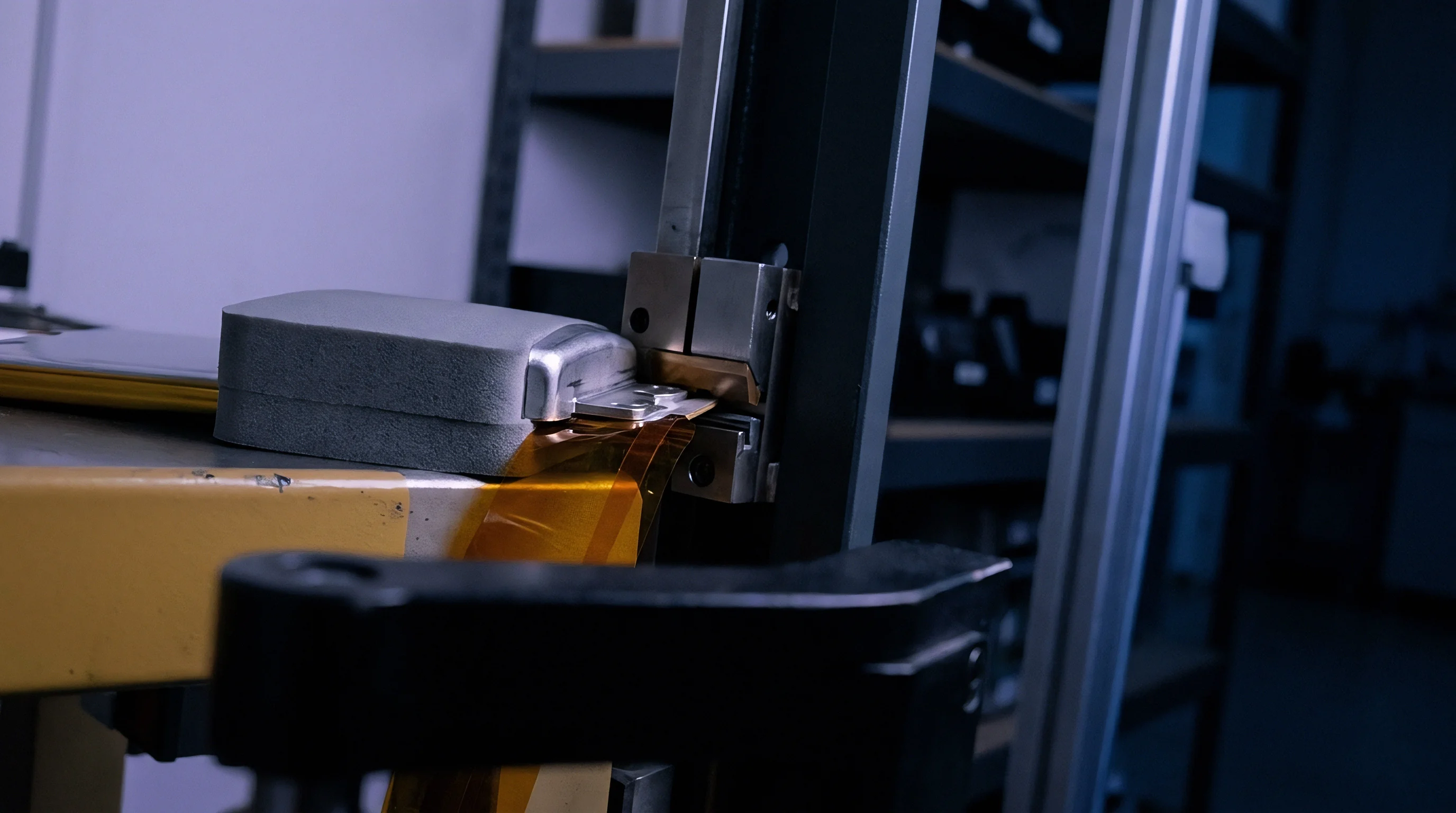
- Tooling Cavity Calibration validates that the vacuum nest supports the pouch faces under deep vacuum without masking the tab shoulder perimeter or creating false sealing pressure against the chamber walls.
- Temperature Corrected Leak Limits normalize measured leak rates to a 293 Kelvin reference state, eliminating seasonal temperature bias in factory acceptance data.
- Gross Leak Sensor Interlocks ensure the vacuum station aborts test cycles and flags gross seal failures when chamber pressure fails to reach high-vacuum crossover within 3.0 seconds.
It remains uncertain whether polymer creep and ongoing cyclic swelling during vehicle fast-charging permanently alter the Knudsen number of seal micro-defects over operating lifetimes.