Verifying UN 38.3 Laboratory Accreditation Chains during Customs Audits
Verify UN 38.3 reports by matching test dates against active ISO 17025 scopes from ILAC MRA national registries before shipping to avoid customs holds.


Dock
Customs officials at container ports and air cargo hubs demand proof that lithium battery shipments meet UN 38.3 testing requirements. When a container of lithium ion cells or battery packs is held, the immediate problem is rarely the packaging; it almost always starts with the documentation. Border authorities look closely at the accreditation chain behind the laboratory that issued the UN 38.3 test report and summary.
Under Part III, Section 38.3 of the United Nations Manual of Tests and Criteria, dangerous goods regulations mandate that shippers supply a test summary upon request. Auditors do not take these summaries at face value; they trace the lab named on the document back to national accreditation bodies to confirm the facility held an active ISO/IEC 17025 scope for UN 38.3 on the exact date of testing.
A shipping folder can include a clean test summary with lab logos, serial numbers, and passing marks for T.1 through T.8, yet clearance still stalls the moment an auditor checks the testing facility against accreditation databases. If the lab ran altitude simulation, thermal testing, vibration, shock, short circuit, impact, overcharge, or forced discharge under an expired, revoked, or non-existent scope, the shipment is detained immediately. That financial burden lands directly on the importer of record, with port demurrage piling up daily while freight forwarders try to retrieve primary lab records from overseas suppliers.
The physical release of a container at customs relies entirely on verifying that the issuing laboratory held active ISO/IEC 17025 accreditation covering the exact UN 38.3 sub-tests on the date of execution.
Port clearance moves on tight timelines, and customs officers quickly spot flags suggesting invalid or fake certificates. A common problem occurs when a manufacturer submits a report from a lab accredited for general electrical safety under IEC 62133, but missing the transport safety scope required by UN 38.3. Auditors catch that gap immediately.
Having an ISO 9001 quality management stamp on a test summary carries zero regulatory weight for shipping dangerous goods. What auditors look for are ISO/IEC 17025 logos tied to signatories of the International Laboratory Accreditation Cooperation Mutual Recognition Arrangement (ILAC MRA). Without that verified chain, customs treats the cells as uncertified dangerous goods, opening up the importer to civil penalties, cargo forfeiture, and expensive domestic re-testing.
Brokers frequently turn in partial paperwork during peak shipping seasons, leaving importers stranded when customs holds a line item. Resolving the inquiry means pulling the lab’s original scope document directly from the relevant national body ~ whether that is CNAS in China, A2LA or ANAB in the US, or DAkkS in Germany. The importer must show that the lab’s approved scope explicitly listed UN 38.3 at the time of testing.
If the lab earned its accreditation three months after issuing the report, customs will reject any claim of retroactivity. The paper trail has to run unbroken from the production date back to the test bench.

Customs Audit Mechanics and Inspection Triggers
Customs agencies rely on automated risk-scoring systems to select dangerous goods shipments for physical and paper audits. High-risk triggers include new trading companies, declared unit prices well below market averages, and routes out of regions associated with document falsification. Once a flag goes off, the officer issues a formal request for both the full UN 38.3 test summary and the underlying test report.
From there, the audit centers on three core details: whether the physical cell matches the report, whether the lab’s accreditation holds up, and whether the brand name on the cell wrapper connects back to the entity named in the report.
At the import terminal, physical inspections mean opening master cartons to review cell markings directly. The auditor checks the manufacturer name, model number, watt-hour rating, and chemistry against what is declared in the UN 38.3 summary. Minor model suffix variations cause immediate holds ~ a summary for model INR18650-25P will not clear model INR18650-25P-M without formal documentation from the testing lab confirming electrical and structural identity.
Where labs issue consolidated reports for entire cell families, auditors require structural identity declarations on accredited lab letterhead, explaining how design tweaks affect internal impedance, tab thickness, and separator thermal shrink properties.
| Audit Verification Point | Documentary Evidence Demanded | Customs Rejection Threshold | Commercial Impact Rating |
|---|---|---|---|
| Accreditation Scope Date | ISO/IEC 17025 schedule covering test dates | Scope issued after test completion date | Container hold; re-testing required |
| ILAC MRA Signatory Status | National body accreditation certificate | Lab body lacking active ILAC MRA membership | Cargo seizure; regulatory fine |
| Cell Identifier Matching | UN 38.3 section 38.3.5 test summary details | Model suffix variance without lab identity annex | Line-item rejection at port entry |
| Sub-test Scope Coverage | Detailed scope listing T.1 to T.8 explicitly | Scope limited to general safety standards | Immediate demurrage accumulation |
Audits also stretch to verifying the physical signature and identity of the approving lab engineer. Customs authorities share information across borders and can contact foreign accreditation bodies directly. The moment an auditor sends a verification query overseas, cargo movement stops.
Free time at the port runs out quickly, and storage fees mount. Knowing how auditors process these documents lets sourcing teams build contract clauses that require suppliers to maintain live, verifiable accreditation links online before containers ever get loaded onto a ship or plane.
Without third-party ILAC scope validation, unverified internal bench testing can force shipments into bonded storage and require domestic re-testing of three containers at four times the original cost.


Hierarchy
Checking whether a laboratory is valid comes down to tracing the hierarchy of international accreditation. At the top sits the International Laboratory Accreditation Cooperation (ILAC), which runs a Mutual Recognition Arrangement binding regional and national accreditation bodies into one framework. Under this arrangement, a test report from a lab accredited by a recognized national body holds legal equivalence across all participating member states.
When reviewing a UN 38.3 test report, auditors check each link in that chain: from ILAC to the national accreditation body, down to the lab, and finally to the specific test standard and revision level.
National accreditation bodies evaluate labs against ISO/IEC 17025, the standard for competence, impartiality, and consistent laboratory operation. To hold ISO/IEC 17025 accreditation, a lab has to prove technical competence for the exact test methods listed on its scope schedule. Claiming general ISO/IEC 17025 compliance isn’t enough; the formal scope document must explicitly name the test standard ~ like the UN Manual of Tests and Criteria, Part III, sub-section 38.3 ~ and list the edition or amendment level used during testing.
Things fall apart when intermediate links in the chain break down. In major manufacturing regions, unaccredited operations often adopt business names that closely mimic well-known international labs, issuing reports stamped with unauthorized logos or altered accreditation numbers. Customs auditors run routine checks against databases maintained by national bodies like China’s CNAS or the American Association for Laboratory Accreditation (A2LA).
If the lab’s registration code doesn’t match active entries in the national registry, the report gets rejected immediately.
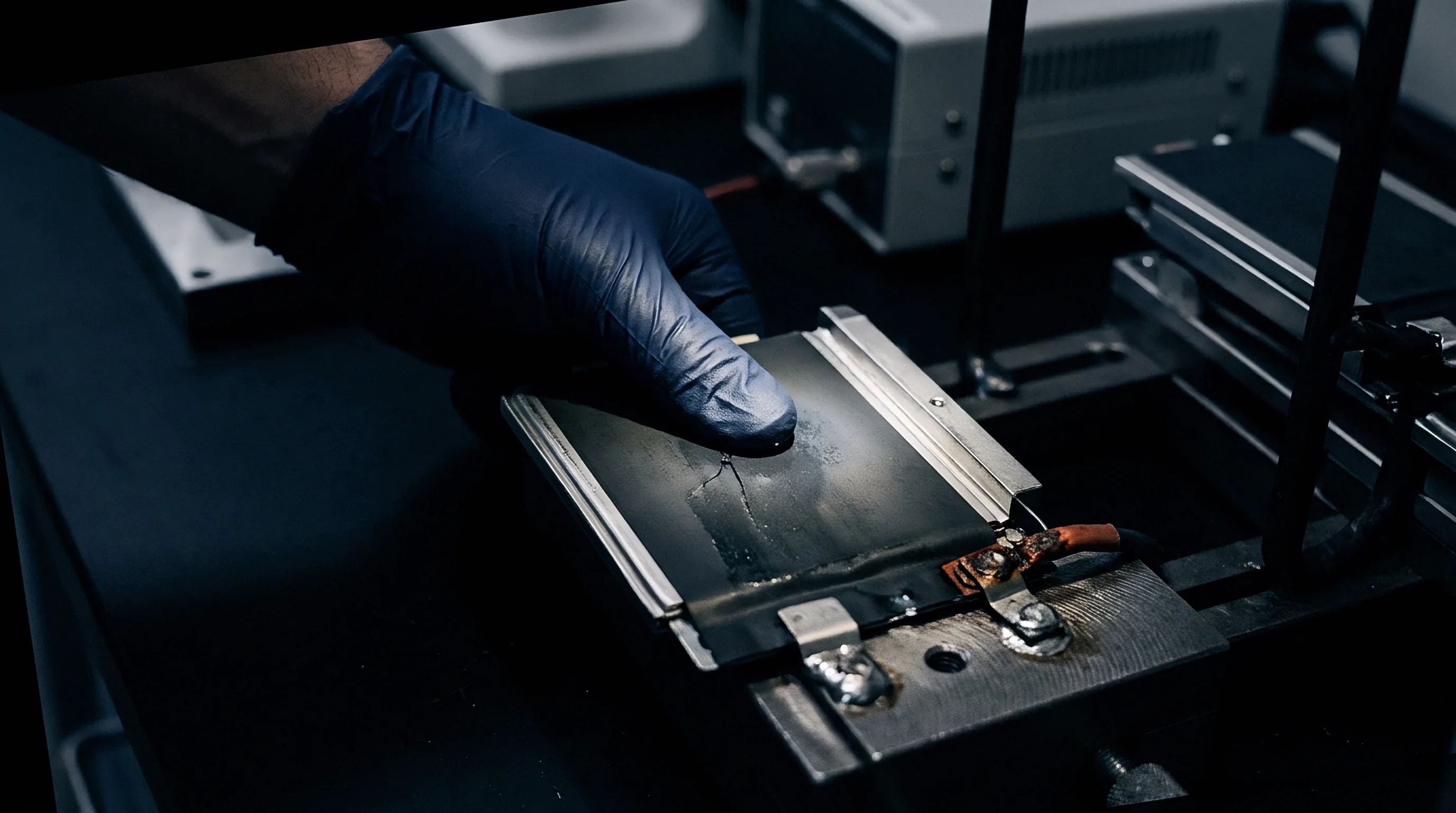
Structure of the ILAC Mutual Recognition Arrangement
The ILAC MRA network builds cross-border trust by putting national accreditation bodies through regular peer evaluations. Regional groups like European co-operation for Accreditation and the Asia Pacific Accreditation Cooperation manage these reviews. When a lab is accredited by an APAC-recognized body like CNAS or A2LA, its test certificates earn automatic acceptance from European and North American customs.
The entire setup relies on public traceability: every accredited lab gets a unique registration number that links straight to its active scope document on the national body’s portal.
- National Accreditation Body Verification starts by extracting the lab registration number from the test summary header and querying the official database of the issuing national accreditation body.
- Scope Schedule Examination checks whether UN 38.3 appears in the accredited scope table, verifying that both cell and pack level testing scope remain active.
- Date Range Correlation verifies that the physical execution date of the UN 38.3 test fell within the effective period shown on the ISO/IEC 17025 scope certificate.
- Test Standard Revision Matching confirms the laboratory held accreditation for the specific revision of the UN Manual of Tests and Criteria declared in the transport dossier.
Auditors look closely at the individual sub-tests listed in a scope schedule. UN 38.3 testing involves eight separate procedures, T.1 through T.8: Altitude Simulation (T.1), Thermal Test (T.2), Vibration (T.3), Shock (T.4), External Short Circuit (T.5), Impact/Crush (T.6), Overcharge (T.7), and Forced Discharge (T.8). Some facilities are only accredited for environmental and mechanical tests T.1 to T.4, outsourcing the electrical tests T.5 to T.8 elsewhere.
If a lab subcontracts part of the sequence, the summary must name the secondary facility and prove it held active ISO/IEC 17025 accreditation for those specific tests.
Outsourced sub-tests within a UN 38.3 dossier invalidate the entire test summary unless the primary laboratory discloses the secondary facility and attaches its active ISO/IEC 17025 scope schedule.
Gaps frequently show up when manufacturers tweak cell chemistry or pack design without updating their test scope. Switching from a nickel-manganese-cobalt cathode to lithium iron phosphate, for instance, invalidates older UN 38.3 paperwork. That change in chemistry alters short-circuit current behavior, thermal runaway temperatures, and forced discharge performance under T.6 and T.8.
Customs auditors who know battery technology will cross-reference the Safety Data Sheet against the material notes in the UN 38.3 report. Any mismatch between the SDS and the summary triggers an immediate hold until the accredited lab provides full technical clarification.
Under standard commercial terms, maintaining valid accreditation records is entirely the importer’s responsibility. Sourcing contracts that skip explicit lab verification terms leave buyers exposed to unexpected holds at the port. A practical compliance process requires suppliers to send direct links to the national accreditation registry before any purchase orders go out.
Verifying those details before cells go into production avoids expensive customs seizures later on.
An overseas supplier certification package showed a lab scope that had expired four days before the T.3 vibration run started, making the entire lot unshippable under international aviation rules.


Proof
Validating UN 38.3 paperwork takes more than skim-reading a PDF summary. While accredited third-party labs work under strict reporting rules, bad actors still alter model numbers, edit valid reports, or fake signatures. Customs auditors use cryptographic checks, digital signature checks, and direct registry searches to verify reports, and import teams need to use those same methods long before shipments arrive at the border.
Verification starts with the UN 38.3 Test Summary mandated by sub-section 38.3.5 of the UN Manual of Tests and Criteria. Regulations require ten specific data points on every summary, and missing even one gives customs officers clear cause to reject the filing. The document must state the cell, module, or battery manufacturer’s contact details (name, address, phone, email, website); the lab’s full contact details and accreditation number; a unique test report number; the report date; a detailed description of the cell or battery parameters; a breakdown of tests conducted and results; a signature along with the printed name and title of the authorized signatory; and, where applicable, confirmation of compliance with assembly testing rules.
Documentary Auditing and Forensic Verification Techniques
Forensic checks on test report PDFs often turn up signs of tampering. Auditors review metadata to trace creation dates, edit histories, and the software used to make the file. If a report supposedly issued by an accredited lab in Munich carries PDF metadata showing edits from graphic design software in Shenzhen, it gets flagged immediately.
Genuine lab reports are issued as read-only, digitally signed files with secure hashes or QR codes linking back to the lab’s verification server.
Scanning a QR code on a test summary should lead directly to an official domain run by the accredited lab, pulling up the exact same summary and raw test data. Fake operators sometimes set up lookalike domains to mimic genuine lab portals. Auditors run WHOIS checks on those domain registrations to ensure they match official corporate filings; if the code opens a site registered weeks ago through a privacy proxy, the file gets flagged as suspect.
| Required Element | Regulatory Reference | Verification Audit Action | Common Discrepancy Found |
|---|---|---|---|
| Cell/Pack Parameters | UN 38.3.5 (f) | Compare mass, Wh, voltage to physical sample | Mismatched capacity or mass parameters |
| Laboratory Details | UN 38.3.5 (b) | Cross-check lab ID with national accreditation body | Unaccredited branch office listed as main lab |
| Sub-test Execution | UN 38.3.5 (g) | Verify pass/fail listed for T.1 through T.8 | Omission of T.7 overcharge for rechargeable cells |
| Signatory Validation | UN 38.3.5 (i) | Match signature against lab registration records | Generic digital image pasted without identity proof |
Checking listed cell parameters against production units takes physical bench measurements. The UN 38.3 summary lists nominal voltage, watt-hour rating, mass, and dimensions. Customs officers will pull sample units from incoming freight to measure those values directly.
If measurements fall outside normal tolerances, auditors assume the batch differs from the units originally tested. For instance, if a report lists a cell weight of 45.0 grams but physical sampling averages 48.5 grams, officials treat it as an unannounced chemical or structural design change, throwing out the original UN test results.
Watt-hour ratings determine which transport rules and packing instructions apply under IATA Dangerous Goods Regulations and the IMDG Code. Lithium ion cells under 20 Wh and packs under 100 Wh fall under Section II of Packing Instructions 965 through 970, which carry lighter regulatory requirements. Exceeding those thresholds bumps cargo into fully regulated Class 9 Dangerous Goods, requiring UN-spec packaging, formal dangerous goods declarations, and certified handling.
Suppliers occasionally shave declared watt-hour figures on test summaries to slip high-capacity cells through under simpler shipping tiers. Auditors recalculate those ratings independently from nominal voltage and capacity numbers to spot the trick.
A supplier once provided a test summary listing a 98 Wh pack rating, but multiplying the 36 V nominal voltage by the 2.8 Ah minimum rated capacity yielded 100.8 Wh ~ instantly pushing the shipment into fully regulated Class 9 and stalling the containers at the port.
When discrepancies crop up, importers have to audit the lab’s primary records directly. That means pulling raw data logs, chamber temperature graphs from T.2 thermal testing, shock peak acceleration traces from T.4, and voltage/current logs from T.5 short-circuit testing. Under ISO/IEC 17025, legitimate labs must archive raw test data for at least ten years and produce it upon request.
Any lab that refuses to release raw logs or claims the data was destroyed early fails the verification check, leaving the importer unprotected during an audit.
Foreign suppliers frequently attempt to substitute generic cell summaries during customs entry to avoid disclosing proprietary protection circuit modifications or full laboratory logs.
Operational risk increases when buying finished battery packs built with integrated protection circuits. UN 38.3 regulations require testing both the raw cells and the finished pack assembly. Any change to the pack ~ swapping cell suppliers, altering series-parallel layouts, rerouting internal wiring, updating the protection circuit, or modifying the casing ~ triggers mandatory re-testing.
Auditors match the bill of materials in the UN 38.3 pack report against current production specs. If a pack manufacturer switches cell suppliers without re-running the full UN 38.3 sequence on the finished assembly, the transport authorization is legally void.

Exposure
When a UN 38.3 accreditation check fails, the financial and legal fallout hits the importer of record first. International trade law holds the importer responsible for every customs filing and regulatory declaration. If customs detains a container over an invalid lab accreditation, the commercial damage cascades fast: daily demurrage fees, freight hold penalties, re-testing expenses, and potential fines from aviation and maritime safety agencies.
Port demurrage stacks up daily once containers sit past their free time allowance at marine terminals or air freight hubs ~ usually three to seven days depending on port congestion and contract terms. Daily rates for dangerous goods run far higher than standard dry freight, frequently topping five hundred dollars per container per day. An audit that requires cross-border verification with overseas accreditation bodies can easily drag on for four to six weeks.
By then, demurrage fees can outstrip the commercial value of the batteries, leaving importers no choice but to abandon the cargo while still remaining on the hook for regulatory cleanup penalties.
The importer of record absorbs all port demurrage costs and regulatory fines when a customs audit invalidates a laboratory’s UN 38.3 accreditation chain.
Beyond immediate port fees, non-compliant dangerous goods shipments draw severe regulatory enforcement. In the US, the Department of Transportation’s Pipeline and Hazardous Materials Safety Administration enforces hazardous materials rules under 49 CFR. Invalid UN 38.3 documentation or improper certification can trigger civil penalties exceeding eighty thousand dollars per violation, with higher fines if non-compliant goods board air freighters or passenger flights.
In the European Union, authorities enforce the EU Battery Regulation, ordering market withdrawals and handing down steep fines to companies placing non-compliant packs on the market.
Protecting against these liabilities requires strict accreditation warranties and explicit indemnification terms in every procurement contract. Generic commercial agreements rarely go far enough on UN 38.3 paperwork validity, leaving buyers with no recourse when customs holds a shipment. Supply contracts need to spell out clear technical requirements for testing labs, require live access to accreditation registries, and place full financial responsibility for document-related delays on the seller.
- Mandatory ISO 17025 Accreditation Warranty obligates the supplier to guarantee that all UN 38.3 testing occurs at facilities holding active accreditation from an ILAC MRA signatory body throughout the testing period.
- Continuous Scope Maintenance Clause requires the seller to provide updated scope schedule documentation immediately upon any renewal, suspension, or modification by the national accreditation body.
- Indemnification for Port Delay Costs holds the seller financially liable for all demurrage, storage, inspection, re-testing, and freight forwarder administrative fees arising from invalid documentation.
- Right of Independent Audit and Raw Data Access grants the buyer explicit authority to request raw laboratory test data directly from the issuing testing facility without requiring seller intervention.
Cargo insurance policies routinely exclude losses from regulatory detention or failure to follow dangerous goods rules. Standard marine cargo coverage denies claims stemming from legal seizure, customs impoundment, or delays caused by improper paperwork. If an uncertified shipment of lithium ion cells suffers thermal runaway in transit, underwriters will scrutinize the UN 38.3 accreditation chain while processing the claim.
Finding an invalid lab scope gives insurers clear grounds to reject multi-million dollar property damage and marine liability claims outright.
Setting firm compliance milestones in purchase orders stops non-compliant freight before it ever reaches the port of export. Sourcing teams should withhold final payment releases until internal compliance verifies the full accreditation chain behind the UN 38.3 test report. Checking those credentials directly with international bodies catches document defects early, protecting balance sheets from unexpected customs impoundments and regulatory fines.
The seller agreed to Clause 14.2 of the supply framework contract, which transfers all port storage fees and customs fines to the vendor if a documentation audit reveals an expired laboratory accreditation scope during border clearance.