Resolving Blended Cathode Phase Dynamics under Dynamic Non Isothermal Pack Operating Conditions
Tracking dual-phase cathode current divergence under thermal gradients protects cells from localized overcharge and premature capacity rejection.
Coupling
Current distribution across dual-phase cathode systems diverges from bulk averages as soon as thermal gradients take hold in a pack. In physical blends pairing lithium nickel manganese cobalt oxide with lithium iron phosphate, or layered oxides with manganese-rich spinels, each material brings its own equilibrium potential, charge transfer resistance, and solid-state lithium diffusion coefficient. At twenty-five degrees Celsius under continuous discharge at zero point five C, the higher-potential layered oxide supplies most of the initial current, while the lower-potential polyanion or spinel phase contributes little until cell voltage drops toward its plateau.
During rapid transients, exchange current densities govern charge transfer rates at the particle interfaces, redistributing the instantaneous amp-hour burden between phases.
Thermal imbalances scramble this thermodynamic and kinetic equilibrium. Following Arrhenius behavior, charge transfer resistance drops exponentially as temperature rises, concentrating interfacial lithium flux into warmer particles while colder zones face higher overpotentials. A three-degree temperature gradient across an eight-millimeter pouch cell can force warmer active particles to sustain up to forty percent higher current densities than nominal pack telemetry indicates.
Local state of charge splits across the blended components ~ a phase-level divergence hidden from standard voltage taps that register only mixed terminal potential.
A three-degree gradient across an eight-millimeter pouch cell shifts forty percent of the transient current density onto the warmest constituent particles.
Unequal phase participation opens distinct degradation pathways. Even if bulk electrode potential stays within safe limits, the layered oxide fraction in an under-cooled module corner can suffer sustained local over-depletion under heavy load. Conversely, during sharp regenerative braking pulses at sub-zero temperatures, sluggish lithium insertion into cold polyanion phases drives adjacent layered oxide grains into severe overpotential excursions, prompting electrolyte oxidation and surface reconstruction.
Tracking these localized kinetic splits determines whether an energy storage asset survives its warranty period.
Electrochemical models that treat dual-component cathodes as single-phase media introduce substantial state-of-charge calculation errors over variable automotive drive cycles. Resolving the system requires separate porous electrode formulations for each phase, coupling distinct open-circuit voltage curves with dedicated solid-state diffusion equations. Once current pulses stop, an internal relaxation current flows between decoupled phases until surface potentials equalize.
This intra-electrode balancing dissipates energy as heat without generating terminal current, skewing standard coulomb-counting algorithms.
Higher operating temperatures consistently drive the faster active material to carry transient loads before kinetic resistance forces the companion phase into conduction.
Grain
Particle morphology sets the physical boundaries for lithium exchange between blended active materials. Bi-modal electrode formulations typically combine large, secondary spherical agglomerates of high-energy nickel-rich oxides with smaller, primary single crystals of iron phosphate or spinel. These contrasting geometries skew the tortuosity of the surrounding porous network, so lithium ions diffusing through liquid electrolyte in the pores traverse unequal path lengths to reach active particle surfaces.
Mismatched thermal expansion worsens these transport bottlenecks. Nickel-rich layered oxides undergo anisotropic lattice contraction along the c-axis during delithiation, building up mechanical stress inside primary crystallites, while polyanion phases shift along entirely different crystallographic planes. Cycling under steep thermal gradients concentrates current locally, amplifying these phase-specific lattice strains and driving intergranular microcracking along grain boundaries.
Electrode mechanical integrity degrades through several discrete structural pathways:
- Intergranular microcracking separates primary crystallites inside secondary layered oxide spheres, severing conductive pathway contact and raising local electronic resistance across the porous layer.
- Conductive network detachment occurs when repetitive differential volumetric breathing forces carbon black and binder ligaments away from rigid polyanion particle surfaces.
- Transition metal dissolution releases manganese and nickel ions into the electrolyte, where they migrate through the separator and deposit directly onto the graphite anode SEI.
- Localized active mass isolation traps unlithiated particles behind cracked composite matrices, permanently reducing usable cell capacity under high-rate discharge conditions.
Degradation proceeds unevenly through the electrode depth. Because thermal gradients in liquid-cooled packs run perpendicular to the current collector foils, active particles next to cooled copper or aluminum tabs exhibit sluggish reaction kinetics, leaving particles near the insulated cell core to carry disproportionate current. Microcracks spread fastest in these hot zones, where high local c-rates coincide with peak mechanical strain.
| Active Phase Formulation | Mean Particle Diameter (μm) | Volume Change 0-100% SoC (%) | Solid Diffusion Coeff (cm²/s) | Exchange Current Density (A/m²) |
|---|---|---|---|---|
| LiNi0.8Co0.1Mn0.1O2 (NMC811) | 10.5 | -5.2 | 2.1 × 10⁻¹¹ | 1.45 |
| LiFePO4 (LFP) | 1.2 | -6.5 | 1.8 × 10⁻¹⁴ | 0.32 |
| LiMn2O4 (Spinel LMO) | 8.0 | -7.3 | 3.5 × 10⁻¹⁰ | 2.10 |
| LiMn0.6Fe0.4PO4 (LMFP) | 1.8 | -7.1 | 4.2 × 10⁻¹⁵ | 0.18 |
Landed costs for packs built with multi-phase cathodes depend heavily on coating scrap rates. Slurry rheology causes recurring Friction between cell assemblers and powder suppliers, as the constituent active materials exhibit divergent surface energies, moisture affinities, and densities. Maintaining uniform dispersion across double-sided coatings requires rigorous control of mixing shear rates and binder solvency.
Whether localized microcracking reflects ordinary break-in settling or accelerated structural failure remains a persistent point of contention between cell assemblers and cathode vendors.
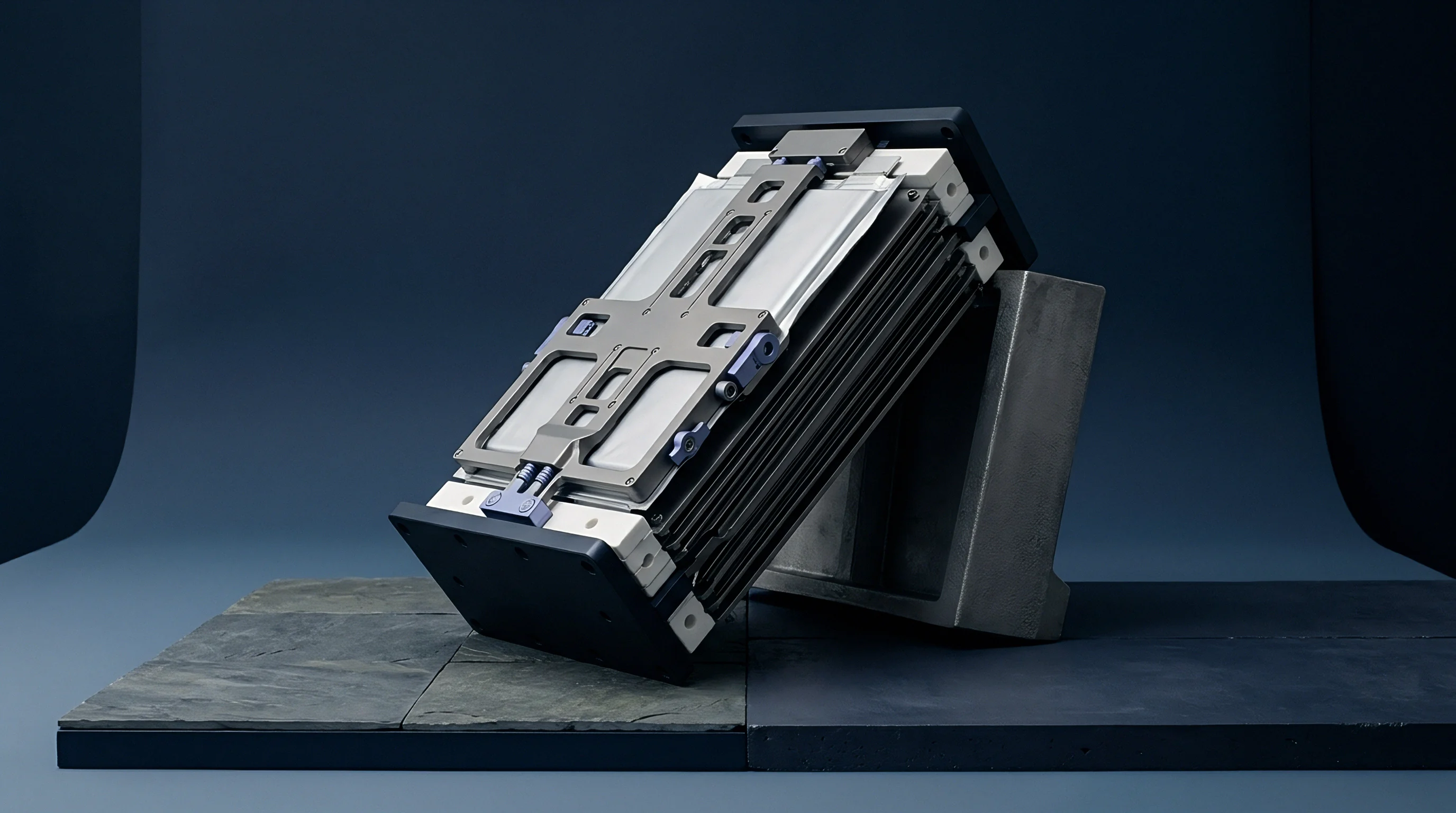
Heat
Heat generation in multi-phase cathode cells combines irreversible overpotential dissipation with reversible entropic contributions from each active phase. Overpotential heating scales quadratically with current density and linearly with internal resistance. Entropic generation, governed by the product of temperature, current, and the entropic temperature coefficient dU/dT, alternates between exothermic and endothermic behavior according to each phase’s local state of charge.
Layered nickel-rich oxides exhibit negative entropic coefficients through intermediate states of charge, shedding heat during discharge. Conversely, polyanion iron phosphates show sharp positive entropic peaks along phase-transition plateaus, absorbing thermal energy during specific lithiation intervals. In a shared composite coating, the net thermal signature is a dynamic superposition of these opposing behaviors.
Fast discharge cycles across uneven pack temperatures break this passive cancellation.

Can Thermal Gradients Invert Local Phase Participation?
Local state-of-charge splits alter the net entropic heat sign across cell micro-domains. If an uncooled edge lags five degrees Celsius behind the module centerline, the colder active material develops an open-circuit voltage offset against the warmer zone. That mismatch drives balancing currents between phases even during rest, producing heat long after current draw ceases and preventing thermal management systems from dropping into low-power sleep.
Entropic heat coefficients flip sign between constituent phases, converting predictable cooling loads into localized thermal peaks during high-rate discharges.
Active cooling systems must handle these localized fluxes. Heat transfer across pouch faces or cylindrical cell walls depends on thermal interface materials with bulk conductivities between one point five and three point zero watts per meter-kelvin. When internal phase decoupling concentrates heat inside narrow bands of the jelly roll, conduction to the casing cannot keep pace with local generation, and the resulting hot spots accelerate electrolyte breakdown.
Dimensioning the cooling system requires accounting for both phase contributions under transient worst-case drive cycles. It remains an open engineering question whether passive conduction through standard pouch packaging can dissipate localized entropic spikes before the solid electrolyte interphase degrades.

Probe
Isolating individual phase kinetics inside sealed commercial cells requires diagnostics that can decouple overlapping electrochemical signals. Standard cyclers log only composite current and terminal voltage. Disentangling active phases non-destructively requires differential analysis coupled with frequency-domain measurements across controlled thermal spans.
Differential capacity analysis resolves broad voltage plateaus into discrete peaks tied to specific phase transitions. In an NMC and LFP blend, the iron phosphate two-phase plateau produces a sharp, narrow peak at three point four two volts against graphite, while nickel-rich layered oxide reactions appear as broader peaks between three point six five and four point one five volts. Tracking the area, height, and potential shifts of these signatures over hundreds of non-isothermal cycles isolates which active material is losing lithium inventory or undergoing lattice degradation.
Diagnostic qualification protocols execute across four sequential stages:
- Initial quasi-static charge and discharge at C/20 inside an isothermal chamber establishes baseline differential capacity profiles for each constituent phase.
- High-rate non-isothermal cycling applies dynamic power profiles under an induced four-degree module temperature gradient.
- Periodic reference performance checks evaluate interfacial charge transfer resistance growth via multi-frequency impedance spectroscopy across five state-of-charge setpoints.
- Destructive physical analysis verifies mechanical microcracking and transition metal deposition levels against non-destructive electrochemical indicators.
Electrochemical impedance spectroscopy separates kinetic resistances across distinct frequency decades. Frequencies above one kilohertz capture electrolyte and contact resistances. The decade between one kilohertz and ten hertz isolates charge transfer at particle interfaces, yielding distinct semicircles when constituent phases have sufficiently separated rate constants.
Below one hertz, Warburg elements reflect solid-state lithium diffusion within the host crystal lattices.
| Thermal Condition | Test Profile | Phase 1 Retention (%) | Phase 2 Retention (%) | Rct Increase (mΩ) |
|---|---|---|---|---|
| Isothermal 25°C | Continuous 1C/1C | 91.4 | 94.2 | 2.1 |
| Isothermal 45°C | Continuous 1C/1C | 84.1 | 89.6 | 4.8 |
| Thermal Gradient Δ4°C | Dynamic Drive Cycle | 76.3 | 88.1 | 9.4 |
| Thermal Gradient Δ8°C | Dynamic Drive Cycle | 68.9 | 83.7 | 14.6 |
Under a controlled four-degree thermal gradient, layered oxide capacity drops fifteen percent faster than the companion polyanion material inside the same casing. This divergence stems from localized current crowding during transient acceleration spikes. Although overall terminal capacity may still suggest acceptable health, premature loss of the high-energy phase leaves the cell susceptible to thermal runaway during high-rate charging.
Differential voltage analysis provides complementary confirmation of phase-level de-synchronization without requiring cell teardowns. Plotting dV/dQ against cumulative discharge capacity reveals subtle phase shifts as active lithium redistributes during prolonged rest periods.
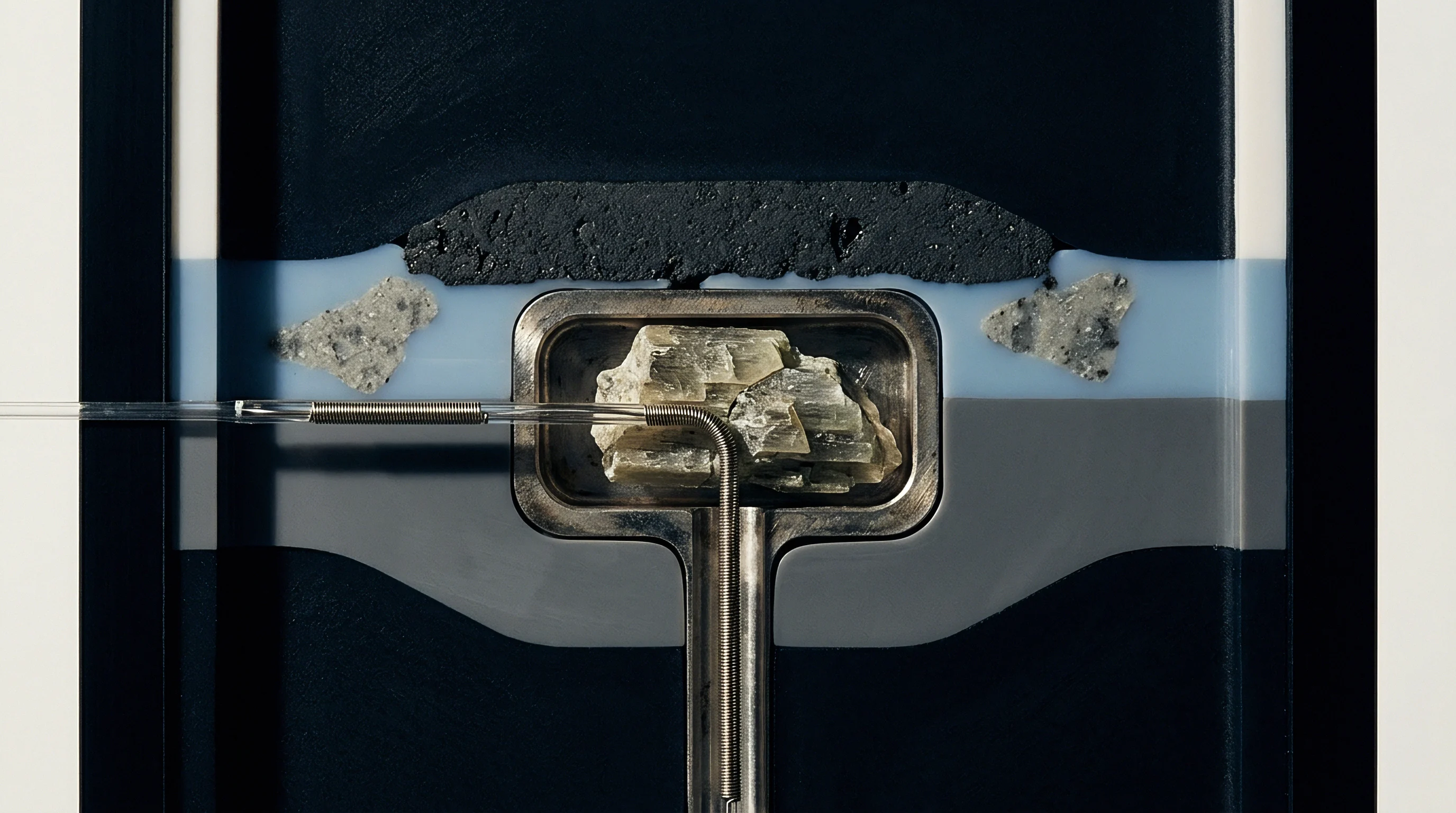
Transit
Transport classification for lithium-ion cells with multi-phase cathodes follows the United Nations Manual of Tests and Criteria, Part III, subsection 38.3. Every commercial cell design must pass the eight UN 38.3 tests before consignments move by air, ocean, or road. The protocol covers altitude simulation, thermal cycling, vibration, shock, external short circuit, impact or crush, overcharge, and forced discharge.
Multi-phase blends present specific failure modes during Test T.2 (thermal cycling) and Test T.5 (external short circuit). Test T.2 cycles unconstrained cells between seventy-two degrees Celsius and negative forty degrees Celsius for ten cycles, followed by twenty-four hours at ambient rest. Differential thermal expansion between coarse layered oxide agglomerates and fine polyanion grains shears particle-binder interfaces, reducing separator contact pressure and driving up internal resistance.
UN 38.3 Test T.5 demands external short-circuit survival at fifty-five degrees Celsius without casing temperature exceeding one hundred fifty degrees.
Test T.5 shorts cell terminals across an external resistance below zero point one ohms at fifty-five degrees Celsius, generating initial discharge rates past thirty C. In composite electrodes, the phase with higher exchange current density dumps charge into the bus immediately, well before the slower phase engages. That sudden surge in heat generation tests the burst limits of standard cell vents.
Dangerous goods regulatory compliance governs all commercial shipping documentation:
- UN 3480 classification covers lithium-ion cells shipped as individual components, mandating strict adherence to IATA Packing Instruction 965 Section IA or IB.
- State of charge limitations restrict air cargo shipments of standalone cells to a maximum thirty percent state of charge under current dangerous goods mandates.
- Test summary dossiers must document successful completion of UN 38.3 sub-tests, signed by an accredited testing laboratory, and made accessible along the commercial logistics chain.
- Defective cell carriage bans prohibit the transport of cells displaying internal swelling, structural damage, or voltage leakage under standard air freight declarations.
Air forwarders hold shipments if test summary sheets do not match the exact active material blend ratio stated on accompanying safety documentation. For ocean freight under the IMDG Code, stowage plans must isolate containers from radiant heat sources on board to prevent localized thermal destabilization of sensitive cathode phases.
IATA Dangerous Goods Regulations Packing Instruction 965 Section IA strictly bars air transport of cells exceeding thirty percent state of charge without competent authority approval.

Settlement
Procurement agreements for dual-phase cathode cells carry commercial exposure rooted directly in phase-level degradation. Contracts that define acceptance solely through nominal amp-hour capacity and bulk direct-current resistance leave buyers vulnerable to early field failures. Under the thermal gradients typical of liquid-cooled automotive packs, the high-energy phase degrades much faster than bulk datasheet values suggest.
Incoming inspection has to catch blend variations between delivered production lots. Acceptance sampling under ISO 2859-1 general inspection level II provides statistical baseline coverage, but single-point capacity checks cannot flag ratio drift. A two percent shift between layered oxide and polyanion fractions changes heat generation profiles and alters open-circuit voltage curves, throwing off onboard state-of-charge tracking.
| Inspection Depth | Testing Cost per Cell ($) | Lot Rejection Risk (%) | Field Warranty Reserve ($) | Total Risk Exposure ($) |
|---|---|---|---|---|
| Single-Point OCV/ACIR Check | 0.08 | 0.5 | 420,000 | 428,000 |
| Three-Point Capacity Grading | 0.35 | 1.8 | 210,000 | 245,000 |
| Differential dQ/dV Verification | 1.15 | 4.2 | 65,000 | 180,000 |
| Non-Isothermal Pulse Audit | 2.40 | 6.5 | 25,000 | 265,000 |
Warranty provisions require precise end-of-life criteria. Automotive agreements commonly mandate eighty percent capacity retention over eight years or one hundred sixty thousand kilometers. With multi-phase chemistries, a pack might register eighty-one percent bulk capacity while its layered oxide phase has dropped below sixty-five percent usable retention.
Under cold-weather peak loads, those cells trigger early low-voltage cutoffs that strand vehicles and drive up warranty expense.
Field repair costs justify stricter incoming qualification. Swapping an EV module runs between four thousand and seven thousand dollars in warranty labor and logistics, wiping out any initial savings gained on unverified cells. Importers of record who skip blend audits absorb that liability directly on their balance sheets.
Omitting phase-resolved degradation limits from master supply agreements shifts millions of dollars in thermal warranty liabilities directly onto the downstream pack integrator.