Validating UN 38 3 Documentation before Cell Shipment
Validate UN 38.3 test summaries by verifying all ten 38.3.5 fields, ISO 17025 lab scope, and cell mass against physical cargo prior to freight tender.


Mandate

Essential Tenets of UN 38 3 Test Summaries
International dangerous goods regulations compel cell vendors to supply verified proof of safety testing before lithium energy storage units enter commercial transport. The United Nations Manual of Tests and Criteria, under Section 38.3.5, establishes a strict ten-point document standard known as the UN 38.3 Test Summary. This document serves as the regulatory passport for individual cells and complete battery assemblies across air, ocean, rail, and highway freight.
Transport authorities require distributors and manufacturers to make this document accessible throughout the logistics chain without requesting proprietary manufacturing schematics.
Validation begins by cross-checking every item against Section 38.3.5 requirements. A compliant summary lists the full legal entity name, street address, telephone number, email contact, and official website of both the cell manufacturer and the independent testing facility. Omission of active contact channels or substituting a third-party trading company for the physical manufacturing entity represents an immediate compliance failure during port authority inspections.
Document audits must confirm the inclusion of a traceable report identifier, execution date, and complete physical description. The summary details the exact cell format, such as cylindrical, prismatic, or pouch, alongside the chemical composition, total mass in grams, and maximum nominal Watt-hour rating. Discrepancies between the cell mass listed on the shipping manifest and the mass recorded in the test summary trigger freight holds at export terminals.
| Field Item | Required Technical Content | Validation Standard | Common Non-Compliance Defect |
|---|---|---|---|
| Manufacturer Detail | Legal corporate name, physical facility address, active phone number, verified domain email | Matches bills of lading and commercial invoices exactly | Listing trading company name instead of actual cell manufacturing entity |
| Laboratory Accreditation | ISO/IEC 17025 accredited laboratory name, address, contact, and report registration | Verification against CNAS, A2LA, or equivalent accreditation scope | Unaccredited in-house factory test sheets lacking independent lab credentials |
| Unique Report Tracking | Distinct test report serial identifier and formal completion date | Traceable report number matching laboratory database entry | Discrepancies between invoice part numbers and summary report codes |
| Physical Specification | Exact cell format, chemistry classification, total mass in grams, maximum nominal Watt-hour rating | Mass within one gram tolerance and energy matching datasheet nominal capacity | Omission of mass or mismatching Watt-hour ratings for altered cell revisions |
| Test Suite Status | Individual pass outcome for T.1 through T.8 test series under specified revision | Clear indication of passed status for every applicable sub-test | Missing T.7 status on cells or omitted T.8 forced discharge validation |
| Authorized Signature | Physical or cryptographic signature, printed full name, corporate title | Executed by designated corporate officer or compliance engineer | Unsigned PDF documents or typed signature fields without title attribution |
A test summary lacking an accredited laboratory registration number leaves freight forwarders no option except cargo refusal at the export gateway.
The standard requires explicit verification of the quality management system governing cell production. Manufacturers document adherence to quality frameworks described in UN Model Regulations section 2.9.4.5, typically demonstrated through valid ISO 9001 certification. The document concludes with the printed name, corporate title, and physical or cryptographic signature of an authorized executive officer.
Freight forwarders reject incomplete files.
- Manufacturer Identity Audit Validate the legal corporate entity and physical factory address against international business registries.
- Laboratory Registration Verification Cross-reference the issuing laboratory name against global accreditation bodies to confirm active ISO/IEC 17025 status.
- Physical Parameter Matching Compare cell mass, shape, and Watt-hour ratings on the test summary directly against engineering datasheets.
- Signatory Authority Confirmation Check that the document contains a valid cryptographic or physical signature alongside an executive corporate title.
Suppliers frequently claim that proprietary cell construction drawings and full laboratory raw trace logs remain confidential internal property, offering shortened internal certificate sheets while withholding the formal ten-point summary.


Regime
Mechanical and Environmental Stress Protocols
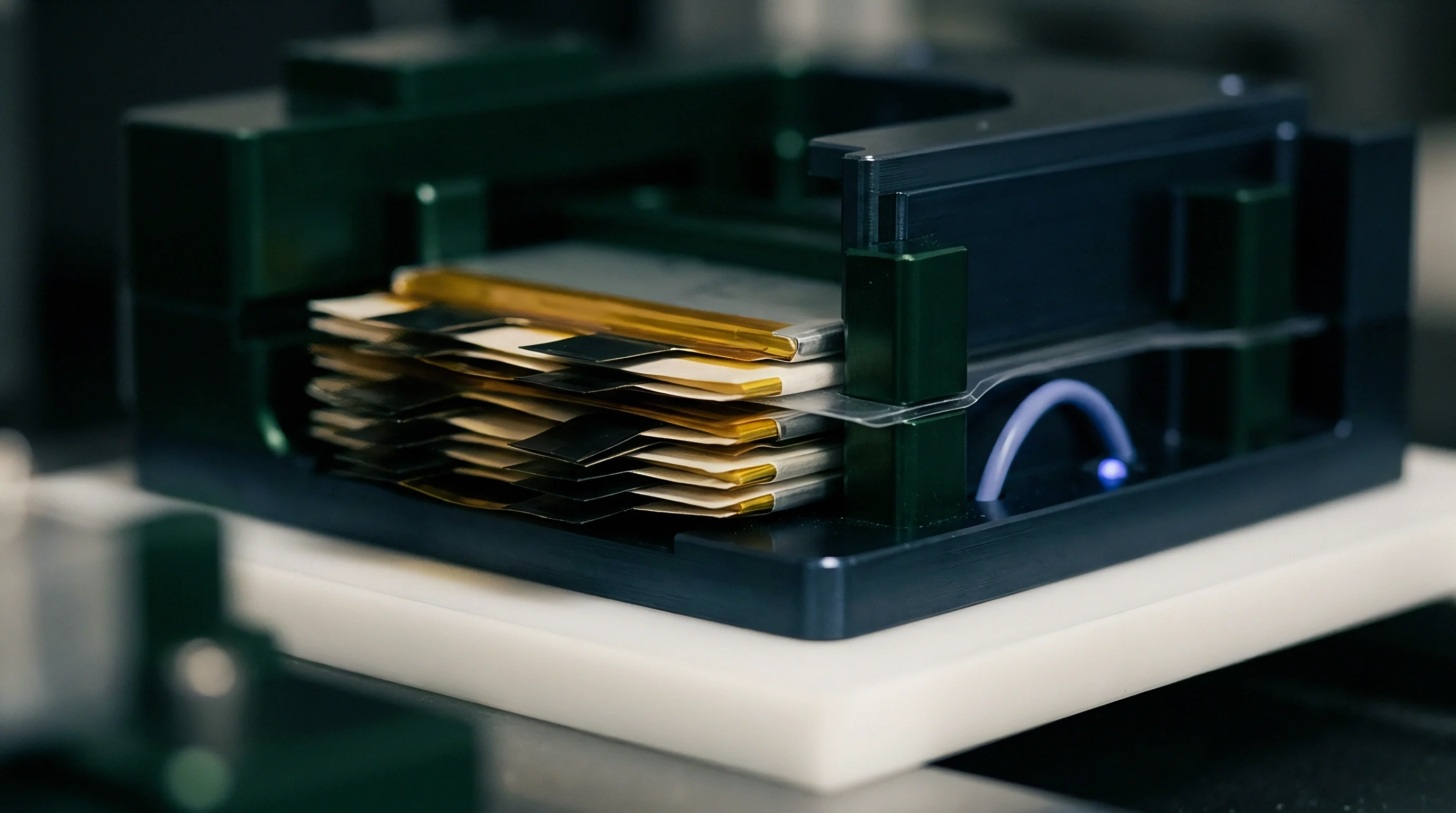
Proving cell stability under shipping conditions requires subject units to survive eight distinct environmental, mechanical, and electrical challenges designated as tests T.1 through T.8. Test T.1 simulates unpressurized aircraft cargo holds by exposing fully charged cells to an absolute pressure of 11.6 kilopascals or less for six hours at 20 degrees Celsius. Test T.2 evaluates thermal endurance by cycling cells between minus 40 degrees Celsius and plus 72 degrees Celsius across ten extreme temperature shocks, holding peak exposures for six hours per dwell period.
Passing T.1 and T.2 demands zero mass loss, zero fluid leakage, zero internal venting, and a post-test open circuit voltage retaining at least 90 percent of pre-test potential.
Mechanical stress validation involves sinusoidal vibration under test T.3 and violent kinetic acceleration under test T.4. Vibration testing sweeps frequencies from 7 Hertz to 200 Hertz over 15 minutes across three orthogonal axes, repeating the sequence 12 times per orientation. Test T.4 subjects cells to half-sine shock pulses reaching 150 peak acceleration units over six milliseconds, or 50 peak acceleration units for larger cell formats.
Internal structural degradation, internal shorts, or housing fractures during kinetic testing constitute immediate test failures.
Electrical safety testing centers on short circuit endurance under T.5, impact resilience under T.6, overcharge behavior under T.7, and forced discharge safety under T.8. Test T.5 subjects cells to an external short circuit resistance below 0.1 ohm at 55 degrees Celsius ambient temperature, continuing exposure until internal cell temperature drops back to baseline. Surface temperatures must not exceed 170 degrees Celsius.
Primary cells require T.8 testing.
| Test Code | Test Description | Parameter Conditions | Pass Criteria |
|---|---|---|---|
| T.1 | Altitude Simulation | Pressure 11.6 kPa or less, duration 6 hours minimum at 20°C | No mass loss, no venting, no leakage, no rupture, no fire, OCV retained >= 90% |
| T.2 | Thermal Test | Dwell 6 hours at 72°C, 6 hours at -40°C, 10 cycles, 11 h max transition | No mass loss, zero leakage, no venting, no rupture, zero fire, OCV retained >= 90% |
| T.3 | Vibration | Sinusoidal 7 Hz to 200 Hz sweep over 15 min, 12 sweeps across 3 axes | Mass loss under threshold, no rupture, zero fire, residual OCV within 90% baseline |
| T.4 | Shock | Half-sine pulse, 150 gn peak acceleration, 6 ms duration, 18 shocks total | Retained structural integrity, zero electrolyte leakage, OCV drop under 10% |
| T.5 | External Short Circuit | External resistance under 0.1 ohm at 55°C, monitor until temperature normalizes | Peak temperature below 170°C, zero disassembly, zero rupture, zero fire within 6 hours |
| T.6 | Impact / Crush | Bar crush 13 mm/s or 9.1 kg drop from 61 cm onto 15.8 mm bar | Surface temperature under 170°C, zero disassembly, zero fire within 6 hours post-test |
| T.7 | Overcharge | Charge current 2x manufacturer maximum for 24 hours continuous | Applied to rechargeable batteries: zero disassembly, zero fire within 7 days post-test |
| T.8 | Forced Discharge | 12V DC power supply in series at maximum rated discharge current | Applied to primary or secondary cells: zero disassembly, zero fire within 7 days |
A change in cell cathode active material mass exceeding two percent invalidates existing UN 38.3 test summaries, requiring a complete T.1 through T.8 test sequence re-run.

Thresholds for Cell Re-Testing and Scope Boundaries
Altering cell design or manufacturing parameters introduces strict regulatory re-qualification obligations. Section 38.3.2.2 defines the threshold parameters that force full re-testing of modified cell architectures. A shift in cathode chemistry, such as transitioning from lithium iron phosphate to nickel manganese cobalt, invalidates existing test summary documentation.
Modifications altering total cell mass by more than 20 percent, or changing nominal energy capacity by more than 20 percent, require a fresh qualification dossier.
Cell mass dictates test applicability. Structural revisions to outer casing thickness, safety vent burst pressures, or internal current collector tab dimensions alter thermal dissipations and mechanical stress responses. Substituting separator membrane suppliers or altering internal electrolyte solvent ratios invalidates derivative test claims.
You must verify that the cell model number printed on the commercial package matches the exact designation recorded during initial T.1 through T.8 lab qualification.
Engineers continue to debate whether micro-structural modifications to solid-electrolyte interphase additives that alter thermal run-away onset by a few degrees without altering nominal mass ought to trigger a full T.5 re-qualification cycle.

Cargo

IATA PI 965 and Maritime Code Alignment
Transporting standalone lithium ion cells demands strict adherence to mode-specific dangerous goods packing instructions. International Air Transport Association rules under Packing Instruction 965 govern standalone cell shipments aboard cargo aircraft. PI 965 separates shipments into Section IA, Section IB, and Section II based on cell energy capacity and total package mass.
Standalone cells rated above 20 Watt-hours ship under Section IA, requiring fully declared dangerous goods documentation, UN-certified outer packaging, and rigid Class 9 hazard labeling. Ocean freight options fall under the International Maritime Dangerous Goods Code, where Special Provisions 188, 310, and 348 regulate maritime cell carriage.
Air freight carriage imposes an absolute state of charge threshold. Standalone lithium ion cells tendered for air transport under UN 3480 must not exceed 30 percent state of charge at the time of delivery to the air carrier. Air carriers enforce OCV voltage limits.
Does State of Charge Drift Invalidate Air Freight Summaries?
Extended storage periods between factory grading and airport handover lead to open circuit voltage shifts caused by natural cell self-discharge. Acceptance desks at major cargo hubs check terminal voltages against chemistry-specific OCV-to-SoC reference curves. Tendered pallets exhibiting open circuit voltages corresponding to 32 percent state of charge face immediate carrier rejection.
Transport personnel place rejected lots into quarantine, generating substantial airport storage surcharges while requiring manual cell discharging prior to flight booking.
- Document Misalignment Holding Cargo ground handlers stop freight progress when test summary numbers differ from dangerous goods declarations.
- Voltage Calibration Skew Uncalibrated factory end-of-line testers record incorrect resting voltages, leading to air carrier rejection for state of charge overage.
- Package Label Omission Missing Class 9 lithium battery hazard labels or Cargo Aircraft Only stickers results in immediate port customs intervention.
- Unaccredited Broker Packaging Utilizing outer cartons lacking UN performance specification stamps invalidates dangerous goods shipping compliance.
Under Section IA of IATA Packing Instruction 965, tendering lithium ion cells above thirty percent state of charge exposes the shipper of record to immediate air freight clearance revocation and statutory civil penalties.
When shipping standalone cells across ocean and air channels, aligning the test summary part numbers with the exact bill of lading descriptions prevents freight forwarder rejections at the port gateway.
Dock

Auditing Laboratory Accreditation and Serial Integrity
Verifying document authenticity requires direct audit procedures applied to issuing laboratory credentials. Shippers and importers cross-check test summaries against international laboratory databases such as the China National Accreditation Service or the American Association for Laboratory Accreditation. Fraudulent test summaries frequently cite legitimate accreditation numbers belonging to facilities that lack UN 38.3 test scope authorizations.
Legitimate summaries link directly to ISO/IEC 17025 accredited facilities holding specific testing mandates for lithium energy storage systems.
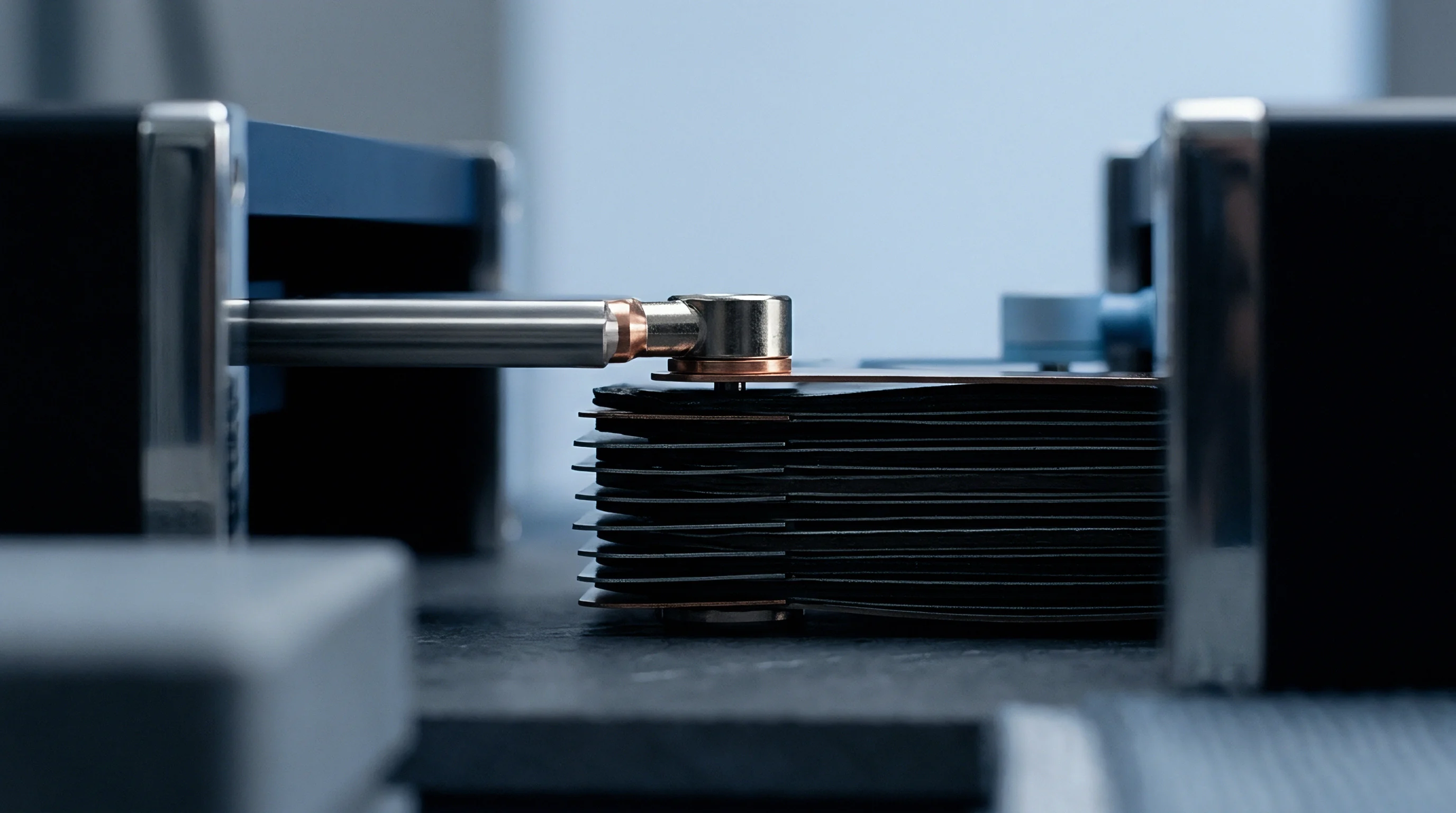
Physical incoming inspection validates the alignment between documented specifications and delivered hardware. Technicians check outer shrink-wrap printing, matrix codes, and laser-etched serial numbers on cell cans to confirm production batch origins. White-label brokers occasionally re-wrap discarded or degraded cells with fresh PVC sleeves bearing part numbers corresponding to valid UN 38.3 test summaries.
Stripping outer sleeves reveals underlying factory markings, double sleeves, or reworked terminal caps indicating batch falsification.
- Laboratory Portal Verification Confirm test report numbers directly through the issuing laboratory web portal or official email registry.
- Physical Mass Measurement Sample 30 random cells per pallet to verify that average cell mass matches the test summary weight within one gram.
- Microscopic Sleeve Inspection Examine sleeve edges and inkjet alignment under 10x magnification to identify re-wrapped cell bodies.
Consider a commercial procurement of 50,000 cylindrical 21700 NMC cells priced at $2.10 per unit under a Delivered Duty Paid agreement. Incoming dock audits execute sample extraction under ISO 2859-1 standards, selecting 315 cells for parameter verification. Laboratory cross-checks reveal that 14 sampled cells display laser-etched matrix codes belonging to an obsolete LFP chemistry production run tested four years prior under a different model prefix.
Resolving this mismatch requires re-testing the current cell lot at an independent ISO/IEC 17025 facility. Commissioning a full T.1 through T.8 test program costs $14,500 and consumes 21 calendar days. Daily warehouse holding fees at the port of entry accumulate at $850 per container day.
Ocean carriers charge $350 per day per container in demurrage after a five-day grace period. Over a 21-day delay, demurrage and storage costs total $20,400, bringing total unexpected compliance charges to $34,900 on a $105,000 cell order. Direct lab checks reveal fraud.
Establishing direct verification links with accredited test facilities before issuing final container clearance ensures non-compliant cell lots remain at the export port prior to title transfer.


Exposure

Commercial Risk and Contractual Allocation
Regulatory authorities place legal liability for dangerous goods transport non-compliance on the designated importer of record and shipper. Under United States Department of Transportation Title 49 CFR Section 173.185 and European Union Battery Regulation 2023/1542, tendering non-compliant lithium cells exposes commercial buyers to severe administrative fines and criminal enforcement. Civil penalties for introducing uncertified cell lots into commercial transportation channels reach $85,000 per violation day.
Importers carry primary civil liability.
Commercial contracts must explicitly allocate regulatory compliance obligations between cell vendors, freight intermediaries, and buyers. Contracting under Ex Works terms leaves the buyer fully exposed to export gateway seizures and dangerous goods violations. Purchasing under Delivered Duty Paid conditions transfers carriage risk to the vendor until final dock acceptance.
International commercial contracts incorporate explicit covenants conditioning final payment transfers on successful physical dock audits and document verification.
| Failure Point | Regulatory Instrument | Immediate Financial Exposure | Liability Allocation |
|---|---|---|---|
| Missing Test Summary at Port | US DOT 49 CFR 173.185 / ICAO TI | Demurrage and delay fees accrued daily | Importer of Record carries primary carrier penalties under FOB terms |
| Fraudulent Lab Credentials | EU Regulation 2023/1542 Art 41 | Cargo seizure, mandatory destruction fees | Freight forwarder rejects liability; recourse limited to vendor indemnity clauses |
| State of Charge Over Limit (>30%) | IATA DGR PI 965 Section IA | Civil enforcement fines per violation | Shipper named on dangerous goods declaration bears strict statutory liability |
| Unmatched Cell Mass / Model | IMDG Code Section 5.4.1 | Port authority cargo hold, re-testing costs | Buyer halts letter of credit payment under standard compliance covenants |
Cargo insurance claims for dangerous goods transit failures drop to zero recovery when cell shipments lack valid UN Section 38.3 test summaries prior to bill of lading issuance.
Marine insurance coverage standardly excludes losses resulting from illegal cargo tendering, statutory transport violations, or invalid dangerous goods documentation. When a cargo container experiences thermal runaway or structural fire during ocean transit, insurance adjusters demand immediate presentation of the UN 38.3 test summary and laboratory accreditation files. Absence of valid documentation voids cargo indemnity coverage, exposing the shipping party to complete hull damage claims and salvage liability.
Defective documents invalidate cargo insurance.
Failing to validate test summaries prior to vessel loading leaves cell buyers fully exposed to carrier demurrage fees, cargo seizure, and complete loss of insurance coverage when regulatory authorities flag documentation discrepancies at the arrival port.