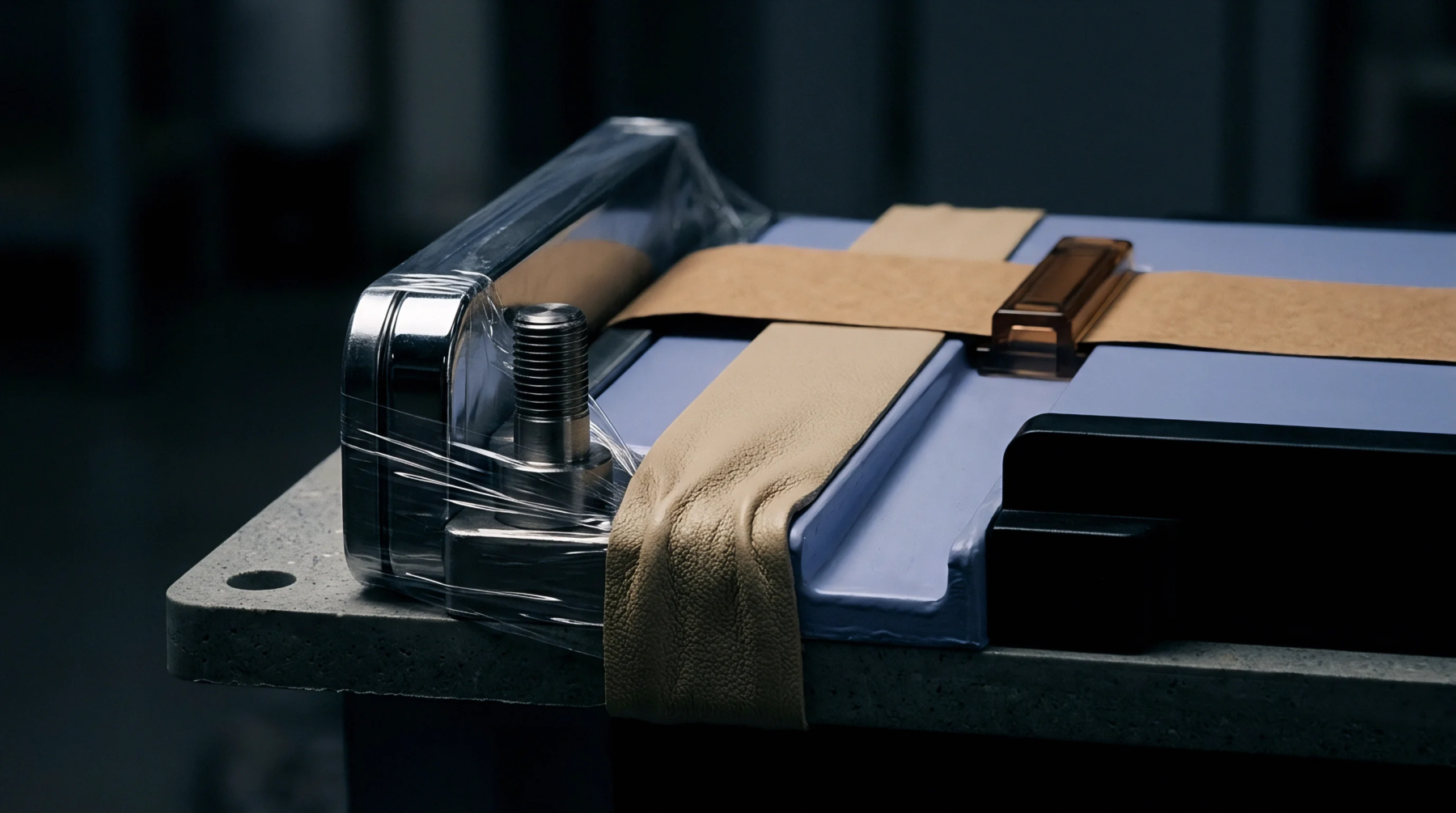
Mechanical Clamping Compression Mechanics under Cyclic Lithium Cell Swelling
Controlled mechanical clamping combines rigid platen bracing with elastomeric cushions to constrain cyclic lithium cell swelling stress between 0.2 and 0.5 MPa.
Reversible volumetric expansion and contraction of electrode host matrices caused by the insertion and extraction of guest lithium ions during electrochemical charge and discharge cycles constitutes a fundamental property of secondary battery cells. The phenomenon of intercalation dilation produces measurable dimensional fluctuations across cell jelly rolls, pouch envelopes, and prismatic cell casings as lithium shuttles between cathode and anode lattices. Boundaries of the mechanism cover reversible crystallographic strain and immediate elastic swelling, ending where plastic deformation, structural particle cracking, and irreversible solid electrolyte interphase buildup begin.
In situ dilatometry, displacement sensors, and mechanical load cells measure thickness and stress changes as a function of state of charge. Battery engineers evaluate dilation figures to design mechanical expansion allowances in modules and to avoid localized stress concentrations that trigger mechanical degradation.
Host lattice dimensions shift continuously as lithium ions occupy interstitial crystallographic sites within active electrode materials. Graphite anodes undergo a sequence of distinct phase transitions, expanding along the c-axis by roughly ten to thirteen percent as the material progresses from pristine graphite to fully lithiated LiC6. Silicon anodes exhibit much higher dilation, expanding up to three hundred percent via alloying reactions that produce massive local strain fields.
Lithium nickel manganese cobalt oxide cathodes generally contract slightly during lithium de-intercalation at high voltages, though phase collapse at extreme delithiation introduces non-linear strains. Summing opposing cathode and anode volumetric shifts across full discharge to charge cycles generates a net positive expansion across the cell stack at high states of charge.
Stiff module containment structures convert free volumetric expansion into internal compressive stress when cells swell against rigid end plates. As intercalation dilation forces cell layers outward, normal stress on separator membranes rises proportionally to the elastic modulus of the restraint system. Unrestrained pouch cells show macroscopic breathing where outer pouch foil displaces outward by several percent of total nominal thickness.
Excessive pressure accumulation throttles liquid electrolyte transport across porous separators, starving high rate reaction zones of lithium ions. Conversely, complete stress relaxation upon discharge can open micro-voids between active coatings and metallic foil substrates if baseline clamping remains inadequate.
Battery pack mechanical designers incorporate compliant elements, such as microcellular elastomer cushions, to absorb predictable intercalation dilation without stressing structural fasteners. Mathematical swelling models predict dimensional changes across dynamic drive cycles, allowing battery management systems to correlate casing stress with internal state of charge. Cell specification sheets outline free swelling percentages alongside swelling force curves under fixed gap conditions.
Sourcing teams use dilation metrics to select appropriate enclosure materials and to prevent cell swelling from binding adjacent cooling plates. Intercalation dilation dictates the mechanical clearance budgets required inside high density battery module enclosures.
Controlled mechanical clamping combines rigid platen bracing with elastomeric cushions to constrain cyclic lithium cell swelling stress between 0.2 and 0.5 MPa.
Expertise is a utility, not a secret. sentiention™ publishes its working knowledge as open reference: intelligence layer covering the materials it sources, the markets it enters, and the reference that serves both.