Diagnostic Identification of Reversible Lithium Stripping Kinetics under Cold Operation
Reversible lithium stripping under cold operation requires voltage relaxation or dQ/dV diagnostic tracking to adjust BMS derating and protect cycle life.

Nucleation
Charging a lithium-ion cell below zero degrees Celsius alters the thermodynamic equilibrium between ion intercalation and surface electrodeposition. Solid-state diffusion inside the bulk graphite anode slows by up to two orders of magnitude relative to room temperature: the diffusion coefficient drops from roughly 10-10 square centimeters per second at 25 degrees Celsius down to 10-14 square centimeters per second at -20 degrees Celsius. At the same time, charge transfer resistance across the electrode-electrolyte interface climbs steeply as ion desolvation requires higher activation energy.
When applied charging current supplies ions to the anode faster than solid-state intercalation can accommodate them, the local anode potential falls below zero volts relative to the reference lithium/lithium ion couple.
This negative overpotential drives metallic lithium deposition directly onto the graphite surface, starting with heterogeneous nucleation at high-energy surface sites, defect zones, and graphite particle edge planes. The magnitude of the overpotential determines whether the metal forms a uniform microscopic film or branches into localized dendrites. That transition depends on the kinetic balance between charge transfer current and intercalation diffusion current.
Without adequate voltage or current derating during cold charging, metallic plating turns into the dominant charge acceptance pathway rather than a secondary side reaction.
| Temperature (Celsius) | Graphite Diffusion Coefficient (cm²/s) | Charge Transfer Resistance (Ohm·cm²) | Exchange Current Density (mA/cm²) | Critical Plating C-Rate Threshold |
|---|---|---|---|---|
| 25 | 1.2 × 10⁻¹⁰ | 15 | 1.50 | 2.50 C |
| 0 | 3.5 × 10⁻¹² | 85 | 0.35 | 0.60 C |
| -10 | 4.1 × 10⁻¹³ | 240 | 0.12 | 0.20 C |
| -20 | 1.8 × 10⁻¹⁴ | 780 | 0.03 | 0.05 C |
Operating at -20 degrees Celsius narrows the safe operational window to fractional C-rates, as detailed in the kinetic parameters above. Cell design factors such as negative-to-positive capacity ratio, coating thickness, and electrolyte additive formulation shift these threshold values considerably. Higher electrode tortuosity concentrates local current, creating localized potential drops that trigger plating even while overall cell terminal voltage remains within normal limits.
Butler-Volmer kinetics govern this shift, with transfer coefficients and exchange current densities falling non-linearly as temperature drops.
Plated metallic lithium re-intercalates into graphite during thermal equalization or oxidizes back into active ions during immediate discharge cycles.
Electrolyte formulation strongly influences cold charge transfer energetics. Standard carbonate mixtures like ethylene carbonate and dimethyl carbonate thicken and lose ionic conductivity at sub-zero temperatures. Adding fluoroethylene carbonate modifies the solid electrolyte interphase structure to lower the interfacial desolvation barrier for lithium ions, which reduces charge transfer impedance and delays negative anode overpotentials.
Without these additives, standard cell configurations undergo rapid metallic deposition as soon as sub-zero charging begins.
Thermally Constrained Charge Transfer Dynamics
Interfacial kinetics in cold conditions depend heavily on ion desolvation at the outer Helmholtz plane. Lithium ions dissolved in alkyl carbonate solvents form tight solvation shells that require thermal energy to shed before passing through the solid electrolyte interphase. At low temperatures, the energy needed for desolvation surpasses the barrier for direct electron transfer to solvated ions, favoring metallic deposition on the electrode surface and dropping the exchange current density into a regime governed primarily by charge transfer resistance.
Solid-state transport within the graphite lattice forms a second bottleneck. Lithium diffusion through the carbon layers proceeds via vacancy hopping with an activation energy of roughly 38 kilojoules per mole. As temperature drops, ion migration away from the particle surface slows, building a steep concentration gradient in the outer carbon layers.
This concentration polarization saturates the localized state of charge at particle edges, leaving arriving ions with no available insertion sites and forcing excess current into surface metal deposition.
Thermodynamic Drivers of Metallic Deposition
Depending on stoichiometry, the thermodynamic equilibrium potential for lithium intercalation into graphite rests between 80 millivolts and 200 millivolts positive against metallic lithium. Applied charging currents generate ohmic drop and polarization overpotential across the electrode layer through internal resistance and mass transport constraints. When the combined ohmic, activation, and concentration polarizations exceed the equilibrium margin, local potential on the graphite surface drops below zero volts versus the metallic lithium reference.
Sub-zero capacity loss is often ascribed to temporary electrolyte viscosity increases rather than surface metallic deposition, on the premise that room-temperature thermal cycling restores full nominal amp-hour ratings.

Relaxation
Tracking open-circuit voltage right after cold charging provides a non-destructive view of anode surface conditions. If surface-plated metallic lithium is present, the voltage does not follow a typical single-exponential decay upon resting. Instead, coexisting metallic lithium and lithiated graphite establish a mixed potential that holds the negative electrode near zero volts relative to metallic lithium, producing a flattened voltage plateau during rest.
The duration of this relaxation plateau directly correlates with the amount of metallic lithium on the graphite surface. During open-circuit rest, two competing mechanisms remove the metallic phase: electrochemical re-intercalation into the carbon lattice and chemical reaction with electrolyte species. Re-intercalation returns active lithium to the cyclable inventory, while parasitic reactions consume mobile ions to form inactive dead lithium.
At -15 degrees Celsius, an overpotential exceeding 42 millivolts forces metallic phase formation within 180 seconds of constant current charging.
Measuring plateau length requires high-precision voltage logging throughout rest. Differentiating the open-circuit voltage curve over time highlights the inflection point where metallic lithium fully clears from the graphite interface. The resulting first derivative peak marks the transition as anode potential departs from the metallic lithium potential and moves toward the equilibrium potential of lithiated graphite.
Anomalies detected during open-circuit monitoring signal specific structural degradation pathways on the anode surface:
- Chemical re-intercalation stall occurs when saturation at the graphite surface prevents further lithium uptake, lengthening the plateau without adding recoverable capacity.
- SEI fracture propagation stems from volume expansion during plating, exposing fresh metal to ongoing reaction with organic solvents.
- Isothermal voltage drift reflects temperature redistribution inside the jelly-roll as residual heat from cold charging dissipates through the casing.
- Secondary phase decoupling marks the thermodynamic separation of lithiated graphite stages from isolated metallic islands that have lost electrical contact with the matrix.
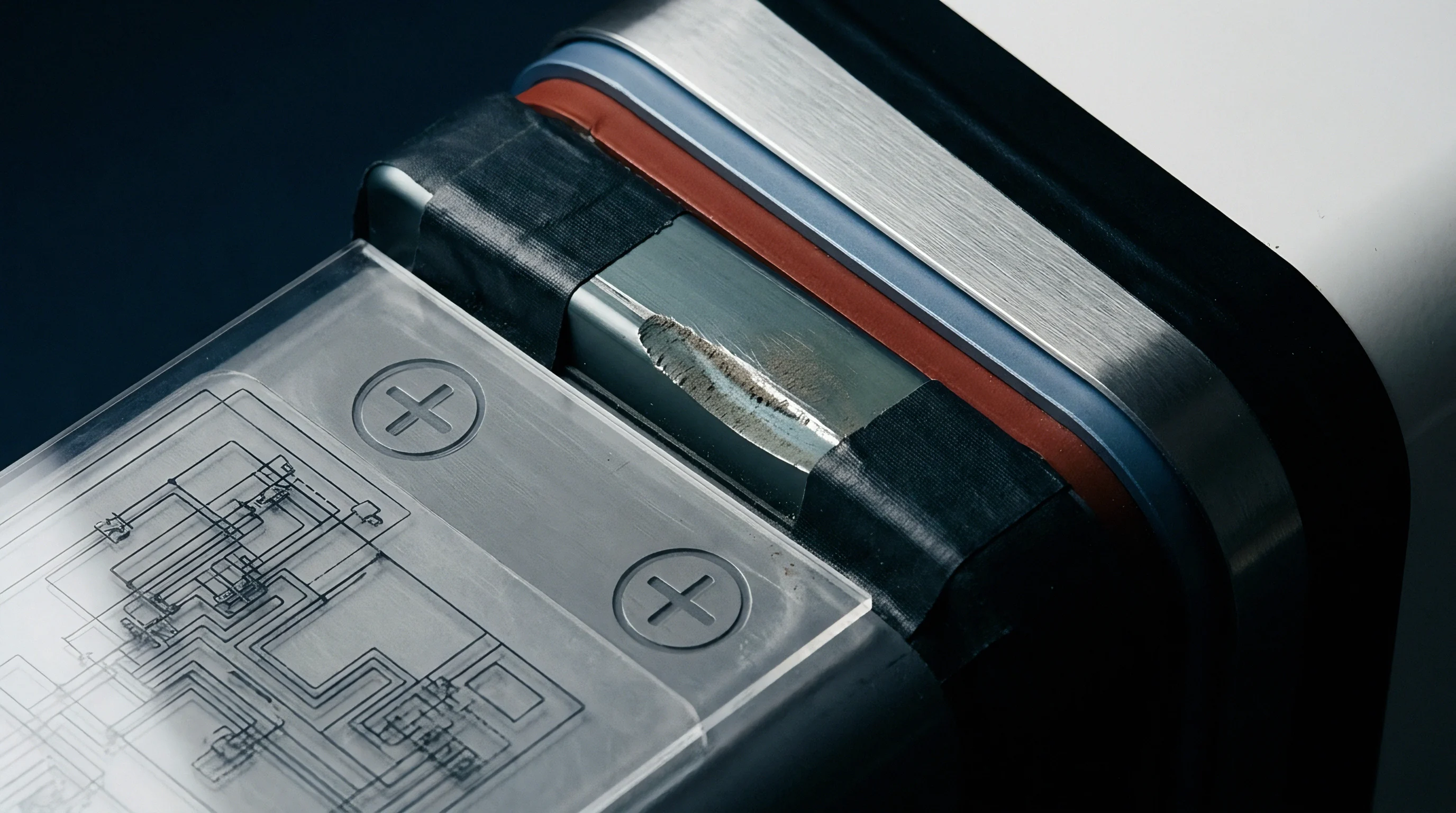
Voltage Plateau Decomposition Protocols
Extracting quantitative stripping data from voltage relaxation signals requires fitting measured rest curves to composite kinetic models. The overall rest voltage curve combines three components: ohmic recovery, double-layer discharge, and phase equilibrium drift. Ohmic drop resolves within milliseconds of current interruption, double-layer depolarization settles over several seconds, and the metallic dissolution plateau persists for hundreds to thousands of seconds depending on temperature and deposited mass.
Isolating the plateau requires converting time-series voltage data into dV/dt space. A minimum in the time-derivative curve marks steady-state dissolution, followed by a derivative peak that signals complete surface metal depletion. Integrating the charge current prior to rest against the duration of this derivative feature allows analytical models to split total input charge into intercalated, reversibly stripped, and permanently lost parasitic fractions.

Differential Capacity Fingerprinting
Differential capacity analysis converts voltage and capacity measurements into phase transformation profiles. Applying dQ/dV processing during early discharge right after a cold charge exposes a distinct secondary feature: while standard graphite deintercalation peaks appear at defined potential steps for each stage transition, metallic lithium stripping creates a sharp, narrow peak ahead of the main graphite feature.
The area beneath this low-voltage stripping peak measures the charge recovered through direct electrochemical re-oxidation of surface metal. Tracking peak area across successive cold cycles quantifies stripping reversibility; a shrinking peak under identical charging conditions signals progressive dead lithium formation or rapid chemical SEI passivation.
Whether applying high-frequency AC impedance pulses during relaxation can accelerate lithium re-intercalation without prompting localized micro-dendritic growth remains an open question.
Sorption
Re-oxidation kinetics govern how effectively deposited lithium returns to active ionic form during low-temperature discharge. Plated metal on a graphite matrix contacts conducting carbon underneath and liquid electrolyte above. When discharge begins immediately after cold charging, two pathways compete: electrochemical stripping draws electrons into the current collector while releasing lithium ions into solution, while spontaneous chemical re-intercalation drives lithium into vacant graphite sites without external current.
Electrochemical stripping kinetics depend on discharge C-rate, temperature, and deposit morphology. High local current density at dendrite tips can cause rapid local stripping and mechanical necking, isolating metallic lithium islands from the anode substrate. Once electrically disconnected, this metal cannot be oxidized electrochemically and becomes permanent dead lithium.
How Does Temperature Shift Stripping Efficiency?
Ambient temperature determines the balance between productive stripping, spontaneous re-intercalation, and parasitic passivation. Identifying and measuring the reversible stripping fraction via low-temperature discharge diagnostics follows this sequence:
- Equilibrate the cell in an environmental chamber at the target sub-zero temperature for at least four hours.
- Apply the specified cold charge profile while logging voltage, current, and surface temperature at 10 Hertz or higher.
- Discharge immediately at a controlled low C-rate, avoiding rest periods that allow premature spontaneous re-intercalation.
- Convert low-temperature discharge capacity data via differential capacity transformation to separate the metallic stripping peak from bulk graphite deintercalation.
Lower operating temperatures slow solid-state diffusion faster than surface oxidation, shifting the balance between chemically absorbed and electrochemically stripped metal. Below -20 degrees Celsius, spontaneous re-intercalation slows to negligible rates, leaving direct electrochemical stripping as the primary recovery mechanism for active lithium.
Under UN 38.3 transport safety verification, cells exposed to sub-zero charging regimes must demonstrate structural interface stability without thermal runaway propagation.
Electrochemical Re-Oxidation Pathways
Direct electrochemical oxidation converts surface lithium into soluble ions through a single-electron reaction. The overpotential needed at sub-zero temperatures depends on the porosity and composition of surface films. If cold charging has degraded the solid electrolyte interphase, elevated charge transfer resistance demands higher discharge overpotentials, triggering lower-cutoff voltage limits early and leaving unstripped metal on the electrode.
Chemical re-intercalation functions via local galvanic cells where metallic lithium acts as a micro-anode and underlying graphite as a micro-cathode. This local reaction continues as long as the metal maintains electronic contact with graphite and vacant carbon sites remain available. With an activation energy near 25 kilojoules per mole, chemical re-intercalation between -10 degrees Celsius and 0 degrees Celsius can recover up to 70 percent of plated metal within a 30-minute rest window.
Discharging at higher C-rates immediately after a cold charge recovers a larger fraction of metallic lithium before electrical isolation leaves the deposit inactive.
Pulse
Adding high-frequency pulse testing to bench routines allows quick evaluation of reversible stripping kinetics without long thermal rest periods. Because standard continuous cycling cannot separate transient concentration polarization from surface phase changes, applying short current pulses over microsecond to second timescales isolates fast charge transfer and double-layer effects from slower diffusion processes.
Pulsed diagnostic sequences measure transient voltage under high-rate galvanostatic excitation. By comparing response asymmetry between brief charge and discharge pulses, test systems calculate instantaneous differential resistance at the anode interface. A drop in interfacial discharge resistance relative to charge resistance points to conductive metallic lithium films on the carbon matrix, providing a real-time indicator of cell plating.
| Diagnostic Method | Targeted Mechanism | Measurement Window | Equipment Complexity | Commercial Viability |
|---|---|---|---|---|
| Voltage Relaxation (OCV) | Mixed potential plateaus | 100 to 3000 seconds post-charge | Standard cycling channels | High for qualification lots |
| Differential Capacity (dQ/dV) | Secondary stripping peaks | Early discharge phase | High-precision cyclers | High for incoming inspection |
| Electrochemical Impedance (EIS) | Charge transfer resistance dip | Stationary rest states | Frequency response analyzer | Medium for lab qualification |
| High-Frequency Pulse Response | Charge/discharge asymmetry | In-line during active charging | Fast-sampling pulse channels | High for pack-level BMS |
High-frequency impedance interrogation measures real and imaginary responses across specific spectral windows. The transition from double-layer charging to active metallic stripping creates a low-frequency arc shift on Nyquist plots. Test channels with fast Fourier transform processing detect these spectral shifts in seconds, supporting automated pass-fail sorting during cold qualification.
Dynamic pulse asymmetry ratios exceeding 1.35 during sub-zero operation confirm active surface metallic deposition.
Cell qualification criteria for sub-zero operation rely on specific bounds to ensure lot-to-lot consistency:
- Thermodynamic window mapping confirms cell-level overpotential limits across ten-degree intervals from 0 degrees Celsius down to -30 degrees Celsius.
- Relaxation sampling frequency requires a minimum recording resolution of 16 bits at 10 Hertz during post-charge rest.
- Differential discharge resolution mandates low-rate discharge channels holding current stability within 0.05 percent of setpoint.
- Thermal settling allowances specify climate chamber dwell times to eliminate internal thermal gradients before pulse testing.
Factory Channel Diagnostics for Cold Validation
Running cold diagnostic routines on the factory floor requires close integration between cycling hardware, environmental chambers, and data acquisition software. Standard cycling channels frequently lack the sampling speed needed to catch fast voltage relaxation derivative spikes. Installing 16-bit high-speed analog-to-digital converters captures these inflection points accurately, turning routine screening into a quantitative audit.
Diagnostic channels require regular baseline calibration against symmetric reference cells or precision shunts. Keeping noise low is critical for differential capacity analysis, where compressor vibration and power supply ripple introduce high-frequency artifacts into dQ/dV signals. Post-acquisition digital low-pass filtering, such as Savitzky-Golay smoothing, removes background noise while preserving narrow stripping peaks.
High-Frequency Interrogation Formats
Intermittent micro-pulse trains embedded in sub-zero charge profiles allow continuous tracking of anode surface conditions. The sequence introduces brief, high-amplitude discharge pulses into the charging current; voltage response to these pulses reflects changes in interfacial charge transfer resistance caused by lithium accumulation.
Evaluating micro-pulse data involves calculating instantaneous overpotential steps at the start and end of each pulse. When metallic lithium nucleates, apparent charge transfer resistance during discharge drops rapidly because metallic stripping proceeds faster than graphite deintercalation. Battery management algorithms use this resistance drop to detect early plating before dendrites breach separators or cause permanent capacity loss.
Under ISO 12405-4 cold-charge test standards, cells showing open-circuit voltage relaxation plateaus after charging require immediate cycle-life derating prior to batch acceptance.

Exposure
Translating cold stripping kinetics into sourcing decisions requires weighing performance risks against financial liabilities. Uncontrolled lithium plating at low temperatures accelerates capacity fade, increases internal impedance, and elevates field failure rates, creating significant warranty exposure. Evaluation requires balancing hardware costs ~ such as pre-heating elements and insulation ~ against the landed cost per delivered cycle over the asset’s contract lifespan.
While graphite diffusion activation energy is commonly measured near 38 kilojoules per mole in three-electrode symmetric cells, high-silicon anode blends push this barrier toward 45 kilojoules per mole, narrowing safe cold-charging windows. Neutron diffraction measurements on standard NMC811 cells show irreversible lithium loss averaging 1.2 percent per cycle under -10 degrees Celsius charging at 0.5 C. Depending on electrolyte additives, the split between chemical re-intercalation and direct electrochemical stripping ranges from 0.35 to 0.65 ~ a variance buyers monitor by running differential capacity baseline checks on incoming cell lots.
Thermal Derating Matrices in Battery Management Systems
Effective battery management algorithms embed temperature-dependent current limits directly into firmware. These derating matrices set allowable charge and discharge rates across narrow temperature bands, throttling charge currents to fractional C-rates below freezing. While strict derating protects cell life, it reduces overall utility and can fall short of operational demands in cold environments.
Active thermal management provides an alternative to severe current throttling. PTC heater arrays or liquid warming loops bring internal cell temperatures above zero degrees Celsius before high-rate charging starts. The decision comes down to capital versus operating expenditure: active heating adds upfront hardware costs, while omitting it increases long-term replacement costs from cold-charging degradation.
Commercial Warranty Adjustments for Sub-Zero Duty
Cell supply contracts for cold-climate applications require specific language establishing operational boundaries. Standard warranties often void coverage if charging occurs below zero degrees Celsius without explicit authorization. Sourcing agreements typically mandate non-volatile logging in the battery management system to track lifetime temperature-current histograms for warranty verification.
A 50 kilowatt-hour commercial battery pack operating at -20 degrees Celsius with initial cell costs of 95 dollars per kilowatt-hour represents a base cell value of 4,750 dollars. Uncontrolled cold charging without pre-heating causes irreversible capacity loss at roughly 0.8 percent per cycle from dead lithium accumulation and SEI growth. Across 250 cold cycles per year, the pack loses 20 percent of its usable capacity within 12 months, triggering replacement terms.
Installing an active liquid heating loop adds 420 dollars in upfront hardware costs and uses 1.8 kilowatt-hours of auxiliary power per cycle to raise cell temperatures to 10 degrees Celsius before charging. At an electricity tariff of 0.15 dollars per kilowatt-hour, auxiliary heating costs 67.50 dollars annually over 250 cycles, bringing total first-year thermal protection costs to 487.50 dollars and ongoing costs to 67.50 dollars per year.
Without pre-heating, capacity loss forces full pack replacement after one year, incurring a 4,750 dollars cell penalty plus replacement labor. Active pre-heating extends pack lifespan from 250 cycles to 2,500 cycles at 80 percent end-of-life capacity. Amortizing hardware costs and heating energy over a ten-year window lowers the landed cost per delivered kilowatt-hour cycle from 0.38 dollars to 0.05 dollars.
Failing to distinguish reversible surface stripping from permanent dead lithium loss results either in overly conservative charge limits that drive up heating hardware costs, or aggressive charge profiles that lead to premature field failure.