Evaluating Lithium Ion Cell Capacity at Subzero Temperatures
Evaluating subzero cell capacity requires measuring charge transfer resistance and verifying thermal equilibration before accepting supplier datasheet claims.

Polarization
Subzero operating environments suppress cell terminal voltage through three main electrochemical mechanisms. When temperatures drop below zero degrees Celsius, liquid electrolyte viscosity increases while ionic diffusion within active electrode particles slows down. The combined increase in bulk electrolyte resistance, charge transfer resistance at the electrode-electrolyte interface, and solid-state diffusion resistance depresses the operational voltage curve under load.
As a result, the cell hits its discharge cut-off threshold long before active materials reach thermodynamic exhaustion.
Electrolyte Resistance and Ionic Mobility
Liquid solvents in lithium-ion cells thicken rapidly as thermal energy leaves the system. Ethylene carbonate, included to build a stable passivating layer on graphite anodes, has a high melting point near thirty-six degrees Celsius. Linear co-solvents like dimethyl carbonate and ethyl methyl carbonate lower the freezing point, but the overall ionic conductivity of standard ethyl methyl carbonate solutions still drops from eleven millisiemens per centimeter at twenty-five degrees Celsius to below one millisiemens per centimeter at minus twenty degrees Celsius.
This elevated bulk electrolyte resistance causes an immediate ohmic voltage drop as soon as a discharge load is applied.
Discharge current at minus twenty degrees Celsius reduces usable capacity by thirty-five percent under a continuous one-C discharge rate.
Charge Transfer Impedance at Interfacial Boundaries
Desolvation of lithium ions at the interface between liquid electrolyte and solid electrode material is the dominant activation barrier at low temperatures. The kinetic rate constant for ion transfer across the solid electrolyte interphase decays according to the Arrhenius relation, driving a tenfold jump in charge transfer resistance between room temperature and minus twenty degrees Celsius. This interfacial barrier creates substantial overpotential, forcing cell terminals to hit voltage limits even under modest discharge currents.
Where Does Usable Energy Vanish Cold?
Solid-state diffusion within active material particles limits capacity extraction during extended subzero discharges. Diffusion coefficients for lithium ions in nickel manganese cobalt oxide cathodes and graphite anodes drop by three orders of magnitude between room temperature and minus thirty degrees Celsius. Lithium ions accumulate near particle surfaces, establishing steep intra-particle concentration gradients that trigger premature low-voltage cut-offs.
Higher discharge rates compound the problem, leaving unreacted lithium locked deep inside particle cores.
Whether modifying the solid electrolyte interphase can eliminate charge transfer barriers below minus thirty degrees Celsius without destabilizing high-voltage cathode interfaces remains unsettled in commercial cell design.

Frost
Subzero discharge performance varies widely depending on active material chemistry and electrolyte additives. Cell designers use low-viscosity ester co-solvents to push operational limits down to minus forty degrees Celsius, though these additives compromise cathode stability and high-temperature cycle life.

Lithium Plating Hazards during Low Temperature Operation
Lithium intercalation into graphite slows significantly at subzero temperatures due to high charge transfer impedance. Charging or applying regenerative braking pulses in the cold drops the graphite anode potential below zero volts relative to lithium reference potentials. As a result, dendritic metallic lithium structures grow on anode surfaces, consuming active lithium inventory and risking short circuits across thin polymer separators.
Solvent Formulations and Low Viscosity Ester Additives
Standard carbonate solvent blends freeze or turn highly viscous at subzero temperatures. To maintain performance in cold climates, cell manufacturers add low-viscosity carboxylate esters ~ such as methyl propionate, ethyl propionate, or methyl acetate ~ to the electrolyte mixture. While these co-solvents preserve ionic transport down to minus forty degrees Celsius, they also lower the electrolyte flashpoint and accelerate gas generation during high-temperature storage.
| Chemistry Type | Capacity Retention at 25°C | Capacity Retention at -10°C | Capacity Retention at -20°C | Capacity Retention at -30°C |
|---|---|---|---|---|
| Lithium Iron Phosphate (LFP) | 100.0% | 82.5% | 58.0% | 31.2% |
| Nickel Manganese Cobalt (NMC 811) | 100.0% | 91.2% | 76.4% | 54.1% |
| Lithium Titanate Oxide (LTO) | 100.0% | 96.8% | 88.5% | 79.2% |
| Data normalized to 0.2C constant current discharge from 100% state of charge following a 6-hour thermal soak at specified temperature. | ||||
Selecting cells for subzero environments often favors thin-electrode pouch designs over heavy cylindrical formats, which helps minimize internal thermal gradients during rapid discharge.

Chamber
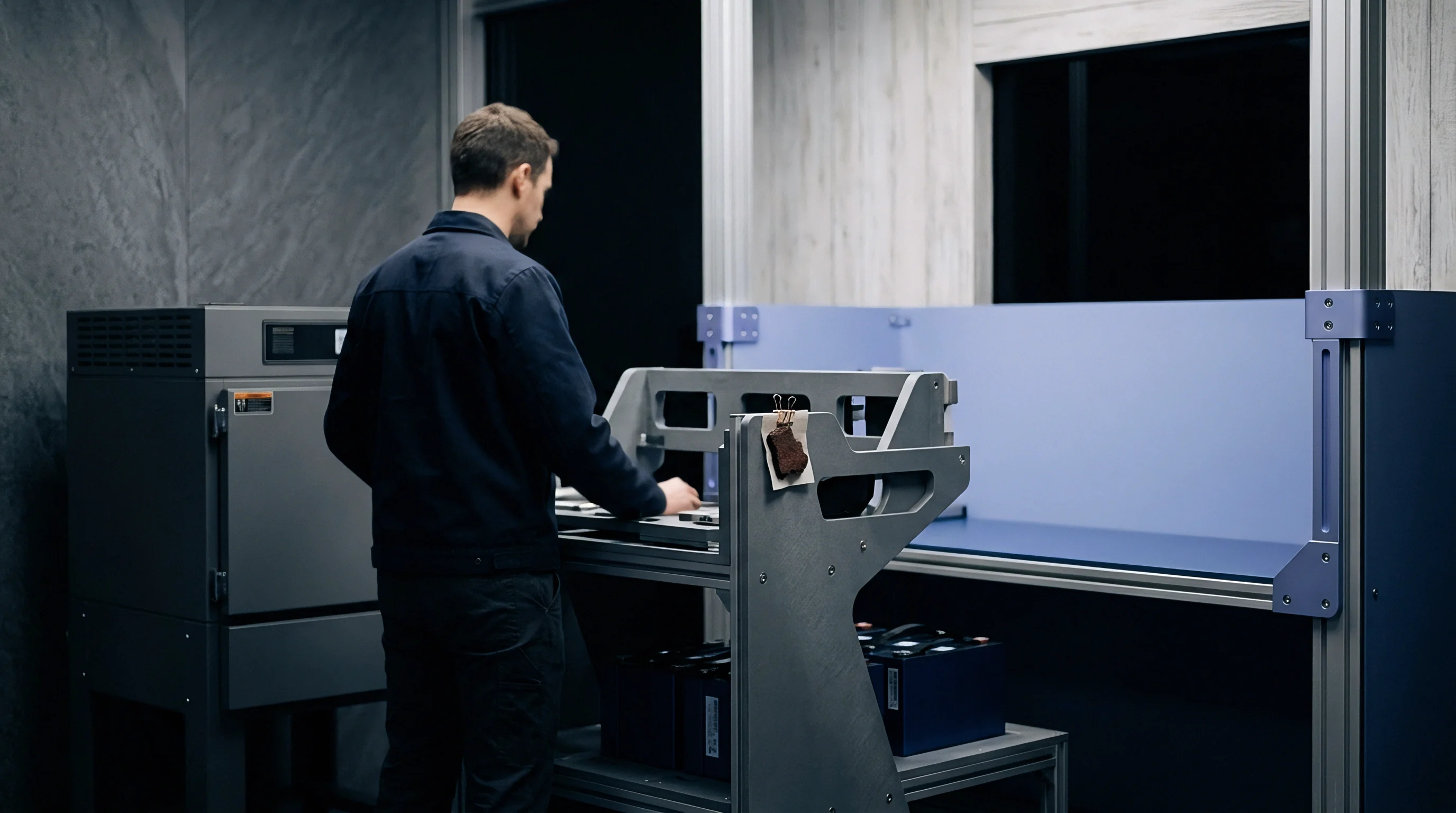
Verifying low-temperature cell performance requires strict environmental control and standardized thermal soak protocols. Test results gathered without reaching true thermal equilibrium reflect warm internal core states rather than actual subzero performance.
Soak Protocols and Core Thermal Equilibrium
Air inside an environmental chamber cools far faster than the dense core of a commercial lithium-ion cell. Large prismatic cells need long hold times to reach uniform temperatures across their jellyrolls or stacked plates. Surface sensors frequently hit targeted subzero values while the core remains up to fifteen degrees warmer, producing artificially inflated capacity figures.
- Mount thermocouple sensors directly onto the central surface of the cell casing using high-thermal-conductivity epoxy.
- Place the instrumented cell inside the chamber, leaving at least three centimeters of clearance on all sides for uniform airflow.
- Cool the chamber to the specified target temperature at a rate no faster than one degree Celsius per minute.
- Hold chamber temperature for at least six hours to allow core thermal equilibration.
- Verify equilibrium by confirming zero voltage drift and steady surface temperature readings across all sensors before applying load.
IEC 62660-1 Clause 6.2 mandates a minimum six-hour environmental chamber soak at subzero setpoints before applying capacity test loads.
Discharge Rate Scaling and Dynamic Joule Heating
Current flow generates dynamic resistive heat during discharge, raising internal cell temperatures mid-test. At high discharge rates, this self-heating lowers internal impedance, recovering terminal voltage and artificially inflating measured capacity. Low-rate discharges generate minimal heat, exposing true subzero thermodynamic limits.
IEC 61960-3 Clause 5.2.2 mandates at least a four-hour thermal soak at the ambient test temperature before discharge begins, ensuring test reports reflect full core stabilization rather than surface cooling.
Grading
Standard factory sorting processes measure cell capacity and internal resistance exclusively at twenty-five degrees Celsius. However, room-temperature direct current resistance values fail to reliably predict performance under subzero loads.

Room Temperature Sorting Disconnects
Cell batches showing tight three-percent capacity distributions at room temperature often exhibit wide performance spreads when cooled to minus twenty degrees Celsius. Microscopic variations in electrode coating weight, separator porosity, and electrolyte fill volume create significant performance divergence under subzero polarization.
Capacity variance across single production batches expands from two percent at room temperature to fifteen percent at subzero.
Electrochemical Impedance Spectroscopy at Low Temperatures
Standard one-kilohertz alternating current resistance meters capture simple ohmic resistance but miss charge transfer barriers entirely. Low-temperature electrochemical impedance spectroscopy exposes the interfacial resistance changes that drive subzero behavior. Screening incoming cells under cold conditions prevents early pack imbalance in field deployments.
- Interfacial charge transfer resistance shifts unpredictably across cell lots due to subtle variations in solid electrolyte interphase thickness.
- Electrolyte distribution defects manifest as localized dry spots that severely restrict ionic pathways as fluid viscosity rises in the cold.
- Separator tortuosity fluctuations pinch ion migration pathways, causing premature voltage cut-offs under load.
- Current collector foil bonding variations introduce high contact resistance that accelerates localized heating during subzero discharge.
Subzero capacity shortfalls often stem from variations in internal cell impedance rather than uncalibrated discharge equipment.
Derating
Pack design requires system-level engineering adjustments to compensate for subzero capacity losses. Usable energy must be calculated by combining electrochemical polarization losses with parasitic power drawn by thermal management heaters.
Usable Energy Calculations for Subzero Battery Packs
Evaluating usable energy in a subzero pack requires subtracting polarization losses and heating demands from nominal room-temperature ratings. For instance, in a fifty kilowatt-hour nominal pack using nickel manganese cobalt pouch cells at minus twenty degrees Celsius under a constant zero-point-five C discharge load, electrochemical polarization reduces usable cell capacity by twenty-four percent. Heating the pack to safe operating windows consumes additional energy.
| Ambient Temperature (°C) | Nominal Cell Capacity (kWh) | Polarization Loss (kWh) | Heater Energy Draw (kWh) | Net Usable Energy (kWh) |
|---|---|---|---|---|
| 25°C | 50.0 | 0.0 | 0.0 | 50.0 |
| 0°C | 50.0 | 5.5 | 1.2 | 43.3 |
| -10°C | 50.0 | 8.0 | 2.8 | 39.2 |
| -20°C | 50.0 | 12.0 | 4.5 | 33.5 |
| -30°C | 50.0 | 21.5 | 7.0 | 21.5 |
Subzero capacity derating curves must incorporate active thermal management power consumption alongside internal cell polarization loss.
Parasitic Heating Loads Vs Cell Delivered Energy
Active resistive heating elements or heat pumps protect cells from severe cold limits but draw power directly from the pack. At subzero temperatures, running internal heaters can consume up to fifteen percent of gross stored energy before any power reaches external loads. Maximizing efficiency requires balancing heater power against polarization voltage drops.
- Cell chemistry selection sets the baseline polarization threshold before heaters ever engage.
- Thermal insulation envelope thickness limits passive heat loss to the environment during extended park periods.
- Heater power density configuration dictates how quickly the pack warms from a cold soak to operating temperature.
- BMS temperature thresholds establish cut-offs that block subzero charging while permitting subzero discharge.
Ignoring heater power draw leads to premature system shutdown, accelerated cell degradation, and costly warranty disputes when nominal capacity claims fall short in the field.

Invoice
Commercial agreements and purchasing contracts must explicitly define subzero test conditions to prevent disputes over missing capacity where standard warranty clauses limit recovery. Specifying bare capacity figures without setting temperature, discharge rate, and thermal soak constraints leaves buyers exposed to unrecoverable performance shortfalls.

Contractual Definiteness in Subzero Capacity Specifications
Datasheets citing operation down to minus forty degrees Celsius frequently reflect functional survival rather than rated capacity delivery. Contractual schedules need to specify minimum usable amp-hour capacity at defined temperatures, C-rates, and chamber soak durations. Omitting soak requirements permits testing on pre-warmed cells that pass lab metrics but fail cold in field deployments.

Landed Cost Metrics per Delivered Cold Cycle
Evaluating cell costs solely on nominal twenty-five degree Celsius ratings distorts economic calculations for cold-climate applications. High-nickel chemistries and low-viscosity electrolyte formulations carry higher upfront prices per kilowatt-hour, but deliver better capacity retention in the cold. Calculating landed cost per delivered subzero kilowatt-hour over the target operating lifecycle reveals the true procurement economics, fixing the final financial commitment before cells ever reach the assembly plant.