Low Temperature Lithium Plating Mechanisms in Logistics Packs
Subzero lithium plating occurs when anode potential drops below zero volts, demanding auxiliary cell heating or current derating to stop cell degradation.

Threshold
At minus ten degrees Celsius, the graphite negative electrode reaches zero volts against metallic lithium during standard constant-current charging. This thermodynamic tipping point initiates competitive electrodeposition alongside intercalation. Lithium ions migrating through the liquid electrolyte face kinetic obstacles at subzero temperatures.
Charge-transfer resistance across the solid electrolyte interphase increases exponentially, following Arrhenius behavior with activation energies between 50 and 70 kilojoules per mole. Solid-state diffusion of lithium atoms within graphite particles stalls, dropping by three orders of magnitude from room-temperature values down to 10-12 square centimeters per second. When the overpotential required to drive lithium intercalation exceeds the equilibrium potential of the Li/Li+ couple, metallic lithium deposits directly onto the particle facets.
Plated metal consumes active lithium.
Thermodynamic models express negative electrode potential as the sum of open-circuit potential, ohmic drop, charge-transfer overpotential, and solid-state concentration polarization. Charge-transfer overpotential dominates at temperatures below zero degrees Celsius. Butler-Volmer kinetics govern this interface reaction.
The exchange current density shrinks as thermal energy declines, forcing the local potential to plunge negative under modest applied currents. Once local potential dips below zero volts relative to Li/Li+, electrocrystallization of metallic lithium becomes energetically favorable. Graphite rejects incoming ions.
A graphite anode charged at 1C at minus ten degrees Celsius drops below zero millivolts against lithium within thirty seconds of current onset.
Local current density distribution across the electrode thickness exacerbates plating severity. Liquid-phase diffusion limitations within tortuous electrode pores cause ion depletion near the separator interface. Porous electrode theory shows that salt concentration gradients steepen rapidly when the electrolyte transport properties deteriorate.
The transference number of lithium ions remains below 0.4 in standard carbonate blends, meaning counter-anions carry the majority of transference current while concentration polarization escalates. Local reaction currents concentrate heavily at the electrode surface facing the separator, creating localized overpotentials that exceed the bulk measurement by more than 150 millivolts.
Overpotentials rise with pack age.
Kinetic Resistance and Charge Transfer Overpotentials
Electrochemical impedance spectroscopy tracks the resistance surge across falling temperatures. The high-frequency intercept on the real axis represents pure electrolyte and contact resistance, while the mid-frequency arc quantifies charge-transfer resistance coupled with interphase film capacitance. At twenty-five degrees Celsius, charge-transfer resistance in a fresh 50 Ah prismatic automotive-grade cell measures approximately 0.4 milliohms.
At minus twenty degrees Celsius, this value expands beyond 8.5 milliohms. The voltage drop across this single interface reaches 425 millivolts under a 50-ampere charge current, pushing the graphite interface deeply into negative potential territory.
| Temperature (°C) | Ohmic Drop (mV) | Charge Transfer Overpotential (mV) | Diffusion Overpotential (mV) | Anode Potential vs Li/Li+ (mV) | Plating Propensity |
|---|---|---|---|---|---|
| 25 | 12 | 28 | 15 | +65 | Zero |
| 10 | 18 | 46 | 29 | +27 | Negligible |
| 0 | 29 | 84 | 58 | -11 | Moderate |
| -10 | 47 | 172 | 114 | -113 | Severe |
| -20 | 82 | 385 | 240 | -387 | Catastrophic |
| Measurements derived from three-electrode pouch cell configurations using 1.2M LiPF6 in EC:EMC 3:7 electrolyte on natural graphite anodes balanced to NMC811 cathodes. | |||||
Three-electrode validation trials on 3.5 Ah cylindrical cells from the 2023 production year establish that a negative electrode overpotential of minus fifty millivolts maintained for longer than twenty seconds generates detectable surface moss. This metric rests on reference-electrode instrumentation using metallic lithium micro-wires embedded within the separator layer. Thick electrode coatings with areal loadings above 3.5 milliampere-hours per square centimeter lower the critical plating current threshold by fifty percent compared to thin-film designs, because tortuous pore paths starve the inner particle surfaces while overloading outer regions.

Concentration Gradients across Low Temperature Intercalation Pathways
Solid-state diffusion limits enforce strict boundaries on charge acceptance. Graphite exhibits a layered structure where lithium atoms intercalate between graphene sheets, forming sequential stage structures from stage-4 down to stage-1 LiC6. The chemical diffusion coefficient controls the speed at which lithium moves from particle surfaces into bulk structures.
At room temperature, solid diffusion proceeds fast enough to accommodate incoming flux at rates up to 1C without surface saturation. At subzero conditions, diffusion stalls, causing lithium atoms to pile up at external edge planes. Surface saturation triggers metallic phase nucleation.
Whether electrochemists can design an electrolyte formulation that maintains high ionic conductivity without accelerating transition-metal dissolution at elevated temperatures remains an active industry debate without unified empirical resolution.
Dock
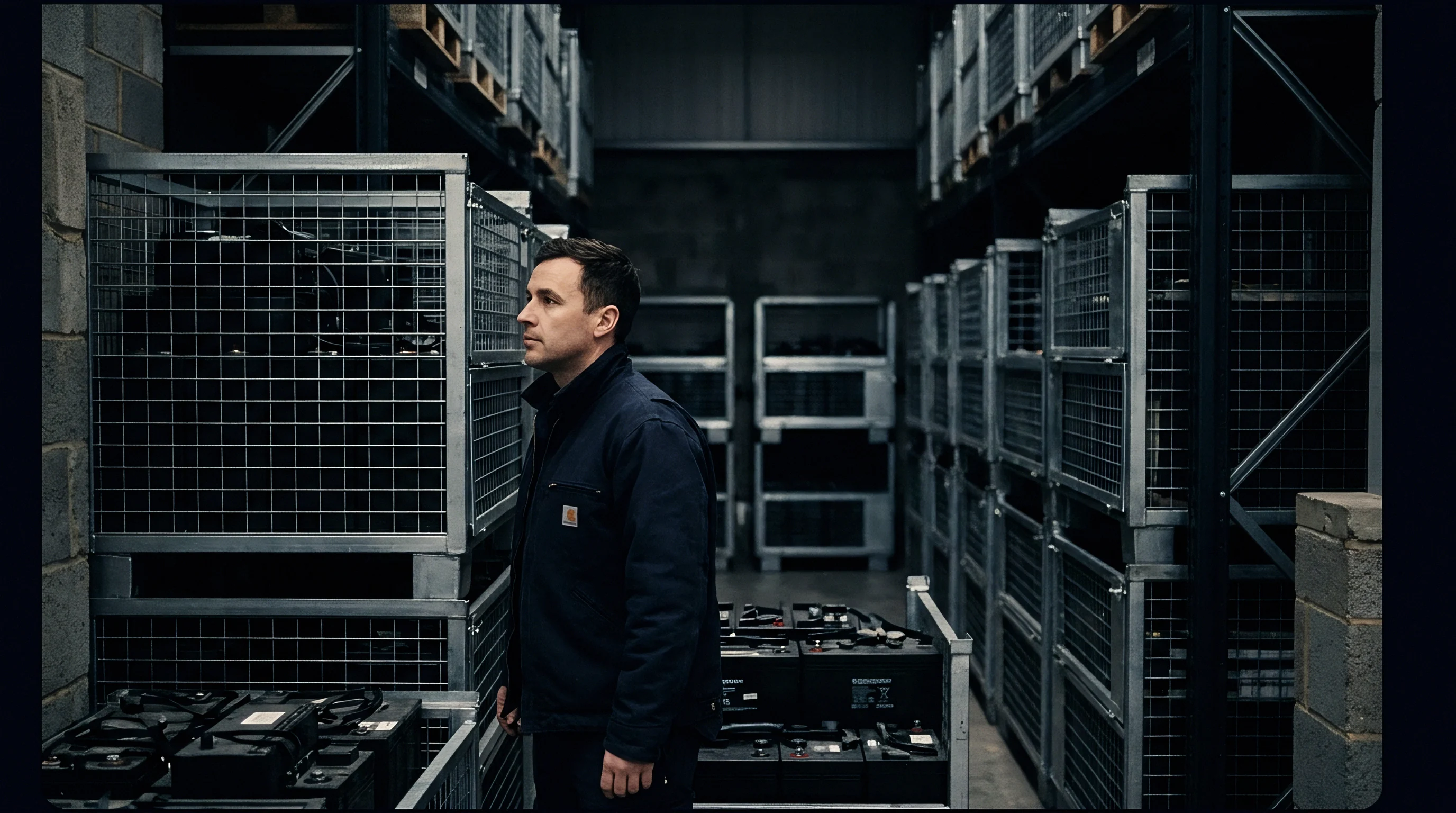
Material handling fleets operate in unconditioned transfer sheds and blast freezers where ambient temperatures stabilize between minus twenty and minus twenty-five degrees Celsius. Class I counterbalanced forklifts, reach trucks, and autonomous tow tractors cycle continuously between refrigerated storage rooms and unconditioned staging zones. Operations demand continuous utilization, leaving minimal dwell time for thermal equilibration.
Warehouse schedules frequently mandate short thirty-minute meal breaks where operators plug equipment into multi-kilowatt fast chargers, forcing high direct-current pulses into frozen battery packs.
Cold packs resist fast charging.
Thermal lag within large logistics packs creates severe internal temperature differentials. A 48-volt, 600-ampere-hour pack enclosed in a steel counterweight enclosure contains over two hundred kilograms of cell mass and structural framing. While outer cells in proximity to pack perimeter walls chill down to the storage environment, core cells retain thermal energy generated during preceding heavy discharge cycles.
Plugging this pack into an eighty-ampere depot charger without pre-conditioning subjects peripheral cells to immediate lithium deposition. The battery management system measures temperature via thermistors positioned across select module busbars, frequently missing localized chill spots.
What Drives Metallic Lithium Deposition below Freezing?
Refrigerated warehouse operations expose packs to thermodynamic conditions that favor phase change over intercalation. The primary driver remains the mismatch between applied charging currents and electrochemical reaction rates at the negative electrode. Fast turnaround practices push 0.5C to 1C charge rates into cells soaked below freezing.
Operators demand rapid turnarounds to maintain forklift fleet uptime across multi-shift schedules. Because direct-current fast chargers apply constant-current profiles until voltage limits are hit, the pack terminal voltage climbs rapidly due to high internal resistance, masking the true negative electrode potential collapse. Safety margins vanish rapidly.
- Unconditioned plug-in initiation occurs when an operator connects a cold-soaked pack directly to a depot fast charger without allowing auxiliary heaters to execute a thermal ramp cycle.
- Terminal voltage runaway compresses the constant-current charging phase, prompting uncalibrated charge equipment to throttle current prematurely or force high-voltage overpotential spikes into outer cell groups.
- Dendrite propagation through separators develops across repeated cold charge intervals, establishing localized micro-shorts that steadily elevate self-discharge rates.
- Permanent capacity detachment manifests as deposited lithium oxidizes with surrounding electrolyte solvents, forming thick interphase crusts that lock active lithium away from subsequent electrochemical reactions.
Regenerative Braking Pulses in Subzero Warehouses
Industrial forklifts handling multi-tonne pallets generate severe regenerative braking spikes during descent and deceleration maneuvers. Lowering a three-tonne load down mast rails or stopping a loaded reach truck drives instantaneous reverse currents exceeding 1.5C into the traction battery. In a warehouse maintained at minus twenty degrees Celsius, these regenerative current spikes last between two and six seconds.
The battery management system cannot route this energy to external resistive dump loads quickly enough in budget vehicle architectures, forcing the cell array to absorb the regenerative transient. Dendrites pierce the separator.
An unheated pack accepted for rapid charging in subzero air trades calendar longevity for turnaround speed.
Similar physical conditions govern mechanical behavior across disparate engineering systems. When structural carbon steel drops below its ductile-to-brittle transition temperature, dislocation mobility ceases and lattice planes shear under mechanical shock loads rather than yielding plastically. Graphite electrodes undergo an analogous kinetic freeze, refusing atomic insertion and forcing incoming charge to accumulate externally on crystal faces.
Suppliers routinely dismiss field degradation by asserting that brief opportunity charging below zero degrees falls within permissible limits provided average cell temperatures remain positive across the shift.

Residue
Metallic deposits on graphite split into chemically active deposits and electrically isolated fragments during subsequent discharge. Active lithium remains in physical and electrical contact with the conductive carbon substrate, allowing partial re-oxidation back into solvated lithium ions during warming periods or low-rate discharge cycles. This process is termed electrochemical stripping.
Inactive deposits lose electrical contact through non-uniform stripping at the dendrite base. As lithium dissolves from narrow structural necks, the tip separates entirely from the negative electrode matrix, floating freely within the porous separator channels. Dead lithium never recovers.
Corrosion reactions consume liquid electrolyte.
Freshly deposited metallic lithium possesses extreme chemical reactivity against organic carbonates. Ethylene carbonate and ethyl methyl carbonate solvents decompose instantly upon contacting metallic lithium, creating an outer secondary passivation layer consisting of lithium fluoride, lithium carbonate, and alkyl carbonates. This secondary interphase layer grows much thicker than the pristine interphase formed at twenty-five degrees Celsius.
Continuous cracking and reformation of this film during subsequent expansion cycles bleeds active electrolyte salt and solvent from the cell, driving up internal bulk resistance and accelerating drying across separator pores.
Where Does Stripped Lithium Reenter Solution?
Stripping efficiency dictates the reversibility of cold-weather charging events. During discharge, active metallic lithium strips at potentials close to zero volts relative to Li/Li+, preceding the de-intercalation of lithium from graphite stages. Electrochemical stripping produces distinct plateaus on voltage-time discharge profiles.
If discharge begins immediately following low-temperature charging while the cell remains cold, high overpotentials stifle dissolution kinetics, stranding greater proportions of isolated metal. As the cell warms, atomic mobility improves, permitting a larger fraction of active surface deposits to dissolve back into the liquid phase before chemical parasitic reactions seal their surfaces.
Quantifying the precise proportion of plated metal that converts into dead residue remains subject to substantial analytical variance across testing laboratories. Published figures span from thirty percent to seventy-five percent depending on relaxation intervals, ambient temperature, and cell compression pressure. Under this uncertainty, conservative pack integrators specify thermal management parameters that prevent the negative electrode from touching zero volts rather than relying on stripping recovery algorithms.
- Mossy morphological growth forms under low current density excursions below zero degrees, creating spongy, high-surface-area metal mats that rapidly consume electrolyte.
- Whisker and dendrite propagation accelerates under high-rate charging pulses, driving needle-like crystals through microporous polyolefin separators to trigger localized internal short circuits.
- Electrolyte desolvation failure creates high activation barriers at the interphase film, starving particle surfaces of coordinated lithium ions.
- Active lithium isolation severs electrical pathways between stripped deposits and current collectors, causing irreversible coulombic efficiency deficits that show up on end-of-cycle logs.

Differential Capacity Signatures of Inactive Deposits
Differential capacity analysis (dQ/dV) serves as a nondestructive diagnostic method for detecting plated metal inside hermetically sealed cells. Plotting the derivative of charge capacity with respect to terminal voltage reveals phase transition peaks corresponding to graphite staging. When lithium plating occurs during a preceding charge, the subsequent discharge curve develops an anomalous phase peak above 3.4 volts in NMC-graphite systems.
This signature corresponds to the stripping of metallic lithium occurring alongside normal cathode lithiation. The area beneath the stripping peak quantifies the volume of active metallic lithium participating in the stripping reaction.
| Diagnostic Method | Observable Parameter | Sensitivity Threshold | Implementation Feasibility | Operational Limitations |
|---|---|---|---|---|
| Differential Capacity (dQ/dV) | Phase stripping peak shift | 1.5% plated lithium | Medium | Requires low-rate discharge data |
| Voltage Relaxation Profiles | Inflection during rest period | 3.0% plated lithium | High | Needs 30+ minutes quiescent pack rest |
| Electrochemical Impedance | Charge-transfer diameter shift | 5.0% surface coverage | Low | Demands complex onboard signal generators |
| Mechanical Thickness Swell | Irreversible thickness growth | 2.0% volume expansion | Medium | Requires integrated strain gauges |
| Coulombic Efficiency Drop | Cycle-to-cycle Ampere-hour deficit | 0.5% missing charge | High | Obscured by sensor drift in the field |
Voltage relaxation signatures provide a viable fleet diagnostic. When charging ceases, an unaffected graphite cell exhibits smooth, monotonic voltage decay toward open-circuit equilibrium. A cell containing metallic surface plating displays an extended voltage plateau or an inflection point within the initial fifteen minutes of rest.
This plateau occurs because the coexistence of metallic lithium and intercalated graphite pins the negative electrode potential near zero volts until the metallic reservoir dissolves chemically or electrochemically into the carbon matrix. Inspection catches the shift.
Tracking the duration of this relaxation plateau enables fleet telemetry algorithms to calculate the exact onset of surface deposition without requiring destructive teardown audits.

Heater
Thermal management systems consume auxiliary energy from the main DC bus to raise core jelly-roll temperatures before permitting full charge acceptance. Logistics packs operating in subzero environments require active thermal conditioning to prevent destructive overpotentials. Positive temperature coefficient resistive elements, etched-foil silicone mats, and liquid cooling-heating plates serve as primary methods for delivering thermal energy to cold cell arrays.
Sizing these systems balances parasitic energy consumption against operational downtime and vehicle productivity targets.
Auxiliary energy drains pack reserves.
Internal alternating-current preheating represents an alternative approach under commercial deployment. Applying high-frequency sinusoidal currents between one and ten kilohertz excites internal cell impedance without triggering electrochemical reactions or phase deposition. Ohmic resistance across the electrolyte and current collectors generates rapid, uniform heat inside the jelly roll itself.
Internal preheating achieves thermal ramp rates of up to five degrees Celsius per minute, bypassing the thermal conductance barriers inherent to external heating pads. This method eliminates the severe core-to-surface thermal gradients that plague conduction-based heating blankets.

Pack Architecture Provisions for Subzero Logistics Duties
External conduction heating remains standard practice across heavy industrial batteries due to lower bill-of-materials costs and proven mechanical reliability. Heating pads mount against aluminum module side-plates or sandwich between cell rows. Conduction through cell casings depends heavily on internal thermal conductivity, which exhibits strong anisotropy.
Prismatic and pouch cells conduct thermal energy along their internal foil planes up to thirty times faster than across the composite electrode-separator layers. External heating pads applied to the broad faces of prismatic cells transfer energy slowly across insulating separator sheets, prolonging thermal equilibration cycles.
- Insulated pack enclosures utilize aerogel blankets or polyurethane foam linings to minimize thermal losses to unconditioned ambient depot air.
- Zoned thermistor placement positions sensors at peripheral cell corners and current busbars to capture worst-case negative temperature extremes.
- Current derating look-up tables restrict allowable charge rates in five-degree increments between plus ten degrees and minus thirty degrees Celsius.
- Interlocking charger handshake protocols prevent depot chargers from delivering high-current pulses until internal thermistors verify core temperatures above five degrees Celsius.
Worked Calculation for Thermal Conditioning Envelopes
Analyzing thermal conditioning demands requires evaluating the energy budget of a standard material handling pack. Take a 48-volt, 400-ampere-hour (19.2 kilowatt-hour gross capacity) Class I forklift battery constructed from sixteen series-connected 400 Ah prismatic lithium iron phosphate cells. The cell mass totals 145 kilograms, with an additional 35 kilograms of internal aluminum structural framing and copper busbars.
The specific heat capacity of the prismatic cell bodies averages 1,100 joules per kilogram-kelvin, while aluminum framing exhibits 900 joules per kilogram-kelvin.
Assume the logistics pack sits cold-soaked inside a minus twenty degree Celsius blast freezer depot. The battery management system enforces an operational policy prohibiting charge currents exceeding 0.05C until all cell bodies achieve a baseline temperature of plus five degrees Celsius. The required temperature rise equals twenty-five kelvin.
The thermal energy required to elevate the cell mass calculates as 145 kilograms multiplied by 1,100 joules per kilogram-kelvin multiplied by 25 kelvin, yielding 3,987,500 joules. The framing mass requires 35 kilograms multiplied by 900 joules per kilogram-kelvin multiplied by 25 kelvin, equaling 787,500 joules. Total thermal energy required reaches 4,775,000 joules, representing 1.33 kilowatt-hours of pure heat.
Accounting for conductive heat dissipation into ambient air through uninsulated pack walls introduces a twenty-percent thermal efficiency penalty, pushing total required heater output to 1.60 kilowatt-hours. Deploying an internal 1.2-kilowatt resistive heating circuit demands a conditioning duration of eighty minutes before fast opportunity charging can commence safely. Drawing this energy from an unconditioned dock charger extends vehicle downtime; drawing it from the internal battery reserve reduces available state of charge by 8.3 percent.
Cell voltage rebounds slowly.
Thermal gradients between peripheral cells and the pack core create uneven plating patterns across parallel strings.
Thermal management designs succeed only when the rate of heat delivery to the coldest cell matches the heat dissipation rate of the pack exterior.

Exposure
Cell degradation in refrigerated fleets manifests as premature capacity loss and warranty rejections that land directly on the balance sheet. Lithium plating drives severe non-linear aging. A pack design delivering three thousand equivalent full cycles under controlled warehouse ambient conditions may degrade to seventy percent nominal capacity in fewer than four hundred cycles when operated in subzero depots without preheating.
The sudden onset of this capacity drop catches fleet operators off guard. Rapid degradation ruins operating unit economics.
Capital outlays escalate through replacement cycles.

Electrode Chemistry Selection for Unconditioned Depots
Chemistry selection establishes the fundamental vulnerability of logistics equipment to cold-weather charging degradation. Lithium titanate (LTO) replaces standard graphite anodes with a spinel Li4Ti5O12 structure exhibiting an equilibrium potential of 1.55 volts relative to metallic lithium. This high operating potential prevents the negative electrode from touching zero volts even under 3C charge rates at minus thirty degrees Celsius, completely eliminating metallic deposition mechanisms.
Lithium titanate suffers from low energy density (approximately 70 to 90 watt-hours per kilogram at pack level) and high upfront procurement costs, limiting its commercial adoption to specialized heavy-duty continuous-cycle fleets.
| Chemistry Type | Anode Composition | Nominal Cell Voltage (V) | Plating Risk at 0.5C Charge (-10°C) | Typical Cycle Life (Cold Duty) | Landed Cell Cost ($/kWh) |
|---|---|---|---|---|---|
| LFP-Graphite | Natural / Synthetic Graphite | 3.2 | Severe | 400 – 700 | 85 – 105 |
| NMC811-Graphite | Silicon-doped Graphite | 3.7 | Catastrophic | 250 – 500 | 110 – 130 |
| Hard Carbon | Disordered Non-graphitizable Carbon | 3.6 | Low | 1,800 – 2,500 | 140 – 170 |
| LTO | Lithium Titanate Spinel | 2.3 | Zero | 10,000 – 15,000 | 260 – 320 |
Graphite-blended anodes incorporating five to ten percent silicon oxide increase cell gravimetric energy density while complicating low-temperature behavior. Silicon particles experience three-hundred percent volumetric expansion during lithiation, disrupting local mechanical contacts and producing uneven current distributions that accelerate lithium plating across adjacent graphite grains. Pouch and prismatic cells employing hard carbon anodes demonstrate superior subzero kinetics due to wider interlayer spacing and lower activation energy barriers, but hard carbon suffers from lower initial coulombic efficiency during early formation cycles.
Warranty Exclusions and Battery Management Logging
Standard industrial battery warranties explicitly exclude damages resulting from charging below manufacturer-specified temperature thresholds. Cell supply contracts stipulate that graphite cells exposed to charge currents exceeding 0.02C at temperatures below zero degrees Celsius forfeit cycle-life performance guarantees. Tier-one cell manufacturers implement stringent validation criteria to confirm whether field-returned packs suffered from cold-temperature abuse.
Teardown audits involve disassembling cells in argon-filled gloveboxes, inspecting separator surfaces for telltale grey-white lithium metallic deposits, and executing inductively coupled plasma mass spectrometry to measure immobilized lithium salt concentrations.
Operation of unconditioned graphite cells below freezing voids standard cycle warranties unless the telemetry log proves auxiliary preheating engaged prior to current acceptance.
Modern battery management hardware incorporates non-volatile black-box memory registers that log temperature, cell voltage, and current simultaneously at sub-second intervals. Sourcing contracts govern the integrity of these telemetry logs. If logs record charging events below five degrees Celsius without auxiliary heater activation flags, suppliers reject warranty reimbursement claims.
Fleet buyers lacking automated pre-heating architectures face entire fleet pack replacements funded entirely from contingency reserves.
Procuring cells for cold logistics environments without strictly verifying manufacturer-certified low-temperature charge derating curves and enforcing automated heating lockouts transfers hundreds of thousands of dollars in premature replacement liabilities directly to the balance sheet.