Nonlinear Kinetic Limitations and Solid State Diffusion Degradation in Thick Silicon Graphite Blends below Freezing
Thick silicon-graphite anodes charged below freezing suffer acute diffusion choke and lithium plating forcing current derating below zero point zero five C.
Choke
Sub-zero charge acceptance in high-energy lithium-ion cells drops abruptly once electrodes carry heavy mass loadings. Achieving areal capacities beyond 3.8 milliamp-hours per square centimeter requires anode coatings thicker than seventy micrometers. Below minus ten degrees Celsius, kinetic restrictions across these dense porous structures compound non-linearly: ohmic drops across the pore network, desolvation barriers at particle boundaries, and sluggish solid-state transport together drag the negative electrode potential below zero volts versus metallic lithium.
Degradation begins immediately, well before the bulk cell reaches its rated cut-off voltage.
Within the pore network, liquid electrolyte thickens as temperatures drop. Solvents like ethylene carbonate see dynamic viscosity climb by roughly an order of magnitude between room temperature and minus twenty degrees Celsius, while the ionic conductivity of standard ternary mixtures with lithium hexafluorophosphate falls from eleven millisiemens per centimeter down to under 1.2 millisiemens per centimeter at minus twenty. In heavy coatings, these losses are magnified by the tortuosity factor ~ typically 3.2 to 4.8 in calendared films with twenty-six percent porosity ~ which elongates ion paths and drives localized salt exhaustion.
At minus twenty degrees Celsius, an anode rated at 4.0 milliamp-hours per square centimeter under a 0.2C charge drops forty-two percent of its operating voltage across pore resistance in the liquid phase alone.
Concentration polarization skews current density across the thickness of the coating. Salt ions struggle to reach the copper current collector through the tortuous pore network, leaving active particles near the separator face to bear disproportionate local overpotentials. While this gradient simply distorts staging in pure graphite, it creates severe imbalances in composites loaded with eight to fifteen weight percent silicon.
Because silicon provides ten times the volumetric capacity of graphite, concentrated local current forces particles facing the separator into lithiation regimes far faster than solid-state diffusion can support at low temperatures.
Transport Bottlenecks in High Loading Blends
Commercial anodes disperse nano-silicon clusters or silicon suboxide through a synthetic or natural graphite matrix. Graphite provides the conductive backbone alongside baseline intercalation capacity, while the silicon phase supplies high volumetric density. At twenty-five degrees Celsius, transport through both materials proceeds smoothly: chemical diffusion coefficients in crystalline graphite hover around 10 to the power of minus ten square centimeters per second, whereas amorphous or nanostructured silicon manages between 10 to the power of minus twelve and 10 to the power of minus thirteen square centimeters per second.
Sub-zero temperatures break this balance. Diffusion in both hosts relies on thermally activated hops, but the activation energy for lithium motion inside lithiated silicon runs between 0.55 and 0.75 electron-volts, against 0.30 to 0.45 electron-volts for graphite staging. Because silicon faces that higher energetic hurdle, its transport rate decays far more steeply as the cell cools.
At minus twenty degrees Celsius, solid diffusion inside silicon slows to roughly 10 to the power of minus sixteen square centimeters per second, effectively banking ions up at the phase boundary. Lithium piles up on the particle exterior, establishing steep surface-to-core concentration gradients where outer shells near saturation while the cores sit unlithiated. The resulting surface overpotential pushes the local electrochemical potential negative against metallic lithium, choking off charge acceptance across the alloy phase.
Arrhenius Divergence across Silicon and Graphite Phases
While rate constants follow Arrhenius trends across both active materials, their divergence profiles part ways under sub-zero conditions. Graphite lithiates through sequential staging transitions ~ from stage four through stages three and two down to stage one, the fully lithiated LiC6 structure at eighty-five millivolts versus lithium ~ each with its own overpotential curve. Below freezing, charge-transfer kinetics at the graphite surface falter alongside desolvation.
Stripping the ethylene carbonate sheath from a lithium ion demands between fifty and sixty-five kilojoules per mole, a barrier that comes to dominate high-frequency impedance once the cell cools.
Silicon operates by continuous alloying rather than discrete staging. Pristine crystalline or amorphous silicon transforms progressively into amorphous lithium silicide before metastable Li15Si4 crystallizes near fifty millivolts versus lithium. At minus twenty degrees Celsius, the kinetic resistance against forming crystalline Li15Si4 mounts sharply, as the rigid host lattice resists the severe atomic reorganization required to pack nearly four lithium atoms onto each silicon site.
Early in charging, current channels preferentially into graphite because it maintains higher exchange current densities at low temperatures. Once graphite reaches stage two and its operating potential nears ninety millivolts, current redistributes toward the silicon to balance the cell potential. Silicon cannot take this influx under cryogenic diffusion limits, driving interfacial polarization down until the composite surface potential falls below zero volts.
Plating
Metallic lithium plating is the primary failure mode when dense composite anodes charge in the cold. Once the local negative electrode potential slips below zero millivolts versus Li/Li+, reducing solvated ions directly to metallic lithium becomes thermodynamically favored over insertion into graphite or silicon. For high-loading electrodes, that threshold is crossed at remarkably low currents: a cell that accepts a 3C rate at thirty degrees Celsius can start plating metallic lithium at just 0.05C once cooled to minus twenty degrees Celsius.
The morphology of plated lithium depends on local current density and electrolyte chemistry, with sub-zero temperatures steering growth away from smooth planar deposits toward mossy and dendritic structures. Sluggish adatom surface diffusion prevents newly reduced lithium atoms from migrating to energetic minima on metallic nuclei. Instead, needle-like dendrites push outward into open pores, reacting with liquid electrolyte and puncturing the passivating interphase layer.
A standard three-electrode test at minus twenty degrees Celsius demonstrates negative electrode polarization below zero volts versus lithium within four minutes of initiating a 0.1C charge step.
Pore architecture governs where metallic deposits concentrate. In pure graphite, localized salt depletion confines plating largely to the outer surface facing the separator. Blended silicon-graphite anodes show an even tighter surface bias: silicon particles near the separator boundary saturate almost immediately, offering prime nucleation sites for dendrites.
Because metallic lithium conducts electrons better than the lithiated silicon beneath it, fresh deposits siphon off a growing share of incoming current, accelerating filament growth.

Thermodynamic Shift below Zero Volts
Under cold charging conditions, the negative electrode is forced below the thermodynamic potential of the lithium reference. Total overpotential reflects four concurrent penalties: bulk electrolyte ohmic drop, mass transfer across tortuous pores, charge transfer through the solid-electrolyte interphase, and solid-state diffusion within the active particles themselves. In thick coatings, solid-state diffusion limitations account for over half of this negative polarization during sub-zero operation.
Micro-reference electrode measurements track how this thermodynamic collapse develops. At twenty-five degrees Celsius under a 0.1C charge, a graphite-silicon anode stays comfortably positive, holding between seventy and two hundred millivolts across its entire state of charge. At minus ten degrees Celsius, that margin erodes, dropping below zero millivolts past thirty percent state of charge.
At minus twenty degrees Celsius, the potential plunges below zero millivolts almost the moment current starts flowing, with the thermodynamic driving force for plating scaling alongside the depth of the voltage drop.
Crossing that thermodynamic threshold triggers a characteristic degradation cascade:
- Interfacial Nucleation begins when local overpotential exceeds the critical nucleation threshold, seeding sub-micron metallic deposits across particle junctions.
- Mossy Lithium Accumulation consumes liquid electrolyte through ongoing reduction reactions, building porous metallic layers that obstruct transport deeper into the electrode pores.
- Dead Lithium Isolation sets in during later discharge or warming, as mossy filaments lose electronic connection to the active network and permanently strand cyclable lithium.
- Separator Encroachment emerges during extended charging under deep polarization, driving dendrites through polymeric separator pores toward micro-short circuits.
Are Anode Phase Transitions Suppressed under Polarization?
Thermal loss alters staging inside crystalline graphite. Under equilibrium conditions, transitions proceed through distinct, flat open-circuit voltage plateaus. Below freezing, high charge-transfer resistance blurs these boundaries into a sloped, featureless profile.
The sharp transition between stage two (LiC12) and stage one (LiC6) requires cooperative movement of intercalated lithium ions within graphene layers; lacking thermal energy, the ions lose the mobility needed to organize into long-range ordered stages.
Silicon undergoes an even more pronounced structural freeze. At room temperature, lithiation starts with a two-phase reaction between pristine material and an amorphous lithiated phase, moves through solid-solution lithiation, and ends with the sharp crystallization of Li15Si4 below fifty millivolts. Differential capacity curves (dQ/dV) taken below zero degrees Celsius show this Li15Si4 crystallization peak disappearing entirely.
Strong lattice resistance at low temperatures suppresses the collective atomic movement needed to crystallize, stranding the silicon in an amorphous, kinetically pinned state that delivers lower thermodynamic capacity.
| Temperature (°C) | D_Li in Graphite (cm²/s) | D_Li in Silicon (cm²/s) | Charge Transfer R_ct (Ω·cm²) | Critical Plating C-Rate |
|---|---|---|---|---|
| 25 | 2.1 × 10⁻¹⁰ | 4.5 × 10⁻¹³ | 12.4 | 1.80C |
| 0 | 4.8 × 10⁻¹¹ | 6.2 × 10⁻¹⁴ | 48.2 | 0.35C |
| -10 | 1.2 × 10⁻¹¹ | 8.5 × 10⁻¹⁵ | 145.0 | 0.12C |
| -20 | 2.3 × 10⁻¹² | 7.1 × 10⁻¹⁶ | 460.0 | 0.03C |
Plating leads directly to irreversible loss of capacity. Freshly deposited metal reacts with alkyl carbonate solvents to form a thick, porous secondary interphase. On warming or subsequent discharge, part of this lithium strips back into solution ~ forming a distinct voltage plateau ~ while the rest detaches from the conductive matrix as electrically isolated dead lithium.
Operating high-energy cells without respecting these kinetic limits produces severe capacity fade within twenty to fifty cold-weather cycles, compromising pack life and voiding warranties.
Expansion
Volume changes during silicon lithiation generate severe mechanical stresses that worsen significantly in the cold. While graphite expands by approximately ten to twelve percent upon full lithiation to LiC6, unconstrained silicon swells by roughly two hundred and eighty percent when forming Li15Si4. For an electrode incorporating ten weight percent silicon, macroscopic thickness expands thirty to fifty percent over a standard room-temperature charge, with the surrounding graphite and polymer network accommodating the strain through a mix of elastic and plastic deformation.
Sub-zero conditions alter the mechanical behavior of every constituent in the electrode coating. Common binder systems ~ such as polyacrylic acid (PAA) or carboxymethyl cellulose (CMC) combined with styrene-butadiene rubber (SBR) ~ rely on viscoelastic compliance. At twenty-five degrees Celsius, their polymer chains retain enough mobility to deform alongside expanding silicon without tearing, maintaining the contact forces that tie active particles into the carbon black conductive additive network.
Frozen polymer networks lose their elastic compliance under sub-zero strain.
Dropping below minus ten degrees Celsius brings the plasticized binder close to or past its glass transition temperature. The polymer shifts from a ductile, energy-absorbing state into a brittle glassy phase: its Young modulus rises by a factor of three to five, while elongation-to-break falls sharply. When silicon swells inside this rigid matrix, stresses can no longer relax viscoelastically, sending micro-cracks through the polymer bridges and severing local conductive paths.

Mechanical Strain in Frozen Polymeric Networks
As polyacrylic acid and carboxymethyl cellulose binders vitrify below minus ten degrees Celsius, silicon expansion drives core compressive stresses beyond two gigapascals alongside intense hoop stresses in the surrounding polymer shells. At room temperature, viscoelastic creep relaxes these stress concentrations within minutes. Under freezing conditions, creep rates drop exponentially, leaving peak loads in place throughout the charge cycle and causing extensive interfacial delamination between active particles and the conductive network.
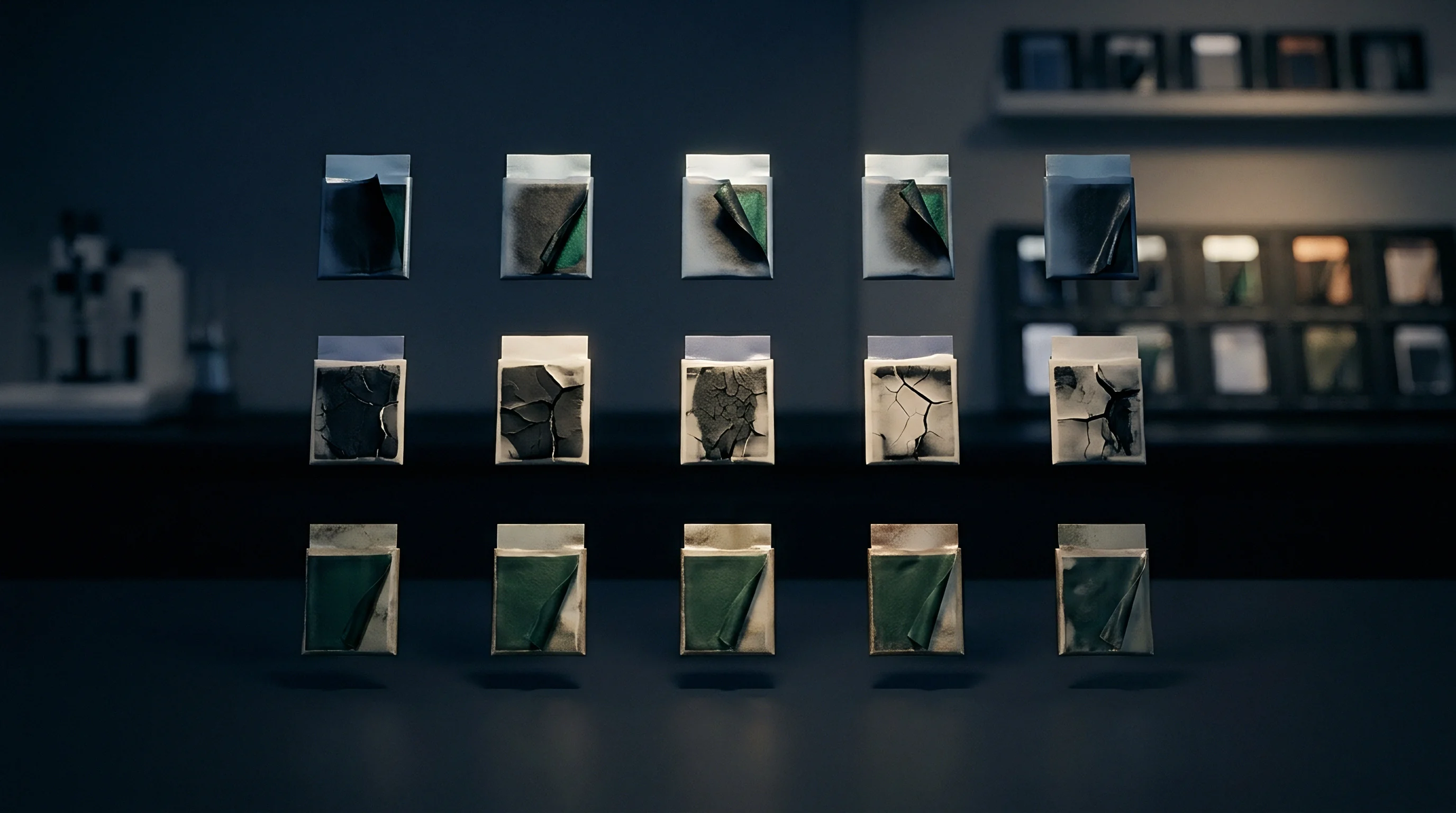
Under the unrelaxed tensile stresses of cold charging, silicon particles larger than one hundred and fifty nanometers crack along cleavage planes. These fractures expose fresh, unpassivated silicon directly to the liquid electrolyte, provoking immediate decomposition that consumes cyclable lithium and packs the interior fissures with resistive interphase debris.
Repeated cold cycling also crushes available pore volume. Expanding silicon drives against rigid graphite grains, compressing the surrounding void space; in calendared coatings designed with twenty-six percent initial porosity, local porosity in the upper third can fall below twelve percent during full lithiation. This constriction pinches liquid transport channels, pushing the effective tortuosity factor from 3.5 to over 8.0 and sharply accelerating the onset of metallic lithium deposition.

Should Pack Designers Mandate Internal Heating?
Thermal management design largely dictates whether high-loading silicon cells survive winter service. Surface-mounted heating blankets conduct heat inwards through the casing, where through-plane thermal conductivity in pouch or prismatic formats rarely exceeds 1.0 watt per meter-kelvin across alternating layers of foil, porous coatings, and separators. Heating from the outside thus establishes sharp internal gradients, warming outer wraps to ten degrees Celsius while the jelly roll core remains chilled at minus fifteen degrees Celsius.
Pack integrators evaluate internal heating approaches across a structured sequence prior to selecting cell formats for low-temperature deployment:
- Measure through-plane thermal conductivity across the targeted state-of-charge window using guarded heat flow methods to determine baseline conduction limits.
- Apply high-frequency alternating current between one hundred hertz and one kilohertz to induce uniform Joule heating within the jelly roll without driving electrochemical reactions.
- Monitor localized overpotentials using three-electrode pilot cells to ensure alternating current excitation amplitudes never depress the negative electrode below zero volts versus lithium.
- Calculate auxiliary energy draw from the battery pack to verify that thermal conditioning does not consume more than twelve percent of total pack energy during a cold-start routine.
- Subject heated cells to two hundred charge-discharge cycles at minus twenty degrees Celsius ambient conditions, verifying that capacity retention matches room-temperature baseline trends within five percent.
System engineers remain split on whether the packaging volume and electrical complexity of internal heating justify the protection against plating, or whether accepting sharp vehicle charge deratings during sub-zero spells remains the more practical design choice.
Rupture
Ongoing mechanical breakdown of passivating films drains the cell of cyclable lithium inventory. The solid-electrolyte interphase formed on silicon-graphite composites comprises an inner inorganic layer of lithium fluoride, lithium oxide, and lithium carbonate, overlaid by an outer organic layer of lithium alkyl carbonates and polymeric species. At room temperature, this dual-layer structure maintains adequate mechanical resilience, flexing and stretching slightly as the underlying substrate breathes during cycling.
At low temperatures, this protective barrier turns exceptionally brittle. Its inorganic constituents, particularly lithium fluoride, possess high elastic moduli and near-zero fracture toughness, while thermal contraction freezes out what little molecular relaxation the organic outer components provide. When the underlying silicon particles expand during charging, the frozen interphase layer cannot deform conformally.
Micro-cracks tear through the film, exposing unprotected silicon directly to solvent molecules.
Fluoroethylene carbonate (FEC) serves as the primary film-forming additive in silicon-containing electrolytes, typically added at concentrations between five and fifteen weight percent. Upon contact with newly exposed silicon surfaces, fluoroethylene carbonate defluorinates to create fresh lithium fluoride passivating deposits. At room temperature, this self-healing mechanism stabilizes capacity fade over hundreds of cycles, but at minus twenty degrees Celsius, the healing process is kinetically compromised.
Interfacial Decomposition and Continuous Passivation Loss
Silicon facets freshly exposed by cryogenic micro-cracking react immediately with cyclic carbonates and fluorinated additives, yet the cold environment prevents these products from packing into a dense, coherent film. Reduction yields a porous, disordered layer rich in semi-carbonates and gaseous decomposition products such as ethylene and carbon dioxide, providing minimal resistance against solvent diffusion while imposing massive resistance to lithium ion migration.
Sub-zero cycling drains fluoroethylene carbonate at an unsustainable pace, with each micro-fracture event depleting finite additive reserves from the electrolyte. Once the local concentration of fluoroethylene carbonate drops below two weight percent, the electrolyte loses its ability to passivate expanding silicon. Standard linear carbonates such as dimethyl carbonate and ethyl methyl carbonate begin direct decomposition on the silicon surface, forming unstable, solvent-swollen films that promote accelerated active mass loss.
Repeated rupturing and re-formation cause impedance to build up rapidly as the physical thickness of the surface layer grows from five nanometers to hundreds of nanometers. In high-loading electrodes, this debris fills inter-particle pore channels and degrades electronic contact between silicon clusters and the conductive carbon matrix, isolating pockets of active material and permanently reducing usable cell capacity.
Impedance Spectra Signatures of Cryogenic Degradation
Electrochemical frequency responses measured between ten millihertz and one hundred kilohertz expose the rise of interfacial barriers. A Nyquist plot of a fresh silicon-graphite composite at twenty-five degrees Celsius displays two distinct features: a high-to-medium frequency semicircle representing film and charge-transfer resistance, and a low-frequency sloping line reflecting Warburg solid-state diffusion. The total interfacial resistance typically measures under twenty ohm-square centimeters.
Cooling the cell to minus twenty degrees Celsius expands the charge-transfer semicircle by a factor of thirty to fifty. The film resistance and charge-transfer arcs separate into distinct regimes, with the charge-transfer resistance dominating total cell impedance. Following sub-zero charging cycles where metallic plating and film rupture occur, the spectra change dramatically.
The interphase resistance semicircle broadens substantially, indicating non-uniform film thickness and localized current path constriction. The low-frequency Warburg tail shifts to lower angles, reflecting severe limitations in anomalous diffusion across degraded active particle matrices.
| Charge C-Rate | Capacity Retention (%) | Coulombic Efficiency (%) | Impedance Growth R_ct (%) | Lithium Inventory Loss (%) |
|---|---|---|---|---|
| 0.05C | 91.4 | 99.2 | 42 | 8.2 |
| 0.10C | 82.1 | 97.8 | 115 | 17.4 |
| 0.20C | 64.3 | 94.1 | 280 | 34.8 |
| 0.50C | 41.2 | 88.6 | 640 | 58.1 |
Differential voltage analysis (dV/dQ) performed during low-rate warming cycles confirms the mechanism behind this rapid capacity degradation. The loss of lithium inventory manifests as a lateral shift in the alignment between the negative and positive electrode potential curves. Concurrently, the loss of active anode material appears as a compression of the characteristic silicon and graphite phase feature peaks.
Safe operation requires that thick silicon composite anodes never charge below freezing without verifying that the negative electrode potential maintains positive margin against metallic lithium plating.
Dispatch
Procurement contracts translate these low-temperature limits into enforceable factory acceptance parameters. Automotive and industrial battery buyers regularly source cells whose marketing datasheets advertise operating envelopes from minus thirty to plus sixty degrees Celsius. These broad operational ranges mask critical caveats regarding allowable charge currents at low temperatures.
A supplier may advertise a 50 amp-hour cell with 280 watt-hours per kilogram, but the sub-zero charging specification will derate allowable current to zero below minus ten degrees Celsius, or restrict it to 0.02C.
Incoming inspection programs verify whether production lots match approved chemical formulations. Sourcing engineers cannot dismantle every incoming cell to evaluate electrode coating thickness or silicon particle distribution. Incoming docks implement specialized electrical characterization procedures designed to detect substandard interfacial kinetics and identify lots vulnerable to premature low-temperature degradation.
These procedures screen cells before they enter pack assembly pipelines.
A typical qualification campaign assesses lot-to-lot variance in low-temperature impedance spectra. In a sample of one hundred cells drawn from an incoming production batch, cells displaying charge-transfer resistances more than fifteen percent above the mean at minus ten degrees Celsius correlate with higher localized silicon agglomeration or non-uniform calendaring. Non-uniform electrode density causes uneven current crowding during cold operation, precipitating localized metallic lithium deposition under charging currents that standard cells tolerate without incident.
Incoming Acceptance Thresholds for Cold Duty Cells
Receiving docks filter out suspect lots through targeted differential capacity analysis and low-temperature electrochemical screening. Standard incoming testing at twenty-five degrees Celsius catches gross manufacturing defects such as internal short circuits or out-of-spec formation capacity. However, room-temperature screening fails to reveal variations in binder dispersion, electrolyte additive depletion, or excessive coating tortuosity that govern cold-weather durability.
An audit program for cold-climate battery cells subjects statistical samples to automated thermal chamber testing:
- Cryogenic Hybrid Pulse Power Characterization measures area-specific impedance at minus twenty degrees Celsius across ten percent increments of state of charge, establishing strict upper acceptance bounds for charge-transfer resistance.
- Low-Rate Stripping Titration charges cells at 0.05C at minus fifteen degrees Celsius followed by a twenty-four-hour rest period to detect relaxation voltage plateaus indicative of reversible metallic lithium plating.
- Post-Chill Coulometric Efficiency Tracking measures three successive 0.1C cycles at twenty-five degrees Celsius immediately following low-temperature exposure to quantify unrecoverable cyclable lithium inventory loss.
- High-Precision In-Situ Dilatometry monitors irreversible pouch thickness expansion following cold charging cycles to detect interphase accumulation and gas generation resulting from mechanical film rupture.

Warranty Boundaries and Low Temperature Charging Penalties
Supply contracts define strict operational envelopes to protect pack integrators against catastrophic field claims. A supplier will void warranty obligations if battery management system logs reveal a charging event executed outside the validated thermal envelope. Integrating cells without detailed current-temperature derating maps shifts full financial liability for cold-weather degradation from the cell manufacturer to the pack integrator.
Landed cost calculations incorporate the mechanical and thermal hardware required to protect thick silicon composite anodes. Utilizing dense silicon-graphite cells to capture higher vehicle range adds substantial system costs if those cells require liquid heating loops, active insulation blankets, and pre-charge heating routines. If a battery pack must consume ten percent of its stored capacity simply warming cells from minus twenty to plus ten degrees Celsius before accepting charge, the practical system-level energy density drops significantly.
Standard procurement agreements stipulate compliance with rigorous international safety and durability testing frameworks. Cell models undergo formal qualification under standard protocols such as IEC 62660-1 for performance characterization and UL 2580 for pack safety. Buyers targeting cold-weather deployments mandate the inclusion of Clause 6.4 from IEC 62660-2, which subjects cells to cyclic charging under dynamic sub-zero temperature profiles, establishing legal non-conformance penalties if capacity loss exceeds ten percent across fifty validated thermal cycles.