Spatial Lithium Ion Concentration Gradients in Low Temperature Charging
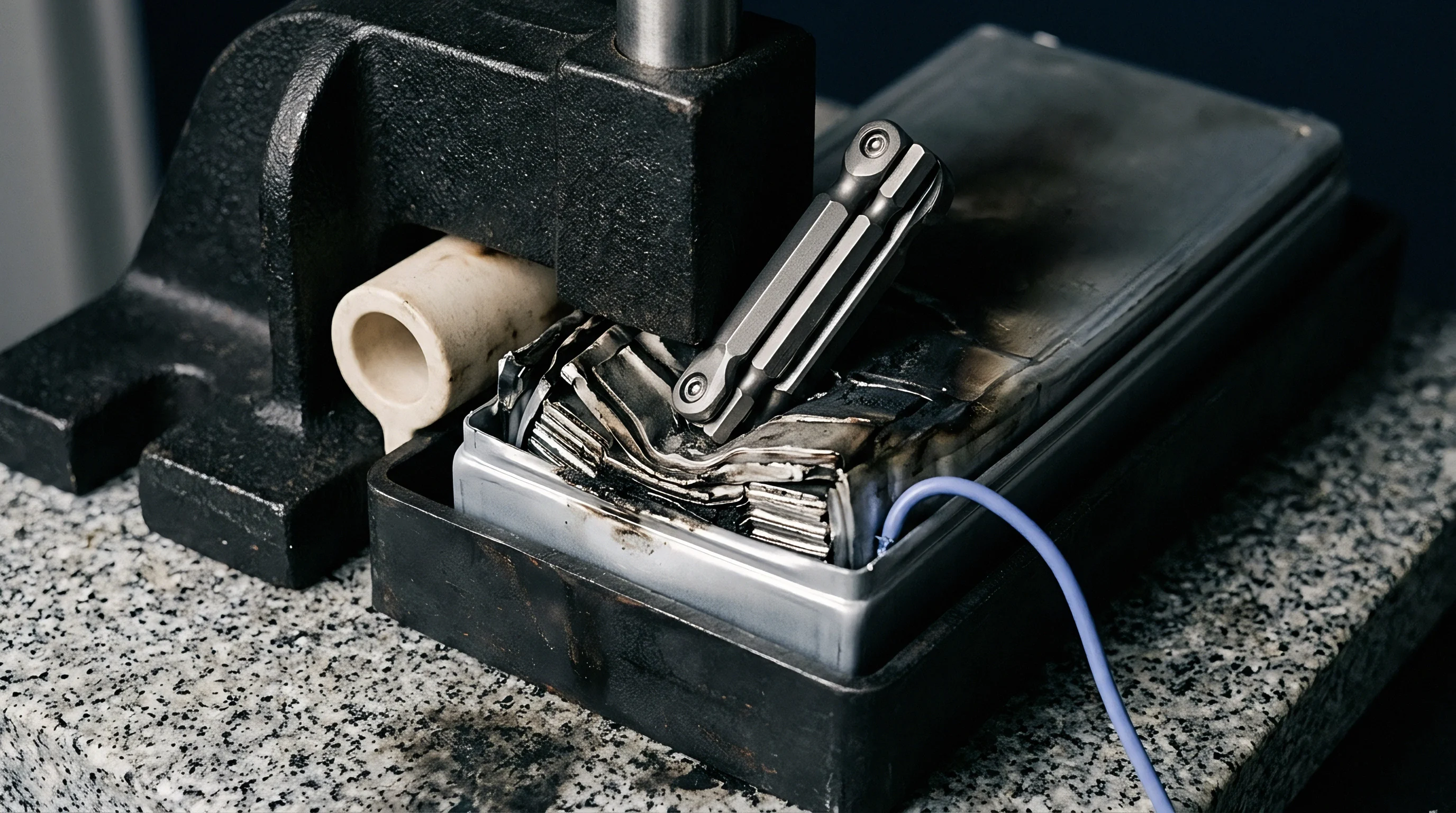
Low-temperature charging creates porous anode lithium salt depletion, driving localized overpotentials below zero volts and triggering irreversible lithium plating.
Salt
When cell temperatures drop below ambient operational thresholds, liquid-phase transport parameters change drastically. Within a lithium-ion cell charging between minus thirty degrees Celsius and zero degrees Celsius, dynamic viscosity in the liquid electrolyte climbs sharply while ionic conductivity plunges. Across this thermal span, the bulk diffusion coefficient of lithium ions in standard organic carbonate solutions falls by more than an order of magnitude.
As an external circuit applies charging current, lithium ions pass through the separator into the porous graphite anode, where electrochemical intercalation consumes them at solid particle surfaces faster than liquid-phase diffusion can replenish the pore network.
Spatial variations in salt molality generate substantial potential drops across the liquid phase within electrode pores. This concentration polarization establishes a steep lithium-ion concentration gradient along the electrode thickness: high salt concentrations gather at the separator interface while severe depletion develops deep in the layer near the copper current collector foil, starving inner pores.
The magnitude of this concentration gradient depends on several interacting physical parameters governed by Nernst-Planck transport kinetics:
- Electrolyte transference number dictates the proportion of electric current carried by lithium cations relative to solvated hexafluorophosphate anions across the porous separator.
- Porous electrode tortuosity increases effective ionic path length, restricting liquid-phase transport far beyond what volume porosity alone would suggest.
- Charge current density determines the volumetric flux of ions demanded at the solid-liquid interface per unit time.
- Electrode coating thickness defines the spatial boundary length over which salt depletion profiles form during continuous charge steps.
When salt concentration near the current collector approaches zero, local liquid-phase ohmic resistance climbs exponentially. This localized resistance surge limits current penetration into the electrode depth, forcing charging current to concentrate heavily in the active layer adjacent to the separator face.
At -20°C, liquid-phase lithium ion diffusion coefficients drop below 1.5 × 10^-7 cm²/s, causing concentration polarizations exceeding 400 mV across a standard 70-micrometer graphite anode under a 0.5C charge.
Intercalation slows dramatically at subzero temperatures. Current crowding near the separator interface elevates local reaction flux density, exacerbating charge transfer overpotentials. Combined with high liquid-phase concentration polarization, this charge transfer resistance forces the local anode solid-phase equilibrium potential downward.
Without proper thermal derating, pore salt depletion accelerates capacity fade and can destroy cells through internal short circuits.
Layer
Particle lithiation states vary sharply along the path from the current collector to the separator interface. Solid-state diffusion of lithium inside graphite flakes follows strict Arrhenius temperature dependence: the diffusion coefficient in natural or synthetic graphite drops from roughly ten to the minus nine square centimeters per second at room temperature to less than ten to the minus eleven square centimeters per second at minus twenty degrees Celsius. Consequently, lithium ions reaching particle surfaces face a severe kinetic barrier before entering host lattice interstitial sites.
Anode potential drops below zero volts versus metallic lithium whenever pore-electrolyte salt depletion coincides with high charge current density. In standard room-temperature charging, the electrochemical potential of the graphite anode remains positive relative to the lithium reference electrode, favoring stage-one C6 to LiC6 intercalation reactions. Under subzero conditions, severe liquid-phase concentration polarization combines with solid-state diffusion limitations and charge-transfer overpotentials.
The composite anode surface overpotential drops below zero volts against metallic lithium at the separator face, where plating begins.
Once local potential drops below this thermodynamic threshold, side reactions compete directly with intercalation. Solvated lithium ions accept electrons right at the outer particle surfaces, depositing as a metallic lithium film rather than intercalating into graphene layers. These initial deposits form irregular, mossy structures that rapidly evolve into high-aspect-ratio dendrites under sustained current flow, creating latent short circuits.
| Temperature (°C) | Viscosity (cP) | Ionic Conductivity (mS/cm) | Li+ Diffusion Coeff (cm²/s) | Transference Number | Max Polarization (mV) |
|---|---|---|---|---|---|
| 25 | 3.1 | 10.8 | 2.4 × 10^-6 | 0.38 | 25 |
| 0 | 6.8 | 5.2 | 8.1 × 10^-7 | 0.33 | 110 |
| -10 | 11.4 | 3.1 | 4.2 × 10^-7 | 0.29 | 240 |
| -20 | 22.5 | 1.4 | 1.3 × 10^-7 | 0.24 | 460 |
| -30 | 48.0 | 0.5 | 3.5 × 10^-8 | 0.18 | 890 |
Metallic lithium on graphite surfaces reacts exothermically with organic carbonate solvents, generating additional solid-electrolyte interphase material. This reaction consumes active lithium ions irreversibly, driving permanent capacity loss. In subsequent discharge cycles, isolated metallic fragments disconnect electronically from the graphite matrix, becoming dead lithium that no longer contributes to storage capacity.
Matching electrode structural parameters reduces the severity of localized potential drops during subzero charging cycles. Engineers specify cell designs based on exact physical and chemical metrics to control spatial gradient steepness:
- Particle size grading places smaller graphite particles near the separator face to shorten solid-state diffusion lengths where local current density peaks.
- Porosity gradient profiling maintains higher void volume fractions adjacent to the separator to provide expanded liquid transport channels for salt replenishment.
- Porous coating thickness matching caps total anode areal capacity to prevent extreme concentration polarization from reaching critical thresholds deep in the layer.
- Electrolyte co-solvent selection incorporates low-viscosity linear esters like methyl propionate to preserve ionic mobility down into subzero operating regimes.
Cells subjected to charging below 0°C without explicit low-temperature qualification protocols forfeit safety certification due to internal short-circuit hazards from dendritic growth.
Cold-charge degradation often stems from pack controllers exceeding recommended charging C-rates at low temperatures.


Signal
Post-charge open-circuit potential monitoring captures how dissolved ions and surface lithium redistribute after charging. Immediately following a cold charge step, a cell containing spatial lithium concentration gradients and metallic lithium deposits displays a characteristic multi-stage voltage relaxation curve. Liquid-phase salt redistribution takes from ten seconds to several minutes as ions diffuse along the established gradient.
At the same time, active surface lithium re-intercalates into vacant graphite sites while reacting corrosively with the liquid electrolyte.
What Voltage Relaxation Signals Indicate Internal Salt Depletion?
Voltage differential analysis of the open-circuit relaxation curve separates liquid diffusion processes from metallic lithium relaxation dynamics. When metallic lithium exists on the anode surface, terminal voltage displays a distinct plateau or inflection point during relaxation. The duration of this plateau correlates directly with the mass of reversible metallic lithium plated during charge.
Once that lithium either re-intercalates or converts to dead lithium, the curve returns to standard logarithmic decay governed by solid-state diffusion within the bulk graphite particles.
Executing non-destructive diagnostic sequences allows incoming quality inspection facilities to detect cold charge damage without destroying production samples:
- Stabilize the target cell at the subzero evaluation temperature inside an environmental test chamber for a minimum of four hours.
- Apply the supplier-specified charging current while continuously logging high-resolution terminal voltage and current data at sampling frequencies above ten hertz.
- Disconnect the charging circuit immediately upon reaching the upper cut-off voltage, switching the cell channel to open-circuit voltage monitoring.
- Log open-circuit voltage decay continuously for two hours to record the presence and duration of characteristic voltage relaxation inflection plateaus.
- Warm the cell to twenty-five degrees Celsius and execute a controlled reference discharge at a low C-rate to perform differential capacity analysis.
Differential Capacity and Impedance Signatures
Derivative capacity curves extracted during subsequent warm discharge reveal distinct stripping peaks associated with reversible metallic deposits. Plotting dQ/dV against cell terminal voltage generates clear structural signatures. A distinct peak appearing at lower discharge potential values indicates the stripping of metallic lithium prior to standard graphite de-intercalation stages.
The area under this stripping peak quantifies the precise state-of-charge equivalent of plated lithium recovered during discharge.
Electrochemical impedance spectroscopy provides complementary data regarding liquid-phase salt depletion. Impedance spectra gathered at subzero temperatures display an enlarged mid-frequency charge-transfer semicircle overlapping low-frequency Warburg diffusion impedance distortions. As salt depletion develops in electrode pores, the ohmic intercept shifts toward higher resistance values while the Warburg slope flattens, signaling extreme transport constraints within the liquid phase.
Relaxation times allowed for salt equilibrium after cold fast charging determine whether local overpotentials decay safely before lithium intercalation resumes.
Whether high-frequency electrochemical impedance measurements can isolate transient pore salt depletion from irreversible solid-electrolyte interphase growth during active cold fast charging remains an active area of investigation.

Profile
Algorithm-driven current steps mitigate liquid-phase ion starvation by periodically relieving concentration polarization during low-temperature cycles. Multi-stage constant current charging strategies divide the operational charge window into discrete current steps tailored to local salt transport limits. At high states of charge or low temperatures, the battery management system reduces applied current in calculated increments.
This current reduction allows liquid-phase mass diffusion to catch up with surface reaction rates, collapsing concentration gradients before local anode potentials dip below zero volts.
Pulse current charging introduces intermittent short-duration discharge or zero-current relaxation pulses into the charging profile. Depolarizing discharge pulses draw a micro-ampere pulse of reverse current from the cell. This brief reversal rapidly oxidizes early-stage lithium nuclei formed at graphite particle surfaces and allows local salt concentration at the separator interface to dissipate into the pore depth.
| Temp Band (°C) | Max Continuous C-Rate | Pulse Current Factor | Intermittent Rest (s) | Plating Onset Potential (mV) |
|---|---|---|---|---|
| 10 to 15 | 1.20C | 1.50C | 0 | +45 |
| 0 to 10 | 0.50C | 0.80C | 10 per 60s charge | +15 |
| -10 to 0 | 0.15C | 0.30C | 20 per 30s charge | -5 (High Risk) |
| -20 to -10 | 0.05C | 0.10C | 30 per 15s charge | -45 (Severe Plating) |
| Method Note: Values established via operando three-electrode reference cell testing with LiPF6 EC:EMC electrolyte on 70µm graphite anodes. | ||||
Self-heating cell designs resolve liquid transport limitations by raising core temperatures before applying charge current. High-frequency alternating current signals passed through the cell generate internal Joule heating without causing net state-of-charge accumulation or localized plating. Internal AC heating warms the electrode active mass and pore electrolyte uniformly from within, avoiding the steep thermal gradients created by external heating blankets.
Electrode Structural Design for Reduced Concentration Polarization
Tailoring particle size distributions and porosity fractions along the electrode thickness balances ion flux across the liquid phase. Advanced electrode architectures implement dual-layer or continuously graded coating structures. High-porosity regions located adjacent to the separator face maximize bulk electrolyte volume and reduce ionic resistance where flux demands peak, while lower porosity regions near the copper current collector maintain high volumetric energy density.
System designers select control strategies and hardware configurations based on targeted operating constraints:
- Multi-stage step derating lowers continuous charging currents as cell terminal voltage climbs, keeping surface overpotentials positive.
- Integrated pulse depolarization incorporates brief high-frequency discharge spikes into the BMS charging algorithm to strip transient surface deposits.
- Pre-charge internal heating activates high-frequency AC self-heating protocols to elevate core temperatures above zero degrees Celsius prior to current injection.
- Electrode tortuosity engineering selects laser-patterned or magnetic field-aligned graphite structures to create direct, low-resistance ionic channels through the layer depth.
Anode surface potential drops below zero volts versus metallic lithium whenever pore-electrolyte salt depletion coincides with high charge current density.
Higher electrolyte salt concentration combined with low tortuosity electrodes consistently extends the safe charging current window before lithium plating initiates.

Warranty
Commercial agreements for industrial cell orders explicitly allocate financial liabilities for capacity loss resulting from subzero charging routines. Standard cell manufacturer specification sheets list conservative operating windows, typically restricting charging to temperatures above zero degrees Celsius. When an industrial buyer integrates cells into outdoor infrastructure or electric vehicle applications that experience cold ambient environments, operating without preconditioning triggers rapid capacity degradation.
Standard warranty coverage terminates if onboard logger data reveals charging events below minimum temperature thresholds without authorized software controls.
Energy consumed by battery thermal management systems during cold pre-heating directly alters the financial return on pack deployment. To evaluate the true economic balance, consider a worked financial comparison between unconditioned cold charging and thermally managed pre-heating across a fleet operating in subzero climates.
Take a 100 kilowatt-hour industrial battery pack constructed from NMC811 graphite-silicon cells, operating in a minus fifteen degrees Celsius environment. Assume an initial pack procurement cost of 115 dollars per kilowatt-hour, yielding a total pack capital cost of 11,500 dollars.
In Scenario A, the pack charging system applies a continuous 0.3C charging current directly at minus fifteen degrees Celsius without thermal pre-conditioning. Severe pore salt depletion and metallic lithium plating reduce cell capacity rapidly, forcing pack retirement at 500 equivalent full cycles when state-of-health drops to 80 percent. Total energy delivered by the pack across its operational lifespan equals 40,000 kilowatt-hours.
Dividing initial capital cost by lifetime energy throughput yields a direct capital cost of 0.2875 dollars per delivered kilowatt-hour.
In Scenario B, the system routes 4 kilowatt-hours of energy from an auxiliary source or grid connection to run internal AC self-heating, raising pack temperature from minus fifteen degrees Celsius to plus ten degrees Celsius in twelve minutes prior to charge initiation. Charging proceeds safely at 1.0C. Thermal management energy expenditure adds a minor operating cost while completely preventing spatial lithium concentration gradients and metallic plating.
Under these conditions, the pack achieves 2,500 equivalent full cycles before reaching the 80 percent end-of-life threshold.
Total lifetime energy delivered in Scenario B equals 200,000 kilowatt-hours. Accounting for the additional pre-heating energy consumption across 2,500 charging cycles adds 10,000 kilowatt-hours of parasitic energy cost, priced at an average industrial rate of 0.10 dollars per kilowatt-hour, adding 1,000 dollars to operational expenditure. Total cost for Scenario B reaches 12,500 dollars.
Dividing total cost by net delivered energy yields a capital and heating cost of 0.0625 dollars per delivered kilowatt-hour. Thermal pre-conditioning reduces lifetime energy cost per cycle by over 78 percent while preserving full warranty coverage.
Incorporating an explicit UN 38.3 T.7 cold charge qualification clause into cell supply contracts shifts the financial burden of low-temperature plating failures entirely back to the manufacturer.