Thermomechanical Separator Creep Evaluation under Cell Thermal Runaway
Verify separator creep compliance under combined pack stack pressure and thermal ramps to prevent latent shorting before commit of cell tooling investments.
Web
Extruded polyolefin membranes exhibit marked viscoelastic relaxation long before their thermodynamic melting points arrive on a differential scanning calorimeter trace. Standard wet-process polyethylene melts between 132 and 136 degrees Celsius, while dry-process polypropylene holds its crystalline structure up to 165 degrees Celsius. Thermal runaway cascades, however, initiate localized exothermic cascades well below these phase changes.
Solid-electrolyte interphase decomposition releases heat starting at 80 degrees Celsius, accelerating through 120 degrees Celsius. Within tightly wound or clamped cells, high compressive forces convert nominal heat resistance into real mechanical displacement. Stack compression forces polymer chains past each other through amorphous domains.
Under sustained mechanical preload, the microporous matrix thins, pores collapse, and physical separation degrades.
Polyolefin substrates contract along their machine directions when heated. Mechanical drawing during manufacturing aligns polymer backbones to generate tensile properties and pore volume, but high temperatures unlock these frozen orientations. Unconstrained, the membrane pulls back along its orientation axes and expands in thickness or transverse dimensions.
In wound jellyrolls and clamped prismatic stacks, severe mechanical confinement changes this response: restricted contraction turns entropic recoil energy into tensile stress against cell radii, while normal loads force softened fibrils directly into open void spaces. Evaluating separator stability requires measuring thermomechanical creep under simultaneous normal compressive stress and planar tensile loads.
Membranes undergo viscous flow and fibril buckling under three megapascals of stack pressure at temperatures forty degrees below their datasheet melting points.
Dynamic mechanical analysis under continuous thermal ramps maps the transition from elastic energy storage to viscous dissipation. Storage modulus drops sharply between 90 and 115 degrees Celsius in standard polyethylene films. Loss modulus peaks in this exact thermal window, marking the onset of massive creep susceptibility.
Introducing a ceramic particulate coating modifies this response by establishing a rigid inorganic skeleton across the polymer face. Submicron alumina or boehmite particles bound with fluoropolymer emulsions support the compressive load after the underlying polyolefin matrix softens. The mineral layer prevents physical contact between opposing electrode faces during temporary thermal excursions.
Polymer Viscoelasticity under Elevated Temperatures
Tensile creep compliance curves show three distinct regimes as temperature climbs toward the runaway threshold. Primary creep features a decreasing strain rate over initial thermal exposure. Secondary creep establishes a steady, linear strain rate governed by polymer chain disentanglement.
Tertiary creep accelerates exponentially toward structural necking and pinhole voiding. In an unconstrained furnace test, polyolefin films show twenty to sixty percent area shrinkage at 130 degrees Celsius. Inside an operational cell, compressive stack pressure alters this behavior completely.
Normal loads force hot polymer into the microscopic surface roughness of active material coatings. Microscopic asperities on lithium nickel manganese cobalt oxide cathodes indent the softened separator surface, reducing the effective dielectric thickness across localized points.
Co-extruded trilayer films attempt to exploit staggered thermal behavior. Polypropylene outer skins provide mechanical stiffness up to 160 degrees Celsius. A polyethylene inner core melts at 132 degrees Celsius, filling the pore volume to extinguish ionic conductivity.
This shutdown mechanism assumes structural isolation from extreme compressive spikes. When pack design delivers three to five megapascals of mechanical confinement, melting the middle layer induces rapid fluid displacement rather than passive pore occlusion. The low-viscosity polyethylene melt squeezes outward from high-pressure zones toward the cell margins, leaving thinned polypropylene skins vulnerable to localized puncture.
Creep testing procedures must measure thickness loss under active hydraulic and mechanical displacement.
Differential Scanning Calorimetry and Dynamic Mechanical Analysis
Calorimetric measurements identify enthalpy changes during crystalline melting without capturing mechanical load-bearing capacity. Standard testing protocols run differential scanning calorimetry at ten degrees Celsius per minute to report a single melting peak. That measurement misses the creep window entirely.
Dynamic mechanical thermal analysis measures the complex modulus under defined sinusoidal strain and steady compressive stress. A specimen clamped at 1.0 megapascal reveals significant storage modulus decay starting at 95 degrees Celsius for high-density polyethylene, while the phase angle climbs toward ninety degrees. The material transitions into pure viscous liquid behavior long before the endothermic melt peak registers on the thermal trace.
| Separator Substrate Architecture | Substrate Thickness (um) | Storage Modulus at 90C (MPa) | Thickness Creep at 130C (%) | Tensile Shrinkage at 150C (%) | Puncture Force at 130C (N) |
|---|---|---|---|---|---|
| Wet-Process Monolayer PE | 9.0 plus or minus 0.5 | 210 plus or minus 15 | 38.5 plus or minus 2.4 | 72.0 plus or minus 3.5 | 0.85 plus or minus 0.08 |
| Dry-Process Monolayer PP | 14.0 plus or minus 0.7 | 460 plus or minus 22 | 11.2 plus or minus 1.1 | 41.5 plus or minus 2.1 | 1.95 plus or minus 0.12 |
| Trilayer PP/PE/PP | 16.0 plus or minus 0.8 | 390 plus or minus 18 | 24.6 plus or minus 1.8 | 36.0 plus or minus 1.9 | 1.60 plus or minus 0.10 |
| Al2O3 Coated Wet PE (2um coat) | 12.0 plus or minus 0.6 | 580 plus or minus 25 | 8.4 plus or minus 0.7 | 4.2 plus or minus 0.4 | 3.80 plus or minus 0.15 |
| Boehmite Coated Wet PE (1.5um coat) | 11.5 plus or minus 0.5 | 520 plus or minus 20 | 9.1 plus or minus 0.8 | 5.8 plus or minus 0.5 | 3.45 plus or minus 0.14 |
| Electrospun Polyimide Nonwoven | 15.0 plus or minus 1.0 | 840 plus or minus 30 | 1.5 plus or minus 0.2 | 1.1 plus or minus 0.1 | 5.20 plus or minus 0.22 |
Coated variations retain mechanical dimensions by decoupling structural integrity from the polyolefin core. Nonwoven polyimide and aramid webs eliminate melting transitions entirely, demonstrating dimensional stability beyond 300 degrees Celsius. These nonwoven substrates suffer from wide pore size distributions and high liquid electrolyte uptake, which alters cycle stability and increases baseline material expense.
Selecting separator media requires balancing baseline electrochemical performance during normal cycling against the structural collapse envelope encountered during early thermal runaway. The thinner the separator, the higher the volumetric energy density, and the narrower the margin before mechanical creep provokes direct electrode shorting.
Membranes that sacrifice thickness to chase energy density exhibit accelerated creep kinetics under identical thermal loads.
Pore
Permeability measurements define the internal transit architecture of lithium-ion membranes. Gurley air permeability values, expressed as the time required for one hundred standard cubic centimeters of air to pass through a square inch of film under 1.22 kilopascals of pressure, range from one hundred to two hundred fifty seconds in baseline fresh stock. The MacMullin number characterizes the tortuosity and porosity ratio, scaling directly with internal ionic resistance.
As cell internal temperatures exceed 100 degrees Celsius, viscoelastic flow distorts internal void channels. Pores deform from isotropic elliptic cavities into compressed, isolated pockets. This mechanical pore closure throttles ion flux, driving cell internal impedance upward by two orders of magnitude within seconds.
Baseline impedance jumps past eighty milliohms. Ohmic heating drops as current flow ceases, assuming the pack management system disconnects the external load or the cell operates in a small parallel grouping. In large parallel blocks typical of automotive and grid-scale enclosures, adjacent healthy cells drive current through the high-impedance cell.
The failing unit experiences aggressive resistive heating, turning ionic shutdown into an intense localized heat source. Measuring pore shrinkage kinetics under combined thermal and compressive stresses determines whether an automated shutdown response isolates the cell or accelerates thermal runaway via forced external current injection.
Where Does High Compressive Stress Trigger Shorting?
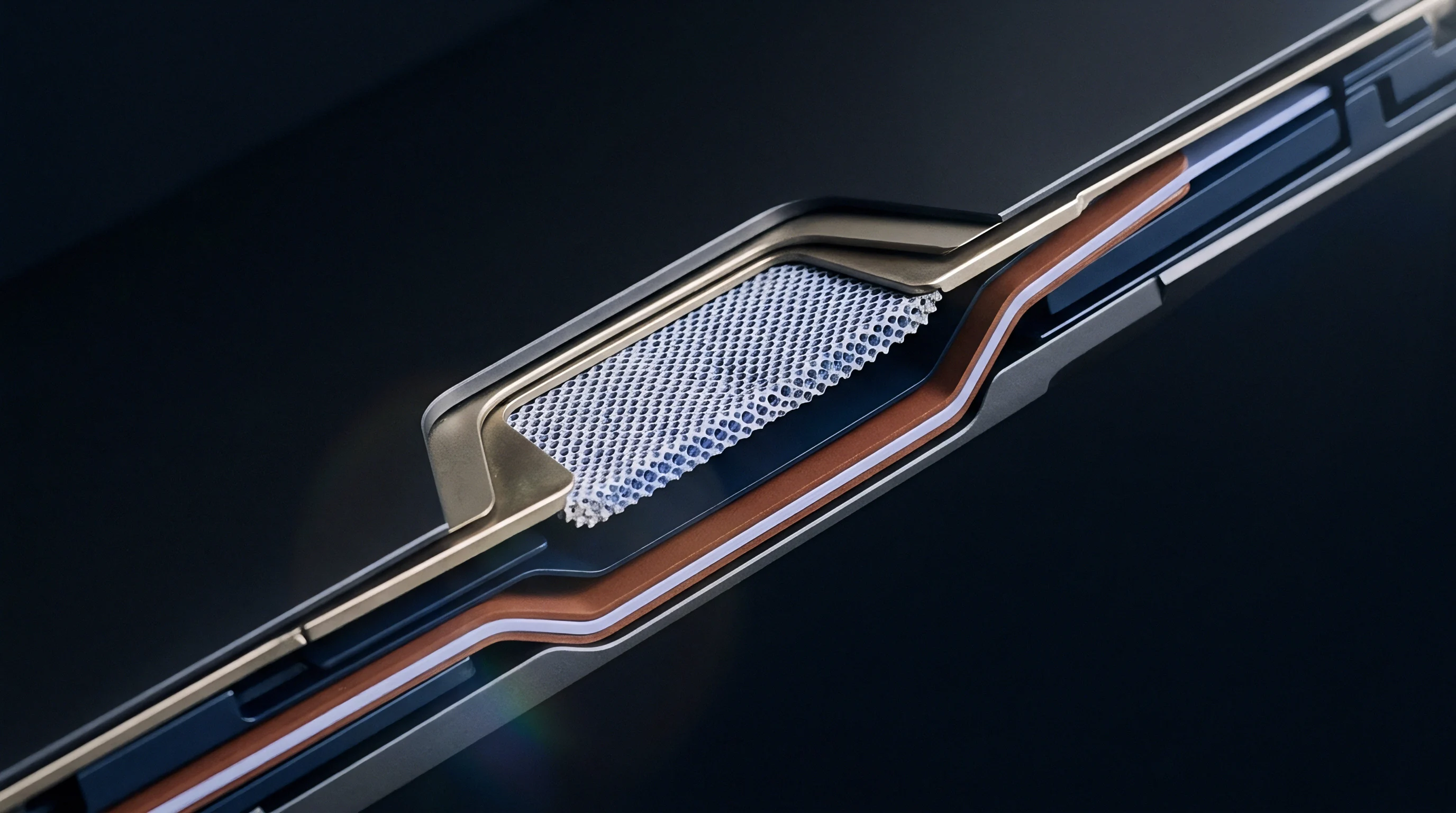
Mechanical stress distributions across electrode faces are inherently non-uniform. Active material coating edges, tab weld zones, and current collector cut burrs concentrate mechanical stresses. Nominal stack pressures of 0.5 to 2.0 megapascals scale up to fifteen or twenty megapascals at burr tips and coating steps.
High compressive stress triggers localized shorting where these stress concentrations align with accelerated thermal softening. As temperature approaches 125 degrees Celsius, the polymer matrix creeps away from the high-stress contact point. The thinned membrane permits direct metallurgical contact between aluminum cathode current collectors and copper anode foils, or between graphite surfaces and cathode active particles.
The initiation sequence follows an identifiable physical progression:
- Microscopic Asperity Indentation displaces polymer chains laterally away from rigid cathode particles under localized pressures exceeding twelve megapascals.
- Localized Pore Occlusion halts electrolyte transport across the indented zone, shifting ion flux to adjacent uncompressed pathways.
- Polymer Chain Disentanglement accelerates under localized shear heating, causing rapid thinning from nine micrometers down to sub-micron dimensions.
- Dielectric Breakdown occurs across the ultra-thin polymer residue as internal potential gradients exceed the diminished dielectric threshold.
- Ohmic Micro-Short Formation creates localized current densities exceeding ten thousand amperes per square centimeter, vaporizing remaining polymer fragments.
Ionic Conduction Cutoff against Structural Collapse
Pore collapse kinetics follow a competition between surface tension forces and viscoelastic resistance. Surface energy drives the minimization of interfacial area, promoting pore closure as the polymer softens. Bulk mechanical constraints oppose or accelerate this process depending on the axis of stress.
Uniaxial planar compression forces pore walls together, speeding up ionic cutoff. Biaxial tension maintains pore opening by pulling the fibrillar structure taut, delaying shutdown until gross mechanical rupture occurs. Separators manufactured via dry-process uniaxially oriented stretching feature slit-like pores that collapse prematurely along the transverse direction under minimal thermal input.
Dynamic mechanical analysis confirms that a two-megapascal compressive load reduces polyolefin separator puncture resistance by seventy-five percent at one hundred twenty degrees Celsius.
Wet-process biaxially oriented separators possess interconnected spherical pores with higher resistance to anisotropic collapse. This structural stability maintains ionic conduction up to higher temperatures, delaying the shutdown effect. The design engineer must decide whether an early shutdown or structural survival represents the safer failure mode for a given pack topology.
A premature shutdown that collapses pores non-uniformly induces localized current crowding at remaining open channels. Current crowding accelerates lithium plating during fast discharge or charging cycles, introducing dendritic growth that penetrates the partially softened web.
Miscalculating the pore collapse envelope allows localized current crowding to breach the dielectric barrier, triggering complete pack loss through uncontained thermal cascading.

Thrust
Mechanical expansion of active battery materials generates severe dynamic loads against cell enclosures. Silicon-doped graphite anodes expand from six to twenty-five percent during lithiation, depending on silicon blending ratios. Nickel-rich cathode materials expand and contract anisotropically along crystallographic axes.
Gas generation during early electrolyte decomposition adds internal pneumatic pressure. In a rigid prismatic can or a constrained module block, these phenomena combine to deliver compressive stresses exceeding five megapascals directly into the electrode separator assembly. This mechanical thrust acts as the primary driving force for accelerated separator creep.
Anode expansion dynamics scale non-linearly with state of charge. Fully charged cells present the maximum mechanical confinement stress precisely when chemical energy storage and thermal runaway sensitivity reach their peak. The separator operates in a high-stress mechanical vise while facing maximum chemical thermodynamic instability.
Evaluating separator creep under passive zero-load conditions produces irrelevant data. Testing must simulate the dynamic mechanical compliance of the pack enclosure and the active expansion characteristics of the electrode couple under thermal runaway ramps.
Giga-Pascal Level Anode Expansion Dynamics
Graphite staging transformations induce distinct volume steps. Transitioning from stage 2 (LiC12) to stage 1 (LiC6) forces a crystallographic expansion of approximately ten percent along the c-axis. When silicon particles enter the formulation, volumetric expansion reaches three hundred percent at full lithiation.
Particle pulverization and solid-electrolyte interphase growth generate irreversible swelling over calendar life. An unyielding pack enclosure forces this swelling backward into the separator matrix. The separator acts as the softest mechanical spring in the series compliance network of the cell.
Internal shorts generate four hundred watts. The localized energy release elevates adjacent material temperatures at rates exceeding one hundred degrees Celsius per second. Under this thermal transient, the effective modulus of the separator collapses instantaneously.
Mechanical compliance modeling calculates the rate of separator thinning using modified Burgers viscoelastic representations, incorporating temperature-dependent Maxwell and Kelvin-Voigt elements:
J(t, T) = 1 / E1(T) + t / eta1(T) + (1 / E2(T)) (1 – exp(-t / tau(T)))
The parameter J represents creep compliance over time t at temperature T. The term E1 defines instantaneous elastic modulus, eta1 represents steady-state viscous flow, and E2 with tau captures delayed viscoelastic relaxation. As temperature approaches 130 degrees Celsius, eta1 drops by four orders of magnitude, causing compliance to diverge upward.
Thermomechanical Creep Compliance Formulation
Laboratory evaluation protocols extract Burgers model parameters by subjecting separator samples to static compressive loads inside temperature-controlled environmental chambers. The platen applies a defined stress step of 2.0 megapascals while linear variable differential transformers measure displacement with sub-micron precision. Uncoated polyethylene substrates show an immediate elastic deflection followed by continuous viscous displacement.
Ceramic-coated substrates introduce a parallel elastic stiffness element that alters the secondary creep slope. The ceramic layer bears the applied load, preventing the compliance divergence seen in raw polyolefins.
| Material Configuration | Test Temperature (C) | E1 Instantaneous (MPa) | E2 Viscoelastic (MPa) | eta1 Viscosity (MPa s) | Compliance at 60s (1/GPa) |
|---|---|---|---|---|---|
| Uncoated Wet-Process PE | 25 | 320 | 140 | 4.2E5 | 10.4 |
| Uncoated Wet-Process PE | 80 | 110 | 45 | 8.5E4 | 31.9 |
| Uncoated Wet-Process PE | 120 | 18 | 6 | 1.2E3 | 222.0 |
| Al2O3 Coated Wet PE | 25 | 480 | 210 | 1.1E6 | 6.9 |
| Al2O3 Coated Wet PE | 80 | 260 | 115 | 3.4E5 | 12.7 |
| Al2O3 Coated Wet PE | 120 | 95 | 38 | 4.8E4 | 37.1 |
| Al2O3 Coated Wet PE | 150 | 32 | 12 | 5.5E3 | 115.0 |
A specific figure in common qualification use is the 120 degrees Celsius creep threshold of 200 reciprocal gigapascals for uncoated films. This figure rests on a 2021 multi-laboratory bench trial using fifty-millimeter circular punch specimens under 2.0 megapascals static deadweight for sixty seconds. Altering the sample aspect ratio or applying an active electrolyte solvent bath shifts this threshold downward by twenty-five degrees Celsius.
Plasticization from carbonate solvents softens the polymer structure, accelerating chain mobility. Solvent swollen membranes reach critical creep compliance at 95 degrees Celsius rather than 120 degrees Celsius. Engineering qualification dossiers that present dry gas chamber measurements overestimate the structural lifespan of wet cell stacks by a significant margin.
Industry standards rely heavily on a sixty-second dwell time for creep compliance certification. Transient runaway events, however, generate heating spikes lasting fractions of a second, while slow thermal propagation across an adjacent module maintains elevated temperatures for tens of minutes. Under this uncertainty, robust evaluation requires creep displacement testing conducted across a dual-envelope test matrix: an ultra-fast thirty-second thermal ramp simulating internal short propagation, and an extended two-hour dwell at 110 degrees Celsius simulating module-level heat soak from an adjacent cell failure.
Industrial polymer stretching processes illustrate this molecular behavior. High-temperature biaxial film orientation equipment relies on precise temperature windows where polymer chains slide freely under mechanical stress without tearing. The battery separator inside a failing cell experiences identical physical conditions.
Stack compression replaces the machine tenter frame, pulling and pushing the amorphous matrix into permanent deformation. When the cell expands, the separator does not rebound. Permanent plastic deformation reduces the dielectric barrier to zero thickness across high-pressure contact zones.
Compressive creep remains negligible only so long as ceramic particles sustain the entire external pack preload.

Rupture
Localized mechanical breach ends the functional life of any separator barrier. Puncture events differ from distributed thinning. Punctures originate from localized geometry: a metallic particle contaminant introduced during electrode calendering, a jagged slitting burr on the cathode foil edge, or a sharp dendritic lithium spine formed during sub-zero fast charging.
Under ambient conditions, standard battery separators resist puncture forces between 2.5 and 5.5 Newtons according to ASTM D3763 or related pin-puncture methods. When cell temperatures climb, the puncture resistance falls precipitously. A pin that requires four Newtons to penetrate at 20 degrees Celsius pierces the membrane with less than 0.5 Newtons at 130 degrees Celsius.
Ceramic alumina coatings halt puncture propagation. High-purity alpha-alumina particles, with diameters calibrated between 300 and 800 nanometers, pack tightly on the polymer face. When a sharp geometry indents the surface, the load distributes across a pyramid of interlocking inorganic granules.
The binder system holding these particles together becomes the decisive chemical element. Standard polyvinylidene fluoride (PVDF) or polyacrylic binders soften between 120 and 160 degrees Celsius. If the binder decomposes or liquefies under localized shear, the ceramic particles move aside, allowing the foreign body or foil burr to pass unimpeded through the softened polyolefin substrate.
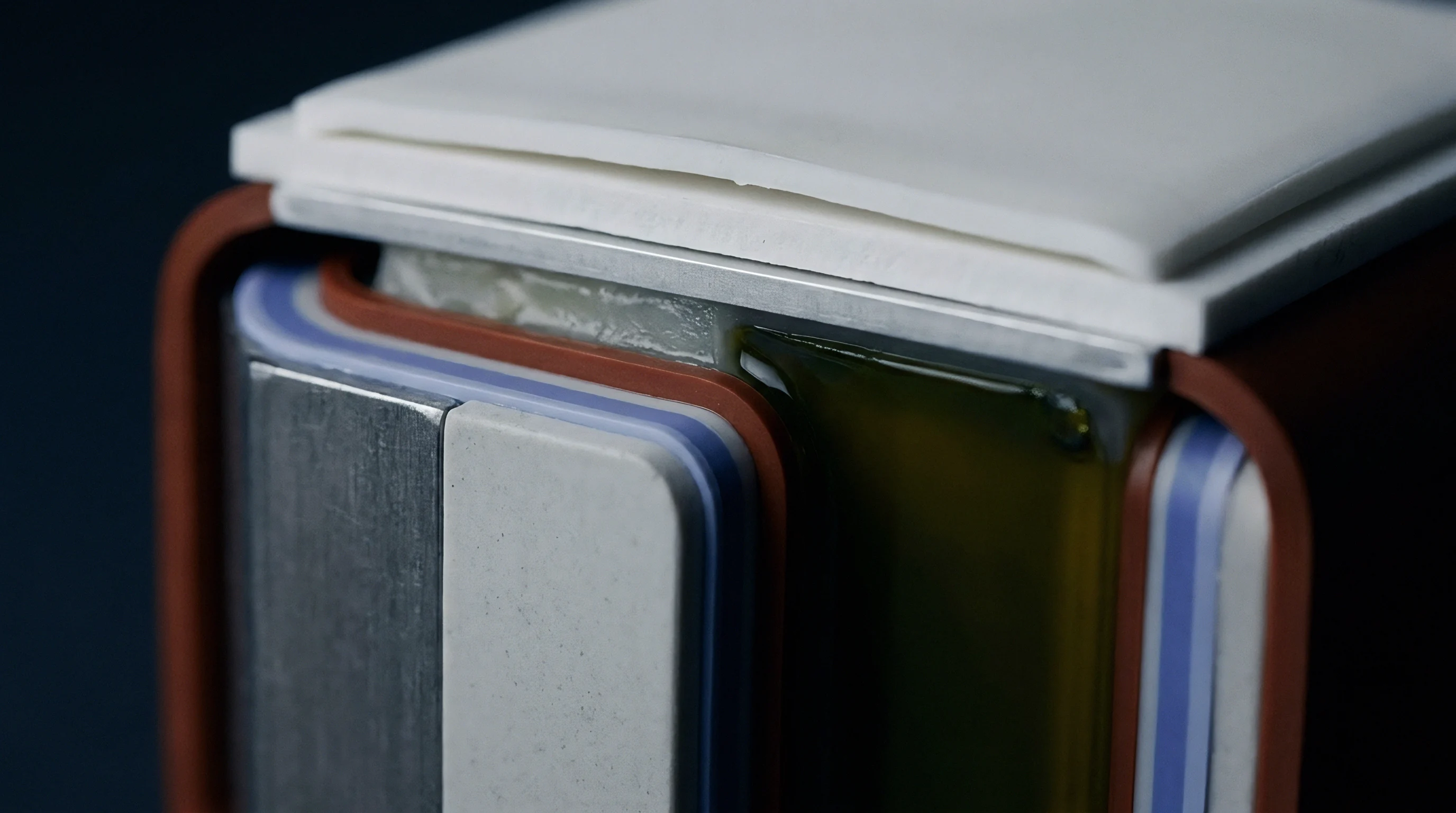
Can Ceramic Composite Coatings Prevent Piercing Failures?
Coating composition determines piercing resistance under runaway conditions. Boehmite (AlOOH) offers lower abrasiveness during coating machine runs compared to alpha-alumina, extending the life of slitting knives and coating heads. Boehmite releases chemically bound water at approximately 250 degrees Celsius, providing an endothermic cooling effect.
Its mechanical hardness sits below that of alumina. Under sharp asperity indentation at elevated temperature, boehmite particles crush or displace more readily than alumina particles, reducing total puncture resistance. Pack architecture must account for whether the separator specification reflects equipment wear considerations or high-temperature mechanical margins.
A second load-bearing failure mechanism involves ceramic layer delamination. As the base polyolefin shrinks under thermal stress, interfacial shear stresses develop between the polymer film and the rigid ceramic topcoat. If the binder lacks sufficient adhesion at elevated temperatures, the ceramic layer spalls away in rigid flakes.
Delamination leaves bare, unreinforced polyolefin exposed to direct mechanical pinching between the electrode faces. Once delamination occurs, macroscopic tears propagate across the membrane within milliseconds.

Particle Penetration Mechanics at Phase Transition
Penetration depth scales with particle geometry, local compressive stress, and the instant shear modulus of the membrane. Testing procedures must capture this physical interaction under active thermal ramps. A standardized laboratory procedure screens separator vulnerability to thermomechanical puncture:
- Mount the separator sample in a rigid circular clamp with an exposed test aperture of thirty millimeters diameter.
- Apply a continuous normal preload of 2.0 megapascals using a spherical tungsten carbide indenter with a tip radius of fifty micrometers.
- Immerse the test fixture in an inert electrolyte solvent simulant to replicate solvent-plasticization effects.
- Initiate a linear thermal ramp of twenty degrees Celsius per minute using an integrated induction heating cartridge.
- Monitor normal displacement continuously via a high-speed optical encoder with sub-micron resolution.
- Record the precise temperature and indenter displacement where electrical contact registers between the indenter and the lower metal platen.
Uncoated polypropylene shrinks fifteen percent longitudinally. That unconstrained measurement flatters the material. Under the indenter screening procedure, an uncoated dry-process polypropylene film suffers electrical shorting at 138 degrees Celsius, twenty-seven degrees below its nominal melting point.
The localized mechanical stress field drives the spherical tip directly through the softening polymer matrix. Coated variations survive until 175 degrees Celsius, where binder softening finally allows particle displacement. Nonwoven aramid membranes resist penetration beyond 260 degrees Celsius, exhibiting only slight baseline indentation without catastrophic shorting.
A ceramic topcoat prevents gross planar area shrinkage without preventing localized particle penetration when binder resins liquefy under five megapascals of localized stack stress.
A specific figure in common industrial use is the five-hundred-gram puncture threshold at room temperature. This value rests on five-millimeter-per-minute punch tests performed with a one-millimeter hemispherical probe across twenty lots of incoming material in 2022. This room-temperature benchmark correlates poorly with high-temperature failure rates.
A separator exhibiting seven hundred grams of puncture force at 20 degrees Celsius often suffers catastrophic creep rupture at 120 degrees Celsius if its binder loses cohesive shear strength. Procurement contracts that specify only room-temperature puncture force allow suppliers to ship membranes with deficient high-temperature structural integrity.
Whether mechanical separators can maintain structural dielectric isolation under the extreme shear and localized normal forces exerted by liquid metal alloy formation during advanced cell thermal runaway remains unproven.
Stack
Cell format defines the mechanical boundary conditions governing separator creep. Cylindrical formats (18650, 21700, 4680) wind the electrode and separator stack into a tight cylindrical spiral inserted into a rigid nickel-plated cold-rolled steel can. Can wall thicknesses vary from 0.15 millimeters in high-density 21700 designs to 0.60 millimeters in structural 4680 formats.
Winding tension generates baseline hoop stress. As the jellyroll expands thermally, the rigid circular steel can prevents radial expansion. Internal radial stress climbs rapidly, forcing the separator layers into continuous high-pressure compression.
The center pin or mandrel location introduces a sharp boundary condition where hoop stresses convert into localized shear loads.
Prismatic cans constrain transverse mechanical creep. Aluminum prismatic enclosures (0.6 to 1.2 millimeter wall thickness) feature flat rectangular surfaces that deform under internal pressure. Cell breathing during charging bows the wide can faces outward.
Pack designers mitigate this by installing rigid module side plates and tie rods, clamping the prismatic cells under three to five kilonewtons of baseline preload. This external clamping creates a uniform compressive field across the flat faces of the winding or z-fold stack. The sharp ninety-degree corner radii of prismatic wound jellyrolls concentrate internal shear stresses.
Separators wrapped around these internal bends experience maximum tensile stretching combined with normal edge compression.

Cylindrical Hoop Stress against Pouch Compliance
Pouch cells lack rigid radial restraint. Enclosed in an aluminum laminate film of 110 to 153 micrometers total thickness, pouch formats possess negligible intrinsic mechanical stiffness against normal expansion. External module plates govern the compressive environment entirely.
If the pack architect uses compliant polyurethane or silicone foams between pouch cells, the separator operates under a controlled, relatively constant compressive stress across thermal ramps. If the pack utilizes rigid structural epoxy bonding without expansion gaps, internal pouch pressures spike aggressively during initial thermal runaway, crushing the separator against the cooling plates.
Pouch formats universally employ z-fold separator configurations rather than continuous spiral rolls. The z-fold process feeds a continuous separator web through oscillating blades while individual cathode and anode sheets are inserted into alternating pockets. This geometry eliminates winding hoop stress.
The primary failure mode shifts to edge pinch creep. During cell assembly and vacuum sealing, the folded separator edges can wrinkle. Wrinkles create localized lines of double thickness that absorb the entire external clamping load, accelerating localized creep thinning along the fold crease under elevated temperatures.
Corner Radii Stress Concentrations in Prismatic Windings
Prismatic wound cells present the highest risk of separator creep rupture at the winding turnarounds. The inner turns wrap around a flat steel or composite mandrel with a corner radius often smaller than 1.5 millimeters. Bending a multilayer stack around this tight radius induces high tensile strains in outer layers and compressive stresses on inner layers.
When thermal runaway raises cell temperature, the separator at the inner turnaround experiences an intense combination of tensile hoop pull and normal compression against the mandrel edge. Uncoated films neck and fail at these turnaround radii long before the flat active areas show significant damage.
| Cell Format and Construction | External Can Thickness (mm) | Baseline Mechanical Confinement | Critical Creep Location | Dominant Stress Mode | Runaway Creep Margin |
|---|---|---|---|---|---|
| Cylindrical 21700 Wound | 0.20 (Steel) | Rigid Radial Constraint | Center Mandrel / Outer Wrap | Hoop Tension plus Compression | Moderate (Can Constrains Gassing) |
| Cylindrical 4680 Tabless | 0.55 (Steel) | Ultra-Rigid Hoop Constraint | Turnaround / Tabless Fold | High Normal Radial Compression | Narrow (High Radial Pressure) |
| Prismatic 150Ah Wound | 0.80 (Aluminum) | External Module Tie-Rods | Jellyroll Bend Radii | Combined Bending and Shear | Poor (Turnaround Radius Pinched) |
| Prismatic 280Ah Z-Fold | 1.00 (Aluminum) | Clamped Module Endplates | Electrode Perimeter Edges | Planar Normal Compression | Good (Uniform Load Distribution) |
| Pouch 60Ah Z-Fold | 0.15 (Laminate) | Compressive Foam / Solid Plate | Separator Fold Creases | Pure Normal Compression | Tunable (Governed by Pack Foam) |
Incoming inspection measures five micrometer deviations. Tooling modifications require twelve weeks lead-time. These operational constraints shape pack development cycles.
When qualifying a new cell format, the pack architect must evaluate whether the separator specification matches the physical mechanics of the enclosure. A separator that functions reliably in a compliant pouch pack can fail catastrophically inside a 4680 cylindrical cell due to the extreme radial hoop stresses generated by the thick-walled steel can.
The qualification protocol for separator integration must account for stack geometry:
- Corner Radius Mapping verifies that turnaround radii in wound prismatic formats maintain a minimum bend ratio of ten times the total separator-electrode bilayer thickness.
- Creep Relaxation Auditing measures stack load decay over one thousand thermal cycles from minus thirty to sixty degrees Celsius to ensure baseline preload does not drift into critical creep regimes.
- Edge Burr Tolerance Verification limits electrode slitting burrs to less than twenty-five percent of nominal separator thickness under maximum specified pack clamping force.
- Thermal Expansion Matching ensures transverse thermal contraction coefficients of the separator align within fifteen percent of the current collector foil elongation rates.
Clause 8.3 of UN 38.3 mandates thermal shock cycling from minus forty to seventy-five degrees Celsius, yet fails to specify external mechanical clamping loads, allowing cells with severe creep vulnerability to pass certification.
Contractual agreements must rectify the gaps left by international testing standards. Standard cell qualification files cite compliance with basic safety regulations while omitting high-temperature creep compliance data under pack-representative mechanical preloads. When sourcing bare cells for custom module integration, the purchase agreement must bind the cell supplier to defined thermomechanical separator parameters.
Failure to specify these values shifts full regulatory and field liability onto the pack assembler once an uncontained propagation event occurs.
Supply agreements incorporating Section 4.2 of SAE J2464 force cell vendors to guarantee non-propagation under mechanical preload, moving compliance liability back to the cell manufacturer.

Invoice
Bill of materials deltas drive commercial separator selection. Baseline nine-micrometer wet-process polyethylene films cost approximately 0.18 to 0.25 US dollars per square meter at automotive container volume. Adding a two-micrometer ceramic coating layer of alumina raises this cost to 0.32 to 0.42 US dollars per square meter.
Upgrading to a double-sided ceramic coating with an added PVDF binder overcoat pushes pricing past 0.55 US dollars per square meter. For a high-capacity 280Ah prismatic cell containing up to fifteen square meters of separator web, moving from an uncoated film to a premium double-sided ceramic coated separator adds four to five US dollars per cell. In a one-hundred-kilowatt-hour pack requiring over one hundred cells, this single material substitution represents an invoice variance of five hundred dollars per vehicle pack.
Cell manufacturers face relentless cost-down pressure from pack builders and automotive original equipment manufacturers. When cell makers negotiate wholesale contracts, stripping cost out of the separator represents an immediate target for margin recovery. Substituted formulations often preserve room-temperature technical datasheet metrics.
Nominal thickness, Gurley porosity, and tensile strength remain identical on incoming inspection sheets. The supplier achieves cost savings by thinning the ceramic coating layer, substituting cheaper coarse boehmite for submicron alpha-alumina, or lowering binder ratios. The cost-reduced separator passes baseline cell grading and standard factory acceptance testing.
Its mechanical creep threshold drops by twenty to thirty degrees Celsius, creating severe latent vulnerability to thermal runaway propagation.
BOM Deltas for High Thermal Integrity Films
Aramid and polyimide nonwoven separators present a steeper commercial barrier. High-temperature nonwoven membranes command 1.20 to 2.50 US dollars per square meter. Sourcing these advanced membranes increases the cell separator bill of materials by four hundred percent.
This price premium prevents their adoption in commodity consumer and volume automotive packs, confining nonwoven membranes to niche aerospace, military, and extreme-performance motorsport applications. The mass market relies exclusively on coated polyolefins, making the mechanical verification of ceramic binder integrity under creep loads the primary technical defense against catastrophic pack fires.
The buyer absorbs field replacement liabilities. When a thermal runaway event cascades across a pack, warranty investigations focus immediately on separator failure modes. If the cell specification sheet failed to document thermomechanical creep limits under defined mechanical stack pressures, cell vendors can claim that pack-level mechanical design over-constrained the cells.
The pack builder faces total financial exposure for vehicle recalls, site remediation, and property damage claims. Sourcing engineers must establish clear engineering boundary definitions in the original cell supply agreement.
Allocation of Propagation Liability across Seams
The contract boundary defines where cell responsibility ends and pack integration responsibility begins. A defensible procurement contract mandates that the cell vendor provide certified thermomechanical analysis (TMA) and creep compliance curves across the full operating and runaway thermal spectrum (up to 200 degrees Celsius) under the buyer-specified pack module clamping pressure. The drawing notes on the pack integration blueprint must specify maximum stack preload tolerances, accounting for endplate deflection, bolt relaxation, and thermal expansion of the enclosure.
Tooling money committed to module enclosures cannot be recovered if separator creep demands a late reduction in stack preload. Modifying an extrusion die or an aluminum high-pressure die-casting tool for a module endplate adds eight to sixteen weeks of production delay and sixty to one hundred twenty thousand dollars in non-recurring engineering charges. Qualifying the separator under coupled mechanical and thermal loads early in the supplier selection phase protects both the engineering timeline and the commercial capital allocated to production hardware.
Commercial qualification closes when the buyer ties batch acceptance directly to high-temperature puncture and creep verification data rather than relying on room-temperature certificate-of-analysis documents. The receiving inspection team samples rolls or finished cells, running destructive hot-platen creep checks on five units per fifty-thousand-cell lot. Batches exhibiting premature mechanical deflection at 120 degrees Celsius under 2.0 megapascals are quarantined at the dock.
The commercial terms allocate all customs re-export expenses, sorting labor, and schedule disruption penalties directly to the cell vendor account.