Knudsen Diffusion Dynamics in Pouch Cell Edge Seal Channels
Submicron voids in pouch cell seals trigger Knudsen diffusion, accelerating dry-out and moisture uptake beyond standard continuum permeation models.

Passage
Molecular Mean Free Path and Channel Diameter Regimes
Mass transport across a pouch cell’s heat-sealed perimeter determines the operational shelf life and field reliability of lithium-ion energy storage systems. The boundary separating ambient air from the cell interior is a laminated stack ~ typically oriented polyamide, an aluminum barrier foil, and an inner thermoplastic bonding layer of cast polypropylene. Heat and pressure applied during sealing fuse the opposing polypropylene surfaces.
However, microscopic surface defects, particulate contamination, and thermal gradients along the seal bars leave narrow, elongated capillaries along the seam. Gas migration through these channels is governed by the ratio between molecular mean free path and characteristic channel diameter.
At 298 Kelvin and standard atmospheric pressure, ambient gas molecules have predictable mean free paths: nitrogen is near 67 nanometers, oxygen measures around 71 nanometers, and water vapor averages 40 to 50 nanometers between collisions. Inside the pouch, vaporized electrolyte solvents like dimethyl carbonate, ethyl methyl carbonate, and diethyl carbonate yield mean free paths of 20 to 45 nanometers under standard pressures. In microchannels with hydraulic diameters above 10 micrometers, gas transport remains in the viscous continuum regime.
Intermolecular collisions dominate here, driving fluid movement through classical Fickian diffusion or Hagen-Poiseuille bulk flow. But when process flaws, incomplete polymer coalescence, or thermal shrinkage narrow channels below 500 nanometers, the transport regime changes completely.
Channel narrowing shifts molecular transport from intermolecular scattering to direct wall collisions.
Transport regimes are defined by the dimensionless Knudsen number ~ the ratio of molecular mean free path to channel hydraulic diameter. Continuum mechanics hold while the Knudsen number remains below 0.01. When hydraulic diameter narrows to between 100 nanometers and 1 micrometer, the Knudsen number enters a transition zone between 0.1 and 10, where gas-to-gas collisions compete directly with wall collisions.
Below 50 nanometers, the Knudsen number exceeds 10, entering pure Knudsen diffusion. Gas molecules strike channel walls almost exclusively rather than one another, eliminating bulk momentum transfer and shear profiles.
Commercial pouch specifications often assume bulk solubility-diffusion models through cast polypropylene, treating gas ingress as isotropic dissolution through the polymer matrix. That assumption falls apart on fast-cycle production lines. Rapid impulse sealing forms micro-fissures and local density gradients around embedded current collector tabs.
In these structural channels, transport is independent of polymer solubility coefficients. Instead, diffusive flux scales inversely with the square root of the permeating species’ molecular weight, accelerating the ingress of light atmospheric contaminants into the dry cell core.
Thinner polymer bonding layers shorten diffusion paths, but they also increase the likelihood of boundary wall contact during heat sealing.
Pore
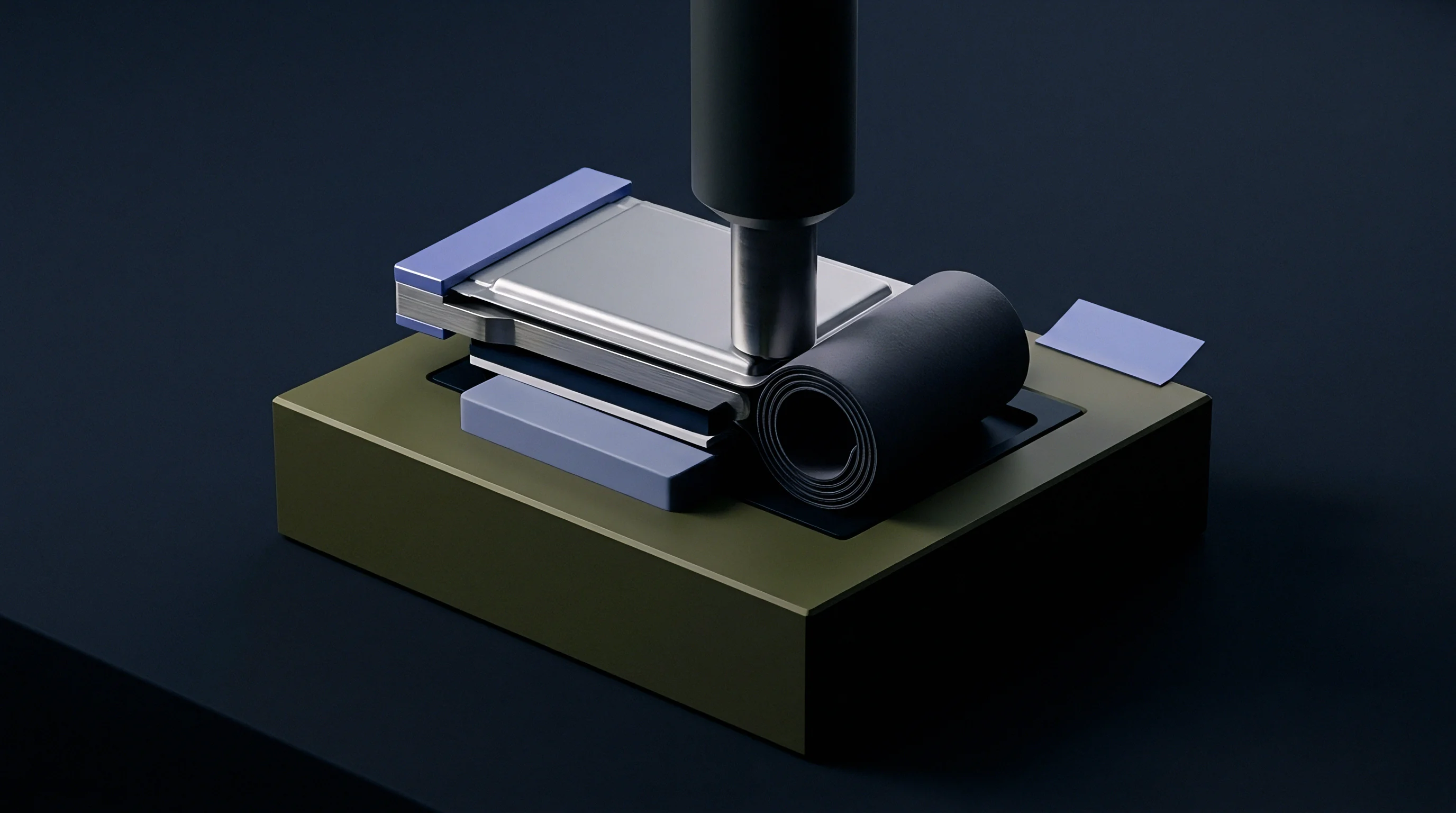
Can Sealing Temperature Alter Submicron Porosity Profiles?
Polymer morphology in the bond line sets channel cross-sections. Cast polypropylene is semi-crystalline, made of amorphous domains interwoven with rigid spherulites. Sealing jaw temperatures from 185 degrees Celsius to 205 degrees Celsius soften and flow these domains under pressures of 0.4 to 0.7 megapascals.
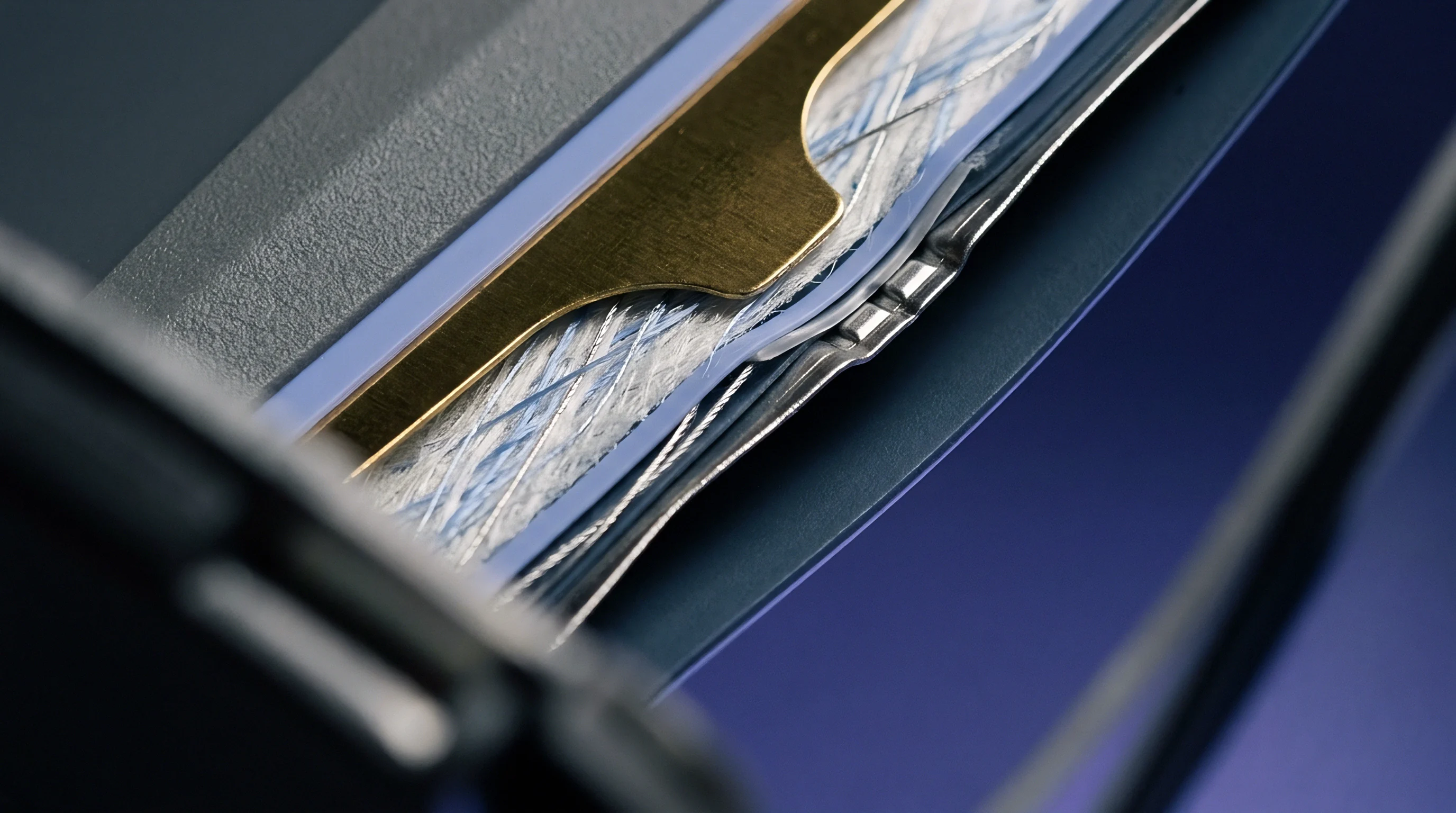
Temperature variations along long seal bars can drop local heat below the polymer melting peak, causing incomplete macromolecular interdiffusion. Amorphous chains then fail to bridge the interface, locking micro-cavities into the cross-section. Scanning electron microscopy of pouch cross-sections shows interconnected voids with equivalent diameters between 40 nanometers and 350 nanometers running parallel to the metal foil.
| Channel Diameter | Carrier Gas Specie | Knudsen Number | Dominant Kinetic Regime | Primary Flux Governor |
|---|---|---|---|---|
| 5.00 micrometers | H2O Vapor | 0.009 | Continuum Flow | Intermolecular collisions |
| 800 nanometers | H2O Vapor | 0.056 | Slip Flow Transition | Fluid wall friction slip |
| 250 nanometers | H2O Vapor | 0.180 | Transitional Knudsen | Mixed wall and gas collision |
| 45 nanometers | H2O Vapor | 1.000 | Knudsen Diffusion | Polymer wall reflection rate |
| 250 nanometers | Dimethyl Carbonate | 0.128 | Transitional Knudsen | Vapor molecular mass drag |
| 30 nanometers | Dimethyl Carbonate | 1.066 | Knudsen Diffusion | Channel wall surface scattering |
The geometry around tab seals introduces complex boundary conditions. Current collector tabs use solid copper or aluminum strips wrapped in maleic anhydride-grafted polypropylene sealant film. Tab edges create step heights of 100 to 200 micrometers that molten polymer must backfill while the tool closes.
Short dwell times leave triangular cusp voids along the tab shoulders. These micro-crevices form channels extending up to several centimeters long, tapering down into sub-micron widths. Within these tapered pathways, gas transport experiences a continuously shifting Knudsen number, altering local mass transfer along the channel length.

What Governs Tortuosity across Seal Geometries?
Geometric channel length is rarely the effective transport distance. Microchannels take winding paths around crystalline spherulites and internal particulate fillers. In properly consolidated polypropylene films, tortuosity ~ the ratio of actual path length to straight-line seal width ~ ranges from 1.5 to 4.2.
In poorly fused seals, delamination creates flat, direct channels where tortuosity drops close to 1. That collapse increases molecular transmission by several hundred percent, even if total void volume stays constant.
- Channel hydraulic radius sets the collision frequency between diffusing vapor molecules and polypropylene wall boundaries, determining the Knudsen transport coefficient.
- Polymer spherulite size dictates the turning angle of capillary paths, where larger spherulites lengthen the transport path across the seal.
- Tab tape blending zones produce local shear stresses that pull sealant tape away from metal surfaces as the cell cools.
- Mechanical cell packaging applies compressive force around the perimeter, squeezing microchannel diameters down and driving transport toward the Knudsen regime.
External packaging loads alter internal void networks over a cell’s operating life. Anode swelling during lithiation exerts outward hydraulic pressure against cell borders. This stress pulls at the inner seal margin, opening craze lines in the polypropylene meniscus.
Solvent vapors enter the expanded cavities, dissolving low-molecular-weight oligomers and opening continuous channels with submicron throats.
Early electrolyte odor near degassing pockets reflects perimeter boundary leakage rather than harmless surface wetting.

Flux
Governing Equations of Microchannel Transport
Quantifying mass flux mathematically requires separating continuum flow from Knudsen diffusion. In continuum mechanics, gas moving through a microchannel of hydraulic diameter d follows Fickian principles modified by Poiseuille flow under pressure gradients. Knudsen diffusion depends instead on kinetic gas theory, with its diffusion coefficient D_k calculated directly from channel diameter and mean molecular velocity:
D_k = (d / 3) sqrt((8 R T) / (pi M))
Here R is the universal gas constant, T is absolute temperature, and M is the molecular weight of the migrating species. The molecular velocity term shows why lighter gases move much faster through Knudsen capillaries. Water vapor, with a molecular mass of 18 grams per mole, reaches a mean thermal speed over 590 meters per second at room temperature.
By comparison, dimethyl carbonate (molecular weight 90 grams per mole) averages roughly 265 meters per second under the same conditions.
Knudsen mass flux scales inversely with the square root of molecular weight, granting rapid passage to atmospheric moisture over heavy electrolyte solvents.
Calculating actual transport rates through porous media accounts for porosity, epsilon, and tortuosity, tau. The effective Knudsen diffusion coefficient, D_k,eff, is given by:
D_k,eff = (epsilon / tau) D_k
Total molar flux, J, driven across seal path length L by a partial pressure difference delta_P across the boundary is:
J = (D_k,eff / (R T)) (delta_P / L)
Under pure Knudsen conditions, total cell pressure does not govern the diffusion coefficient. The driving force is strictly the partial pressure differential of each individual gas component. Outside the cell, air at 50 percent relative humidity and 25 degrees Celsius exerts a water vapor partial pressure of roughly 1.58 kilopascals.
Inside an assembled lithium-ion cell, moisture content is typically below 20 parts per million, keeping internal water vapor partial pressure near zero. This sharp gradient persists across the seal width, driving moisture inward regardless of overall cell pressure.
| Capillary Diameter | Channel Length | Knudsen Coefficient | Daily Ingress Flux | Annual Cell Moisture Gain |
|---|---|---|---|---|
| 20 nanometers | 4.0 millimeters | 3.95e-6 m2/s | 1.48e-9 mol/m2 s | 0.08 milligrams |
| 50 nanometers | 4.0 millimeters | 9.88e-6 m2/s | 3.71e-9 mol/m2 s | 0.21 milligrams |
| 100 nanometers | 4.0 millimeters | 1.97e-5 m2/s | 7.42e-9 mol/m2 s | 0.43 milligrams |
| 250 nanometers | 4.0 millimeters | 4.94e-5 m2/s | 1.85e-8 mol/m2 s | 1.08 milligrams |
| 500 nanometers | 4.0 millimeters | 9.88e-5 m2/s | 3.71e-8 mol/m2 s | 2.16 milligrams |

Worked Calculation of Water Influx and Solvent Depletion
Consider an 80-ampere-hour grid storage pouch cell with a seal perimeter of 0.8 meters, average seal path length L of 4.0 millimeters, and 240 grams of internal electrolyte containing lithium hexafluorophosphate salt. If incoming inspection misses a thermal sealing cold spot that leaves a collective defect cross-section of 2.0e-10 square meters ~ averaged across 100-nanometer hydraulic diameter channels ~ and tortuosity through the semi-crystalline polypropylene is 2.5:
Applying the effective Knudsen diffusion equation at 298 Kelvin gives a water vapor diffusion coefficient of 7.88e-6 square meters per second across the defect zone. Driven by an ambient external water partial pressure of 1.58 kilopascals, flux through this cross-section generates an ingress rate of 1.25e-11 moles per second. Over 365 days of storage, total water ingress through these submicron channels reaches 3.94e-4 moles ~ about 7.1 milligrams of liquid water entering the cell.
In lithium hexafluorophosphate electrolytes, water reacts quickly to form hydrofluoric acid. This moisture volume pushes internal contamination from an initial 15 parts per million to over 44 parts per million, degrading the solid electrolyte interphase, dissolving cathode manganese, and causing significant capacity loss before commissioning.
Organic solvents evaporate outward through the same channels. Inside the sealed cell, dimethyl carbonate maintains a saturation vapor pressure near 7.3 kilopascals at 25 degrees Celsius, while external air contains no solvent vapor. This outward partial pressure gradient drives steady solvent loss.
Because dimethyl carbonate has a higher molecular mass than water, its Knudsen diffusion coefficient drops to 3.52e-6 square meters per second for the same geometry. However, the high internal vapor pressure gradient compensates for the slower diffusion rate, driving steady outward loss. The resulting electrolyte dry-out raises internal cell impedance, dries separator pores, and increases interfacial polarization resistance across the electrodes.
Proof
Helium Mass Spectrometry Resolution Limits
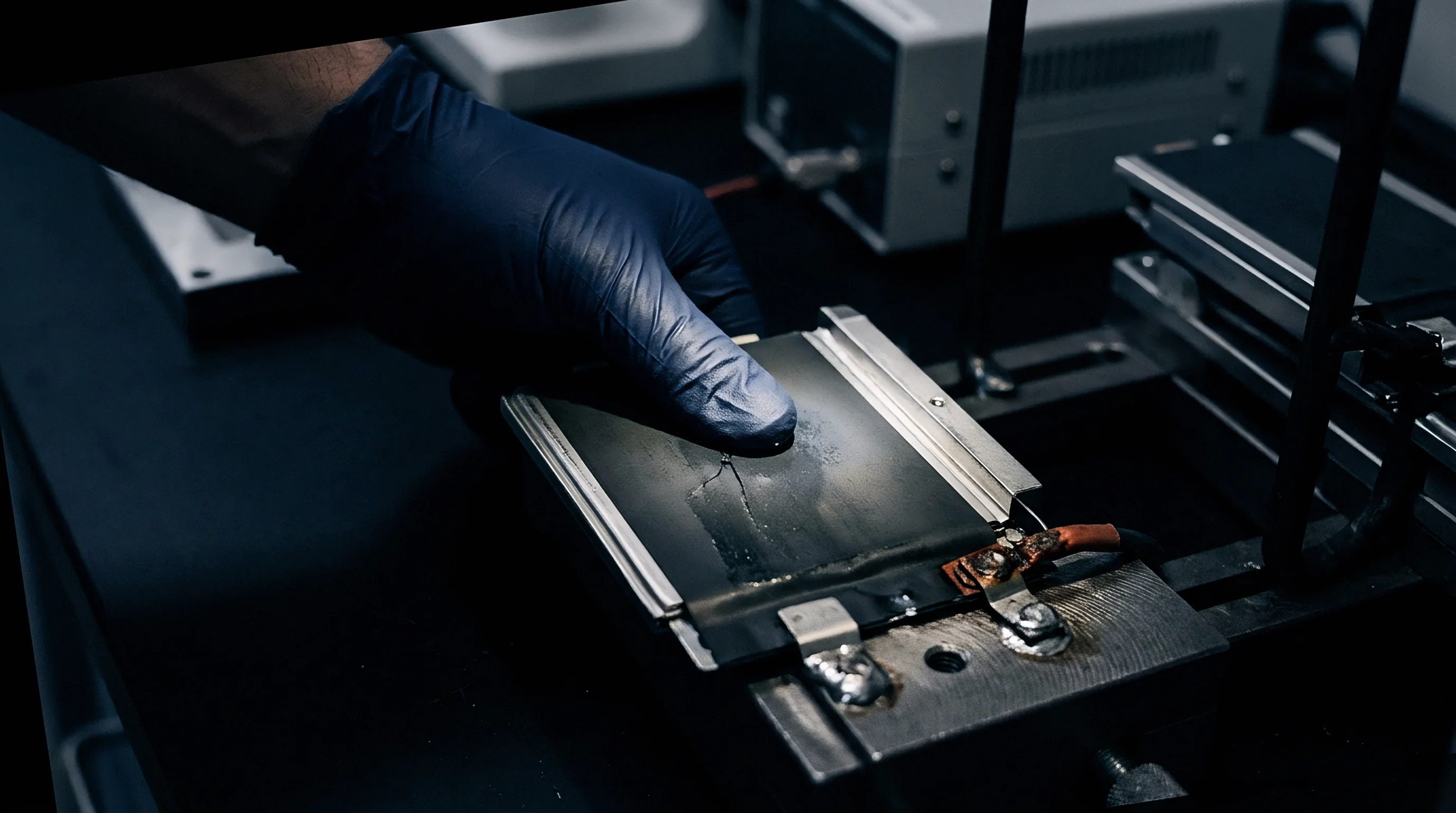
Verifying seal integrity on high-volume production lines poses major practical challenges. Standard screening uses vacuum-chamber helium mass spectrometry based on ASTM E499 or MIL-STD-888. A completed cell goes into an evacuation chamber, drops to a high vacuum below 1.0 pascal, and is monitored for tracer gas release.
But testing pouch cells this way creates physical artifacts: under external vacuum, the flexible pouch walls balloon outward, pinching the perimeter seals against internal tooling fixtures and artificially narrowing defect channels.
Helium’s molecular mass of 4 grams per mole gives it a thermal velocity over 1,250 meters per second at 298 Kelvin. At 10 pascals chamber pressure, its mean free path reaches hundreds of micrometers, pushing gas transit deep into the Knudsen regime inside seal microchannels. But helium leak testing fails to capture chemical adsorption behavior relevant to moisture ingress.
Water molecules bind strongly to polar groups and surface impurities on channel walls through hydrogen bonding, whereas inert monatomic helium passes through unhindered. As a result, a cell with a passing helium leak rate of 1.0e-8 standard cubic centimeters per second can still suffer significant moisture ingress in humid air through capillary condensation within pore networks.
ASTM F1249 water vapor transmission testing provides empirical permeation data that vacuum-based helium mass spectrometry cannot duplicate.
Direct water vapor transmission testing follows ASTM F1249 or ASTM E96, clamping excised polymer seal samples between wet and dry chambers to track moisture accumulation with infrared sensors. Because cutting out seal samples destroys the pouch, this method cannot be used for non-destructive inspection of production cells. Instead, quality assurance teams rely on full-cell type-testing curves combined with calibrated thermal imaging maps of edge seal temperature during sealing.
Regulatory transport testing under UN 38.3 places severe mechanical stress on perimeter seals. Altitude simulation (Test T.1) holds charged cells at an ambient pressure of 11.6 kilopascals for at least six hours at 20 degrees Celsius. Under these conditions, normal inward pressure gradients vanish.
High internal solvent vapor pressure pushes against the low chamber pressure, creating an internal differential that inflates the pouch envelope.
| Test Protocol | Targeted Physical Defect | Primary Measurement Principle | Lower Detection Bound |
|---|---|---|---|
| ASTM F1249 | Polymer moisture permeability | Infrared sensor on dry chamber sweep | 0.005 g/m2 day |
| UN 38.3 Test T.1 | Gross seal split and burst defect | Mass loss and visual envelope inspection | 0.1 percent mass delta |
| IEC 62133-2 7.3.2 | Thermal expansion void dilation | High-temperature envelope creep hold | No venting or leakage |
| Vacuum Helium Sniffing | Microchannel capillary defects | Quadrupole mass spectrometry | 1.0e-9 mbar l/s |
| Electrolyte VOC Sniffing | Solvent seal permeation | Photoionization detector array | 0.5 ppm VOC vapor |
Environmental Stress Dilation in Transit
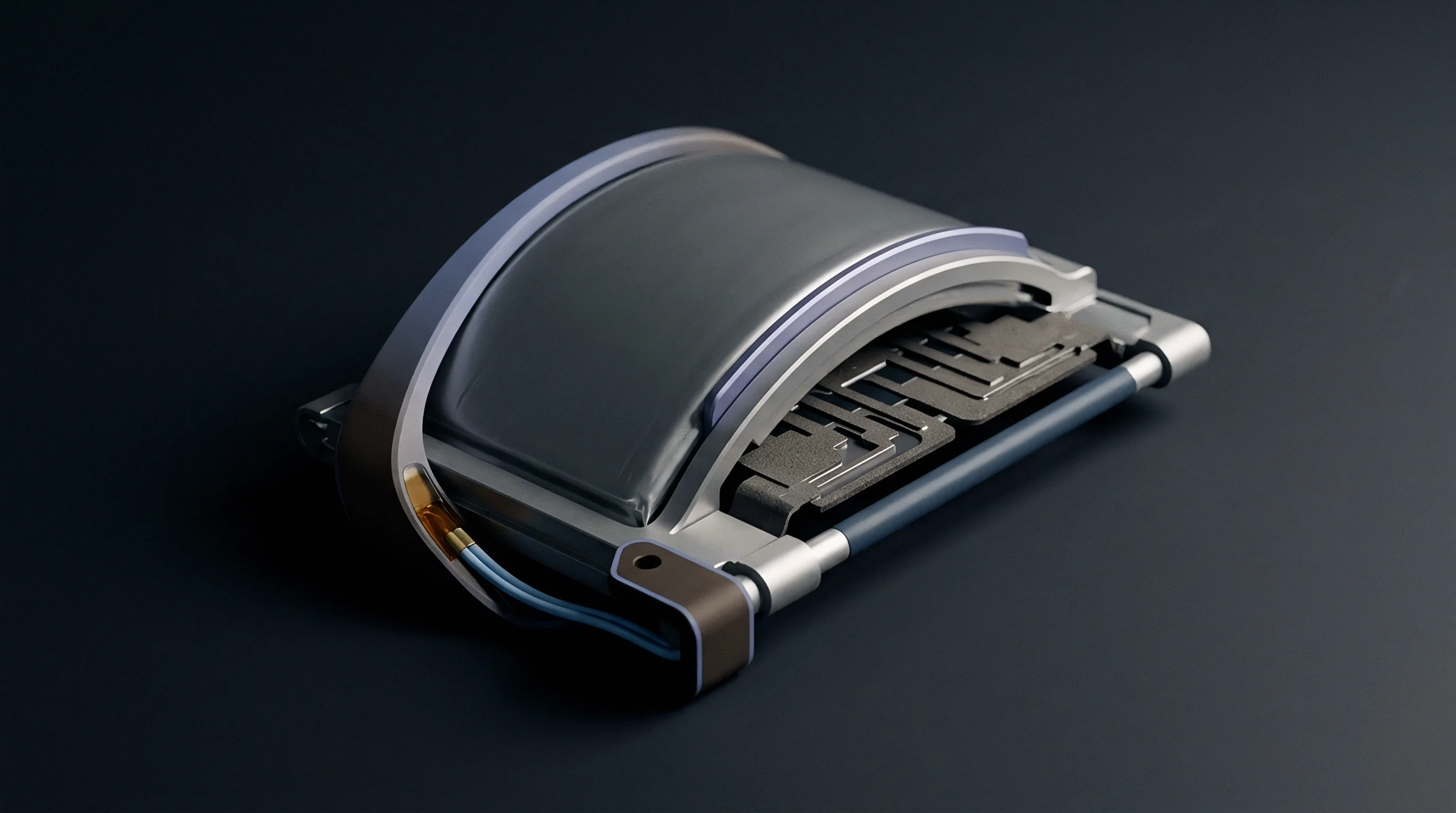
Subsequent UN 38.3 testing ~ specifically Test T.4 (shock) and Test T.5 (external short circuit) ~ further expands micro-fissures in the seal. Rapid heating during short-circuit tests can push cell temperatures to 55 degrees Celsius or higher within minutes, sharply raising solvent vapor pressure. Polypropylene loses stiffness as it heats, lowering the seal’s yield strength.
Under this mechanical stress, submicron pores widen, shifting transport from Knudsen diffusion toward transitional slip flow.
IEC 62133-2 clause 7.3.2 tests thermal endurance by placing fully charged cells in circulating air ovens at 70 degrees Celsius for seven hours. At this temperature, internal dimethyl carbonate partial pressure doubles, widening existing micro-voids. If quality checks rely only on visual inspection rather than mass measurement to three decimal places, slow solvent loss through Knudsen capillaries goes unnoticed, allowing compromised cells to reach field deployment.
Tier-one cell procurement contracts often stipulate that mass loss exceeding 0.05 percent over thirty days at 45 degrees Celsius rejects the lot, shifting return freight costs back to the cell manufacturer.


Settlement
Commercial Consequences of Latent Hermeticity Failures
When submicron channels allow persistent Knudsen-driven mass transport, performance issues often surface months after delivery. Sourcing teams managing utility or industrial storage projects frequently deal with the financial consequences of leaky seals. Cells deployed in humid containerized systems absorb water vapor through seal micro-defects.
Breakdown of electrolyte components generates gas, swelling pouches, warping module housings, and driving early capacity imbalance across series-connected cell strings.
Energy storage warranties typically guarantee 70 to 80 percent capacity retention over 10 to 15 years. Knudsen-driven moisture ingress undermines those projections. An ingress rate of just two milligrams of water per year consumes active lithium through irreversible side reactions.
The resulting capacity loss breaks performance models, sparking disputes between asset owners and cell suppliers over whether degradation stems from duty cycles or factory seal defects. Without detailed sealing bar temperature logs and lot leak testing records, buyers face an uphill battle proving manufacturing flaws.
- Incoming lot sampling audits flag weak seal batches before assembly by performing high-sensitivity electrolyte sniff tests on vacuum-desiccated sample groups.
- Batch temperature log verification checks that sealing heads stayed within plus-or-minus two degrees Celsius across the full bar length during tab bonding.
- Accelerated shelf storage screens isolate suspect cells at 85 degrees Celsius and 85 percent relative humidity for 14 days to confirm mass stability before pack integration.
- In-line machine vision verification inspects every seal perimeter for polymer flash variations, micro-wrinkles, and uneven squeeze-out along tab shoulders.
Insurers for grid-scale energy storage systems increasingly exclude losses tied to packaging or envelope failure. Underwriters inspect failure modes closely, distinguishing thermal runaway caused by internal short circuits from fires triggered by electrolyte leakage and external arc flashover. When teardowns reveal dried-out separators near tab seals, insurers frequently deny coverage under defective manufacturing exemptions.

Legal Allocation of Degradation Exposure
Supply contracts dictate financial recovery when hidden seal defects compromise cell shipments. Standard terms typically cap vendor liability at cell replacement, leaving buyers to absorb field labor, teardown costs, and module re-certification. Experienced buyers reject standard liability caps, linking warranty remedies directly to micro-defect criteria and specifying allowable channel thresholds by water vapor ingress rates rather than gross burst pressure.
Contracts often shift warranty liability back to the cell manufacturer when field data shows rising internal impedance without corresponding thermal spikes. Modern battery management systems track individual cell impedance continuously. A sharp, isolated jump in charge transfer resistance without cycling anomalies points directly to electrolyte dry-out or salt decomposition caused by seal leakage.
Explicitly defining these operational indicators in supply agreements keeps vendors accountable to performance guarantees.
Recall expenses mount quickly when field failures force broad replacements. Swapping degraded pouch cells out of automotive packs or containerized utility storage requires extensive labor, certified shipping containers for damaged cells, and complex hazardous material permits. Buyers protect capital reserves by requiring suppliers to post escrow performance bonds or hold contamination insurance covering latent seal degradation over the full warranty period.
Whether non-destructive inspection can reliably catch 50-nanometer tab channel defects on automated lines running at 60 parts per minute remains an open engineering challenge.