Quantifying Solvent Vapor Exposure Profiles in Sealed Lithium Cells
Solvent vapor quantification via thermal pre-conditioning and GC-MS headspace screening prevents dangerous goods freight rejection and isolates cell micro-leaks before pack assembly.
Leak
The liquid electrolyte in sealed lithium-ion cells is typically a mixture of volatile linear carbonates, cyclic carbonates, and fluorinated lithium salts. When mechanical shock, thermal loading, or manufacturing flaws compromise a pouch seal, laser seam, or crimp header, those organic solvents evaporate into ambient air. The rate of vapor loss depends on solvent partial pressures, the geometry of the leak path, the seal material, and temperature.
Quantifying these trace emissions over extended storage requires analytical instruments capable of isolating microgram-level organic fractions from ambient air.
Cell headers are either laser-welded or cold-crimped over elastomeric grommets. In cylindrical formats such as 18650s and 21700s, the cap assembly integrates a positive temperature coefficient ring, a current interrupt device, and a safety vent disk resting against a polyfluoroelastomer or polypropylene gasket. The seal relies entirely on sustained gasket compression.
When compression drops below thirty percent of nominal design thickness, micro-channels form across the metal-polymer interface, allowing low molecular weight solvents to diffuse out even at room temperature.
Linear alkyl carbonates, predominantly dimethyl carbonate and ethyl methyl carbonate, have substantial vapor pressures under ambient conditions. Dimethyl carbonate exceeds 5.3 kilopascals at 20 degrees Celsius, making it the most volatile constituent in standard formulations. Ethyl methyl carbonate reaches roughly 3.6 kilopascals at the same temperature.
Cyclic carbonates like ethylene carbonate and propylene carbonate have negligible vapor pressures by comparison and stay liquid unless local temperatures exceed 80 degrees Celsius. Initial vapor plumes from compromised seals are therefore composed almost entirely of linear carbonates.

Electrolyte Volatility and Vapor Pressure Dynamics
Internal cell heating drives up internal pressure and accelerates solvent evaporation. Within an intact cell, the electrolyte held in the microporous polyolefin separator exists in equilibrium with the headspace vapor above the electrode stack. Total internal partial pressure corresponds to the combined solvent partial pressures calculated through extended Raoult’s law, corrected for activity coefficients in concentrated salt solutions.
Dissolving one molar lithium hexafluorophosphate lowers vapor pressure slightly via ion-solvent coordination complexes, yet linear carbonates still vaporize readily once containment fails.
Pressure differentials between the cell interior and ambient surroundings govern mass transport through microscopic pathways. Knudsen diffusion predominates in micro-channels between ten nanometers and one micrometer in diameter, where solvent molecules collide more frequently with channel walls than with one another. Above ten micrometers, Poiseuille viscous flow governs transport, resulting in rapid solvent loss that registers on standard gravimetric balances during short test intervals.
Measuring mass loss under vacuum or during a helium purge yields empirical leak rates expressed in standard cubic centimeters per second of equivalent helium.
| Solvent Compound | Molecular Mass (g/mol) | Boiling Point (°C) | Vapor Pressure at 25°C (kPa) | Air Diffusion Constant (cm²/s) |
|---|---|---|---|---|
| Dimethyl Carbonate (DMC) | 90.08 | 90.1 | 7.52 | 0.098 |
| Ethyl Methyl Carbonate (EMC) | 104.10 | 107.5 | 3.85 | 0.084 |
| Diethyl Carbonate (DEC) | 118.13 | 126.0 | 1.44 | 0.073 |
| Ethylene Carbonate (EC) | 88.06 | 244.0 | 0.001 | 0.102 |
| Propylene Carbonate (PC) | 102.09 | 242.0 | 0.004 | 0.087 |
Vapor emission accelerates sharply as cell temperatures approach upper operational boundaries. Shifting ambient temperature from 25 degrees Celsius to 60 degrees Celsius drives dimethyl carbonate vapor pressure up by more than four hundred percent, reaching nearly 32 kilopascals. Under these thermal loads, sub-micron flaws in laser welds release enough solvent to form flammable and toxic atmospheres inside enclosed packs.
Extended high-temperature storage trials tracking solvent loss are standard protocol during cell qualification for automotive and grid applications.
Hermeticity Thresholds in Crimp and Weld Interfaces
Welded aluminum pouch tabs and hard-case prismatic header seams must maintain helium leak rates below 10 to the power of minus seven standard cubic centimeters per second across a ten-year operational lifespan. This threshold keeps cumulative solvent loss under two percent of the total initial electrolyte charge. Exceeding five percent solvent loss results in dry separator zones, rapid impedance growth, severe lithium plating during low-temperature charging, and eventual thermal instability.
Helium mass spectrometry verifies empty cell cans on the production line, while hydrocarbon sniffing or high-precision gravimetric tracking is required for filled, active cells.
Pouch cells rely on multi-layer laminated foil bonded by an inner polymer layer around an aluminum moisture barrier. Thermal sealing fuses the inner polypropylene layers within narrow temperature, pressure, and dwell tolerances. Insufficient sealing creates micro-voids or thinned margins in the seam, generating permeable channels where linear carbonates dissolve and migrate outwards.
As the seal polymer absorbs solvent, it plasticizes and swells, lowering bond strength through repeated thermal cycles between minus 40 degrees Celsius and plus 85 degrees Celsius.
Visual checks and standard pressure-decay methods routinely miss low-rate micro-leaks. A crimp header losing solvent vapor at 10 to the power of minus five millibar liters per second leaves no liquid residue on the cell cap because the solvent evaporates faster than it can pool. Sniffer systems running flame ionization detectors or mass spectrometers calibrated for organic solvents identify these micro-leaks by drawing air from an isolated shroud placed directly over the header.
Standard helium mass spectrometry leak rates below ten to the minus seven standard cubic centimeters per second keep solvent mass loss under two percent over ten years of storage.
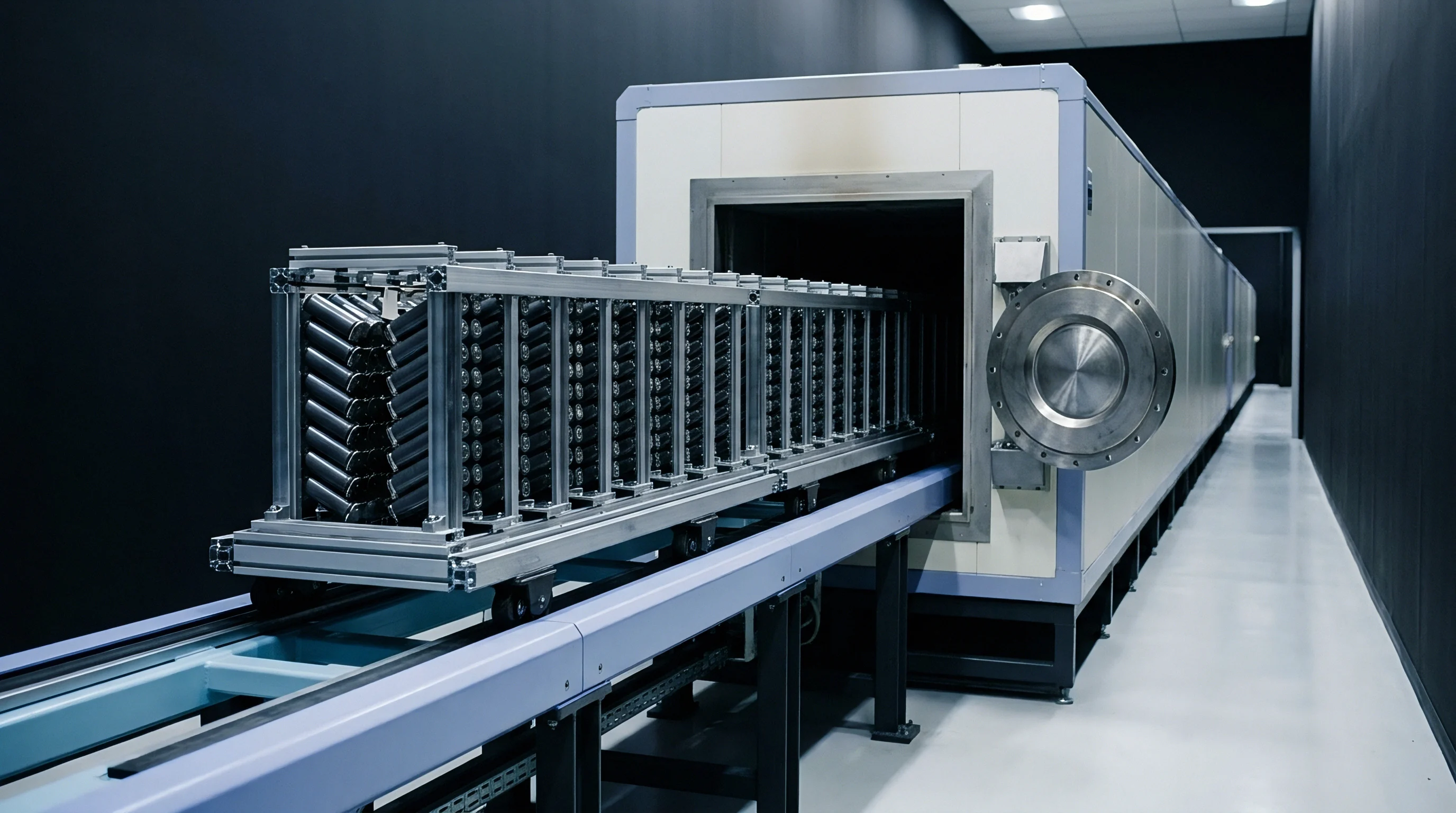
Pack assembly plants often screen incoming lots by tracking mass loss during thermal pre-conditioning. Storing cell lots inside dry rooms held at 45 degrees Celsius and a minus 40 degrees Celsius dewpoint for 72 hours allows micro-balances to register mass changes as low as 0.1 milligrams. A loss exceeding 0.5 milligrams over this window points to micro-channel defects in crimps or header welds.
Micro-gram balance checks inside controlled low-humidity enclosures isolate early header seal delamination in incoming prismatic lots before cells reach module assembly.

Quantification Methodology Comparison
Characterizing solvent vapors requires analytical instruments calibrated specifically for organic carbonates. Flame Ionization Detection offers high sensitivity to carbon-containing species, making it suitable for inline screening of total volatile organic carbon in test chambers. Gas Chromatography-Mass Spectrometry isolates individual solvent components to determine exact molar ratios of DMC, EMC, and DEC in released vapors.
Fourier-Transform Infrared Spectroscopy enables continuous optical monitoring without consuming or altering the gas stream.
Gas chromatography systems fitted with headspace samplers separate solvents outgassed into sealed vials. After a leaking cell is soaked at a controlled temperature within an enclosed vessel, an automated valve injects a fixed headspace volume into a capillary column coated with fluorosilicone or polyethylene glycol. Compounds elute by boiling point and polarity, producing distinct chromatographic peaks for DMC, EMC, DEC, and additive fragments like vinylene carbonate or fluoroethylene carbonate.
Integrating these peak areas against reference gas standards yields precise solvent mass calculations down to nanogram levels.
Fourier-transform infrared instruments track organic carbonates through characteristic carbon-oxygen and carbon-hydrogen vibrational modes. Dimethyl carbonate exhibits strong carbonyl absorption near 1750 inverse centimeters and ester C-O single-bond stretching around 1280 inverse centimeters. Multipass gas cells with optical path lengths up to ten meters detect solvent vapors down to parts-per-million levels in continuous flow setups.
Because optical measurement is non-destructive, it provides continuous concentration profiles during dynamic thermal or mechanical testing.
- Flame Ionization Sensor Integration tracks total volatile hydrocarbon levels continuously without separating species, giving instant micro-gram loss warnings during automated screening.
- Capillary Gas Chromatography Calibration resolves complex solvent mixtures into distinct constituents, allowing precise molar ratio calculations for volatile carbonates escaping through micro-fissures.
- Multipass Infrared Spectroscopy tracks fast shifts in vapor concentration using optical absorption bands, avoiding sampling delays during dynamic environmental testing.
- Helium Mass Spectrometry Verification checks dry cell enclosure tightness before filling, setting baseline mechanical seal performance before solvents enter the cell.
Selecting an analytical method involves balancing throughput, instrument capital costs, and required detection limits. Inline flame ionization detectors offer the speed and low running costs needed for high-volume lines. Root-cause laboratories rely on GC-MS to confirm whether detected volatile organics originate from electrolyte venting or residual manufacturing agents like degreasers and wash solvents.
Background VOC levels on the plant floor must also be established before setting hermeticity rejection limits.
Leak path geometry determines whether electrolyte escapes as dry vapor or as a mixed liquid-vapor discharge. When micro-cracks along laser weld seams exceed 50 micrometers, capillary forces draw liquid electrolyte into the gap, where shear stress and vapor bubbling lead to intermittent fluid spitting. This liquid leakage leaves a white salt ring on the cap as volatile solvents evaporate.
Moisture in the air reacts with residual LiPF6 to form hydrofluoric acid, which attacks aluminum header structures, degrades seals, and generates hazardous off-gases.
Visual inspection fails to reveal internal fissures. Micro-CT X-ray tomography non-destructively maps internal header features, including tab-to-terminal weld alignment, safety vent curvature, and gasket compression uniformity. Correlating these internal structural scans with measured solvent emission rates gives development teams the physical data needed to adjust weld parameters and crimp profiles.
High-resolution CT scans resolve internal voids down to two micrometers, tying physical defects directly to measured mass loss.
Elastomeric seals degrade over time when exposed to organic carbonates and dissolved lithium salts. Fluorinated elastomers show high resistance to linear carbonates, whereas standard ethylene propylene diene monomer swells and softens after prolonged contact. Swelling expands the polymer matrix free volume, accelerating vapor permeation through the gasket over multi-year operational periods.
Seal qualification requires extended immersion and exposure testing at maximum operational temperatures to verify long-term material integrity.
Pouch cell tab feedthroughs introduce specific sealing challenges. Copper and aluminum tabs are pre-coated with polyolefin sealant films designed to fuse with the outer pouch laminate during heat sealing. Mismatched thermal expansion coefficients between the metal conductor and the polymer film create cyclic shear stress during heavy current pulses.
Over thousands of load cycles, micro-delaminations develop along tab edges, creating channels that vent linear carbonate vapors into module enclosures.
Cells stored in non-climate-controlled warehouses experience internal pressure swings driven by diurnal temperature cycles. Day-to-night temperature changes shift internal vapor pressures, causing pouch walls or cap vent disks to flex in a continuous breathing cycle. This breathing action expels small bursts of solvent vapor through sub-micron flaws and draws in ambient moisture during cooling periods.
Over months, ingress of atmospheric moisture degrades electrolyte chemistry while continuous solvent loss cuts rate capability and usable capacity.
A reliable operational baseline applies to cell qualification: any crimped cell exhibiting mass loss above zero point three milligrams after seventy-two hours at forty-five degrees Celsius will vent volatile linear carbonates over its service life in a battery pack.

Chamber
Environmental testing of sealed lithium-ion cells requires specialized chambers engineered to isolate, capture, and quantify trace solvent vapors under controlled thermal profiles. These test enclosures use non-sorptive internal surfaces, typically polished 316L stainless steel or optical quartz, to prevent organic carbonates from sticking to chamber walls. Precise mass flow controls, temperature stability within plus or minus 0.1 degrees Celsius, and dry nitrogen or zero-air purges ensure background volatile organic compounds do not compromise extended test runs.
Gas sampling follows either a continuous sweep or a closed-loop collection architecture, depending on target sensitivity. Continuous sweep configurations route certified zero-grade air or ultra-high-purity nitrogen over the cell at fixed mass flow rates, carrying outgassed components directly to downstream sensors. Dilution ratios require careful balancing so solvent concentrations stay within detector linear ranges without falling below detection floors.
Closed-loop chambers accumulate vapors over defined dwell periods, concentrating trace emissions down to sub-parts-per-billion levels.
Temperature regulation in test channels relies on indirect heating to eliminate localized hot spots on cell casings. Heated conductive jacket blocks or laminar air distribution manifolds deliver uniform heat across the entire cell surface. Maintaining uniform casing temperatures prevents artificial vapor pressure spikes and eliminates mechanical distortion at seal joints.
Surface thermocouple arrays monitor thermal consistency across pouch surfaces, prismatic casings, and cylindrical headers throughout the test cycle.

Environmental Test Channel Instrumentation Setup
Precision test channels incorporate multi-stage gas conditioning assemblies upstream of analytical detectors. Sub-zero cold traps drop out atmospheric moisture while keeping linear carbonate vapors in the gas phase. Eliminating moisture protects GC stationary phases from water degradation and prevents hydrofluoric acid synthesis in sample lines.
Dynamic pressure transducers register micro-bar pressure fluctuations, marking transient gas emissions from micro-venting or seal flexure.
Chambers require comprehensive blank validation before loading test cells. Cycling the empty enclosure through complete thermal and pressure profiles establishes a verified background signal. Baseline VOC concentrations must remain below five parts per billion total carbon equivalent to avoid false positive leak indications.
Calibration relies on certified gas mixtures with known concentrations of dimethyl carbonate, ethyl methyl carbonate, and diethyl carbonate delivered through mass flow controllers.
- Purge the test enclosure with ultra-high purity nitrogen at two liters per minute for sixty minutes to clear residual VOCs from internal surfaces.
- Run an empty chamber baseline thermal sweep from minus twenty degrees Celsius to plus eighty5 degrees Celsius while recording photoionization detector signal stability.
- Mount cell specimens in non-sorptive fluoropolymer fixtures, keeping contact area against cell headers or pouch seams to a minimum.
- Seal test channel manifolds and hold a static vacuum at ten kilopascals absolute pressure for fifteen minutes to confirm external seal integrity.
- Start the programmed thermal and electrical load profile while continuously recording solvent vapor concentrations, flow rates, and surface temperatures.
- Extract headspace gas samples at peak thermal hold plateaus using automated glass syringe loops for offline gas chromatography.
- Flush the chamber with high-purity dry air after testing to clear residual organic carbonate absorption before evaluating the next lot.
Automated multi-port sampling valves periodically divert gas streams into sorbent traps packed with Tenax TA or carboxen matrices. These sorbent beds concentrate linear carbonate vapors at ambient or sub-ambient temperatures. Rapid thermal desorption then flashes the collected analytes directly onto capillary GC columns, creating sharp injection profiles that improve analytical sensitivity by orders of magnitude compared to standard gas loop injections.

When Does Micro-Venting Trigger Freight Forwarder Rejection?
Dangerous goods inspectors and freight handlers use handheld or inline photoionization detectors during cargo staging. When organic vapor readings within packed pallets or freight containers exceed twenty parts per million total volatile organic carbon, cargo acceptance is refused immediately. Rejection halts shipment movement, triggers mandatory hazmat inspections, and requires complete batch recertification before air or maritime transport can proceed.
Micro-venting occurs when internal cell pressure briefly exceeds safety vent seating limits or deforms elastomeric crimps without progressing to full thermal runaway. Thermal expansion of gas, rapid solvent vaporization, and cathode decomposition reactions elevate internal cell pressure during warm transit holds. Once local pressure surpasses the vent seating threshold, solvent vapor escapes past the gasket until the pressure normalizes and the vent reseats.
| Sensor Technology | Target Species | Lower Detection Limit | Response Time (t90) | Primary Application |
|---|---|---|---|---|
| Photoionization Detector (PID) | Total Volatile Organics | 0.1 ppm | < 2 seconds | Continuous Inline Screening |
| Capillary GC-MS | Specific Carbonate Species | 0.01 ppb | 10 to 30 minutes | Laboratory Root Cause Analysis |
| FTIR Gas Cell | Organic Carbonates & HF | 0.5 ppm | < 5 seconds | Multi-Gas Dynamic Monitoring |
| Cavity Ring-Down (CRDS) | Trace Organic Vapors | 0.001 ppm | < 1 second | High-Precision Leak Benchmark |
Identifying micro-venting during pre-flight staging classifies the cargo as compromised under international dangerous goods protocols. Cells exhibiting off-gassing cannot be transported on passenger or cargo aircraft under IATA Dangerous Goods Regulations Packing Instruction 965. Elevated VOC readings are recorded as packaging non-compliance, resulting in immediate transfer of pallets to fire-rated containment zones at cargo facilities.
Headspace Gas Sampling and Flame Ionization Calibration
Calibrating flame ionization detectors for linear carbonates requires compound-specific response factors. In an FID, organic molecules burn in a hydrogen-air flame, producing carbon ions that migrate to a biased collector plate. The resulting ion current is proportional to the number of reduced carbon atoms entering the flame.
Carbonyl carbons, such as the central carbon in dimethyl carbonate, yield lower ionization responses than hydrocarbon carbons, making empirical response factor corrections essential for converting raw ion currents into accurate solvent mass concentrations.
Cylinder-stored gas calibration standards for organic carbonates suffer from wall condensation and concentration drift over time. Accurate calibration requires dynamic vapor generation using certified glass diffusion tubes held at constant temperatures inside gravimetric ovens. Carrier gas flowing across the diffusion aperture at regulated rates delivers precise parts-per-million vapor concentrations.
Periodic gravimetric weighing of the diffusion tubes verifies mass output rates prior to instrument calibration.
Dynamic calibration using certified diffusion tubes generates reliable organic solvent vapor reference streams down to sub-parts-per-million concentrations.
Sample transfer lines must prevent solvent condensation and wall adsorption. Common tubing materials such as silicone, polyurethane, or standard PVC absorb linear carbonates, causing substantial chromatographic peak tailing and underreporting vapor concentrations. Headspace transfer systems require heated fluoropolymer (PTFE or PFA) or deactivated fused silica lines maintained above 80 degrees Celsius to prevent line loss.
Comprehensive qualification protocols test cells under simultaneous vibration and thermal profiles. Sinusoidal and random vibration profiles simulating transport under UN 38.3 Test 3 place mechanical stress on header welds and crimped joints. Continuous monitoring with fast-response photoionization detectors catches transient leaks caused by dynamic seal deformation under vibration peaks ~ flaws that remain undetected during static bench testing.
Testing pouch cell seals requires mechanical boundary conditions matching pack compression plates. Cells held under a continuous compressive load of 0.3 megapascals exhibit significantly lower solvent vapor release rates than unconstrained cells under identical thermal profiles. External compression supports the foil-polymer laminate, counteracting internal vapor pressures that cause micro-delaminations along heat-sealed margins.
Testing pouch cells without mechanical restraint produces elevated failure rates that do not reflect module-level performance.
Monitoring off-gassing during continuous charge-discharge cycling shows how solvent venting tracks operational state of charge. Charging to upper cutoff voltages accelerates electrolyte oxidation at cathode surfaces, generating carbon dioxide, carbon monoxide, and volatile alkyl carbonate degradation products. Gas accumulation elevates internal pressure, forcing solvent vapors through micro-defects.
Correlating vapor spikes with battery management system voltage and current logs identifies the exact electrochemical conditions triggering seal failure.
Processing software integrates raw sensor signals over time to calculate cumulative solvent loss in milligrams per cell. Comparing this cumulative loss to the initial electrolyte fill weight enables engineering teams to project thirty-six-month capacity degradation trends from a seven-day environmental chamber test. The direct correlation between early-stage solvent emissions and late-life cell impedance makes trace vapor measurement an effective accelerated life prediction tool.
Chamber safety systems initiate nitrogen purge routines when vapor concentrations reach twenty-five percent of the lower flammability limit. The purge floods the enclosure with inert gas while disconnecting all electrical loads to eliminate ignition risks. Intrinsically safe instrumentation and explosive-atmosphere safety interlocks protect testing facilities and operators during high-temperature abuse tests.
Trace solvent readings inside shipping crates can arise from either cell containment failure or residual surface contamination from factory wash stations.


Hazard
Bulk transport and warehouse storage of lithium-ion cells present significant fire and explosion hazards when solvent vapors accumulate in poorly ventilated spaces. Alkyl carbonate solvents have low flash points, low lower flammability limits, and wide explosive ranges in air. Dimethyl carbonate has a flash point of 18 degrees Celsius, categorizing it as a Class 3 flammable liquid under transport regulations.
When linear carbonate vapors accumulate in shipping containers or air freight unit load devices, standard cargo areas turn into hazardous spaces vulnerable to vapor cloud ignition.
The formation of explosive atmospheres depends on solvent lower flammability limits. Dimethyl carbonate reaches its lower flammability limit at approximately 4.22 percent by volume, or about 158 grams per cubic meter. Ethyl methyl carbonate reaches its limit near 3.10 percent by volume.
When leaking cells off-gas during long ocean voyages, solvent concentrations inside stretch-wrapped pallets can reach these thresholds, creating an ignition hazard when packaging is disturbed or opened.
Potential ignition sources in transit include electrostatic discharge from packaging films, friction sparks from pallet handling, and electrical arcing across exposed battery terminals. An electrostatic spark with energy below one millijoule is sufficient to ignite a flammable linear carbonate vapor-air mixture at room temperature. Vapor ignition within an enclosed space produces a rapid pressure spike, high flame speeds, and thermal shock that can trigger cascading thermal runaway across adjacent cells.

Flammability Limits and Vapor Phase Thermodynamics
Vapor phase thermodynamics determine flame propagation speeds and overpressures during an ignition event. Mixed solvent vapors containing DMC, EMC, and DEC follow Le Chatelier’s mixing rule, with the effective lower flammability limit determined by the mole fractions of the individual species. Non-condensable off-gases like methane, ethylene, and carbon monoxide released during cell venting further depress the lower flammability limit, increasing combustion risk even under partially depleted oxygen conditions.
High vapor densities cause organic carbonate gases to pool in low-lying, unventilated zones of warehouses and cargo holds. Dimethyl carbonate vapor is approximately 3.1 times denser than air, while ethyl methyl carbonate is nearly 3.6 times denser. Released solvent vapors migrate downward, collecting in floor trenches, lower pallet racks, and drainage sumps.
Local concentrations near floor level can exceed flammability limits even while overhead ventilation monitors register safe ambient levels.
| Chemical Name | Flash Point (°C) | Auto-Ignition Temp (°C) | Lower Flammability Limit (vol %) | Vapor Density (Air = 1.0) |
|---|---|---|---|---|
| Dimethyl Carbonate | 18.0 | 458 | 4.22 | 3.11 |
| Ethyl Methyl Carbonate | 23.0 | 440 | 3.10 | 3.59 |
| Diethyl Carbonate | 25.0 | 445 | 1.20 | 4.07 |
| Propylene Carbonate | 132.0 | 430 | 2.30 | 3.52 |
Organic solvent vapors auto-ignite when contacting surfaces at or above their auto-ignition thresholds without requiring an open spark. Linear carbonates have auto-ignition temperatures between 430 degrees Celsius and 460 degrees Celsius. When an individual cell enters thermal runaway and heats neighboring structural hardware past 500 degrees Celsius, vented solvent vapors auto-ignite on contact, generating torch flames that accelerate fire spread across the battery pack.

Transport Container Vapor Accumulation Models
Evaluating solvent vapor accumulation in intermodal shipping containers requires transport models incorporating cell leak distribution statistics, cargo packaging volume, and container air exchange rates. A standard 20-foot container holding 50,000 cylindrical cells behaves as a sealed volume, with passive air exchange rates often below 0.05 air changes per hour when ventilation ports are obstructed. If just zero point zero one percent of the cargo contains micro-leaks venting DMC at 0.1 milligrams per hour, total solvent concentration reaches flammable levels within 14 days of ocean transit.
Accumulation models treat container air space as either fully mixed or vertically stratified, depending on solar thermal gradients across the exterior hull. Solar radiation on container roofs establishes internal thermal stratification, trapping dense organic vapors in cooler lower cargo layers. Determining local concentrations requires solving coupled differential mass balances that incorporate temperature-dependent solvent evaporation, diffusion through packaging materials, and barometric breathing through container door seals.
- Initial Pallet Vapor Concentration Checks verify that VOC levels inside stretch-wrapped shipments remain below five percent of the lower flammability limit before loading.
- Active Venting Assessment calculates air exchange rates needed in cargo holds to prevent heavy solvent vapors from settling along lower deck plates.
- Thermal Profile Boundary Mapping identifies shipping routes where solar heating triggers solvent vapor pressure spikes inside sealed packaging.
- Inert Gas Packaging Qualification evaluates nitrogen-purged hermetic foil master bags for shielding bulk cell shipments from external ignition hazards.
Pallet packaging materials directly influence vapor accumulation rates. Encapsulating cell cartons in continuous polyethylene stretch wrap traps outgassed solvents inside the pallet perimeter, creating high local VOC concentrations around battery terminals. Utilizing perforated stretch wrap or breathable netting facilitates natural convective air exchange, preventing dangerous vapor build-up while maintaining pallet structural stability during transport.

Air Transport Refusal Thresholds and Off-Gas Precursors
Civil aviation authorities mandate strict concentration ceilings for volatile organic vapors in aircraft cargo compartments under UN Dangerous Goods regulations. Class E cargo holds on freighter aircraft rely on depressurization and low oxygen availability rather than active chemical suppression systems to control fires. Flammable carbonate vapors compromise depressurization fire control because the molecular structure of organic carbonates contains internal oxygen, allowing smoldering combustion to continue at reduced atmospheric pressures.
Airlines require vapor screening prior to loading palletized lithium-ion batteries onto freighter aircraft. Inspectors insert sampling probes through packaging film to draw air across photoionization detectors calibrated for dimethyl carbonate. Pallets exhibiting VOC concentrations above ten parts per million face immediate quarantine, mandatory depalletization, and formal dangerous goods rejection filings.
Staging bay sniffers detecting ethyl methyl carbonate levels at twenty-eight parts per million inside wrapped cartons triggered the rejection of three incoming cell pallets.
Pallet vapor concentrations exceeding ten parts per million total volatile organic carbon trigger mandatory dangerous goods rejection under civil aviation security directives.
Trace off-gassing serves as an early operational indicator of impending cell failure. Before safety vent disks rupture, mechanical stress, localized heating, or overcharge elevates internal cell pressure, driving micro-leaks of solvent vapor across header seals. Continuous VOC monitoring in enclosure exhaust lines provides battery management systems several minutes of warning prior to catastrophic cell venting, enabling emergency electrical isolation and the activation of thermal management systems.
Battery solvent vapors present chemical toxicity and workplace exposure risks for logistics and production staff. Dimethyl carbonate and ethyl methyl carbonate cause eye irritation, respiratory discomfort, and central nervous system depression at concentrations well below their flammability limits. The occupational exposure limit for dimethyl carbonate is typically set at 100 parts per million as an eight-hour time-weighted average.
Continuous VOC monitoring in receiving and storage bays ensures compliance with occupational health standards and protects personnel handling incoming shipments.
Responding to detected solvent leaks requires rapid isolation, thermal imaging, and physical containment. Responders entering contaminated areas must use self-contained breathing apparatus and non-sparking hand tools. Liquid electrolyte spills require cleanup with non-reactive sorbents like vermiculite or polypropylene pillows, followed by immediate transfer to sealed, carbon-filtered hazmat recovery drums.
Disposing of leaking cell batches requires adherence to hazardous waste regulations. Damaged cells releasing solvent vapors cannot be returned through standard freight networks without special dangerous goods permits, certified overpack drums, and hazardous waste documentation. Recycling facilities utilize vacuum shredding under an inert nitrogen blanket to reclaim organic carbonates and black mass metals without atmospheric emissions or dust explosion risks.
Under Section 5.2 of the UN Dangerous Goods Regulations, transport documentation must explicitly certify that packed cells show no evidence of solvent off-gassing or structural compromise prior to tender.

Tariff
The financial impact of solvent leaks across the battery supply chain extends far beyond scrap material costs. When incoming cell lots fail off-gas screening at ports of entry, importers face customs holds, regulatory fines, freight surcharges, and costly quarantine protocols. Determining total landed cost requires financial modeling that accounts for carrier penalties, third-party laboratory verification, assembly line downtime, and contractual recourse under supplier quality agreements.
Carrier penalties for transporting non-compliant off-gassing cargo can exceed fifty thousand dollars per container, alongside the revocation of preferred shipper status with major freight operators. Port terminal operators charge daily fees while suspect containers sit in specialized hazmat storage zones. Accrued logistics and quarantine expenses quickly surpass the purchase value of the cells, creating severe financial exposure when supply agreements lack clear liability transfer terms.
Landed cost calculations must account for the compounding expenses incurred when defective cells reach pack assembly facilities. Cell batches with elevated micro-leak rates trigger non-conformance holds that idle production lines. Downtime in high-volume automotive battery plants costs between twenty thousand and one hundred thousand dollars per hour.
If leaking cells pass initial inspection and enter assembly, locating and replacing defective modules post-pack assembly multiplies warranty and labor costs.

Landed Cost Arithmetic and Surcharge Mechanics
Evaluating containment failures requires complete landed cost accounting. Total Landed Exposure encompasses base cell purchase price, international freight, customs duties, dangerous goods surcharges, terminal quarantine fees, requalification testing costs, and hazardous waste destruction charges. A single leaking cell within a fifty-thousand-cell container invalidates safety declarations for the entire batch, requiring importers to pay for full lot re-screening or scrap the shipment under hazardous waste rules.
Customs duties and import tariffs scale with declared cargo value, whereas statutory penalties for non-compliant dangerous goods shipments are assessed as fixed statutory fines regardless of consignment size. The importer of record carries legal liability for dangerous goods declarations at border crossings. When customs authorities detect solvent off-gassing, the importer absorbs administrative penalties immediately before seeking recovery from foreign manufacturers through arbitration.
| Cost Component | Basis of Calculation | Typical Exposure Range (USD) | Primary Responsible Entity |
|---|---|---|---|
| Carrier DG Penalty Fine | Per Non-Compliant Container Hold | $10,000 to $50,000 | Importer of Record |
| Port Quarantine Terminal Storage | Daily Hold Fee in Fire-Rated Zone | $1,500 to $4,000 / day | Freight Forwarder / Buyer |
| Inline VOC Qualification Sweep | Per Batch Gas Analysis & Sniffing | $8,000 to $25,000 | Pack Assembler / Buyer |
| Production Line Downtime | Hourly Assembly Standstill Rate | $20,000 to $100,000 / hr | Pack Manufacturing Facility |
| Hazardous Waste Batch Destruction | Per Metric Ton Compounded Material | $3,500 to $8,000 / ton | Cell Supplier / Importer |
Insurance policy exclusions present major financial exposure for battery pack integrators receiving leaking cells. Marine cargo policies routinely exclude losses arising from inherent vice, gradual micro-leakage, or inadequate packaging. Underwriters deny coverage when technical reports indicate solvent loss resulted from factory welding defects or insufficient gasket compression rather than an external transit incident.

Contractual Allocation of Solvent Degradation Risk
Managing solvent leak liability requires explicit terms in master procurement contracts. Agreements should define measurable quality thresholds for hermeticity, maximum allowable mass loss during thermal qualification holds, and baseline VOC headspace limits. Commercial terms must classify trace solvent off-gassing as a critical defect, granting buyers the right to reject an entire production lot if a single incoming sample fails analytical screening.
Standard cell supply agreements often restrict vendor liability to the direct replacement cost of defective cells. Replacement-only terms leave buyers responsible for freight penalties, terminal quarantine costs, line stoppages, and teardown labor. Negotiating supplier indemnification clauses covering consequential damages, logistics fines, and third-party laboratory verification transfers financial liability back to the cell manufacturer.
Frameworks such as the EU Battery Regulation mandate extended producer responsibility and comprehensive VOC compliance tracking throughout the supply chain. Importers supplying the European market must maintain complete technical compliance files, including solvent hermeticity records and off-gas inspection logs. Incomplete documentation risks market bans, product recalls, and statutory fines across EU member states.

Worked Example of Batch Rejection Financial Recourse
A batch rejection post-mortem demonstrates how financial recourse operates in practice. A battery pack integrator imports 100,000 21700 cylindrical cells at $2.50 per unit, representing a base material value of $250,000. Ocean freight, customs duties, and standard dangerous goods fees total $35,000, bringing total landed value to $285,000.
During port entry inspection, dangerous goods authorities perform VOC screening across three staging pallets.
Testing detects dimethyl carbonate concentrations reaching 45 parts per million inside the master cartons, exceeding the 10 parts per million regulatory ceiling. Port authorities halt transport and move all 100,000 cells into a fire-rated hazmat quarantine facility. Quarantine storage charges run $2,500 per day.
The importer retains an independent laboratory to perform helium sniffer testing and gas chromatography on a 500-cell sample, costing $15,000.
Laboratory analysis confirms that 1.2 percent of the sampled cells contain microscopic laser seam fractures venting DMC vapor at rates exceeding 10 to the minus five millibar liters per second. Under procurement terms specifying zero tolerance for dangerous goods non-compliance, the importer rejects the entire 100,000-cell lot. Quarantine fees over twenty days total $50,000, shipping line penalties add $25,000, and certified hazardous waste destruction costs $18,000.
Total financial exposure for the importer reaches $393,000 across base procurement, freight, port quarantine, testing, and disposal fees. Under a standard limited liability contract capping supplier exposure at cell replacement value, the buyer recovers only $250,000, absorbing a net deficit of $143,000. Under a contract incorporating comprehensive dangerous goods indemnification and consequential damage coverage, the buyer recovers the full $393,000 through letter-of-credit drawdowns, eliminating financial loss.
Effective contracts establish strict inspection timelines and explicit financial recovery triggers linked to analytical solvent measurements. Agreements should require an incoming 72-hour thermal pre-conditioning hold at 45 degrees Celsius. Headspace VOC concentrations exceeding five parts per million during pre-conditioning automatically trigger full lot rejection, shift storage costs to the vendor, and require seller-funded hazardous waste disposal.
Arbitration of technical quality disputes depends on strict compliance with standardized analytical procedures set out in contract technical annexes. Contracts must detail exact instrument models, calibration gas standards, sweep gas flow rates, and environmental chamber parameters for acceptance testing. Discrepancies between buyer and seller measurements are resolved by submitting lot samples to an independent accredited laboratory whose findings serve as binding arbitration for letter-of-credit releases.
Supply chain traceability requires linking cell serial codes to individual filling lines and laser welding systems. Mapping leak occurrences across manufacturing lots enables engineers to isolate underlying defects such as optical degradation in laser welders or worn crimp tooling. End-to-end component traceability ensures supplier corrective actions address core manufacturing issues rather than simply swapping out rejected inventory.
Maintaining commercial viability in battery manufacturing requires rigorous oversight of cell hermeticity, transport compliance, and seal quality. Integrating trace gas detection into incoming quality control protects manufacturers against unforeseen financial losses, safeguards facility workers from chemical exposure, and ensures deployed battery packs deliver reliable field performance.
What international transport frameworks have yet to resolve is whether unified sensor thresholds for trace linear carbonate vapors will eventually replace manual paperwork, bringing automated real-time off-gas screening to border crossings and air cargo hubs worldwide.