Calculating Latent Solid Electrolyte Interphase Growth in Transoceanic Cell Transit
Latent SEI growth during ocean transit scales with Arrhenius thermal exposure and square-root time, requiring low SOC shipping and arrival impedance audits.

Decay
Lithium-ion cells dispatched from Asian production hubs endure four to seven weeks of maritime transit before unloading at Western intake docks. Throughout this ocean crossing, chemical reactions continue inside hermetically sealed casings without external current. Parasitic reduction of organic carbonate solvents at the negative electrode consumes cyclable lithium inventory while precipitating lithium carbonate, lithium alkyl carbonates, and lithium fluoride into the solid electrolyte interphase.
This film thickens continuously during transit, elevating direct-current internal resistance and subtracting ampere-hour capacity before the cell meets an assembly line.

Parabolic Time Formulation
Film growth on graphite anodes proceeds through diffusion-limited solvent reduction at the negative electrode interface. Solvent molecules migrate across the existing passivating layer, accept electrons tunneling from the lithiated graphite particles, and precipitate fresh inorganic and organic salt species onto the particle exterior. Because the thickening film creates an increasing physical barrier to electron tunneling and solvent diffusion, the reaction rate decelerates inversely with film thickness.
The cumulative capacity loss attributed to interphase growth follows a parabolic square-root-of-time dependence under steady thermal conditions.
Quantifying this passive loss relies on the classical diffusion-governed rate equation: Qloss = Ksei × t0.5, where Qloss denotes active lithium capacity lost in percentage points, t represents elapsed storage time in days, and Ksei functions as the composite reaction rate constant. Interfacial resistance scaling mirrors this geometric accumulation. The growth of interphase film resistance, Rsei, directly tracks thickness expansion: ΔRsei = Kr × t0.5.
Direct-current internal resistance measurements taken at incoming receiving inspection reveal this silent degradation through elevated ohmic and charge-transfer overpotentials.

Temperature Sensitivity and Arrhenius Scaling
Thermal shifts alter reaction kinetics in accordance with activation energies spanning 50 to 68 kilojoules per mole. When shipping containers cross tropical waters, internal ambient temperatures routinely rise from standard factory baselines of 20 or 25 degrees Celsius up to 45 or 55 degrees Celsius. The rate constant scales according to the Arrhenius relationship: Ksei(T) = A × exp(-Ea / (R × T)), where A denotes the pre-exponential frequency factor, Ea is the activation energy of solvent reduction, R equals the universal gas constant (8.314 J/(mol·K)), and T represents absolute temperature in Kelvin.
A maritime transit exposure of 35 degrees Celsius yields roughly a twofold acceleration in daily capacity degradation compared to dockside warehousing at 20 degrees Celsius. An elevated compartment reaching 50 degrees Celsius accelerates interphase formation by a factor exceeding 4.2 relative to baseline storage. Pack developers specifying cell lots often overlook this thermal multiplication, assuming incoming cells retain their factory Certificate of Analysis capacity ratings upon arrival.
State of Charge Exponents
Anode potential rests near 80 millivolts against lithium metal when a cell sits at half capacity. At higher storage potentials, the chemical driving force for solvent reduction increases. The open-circuit voltage of the cell dictates the negative electrode potential, establishing the thermodynamic overpotential that drives electron transfer to solvent molecules, accelerating electron tunneling.
The generalized rate constant integrates state of charge via an empirical power law or exponential multiplier: Ksei(T, SOC) = A × exp(-Ea / (R × T)) × (SOC / 100)α, where the exponent α typically ranges between 0.5 and 0.8 for graphite-based anodes paired with nickel-manganese-cobalt cathodes.
As an analytical construction, assume a 20-tonne consignment of 50 ampere-hour prismatic nickel-manganese-cobalt cells shipping across 45 days. Assume an initial dispatch state of charge of 50 percent versus 30 percent, with an average transit temperature of 35 degrees Celsius and an activation energy of 58 kilojoules per mole. At 50 percent state of charge, the calculated capacity loss reaches 0.73 percent of nominal capacity, paired with a 5.8 percent rise in direct-current internal resistance.
Reducing the initial transit charge to 30 percent suppresses that capacity loss to 0.54 percent and restricts internal resistance expansion to 4.3 percent.
| Mean Transit Temperature | Dispatch State of Charge | Activation Energy Assumption | Calculated Capacity Loss | Direct-Current Resistance Rise |
|---|---|---|---|---|
| 15 °C (Reefer hold) | 30% (3.48 V OCV) | 58 kJ/mol | 0.24% | 1.9% |
| 25 °C (Standard cabin) | 30% (3.48 V OCV) | 58 kJ/mol | 0.37% | 2.9% |
| 25 °C (Standard cabin) | 50% (3.65 V OCV) | 58 kJ/mol | 0.50% | 3.9% |
| 35 °C (Under-deck tropics) | 30% (3.48 V OCV) | 58 kJ/mol | 0.54% | 4.3% |
| 35 °C (Under-deck tropics) | 50% (3.65 V OCV) | 58 kJ/mol | 0.73% | 5.8% |
| 45 °C (Top-tier container) | 30% (3.48 V OCV) | 58 kJ/mol | 0.78% | 6.2% |
| 45 °C (Top-tier container) | 50% (3.65 V OCV) | 58 kJ/mol | 1.05% | 8.4% |
| Calculations employ parabolic square-root time kinetics calibrated against 2023 published pouch cell calendar aging data; activation energy values shift downward toward 50 kJ/mol under high-concentration fluoroethylene carbonate electrolyte additives. | ||||
Cold cell storage prevents parasitic interfacial thickening far more reliably than low voltage alone.
Hull
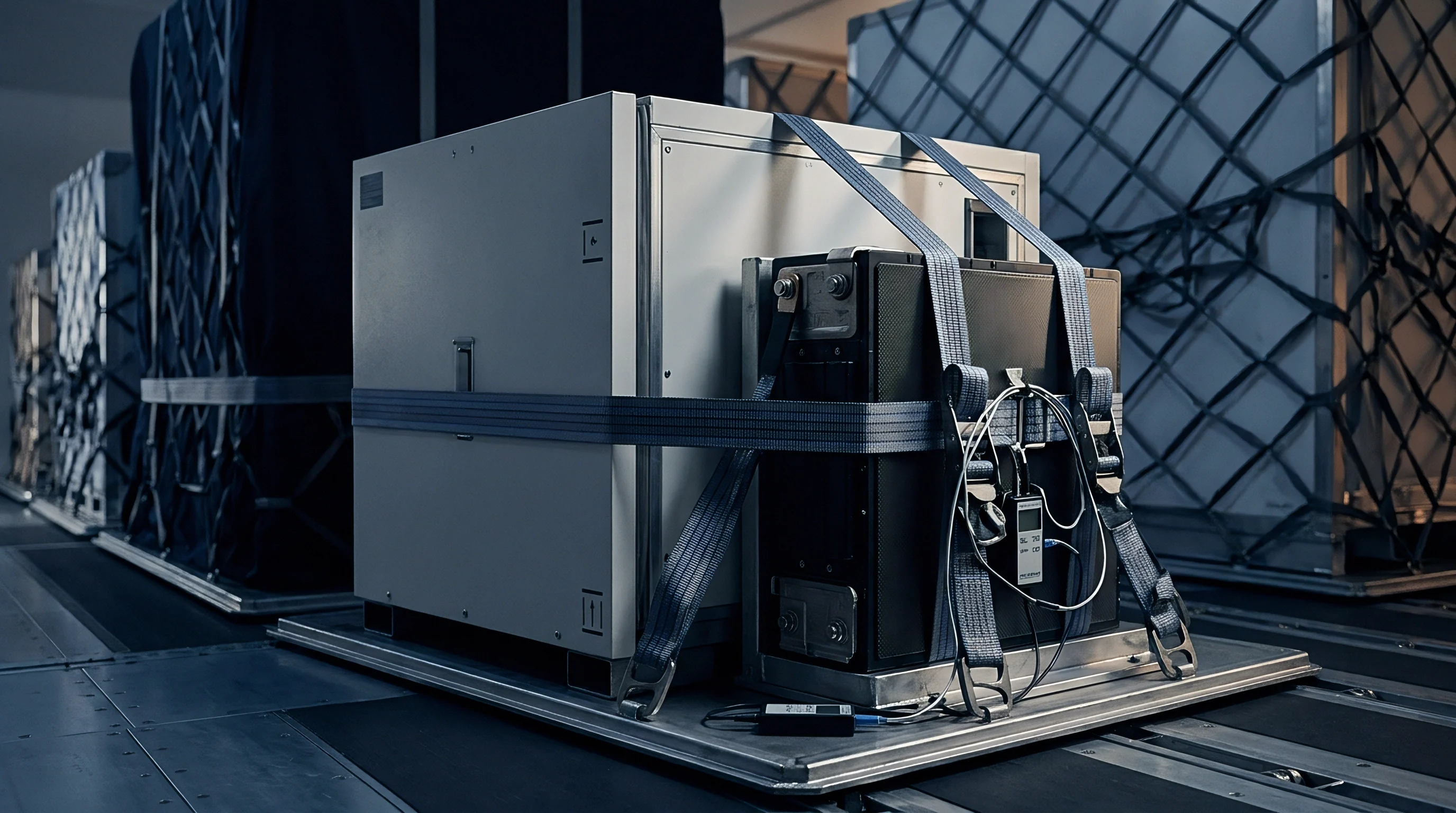
Steel cargo vessels transfer container stacks across severe climatic transitions. A modern container ship loads twenty thousand twenty-foot equivalent units, stacking containers nine high on deck and eight deep within the cargo holds. Thermal environments across these positions diverge dramatically.
A consignment sailing mid-summer from Shanghai to Rotterdam via the Suez Canal navigates the South China Sea, the Indian Ocean, the Red Sea, and the Mediterranean, traversing zones of relentless solar irradiance and high sea-surface temperatures. Packaged cells absorb this energy over weeks.
How Do Ocean Temperatures Drive Film Thickening?
Vessels crossing maritime corridors subject unpowered dry boxes to ambient swings between 18 and 42 degrees Celsius. Direct solar radiation compounds this baseline heating through radiative absorption on raw corrugated steel walls and dark container roofs. Peak roof skin temperatures frequently achieve 68 degrees Celsius during peak equatorial noon periods, warming the upper internal cargo air to 55 degrees Celsius.
Heat transfers downward through wooden flooring and air gaps via natural convection and conductive conduction into outer cell packaging cartons.
A dense pallet containing 2,000 cylindrical 21700 cells possesses substantial thermal mass, creating a 48-to-72-hour phase lag between external ambient peaks and interior pallet cores. Once saturated, however, that dense mass holds heat tenaciously. The pallet core remains trapped at 38 to 42 degrees Celsius even when the ship encounters cooler North Atlantic waters during the final transit leg.
A 40-foot container parked on an open deck through Red Sea summer transit sustains an average internal air temperature of 44.2 degrees Celsius across fourteen consecutive days.

Hold Positions and Thermal Stratification
Stowage location aboard container ships governs the cumulative heating profile experienced by packaged lithium cells. Ocean carriers assign slot positions based on container weight, discharge port sequence, and hazardous cargo classification without regard for the kinetic decay rates of battery materials. Cells stowed below the waterline benefit from the heat sink effect of the surrounding ocean, which stabilizes hold temperatures around 20 to 28 degrees Celsius throughout tropical passages.
Top-tier deck containers endure direct solar exposure, generating elevated kinetic rate constants inside the cargo.
| Stowage Location | Mean Internal Temperature | Maximum Peak Temperature | Diurnal Thermal Swing | Estimated Degradation Multiplier |
|---|---|---|---|---|
| Below waterline (Hold center) | 23.4 °C | 26.1 °C | ±1.2 °C | 1.00 × (Baseline) |
| Above waterline (Hold top tier) | 31.8 °C | 36.5 °C | ±3.4 °C | 1.58 × |
| On-deck (Tier 1 bottom tier) | 29.2 °C | 34.1 °C | ±4.1 °C | 1.41 × |
| On-deck (Tier 4 middle tier) | 36.7 °C | 45.8 °C | ±8.5 °C | 2.10 × |
| On-deck (Tier 7 outer edge) | 42.5 °C | 56.2 °C | ±13.2 °C | 2.84 × |
| Active reefer (Set to 15 °C) | 15.2 °C | 16.8 °C | ±0.8 °C | 0.56 × |
Active refrigeration isolates cargo from solar flux. Maintaining an internal setpoint of 15 degrees Celsius suppresses parasitic Arrhenius reactions, cutting latent passivating film formation by nearly half relative to waterline cargo holds. Sourcing departments rarely book refrigerated transport due to ocean freight surcharges ranging between $2,500 and $4,500 per container.
Opting for cheaper dry boxes saves shipping capital while consuming precious cycle life before pack assembly begins.
Summer container overheating is frequently treated as maritime force majeure outside standard warranty terms, leaving buyers to absorb the resulting thermal damage.


Format
Mechanical boundaries determine how structural components accommodate electrolyte breakdown products. The solid electrolyte interphase occupies distinct molar volume. As lithium ions, organic solvents, and conductive salts react, the resulting species precipitate directly into anode pore structures and onto active material surfaces.
Anode coating volume swells by 1.5 to 3.0 percent across typical factory-to-port maritime windows, altering physical dimensions and mechanical stress distributions according to cell architecture.
Which Cell Formats Tolerate Latent Expansion?
Rigid metal casings confine internal jellyroll displacement along the radial axis. Cylindrical cells such as 18650, 21700, and 4680 formats feature deep-drawn steel cans with wall thicknesses between 0.15 and 0.30 millimeters that resist hoop stress. The rigid circular perimeter translates volumetric interphase expansion into internal compression against the center pin and mandrel cavity.
This radial constraint restricts macroscopic outer dimensional changes to less than 0.05 percent over extended warm transit, preventing mechanical tolerance failures during module insertion.
Constraining physical expansion elevates internal mechanical stack pressure within the cylindrical winding. Localized electrode compression narrows separator pore channels, increases liquid electrolyte tortuosity, and promotes inhomogeneous current distribution during initial formation cycling at destination facilities. In severe cases, extreme interphase growth induces buckling in the inner wraps of the negative electrode, creating localized high-stress wrinkles prone to lithium plating during rapid acceptance testing.
Structural rigidity trades external expansion for internal microstructural strain.
Pouch Swelling and Mechanical Stack Pressure
Flexible polymer-laminated packaging yields outward when solid decomposition products accumulate across active material layers. Lacking structural metal shells, pouch cells translate internal volumetric growth into direct macroscopic thickness increases. An unconstrained 50 Ah automotive pouch cell measuring 10.0 millimeters thick at the factory gate expands to 10.18 or 10.25 millimeters following a warm maritime voyage, creating problems for modules demanding strict dimensional control.
Unconstrained pouch cell thickness dilates by roughly 0.2 millimeters across an unconditioned forty-day maritime crossing.
Similar to the transport of delicate uncured industrial adhesives or phase-change polymers across maritime corridors, lithium cell components possess active chemistries sensitive to transit thermal history. When pouch cells expand beyond nominal allowances, automated pack assembly fixtures jam during cell insertion into structural retention bays. Battery packs designed around zero-clearance aluminum side plates require uniform mechanical stack pressure, typically 0.3 to 0.8 megapascals, maintained via cellular compression foams.
Latent maritime swelling pre-compresses these elastomeric pads, elevating mechanical resting pressure well beyond design thresholds before the pack ever connects to a charger.

Prismatic Enclosures and Internal Stress
Welded aluminum cans resist localized volume growth through heavy side-wall geometry. Prismatic cells employ extruded or deep-drawn aluminum enclosures with wall thicknesses spanning 0.6 to 1.2 millimeters. The broad flat faces of a 100 Ah or 280 Ah prismatic cell exhibit mechanical compliance under internal pressure, deflecting outward toward their centers.
This flat-face deflection induces tensile stress at the welded lid perimeter and high mechanical strain around internal terminal feedthrough seals.
- Interfacial delamination occurs when internal shear stresses overcome the adhesive bond between the copper current collector foil and the graphite anode coating layer.
- Separator pore collapse results from excessive localized stack pressure compressing porous polyethylene membranes, restricting lithium-ion transference numbers.
- Electrolyte starvation develops when solid decomposition products absorb free liquid solvent molecules from adjacent electrode pores, drying out the jellyroll separator interface.
- Terminal header leakage emerges when broad-face casing deflection torques rigid current-collector busbars against polymer hermetic seal rings, breaking case seals.
Ignoring unconstrained pouch expansion during maritime transit yields split module side-plates, cracked busbar welds, and scrapped battery packs on integration lines.

Gate
Receiving docks establish the physical baseline for incoming battery shipments. Cell consignments arriving at port terminals require rigorous electrochemical screening to verify health prior to module integration. Relying on factory-issued birth certificates guarantees downstream pack imbalance.
A rigorous receiving protocol segregates latent storage degradation from native manufacturing defects, identifying lots suffering anomalous internal resistance growth or elevated self-discharge during transit.

Impedance Spectroscopy and Direct-Current Resistance
Testing stations evaluate interfacial passivation layers via 1000-hertz alternating current and high-rate galvanostatic pulses. Alternating-current internal resistance at one kilohertz captures pure ohmic resistance (R0), reflecting electrolyte conductivity, separator permeability, and current collector contact integrity. Pure ohmic measurements remain relatively insensitive to thin solid electrolyte interphase changes.
Identifying true transit degradation necessitates direct-current internal resistance testing per IEC 61960-3 standards.
DCIR characterization pulses the cell with a 1C or 2C discharge current for 10 or 30 seconds, measuring the instantaneous voltage drop and subsequent mass-transport polarization. This calculation exposes charge-transfer resistance (Rct) alongside interphase film resistance (Rsei). Cells experiencing elevated ocean heating show distinct rightward displacement and diameter expansion of the intermediate charge-transfer semicircle on electrochemical impedance spectroscopy Nyquist plots.
| Electrochemical Parameter | Factory Gate Baseline | Maximum Landed Threshold | Allowable Transit Delta | Failure Mechanism Indicated |
|---|---|---|---|---|
| Open-Circuit Voltage (OCV) | 3.295 V (±0.005 V) | 3.275 V | ≤ 20 mV drop | Internal micro-short or transition metal bridging |
| K-Value (Self-discharge rate) | 0.08 mV/day | 0.25 mV/day | ≤ 0.17 mV/day rise | Separator defect or localized iron contamination |
| ACIR (1 kHz impedance) | 0.18 mΩ (±0.02 mΩ) | 0.21 mΩ | ≤ 0.03 mΩ rise | Electrolyte dry-out or tab weld degradation |
| DCIR (10s 1C discharge pulse) | 0.42 mΩ (±0.03 mΩ) | 0.48 mΩ | ≤ 0.06 mΩ rise | Latent solid electrolyte interphase thickening |
| Thickness (At center point) | 71.5 mm (±0.3 mm) | 72.4 mm | ≤ 0.9 mm expansion | Anode volumetric interphase film dilation |
An incoming cell lot exhibiting more than fifteen percent direct-current internal resistance growth above Certificate of Analysis baseline warrants immediate quarantine.

Open-Circuit Voltage and K-Value Triage
Voltage tracking separates benign passivating films from severe internal micro-shorts across quarantined pallets. Normal interphase thickening consumes cyclable lithium inventory, which depresses open-circuit voltage moderately along the known stage-transition curve. Severe voltage decay indicates distinct parallel degradation pathways.
Calculating the voltage drop rate, known as the K-value (K = (OCV1 – OCV2) / Δt), quantifies this self-discharge rate in millivolts per day.
- Initial intake scanning logs incoming voltage and barcode data immediately upon opening shipping containers to detect damaged packages.
- Secondary resting dwell stores pallets in a climate-controlled quarantine warehouse at 23 °C for exactly seven days to isolate temperature-induced voltage fluctuations.
- Automated K-value computation compares terminal voltages across the dwell interval, flagging cells that drop faster than 0.20 millivolts per day for isolation.
- Statistical outlier screening applies a three-sigma filter across the lot distribution, quarantining skewed outliers even if they sit within broad absolute datasheet limits.

Cell Reconditioning Sequence
Incoming electrochemical inventory requires controlled initial cycling to stabilize passivated interphases before mechanical integration. Uncontrolled high-rate charging applied to freshly landed cells risks localized lithium plating on mechanically compressed anodes. A standardized intake formation process restores electrochemical equilibrium across incoming lots.
- Stabilize incoming cell pallet temperatures within a dedicated 23 ± 2 degrees Celsius holding area for forty-eight hours to eliminate container thermal gradients.
- Record high-precision open-circuit voltage down to 0.1 millivolt and alternating-current impedance at 1000 hertz across every individual unit cell.
- Execute a slow C/10 constant-current discharge down to the lower voltage cut-off limit to accurately quantify residual landed charge.
- Perform a C/5 constant-current constant-voltage charge up to nominal operating voltage, imposing a C/20 current termination threshold.
- Execute a reference 1C discharge capacity verification cycle to calibrate actual landed capacity against the factory Certificate of Analysis baseline.
- Subject cells to a 10-second 1C direct-current pulse at 50 percent state of charge to calculate landed internal resistance before releasing cells to pack assembly.
Whether non-destructive high-frequency impedance spectroscopy can reliably separate reversible stage-one lithium reordering from permanent capacity loss on freshly landed cells remains unsettled across high-volume battery intake facilities.

Exposure
Commercial contracts allocate the financial burden of transit-induced cell aging. Sourcing agreements frequently treat maritime transport as an operational blank space, assuming cells remain chemically frozen between factory exit and intake docking. When cells land with depleted active lithium inventories and elevated internal resistances, commercial disputes erupt between purchasing entities, cell manufacturers, freight forwarders, and marine insurance underwriters.
Delivery Terms and Responsibility Seams
Purchase orders referencing Incoterms 2020 assign cargo perils across defined physical transit stages. Under Free on Board (FOB) or Free Carrier (FCA) terms, title transfer and risk pass to the buyer the moment cells clear the vessel rail or leave the manufacturer facility gates. If containers cook on a sun-drenched deck tier, the buyer absorbs the resulting capacity fade and resistance growth entirely.
Negotiating Delivered at Place (DAP) or Delivered Duty Paid (DDP) terms shifts transit survival risk onto the cell vendor. Under DAP destination contracts, incoming quality acceptance occurs at the buyer intake dock rather than the factory packaging line. When incoming direct-current resistance tests breach incoming contract tolerances, the receiving entity holds legal grounds to reject the entire lot at the supplier expense.
Shifting this boundary compels manufacturers to adopt conservative packing, lower state-of-charge shipping points, and temperature-controlled routing.
A delivery specification conditioning final acceptance on post-voyage DCIR thresholds shifts maritime storage risk from buyer accounts to supplier balance sheets.

Transport Regulations and Sourcing Disagreements
Civil aviation and maritime shipping rules restrict state of charge ceilings during bulk transit. The International Maritime Dangerous Goods (IMDG) Code, aligning with UN 38.3 transport recommendations, permits marine shipment of cells at states of charge up to 30 percent without specialized chartered vessel exemptions. Shipping at or below 30 percent state of charge suppresses the electrochemical driving potential for solid electrolyte interphase formation, mitigating degradation during equatorial passages.
Cell manufacturers frequently resist shipping below 30 percent state of charge, citing the risk of permanent copper dissolution if prolonged storage drops cell potentials beneath 1.5 volts, whereas pack integrators prioritize low shipping potentials to prevent latent impedance growth. Sourcing teams resolve this tension by defining strict shipping voltage windows paired with real-time temperature-logger mandates within container bills of lading.
A contract specification binding cell suppliers to destination-port DCIR and capacity thresholds under Incoterms DAP reassigns maritime thermal risk entirely to the vendor.