Discrepancies between Standard Mass Loss Limits and Volatile Organic Solvent Vapor Detection in Air Transport Containment
Standard UN 38.3 mass loss limits allow trace solvent leaks that trigger sensitive air cargo volatile organic compound detectors and cause freight rejections.

Screening
Lithium-ion battery air transport safety rests on gravimetric verification methods defined in the UN Manual of Tests and Criteria, specifically Section 38.3.4.1 Test T.1 (Altitude Simulation) through Test T.5 (External Short Circuit). The pass criterion for mass loss across these tests sets a boundary of 0.1 percent for cells exceeding 75 grams, 0.2 percent for cells between 1 and 75 grams, and 0.5 percent for cells under 1 gram. These thresholds were established to capture catastrophic structural failure or rupture of the cell casing during hypobaric exposure down to 11.6 kilopascals, representing an altitude of 15,000 meters.
A cell weighing 45 grams, typical of an 18650 cylindrical format, satisfies the standard if it loses less than 90 milligrams during test execution. A 21700 cell weighing 70 grams meets the criterion with a loss of up to 140 milligrams. A 50-ampere-hour prismatic cell weighing 1,200 grams remains compliant while releasing up to 1.2 grams of material.
Standard factory analytical balances on packaging lines operate with a resolution between 0.1 and 1.0 milligrams. Laboratory balances achieve 0.01 milligrams under controlled environmental drafts. Gravimetric screening cannot resolve localized, low-rate seal degradation or sub-milligram micro-venting.
Volatile organic solvent vapors, predominantly alkyl carbonates used in liquid electrolytes, escape through defective crimp gaskets, micro-fissures in welded aluminum terminals, or imperfect pouch heat-seals long before the cell registers a mass change on an analytical balance. Photoionization detectors calibrated to isobutylene equivalents detect these volatile organic compounds at concentrations below 0.1 parts per million inside enclosed shipping containers.
A 70-gram cylindrical cell losing 5 milligrams of volatile organic electrolyte passes standard altitude mass criteria while releasing sufficient vapor to saturate a sealed shipping container beyond sensor alarm limits.
A sealed cargo container or hermetic foil liner concentrates escaping solvent molecules over days of transit. The resulting vapor accumulation triggers volatile organic compound sniffers and dangerous goods screening alarms at airport acceptance facilities, even when every cell in the consignment holds a valid UN 38.3 test summary. Shippers discover that physical regulatory compliance under standard mass loss tests does not guarantee transport acceptance at the air cargo terminal.
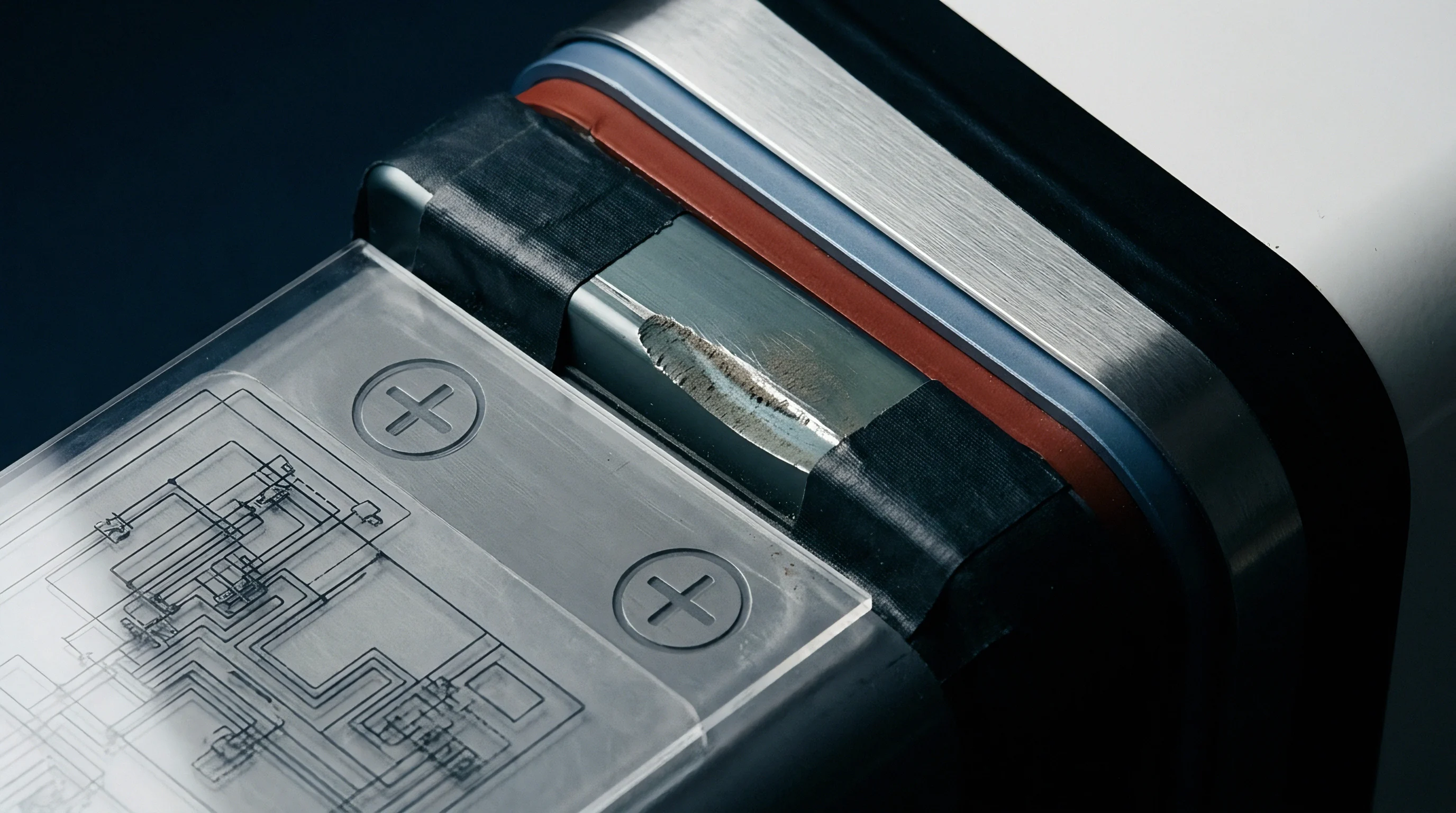
Electrolyte Component Vapor Pressures
Modern lithium-ion electrolytes blend cyclic and linear carbonates with lithium hexafluorophosphate salt. Linear carbonates possess high volatility and low boiling points to lower viscosity and improve low-temperature transport kinetics. Cyclic carbonates provide dielectric permittivity to dissociate the lithium salt.
The physical properties of these solvents govern evaporation rates when cell seal integrity degrades.
| Solvent Name | Chemical Formula | Molecular Weight (g/mol) | Boiling Point (°C) | Vapor Pressure (kPa) | Lower Flammability Limit (vol%) |
|---|---|---|---|---|---|
| Dimethyl Carbonate (DMC) | C3H6O3 | 90.08 | 90.5 | 5.60 | 4.22 |
| Ethyl Methyl Carbonate (EMC) | C4H8O3 | 104.11 | 107.5 | 2.93 | 3.00 |
| Diethyl Carbonate (DEC) | C5H10O3 | 118.13 | 126.0 | 1.15 | 1.40 |
| Ethylene Carbonate (EC) | C3H4O3 | 88.06 | 248.0 | 0.001 | 3.60 |
| Propylene Carbonate (PC) | C4H6O3 | 102.09 | 242.0 | 0.004 | 1.80 |
Dimethyl carbonate and ethyl methyl carbonate dominate vapor evolution in damaged or leaking enclosures. At 20 degrees Celsius, dimethyl carbonate exhibits a vapor pressure of 5.60 kilopascals. This pressure generates a saturated concentration of 55,200 parts per million in stagnant headspace.
Ethyl methyl carbonate reaches 28,900 parts per million under identical conditions. A micro-leak discharging 0.5 milligrams of dimethyl carbonate creates a detectable plume in a 1-cubic-meter cargo compartment. Photoionization detectors alert at 1.0 parts per million.
Thermal cycling and hypobaric conditions experienced in aircraft main decks and lower cargo holds accelerate this evaporation mechanism. Aircraft cargo holds maintain pressures equivalent to 2,400 meters altitude, approximately 75 kilopascals. Under reduced ambient pressure, the pressure gradient across the cell crimp or terminal weld increases.
Solvent evaporation accelerates, driving volatile species into surrounding containment packaging.
Consignments flagged for volatile solvent odors face mandatory ground quarantine, hazardous material team inspections, and carrier surcharges exceeding five thousand dollars per held pallet.
Chamber
Hypobaric test chambers verify mechanical integrity under simulated atmospheric depressurization. UN 38.3.4.1 specifies storing cells at an internal chamber pressure of 11.6 kilopascals or less for at least six hours at an ambient temperature of 20 degrees Celsius, with a tolerance of plus or minus 2 degrees. The mass of each test unit is recorded before insertion and immediately following removal.
The mass loss calculation follows the relation:
Mass Loss Percentage = 100 (M1 – M2) / M1
M1 represents the pre-test mass and M2 represents the post-test mass. A cell passes if the resulting value does not exceed the threshold applicable to its mass class. The standard does not specify continuous gas sampling during chamber pump-down or dwell.
The calculation treats mass loss as a bulk property. A 60-milligram loss from a 60-gram 21700 cell yields a 0.100 percent result, which passes the 0.2 percent limit. That 60 milligrams equates to roughly 0.056 milliliters of liquid dimethyl carbonate.
Converted to gas phase at standard temperature and pressure, 60 milligrams of dimethyl carbonate yields 14.9 milliliters of pure vapor. Dispersed into an air transport outer packaging volume of 0.05 cubic meters, this volume produces an internal concentration of 298 parts per million. The permissible exposure limit established by occupational safety guidelines for similar organic esters is 100 parts per million, and human olfactory thresholds for sweet ester odors sit near 0.5 to 2.0 parts per million.
A mass balance that reads zero across four decimal places fails to prove the absence of hazardous solvent headspace concentration in sealed transport packaging.
The standard test method permits volatile solvent release during altitude simulation as long as the total gravimetric delta stays within the envelope. The test summary document mandated under UN 38.3.5 records a simple binary pass result. Carriers receiving the physical cargo interact with the accumulated gas rather than the certified paper record.
Headspace Gas Accumulation Mechanics
Packaging configurations mandated by ICAO Technical Instructions and IATA Dangerous Goods Regulations PI 965 Section IA and Section IB require strong, rigid outer packagings, commonly UN-specification 4G fiberboard boxes or 4D plywood crates. Cells are placed in inner packagings that completely enclose each unit. Many packagers add hermetically sealed, metalized polyethylene barrier bags or vapor-tight polyethylene liners to prevent moisture ingress.
These liners trap outgassed solvent vapors.
Headspace concentration development in a closed package follows classical diffusion and phase equilibrium steps:
- Liquid Phase Evaporation occurs at the defective micro-seal interface where low molecular weight linear carbonates transition to vapor driven by the internal cell vapor pressure.
- Pore Diffusion carries the volatile carbonate molecules across the porous polymer gasket matrix or along micro-cracks in ultrasonic weld seams.
- Headspace Dissipation distributes the gas phase throughout the internal void volume of the inner packaging and surrounding void fill materials.
- Concentration Equilibrium develops when the partial pressure of each solvent component reaches steady state with the remaining liquid phase or when outer containment barriers leak vapor outward.
Consider a transport box packed with 100 cylindrical cells, each containing 5.0 grams of total electrolyte with a 1:1 weight ratio of dimethyl carbonate to ethylene carbonate. The total solvent payload is 500 grams. If three cells possess defective crimp seals that each leak 2.0 milligrams of dimethyl carbonate during a six-hour transport flight, the total released solvent is 6.0 milligrams.
In a sealed internal void volume of 10 liters (0.01 cubic meters), the resulting dimethyl carbonate concentration reaches 163 parts per million. Analytical balances used for UN 38.3 test verification cannot flag a 2.0-milligram mass drop on a 70-gram cell because 2.0 milligrams represents 0.0028 percent of cell mass, far below the 0.2 percent pass boundary.
Cell manufacturers routinely dismiss detected organic vapors as harmless secondary degassing from external wash residue during electrolyte filling lines.
Vapor
Detection technologies deployed at air cargo terminals, customs inspection stations, and battery warehouse intake docks operate on physical principles distinct from gravimetric scales. Photoionization detectors (PID), non-dispersive infrared sensors (NDIR), and metal oxide semiconductor (MOS) arrays register gas-phase chemical interactions. These instruments detect the presence of volatile species rather than the mass delta of the parent container.
A photoionization detector utilizes an ultraviolet lamp, typically 10.6 electron-volts, to ionize organic molecules with ionization energies below the photon energy of the lamp. Dimethyl carbonate exhibits an ionization potential of 10.5 electron-volts. Ethyl methyl carbonate exhibits an ionization potential of approximately 10.3 electron-volts.
Diethyl carbonate exhibits an ionization potential of 9.9 electron-volts. Ultraviolet light ionizes these linear carbonates directly. The resulting ion current is proportional to the concentration of volatile organic compounds in the sampled air stream.
| Measurement Technology | Target Parameter | Lower Detection Limit | Response Time (t90) | UN 38.3 Direct Equivalency |
|---|---|---|---|---|
| Analytical Gravimetric Scale | Bulk Cell Mass Delta | 0.1 to 1.0 mg | Static (Post-test) | Direct regulatory standard |
| Photoionization Detector (10.6 eV) | Total VOC Ionization | 0.01 to 0.1 ppm | Under 3 seconds | No formal mapping |
| Non-Dispersive Infrared (NDIR) | Carbonate C=O Bond Absorption | 1.0 to 10.0 ppm | Under 10 seconds | No formal mapping |
| Gas Chromatography-Mass Spec (GC-MS) | Speciated Carbonate Identification | 0.001 ppm | 10 to 30 minutes | No formal mapping |
| Electrochemical Toxic Gas Sensor | HF Acid / CO Byproducts | 0.1 ppm | 15 to 30 seconds | Secondary decomposition only |
The gap between a 0.1 percent mass loss criterion and a 0.1 parts per million detection limit spans four orders of magnitude in analytical sensitivity. A shipment that is compliant on the test bench creates a positive hit on cargo intake sniffers.
Electrolyte Breakdown and Degradation Pathways
Electrolyte leakage presents safety hazards beyond volatile organic emissions. Lithium hexafluorophosphate salt in the electrolyte decomposes thermally and hydrolytically when exposed to ambient moisture entering through seal fissures. The salt exists in dynamic equilibrium with phosphorus pentafluoride and lithium fluoride:
LiPF6 (liquid phase) LiF (solid) + PF5 (liquid/gas)
Phosphorus pentafluoride is a strong Lewis acid. When atmospheric water vapor penetrates the cell seal, phosphorus pentafluoride hydrolyzes instantly:
PF5 + H2O -> POF3 + 2 HF
Phosphoryl fluoride (POF3) and hydrofluoric acid (HF) form in the escaping gas phase. Hydrofluoric acid corrodes metallic containment, degrades fiberboard packaging binders, and attacks glass optics on automated cargo sorting lines. Air transport handlers equipped with chemical detection badges or fixed sensor arrays register the presence of acid gases alongside organic carbonate plumes.
A container holding valid UN 38.3 test paperwork remains subject to carrier rejection when sensor arrays detect fluorinated or carbonate offgas.
Containment screening protocols identify three distinct operational risk categories for battery packaging:
- Hermetic Gasket Failure permits slow, continuous evaporation of volatile linear carbonates without cell swelling, triggering sensitive airport gate sniffers while preserving open-circuit voltage stability.
- Micro-Fissure Weld Defects open during cargo hold depressurization, releasing intermittent bursts of pressurized vapor that condense against cooler inner barrier films.
- Active Thermal Decomposition generates carbon dioxide, carbon monoxide, and hydrogen alongside solvent vapors, driving rapid pressure escalation that breaches secondary containment.
Standard packaging agreements referencing only IATA Section IA packing instructions fail to define allowable volatile organic compound emissions, leaving the shipper legally liable for delays when forwarders exercise right-of-refusal clauses.


Freight
Air cargo carriers operate under stringent dangerous goods safety management systems governed by Annex 18 to the Chicago Convention and the ICAO Technical Instructions for the Safe Transport of Dangerous Goods by Air (Doc 9284). When a carrier or freight handler detects chemical odors or triggers automated volatile organic compound alarms during acceptance checks, carrier procedures mandate immediate cargo rejection. The carrier documents the event as a suspected leaking dangerous goods package under IATA Dangerous Goods Regulations Section 9.3.
The presence of a valid UN 38.3 Test Summary (TS) does not override the physical evidence of leakage at the pallet interface.
Shippers face significant commercial and operational disruption when solvent vapor triggers cargo hold isolation. An aircraft crew alerting to chemical odors on the main deck or lower cargo hold initiates emergency diversion checklists. Ground handlers isolate the affected unit load device (ULD) on the tarmac, hazardous materials emergency response teams deploy, and the entire consignment undergoes quarantine.
The shipper bears the direct financial burden of aircraft diversion fees, airport emergency response costs, repackaging expenses, and civil penalties levied by civil aviation authorities.
Containment Engineering and Mitigation
Eliminating the discrepancy between laboratory gravimetric compliance and real-world vapor containment requires engineered packaging solutions. Standard fiberboard boxes provide zero barrier resistance to linear carbonate vapors. Polyethylene bags provide low-to-moderate barrier resistance, as organic esters permeate through low-density polyethylene over several days.
High-barrier packaging specifications integrate specialized materials to prevent solvent migration:
- Metalized Polyester Laminates incorporate aluminum foil layers between polyethylene and polyester substrates, reducing organic vapor transmission rates below 0.005 grams per square meter per 24 hours.
- Activated Carbon Sorbents integrated into packaging void fill capture stray carbonate molecules through physical adsorption before vapor reaches outer package boundaries.
- Elastomeric Hermetic Gaskets in rigid composite transport containers maintain continuous sealing pressures above 150 kilopascals during cyclic altitude variations.
Procurement teams sourcing battery cells for international air shipment must bridge the gap between regulatory minimums and transport realities. Factory acceptance testing must implement volatile organic compound sniff tests on production lots following formation and aging, isolating cells that satisfy gross weight criteria while shedding trace solvent vapors through imperfect seals.
Whether civil aviation authorities will eventually harmonize air transport packaging standards by replacing gravimetric mass loss limits with explicit parts-per-million vapor emission thresholds remains unresolved across international regulatory working groups.