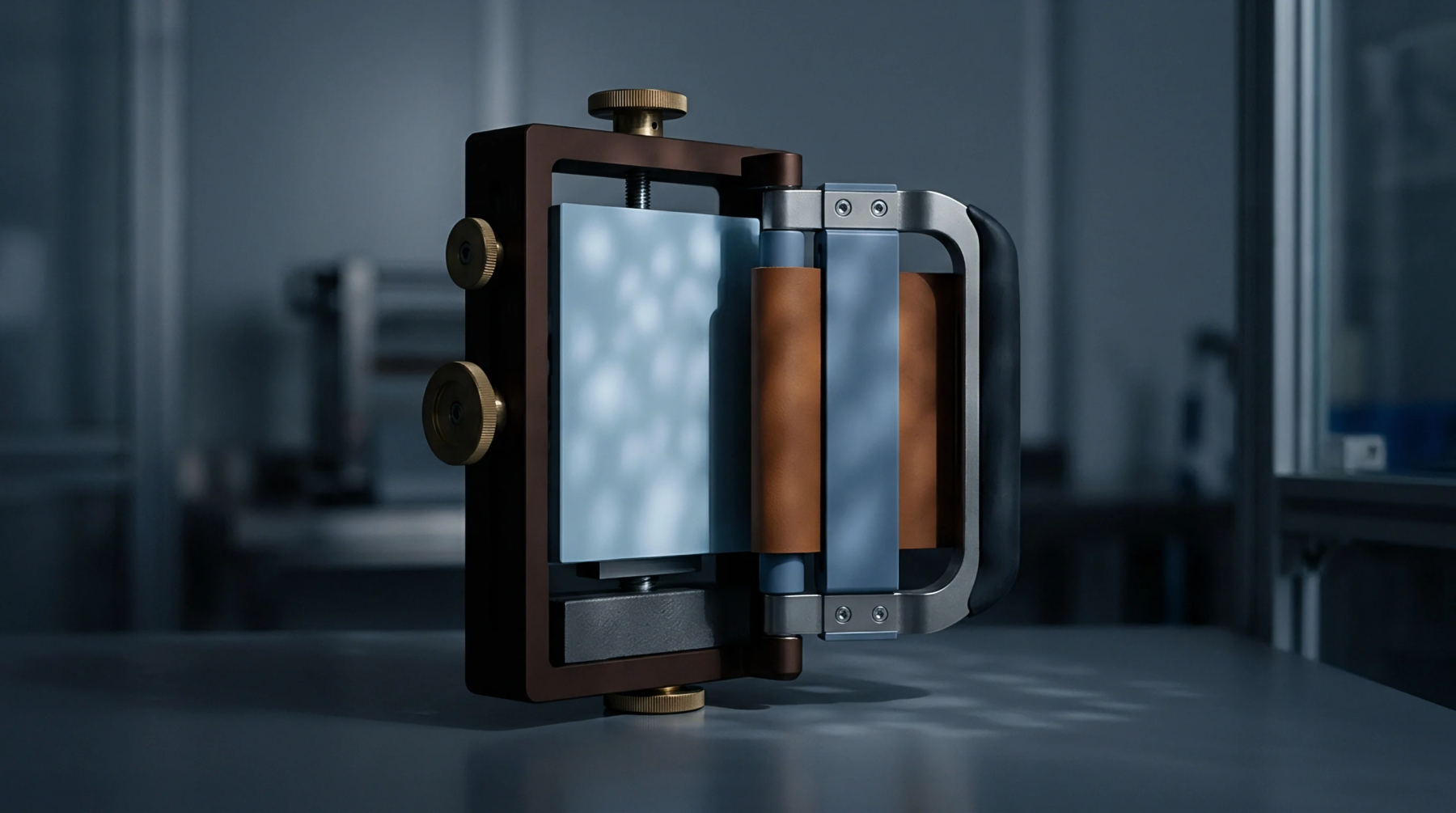
Mechanical Fixture Thermal Strain Deconvolution in Cell Thickness Metrology Baseline
Deconvoluting fixture thermal strain from battery metrology requires baseline transfer matrix subtraction to isolate true electrochemical cell breathing.
Specialized measurement frame constructed from a low expansion nickel steel alloy to ensure dimensional stability during battery thermal characterization. An invar baseline fixture provides a rigid and temperature-resistant platform for sensors that measure the physical growth of cells during environmental testing. The use of invar, which contains approximately thirty-six percent nickel, is necessary because its coefficient of thermal expansion is roughly one-tenth that of standard steel.
This unique property ensures that the fixture itself does not expand or contract significantly as the temperature in the test chamber changes. By maintaining a constant size, the frame allows the sensors to capture the actual expansion of the battery without the data being contaminated by the movement of the hardware. This level of precision is a requirement for any study looking at the relationship between temperature and mechanical swelling in high-performance cells.
Exceptional resistance to thermal deformation makes nickel-iron alloys the preferred choice for high-precision metrology applications. While most laboratory fixtures would grow by several microns for every degree of temperature rise, an invar baseline fixture remains nearly identical in size across a wide range of conditions. This stability is achieved through a phenomenon called the invar effect, where the magnetostriction of the alloy compensates for the normal thermal expansion.
For battery researchers, this means that the zero point of the measurement system stays locked in place even during extreme thermal cycling. Without this stability, the small changes in cell thickness would be lost in the noise of the fixture’s own movement. The alloy is also highly resistant to creep, meaning it will not sag or deform under its own weight over years of continuous use.
Maintenance of the geometric relationship between the sensor and the test subject is essential for collecting accurate displacement data. An invar baseline fixture is typically machined to very tight tolerances to ensure that all surfaces are perfectly flat and parallel. This precision alignment is necessary for applying uniform pressure to the face of the battery during the test.
If the fixture were to warp or twist, the sensor would no longer be perpendicular to the cell surface, leading to an error in the thickness reading. Technicians use laser interferometry to verify the alignment of the frame before and after major experiments. The rigidity of the invar material also helps dampen mechanical vibrations that could interfere with the sensitive electronic probes.
This combination of thermal and mechanical stability is what allows for the detection of sub-micron shifts in electrode volume.
Integration of high-stability hardware into the laboratory workflow significantly improves the quality and repeatability of battery characterization data. Using an invar baseline fixture allows for the direct comparison of results across different seasons and environmental conditions without the need for complex mathematical corrections. This transparency is vital for manufacturers who must guarantee the performance of their cells to automotive clients.
The fixture acts as a solid anchor for the entire measurement chain, providing a level of confidence that cannot be achieved with less stable materials. In long-term aging studies, where the test may run for several years, the permanence of the invar frame is a critical advantage. It ensures that the only variable being measured is the battery itself, rather than the changing state of the test equipment.
Investing in high-quality fixtures is a standard practice for world-class energy storage research facilities.
Deconvoluting fixture thermal strain from battery metrology requires baseline transfer matrix subtraction to isolate true electrochemical cell breathing.
Expertise is a utility, not a secret. sentiention™ publishes its working knowledge as open reference: intelligence layer covering the materials it sources, the markets it enters, and the reference that serves both.