Incoming Inspection Methods for Freight Battery Pallets
Incoming battery pallet inspection combines shock monitoring, four-wire OCV/IR screening, and AQL sampling to catch transit damage and enforce debit notes.
Crate
Receiving dock work on palletized lithium-ion cells begins with containment checks before anyone cuts the stretch wrap. Cells and modules arrive under international transit rules where packaging damage directly threatens physical safety. Dock inspections screen for transit abuse, orientation faults, moisture ingress, and missing dangerous goods placards before shipments move into warehouse storage.

Physical Packaging Integrity and Dangerous Goods Markings
Maritime and air dangerous goods frameworks require UN-approved outer packaging bearing the UN 4G or UN 4GV specification mark. Every pallet carrying lithium-ion cells must display UN 38.3 compliance markings, Class 9 hazard labels, and either the UN 3480 standalone battery identifier or UN 3481 battery-in-equipment identifier. Inspectors check wooden or plastic skids for split deckboards, broken corner blocks, and crushed fiberboard cartons.
Stacking boxes too high deforms the bottom tier, driving uneven compressive loads directly into cell terminals and pouch envelopes.
Punctures from forklift tines, torn shrink wrap, crushed carton corners, and chemical stains all point to compromised containment. Moisture penetration cuts fiberboard strength by up to sixty percent, leaving lower boxes vulnerable to collapse under static top loads. Pallet strapping must stay taut; slack bands indicate that internal cargo shifted or cartons crushed during transit.
A tilt indicator activation exceeding 50 degrees triggers immediate pallet quarantine and 100 percent tear-down inspection under UN 38.3 transportation compliance rules.
Tilt and Shock Sensor Thresholds
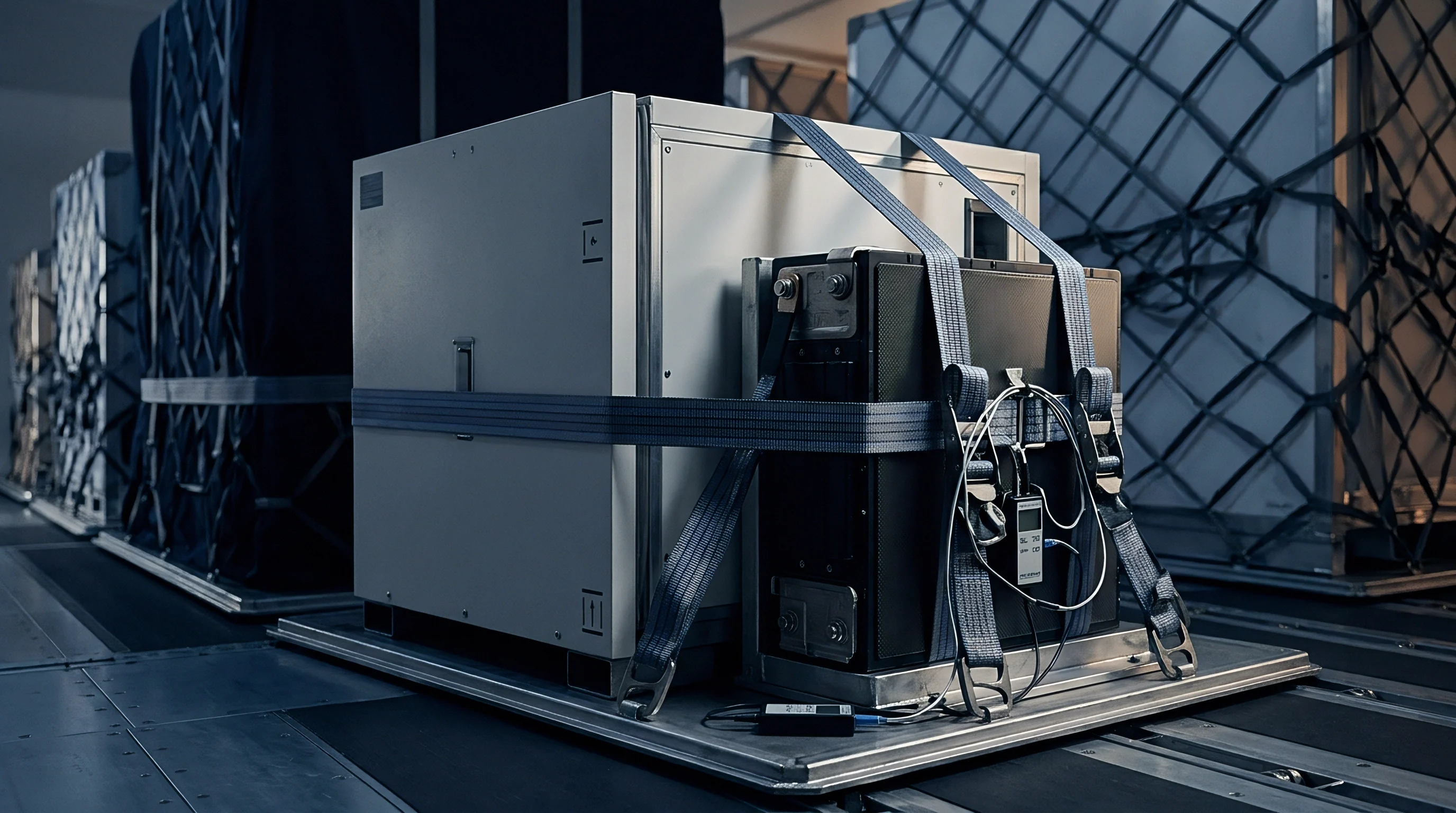
Mechanical impact during transit alters internal electrode registration and risks tearing separator films. Pallets rely on single-use mechanical impact sensors, including DropNTell or ShockWatch devices calibrated between 25g and 75g acceleration thresholds. Shock sensors on the skid base catch severe drops, while sensors placed high on carton faces record tip-overs and rough handling.
Tilt indicators trip when cargo leans past 50 degrees from vertical. Once activated, electrode stacks inside pouch cells or cylindrical jelly-rolls can displace internally without tearing the outer carton. Receiving staff log indicator serial numbers against the bill of lading, photograph the sensor on the pallet, and route the shipment for a full teardown audit.
- Structural carton crushing deforms internal corrugated partitions, transferring freight stack weight onto fragile cell terminals and busbar connection points.
- Tripped impact indicators confirm mechanical shocks above 50g, requiring full X-ray or destructive teardown analysis of sample cells within the pallet load.
- Torn stretch wrapping exposes cardboard packaging to ambient humidity, leading to fiber softening, compression failures, and compromised stacking stability.
- Missing hazard labels violates UN 3480 transport compliance, forcing regulatory freight quarantine before goods cross the receiving dock threshold.
- Chemical off-gas odor signals electrolyte leakage from ruptured cell seals, demanding immediate dock evacuation and hazmat isolation response.
| Defect Category | Inspection Method | Acceptance Criterion | Governing Standard |
|---|---|---|---|
| UN Specification Markings | Visual verify outer box stencil | Legible UN 4G/4GV code and Class 9 label | UN Manual of Tests and Criteria |
| Transit Shock Load | Mechanical shock sensor check | Unbroken indicator tube (acceleration < 25g) | ASTM D4169 |
| Freight Pallet Orientation | TiltWatch sensor state verify | Non-activated central indicator ball | ISTA 3B |
| Moisture Intrusion | Infrared thermography and visual | Zero damp spots or carton soft points | ISO 2859-1 |
| Carton Compression | Dimensional caliper check | Less than 5 percent wall deflection | TAPPI T804 |
Skipping physical receiving checks accepts compromised transit risk onto production floors, where unrecorded shock events surface weeks later as cell short-circuits, thermal runaways, or unresolvable warranty disputes with logistics carriers.

Sensing
Intake electrical checks set the electrochemical baseline for arriving cell populations. High-throughput screening identifies micro-shorts, capacity fade, and abnormal self-discharge before cells hit storage racks or pack assembly. Non-destructive screening centers on open-circuit voltage checks, AC impedance spectroscopy at fixed frequencies, and direct-current resistance pulses across representative sample lots.
Open Circuit Voltage and Self-Discharge Screening
Measuring voltage across series blocks highlights capacity imbalance and early micro-short activity. Arriving lithium-ion cells ship at a state of charge between thirty and thirty percent to meet transit safety caps. Open-circuit voltage readings falling below the manufacturer’s shipping window indicate excessive self-discharge, often caused by separator contamination, localized copper dissolution, or cathode particle penetration.
Test setups require four-wire Kelvin contact fixtures to cancel out lead resistance during millivolt-level verification. Automated test probes contact cell terminals with controlled mechanical force, preventing plating damage while securing low contact resistance. A voltage variance exceeding five millivolt across parallel cell groups within a single pallet box indicates manufacturing lot mixing or localized self-discharge.
- Position the intake pallet inside a climate-controlled test booth maintained at 25 °C plus or minus 2 °C for four hours to eliminate thermal voltage drift.
- Scan the master pallet bar code and map individual cell serial numbers to test channel positions using an automated optical barcode scanner.
- Lower gold-plated four-wire Kelvin probes onto cell terminal pads with a calibrated contact force of 5 Newtons per pin.
- Inject a 1 kHz alternating current signal at 100 milliamperes to measure AC internal resistance across the electrode interface.
- Apply a 10-second direct-current discharge pulse at 1C rate while logging millivolt drop to compute real DC internal resistance.
- Record open-circuit voltage to 0.1 millivolt precision and calculate K-value self-discharge rates against factory shipping dates.
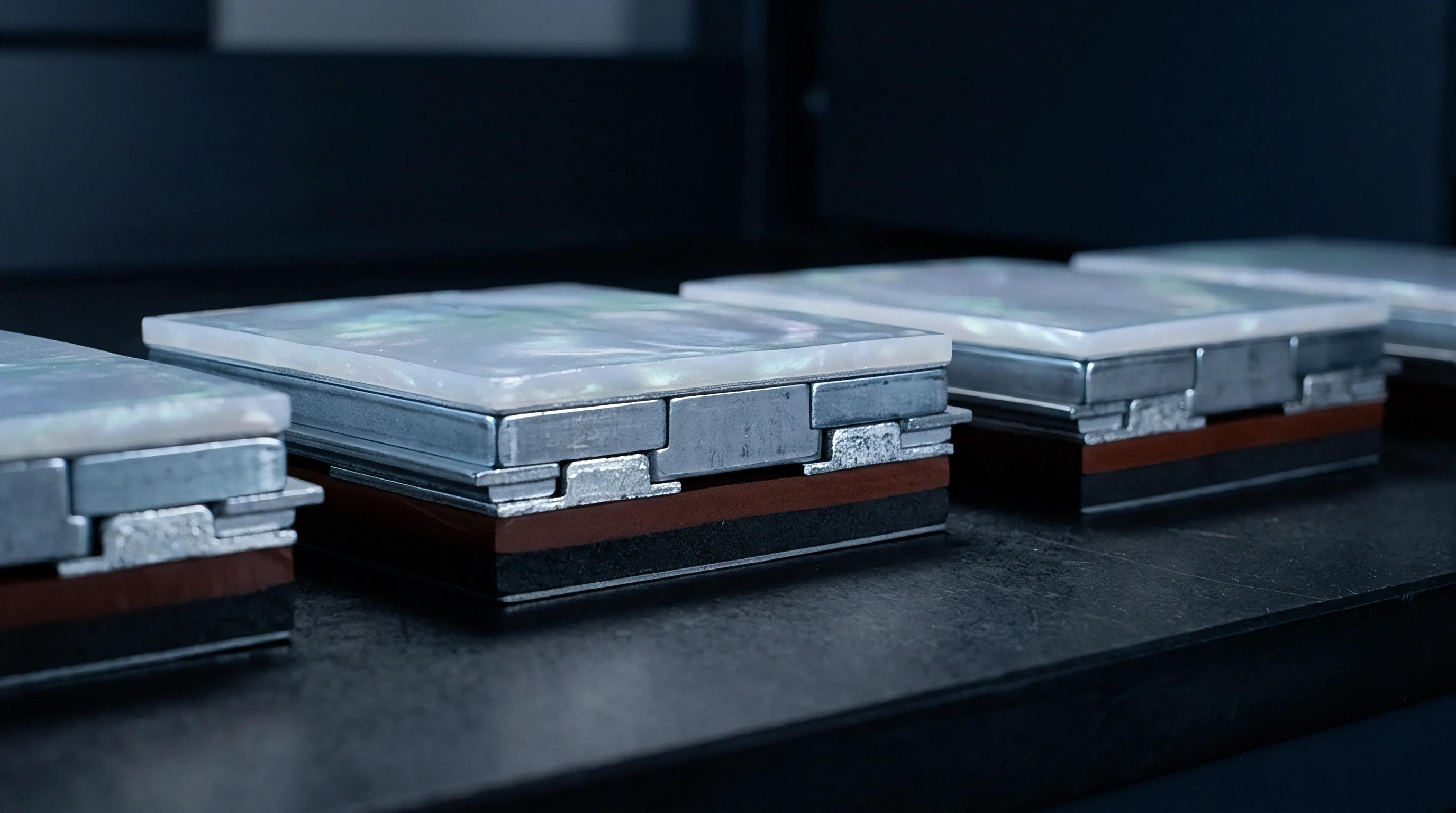
AC-IR and DC-IR Diagnostic Profiling
High-frequency impedance at 1 kHz isolates ohmic resistance contributions from current collectors, electrolyte conductivity, and terminal welds. Because AC internal resistance tests take under one second per cell, complete screening of high-density pallets remains practical. Elevated AC-IR points to electrolyte dry-out, defective tab welds, or cathode current collector corrosion.
Direct-current internal resistance testing captures charge-transfer resistance and solid-electrolyte interphase impedance alongside ohmic resistance. A 10-second load pulse at 1C rate calculates resistance by dividing voltage deflection by applied current pulse amplitude. Because DC-IR dictates high-rate power capability and operational thermal loads, DC-IR thresholds serve as primary criteria for cell grading and lot acceptance.
IEC 61960-3 defines open-circuit voltage tolerances within plus or minus 2 millivolt across incoming parallel cell groups prior to system integration.
| Chemistry Type | Nominal Shipping OCV | OCV Tolerance | Max AC-IR (1 kHz) | Max DC-IR (10s Pulse) |
|---|---|---|---|---|
| LiFePO4 (Prismatic 100Ah) | 3.280 V | ± 5 mV | 0.35 mΩ | 0.85 mΩ |
| NMC 811 (Cylindrical 21700) | 3.580 V | ± 3 mV | 12.5 mΩ | 22.0 mΩ |
| NMC 622 (Pouch 60Ah) | 3.650 V | ± 4 mV | 0.60 mΩ | 1.20 mΩ |
| LTO (Prismatic 23Ah) | 2.300 V | ± 5 mV | 0.25 mΩ | 0.50 mΩ |
Out-of-spec voltage readings may reflect temperature swings during flight or ocean transit that temporarily shift cell impedance, rather than permanent manufacturing defects.


Swell
Volumetric expansion in pouch and prismatic cells indicates gas generation or electrode phase transitions. Physical dimensions dictate pack assembly limits; excessive thickness strains structural frames, deforms cooling plates, and accelerates mechanical wear over operating cycles. Measuring swelling on the dock isolates batches damaged by high-temperature transit or ongoing electrolyte side reactions.

When Does Cell Swelling Exceed Freight Tolerance?
Expansion along the thickness axis of a pouch cell compresses adjacent cooling plates and structural foam inside module enclosures. Standard manufacturing tolerances permit plus or minus 0.15 millimeter thickness variation when fresh from production. Exposure to temperatures above 45 °C during ocean transit accelerates electrolyte decomposition, generating gases like carbon dioxide, ethylene, and fluoroethane that inflate cell pouch foil walls.
Inspectors measure cell thickness using pneumatically actuated flat-plate calipers applying a standard load of 100 kilopascals across the cell face. Point contact measurements yield inaccurate readings due to local pouch displacement. A thickness expansion exceeding two percent over factory lot certificate averages indicates significant gas generation, triggering automatic lot hold and destructive gas chromatography testing.
Pouch cell thickness variations above two percent across an incoming pallet indicate internal gassing from electrolyte decomposition.

K-Value Determination and Self-Discharge Decay
Tracking voltage drop over time, expressed in millivolt per day, isolates self-discharge caused by metallic contamination. The K-value calculation divides the voltage delta between factory release and dock inspection by the elapsed transit duration in days. While lithium-ion cell self-discharge follows exponential decay, a linear approximation over standard 14-day to 45-day transit windows provides a practical receiving threshold.
High K-values point to internal micro-shorts driven by iron or copper particle contamination introduced during electrode slitting. Micro-shorts convert stored chemical energy into localized heat, creating subtle self-discharge that worsens over operational cycles. Cells displaying K-values twice the population median are removed immediately, preventing latent field failures and thermal propagation risks.
Low-amplitude mechanical vibration during transit can disrupt the initial solid-electrolyte interphase layer enough to elevate short-term self-discharge rates without leaving permanent cell damage, though the precise boundary remains difficult to isolate.


Sampling
Statistical intake protocols govern how many units an inspector pulls from an incoming container to represent the full batch. Testing every cell on a 50,000-unit pallet shipment imposes prohibitive labor and equipment costs. Acceptance sampling plans balance buyer risk against supplier risk using standardized statistical frameworks, ensuring statistical confidence while maintaining high receiving throughput.

ANSI ASQ Z1.4 Standard Execution for Battery Freight
Single sampling plans under General Inspection Level II define normal and tightened switching rules based on historical supplier defect rates. For a shipment lot of 35,000 cylindrical cells packaged across 20 pallets, ANSI/ASQ Z1.4 specifies Sample Size Code Letter N, corresponding to a sample size of 500 cells selected randomly across all pallets and packaging levels.
Inspectors extract units proportionally from top, middle, and bottom pallet layers to avoid spatial sampling bias. If historical defect rates exceed contractual thresholds, testing protocols switch to Tightened Inspection under Code Letter N, increasing sample size or lowering acceptable defect counts. Continued failure under tightened inspection triggers full rejection of the entire lot and suspends supplier shipment approval.
- Critical defect thresholds set an Acceptable Quality Limit of 0.065 percent for safety-critical non-conformities like internal short-circuits, zero-voltage cells, or severe electrolyte leaks.
- Major defect limits establish an AQL of 0.40 percent for functional parameters including out-of-spec capacity, elevated DC resistance, and dimensional swell beyond module tolerance.
- Minor defect boundaries permit an AQL of 1.0 percent for cosmetic packaging blemishes, illegible secondary barcodes, or minor pallet wrap tearing.
- Lot tolerance percent defective defines the absolute worst quality level that a buyer accepts with a low ten percent probability of lot acceptance.
| Lot Size (Cells) | Code Letter | Sample Size | Critical AQL (0.065) Accept / Reject | Major AQL (0.40) Accept / Reject | Minor AQL (1.0) Accept / Reject |
|---|---|---|---|---|---|
| 3,201 to 10,000 | L | 200 | 0 / 1 | 2 / 3 | 5 / 6 |
| 10,001 to 35,000 | M | 315 | 0 / 1 | 3 / 4 | 7 / 8 |
| 35,001 to 150,000 | N | 500 | 0 / 1 | 5 / 6 | 10 / 11 |
| 150,001 to 500,000 | P | 800 | 1 / 2 | 7 / 8 | 14 / 15 |
Contractual purchase agreements specifying ISO 2859-1 Zero Acceptance Number sampling plans dictate immediate lot rejection upon discovering a single critical defect in the test sample.


Quarantine
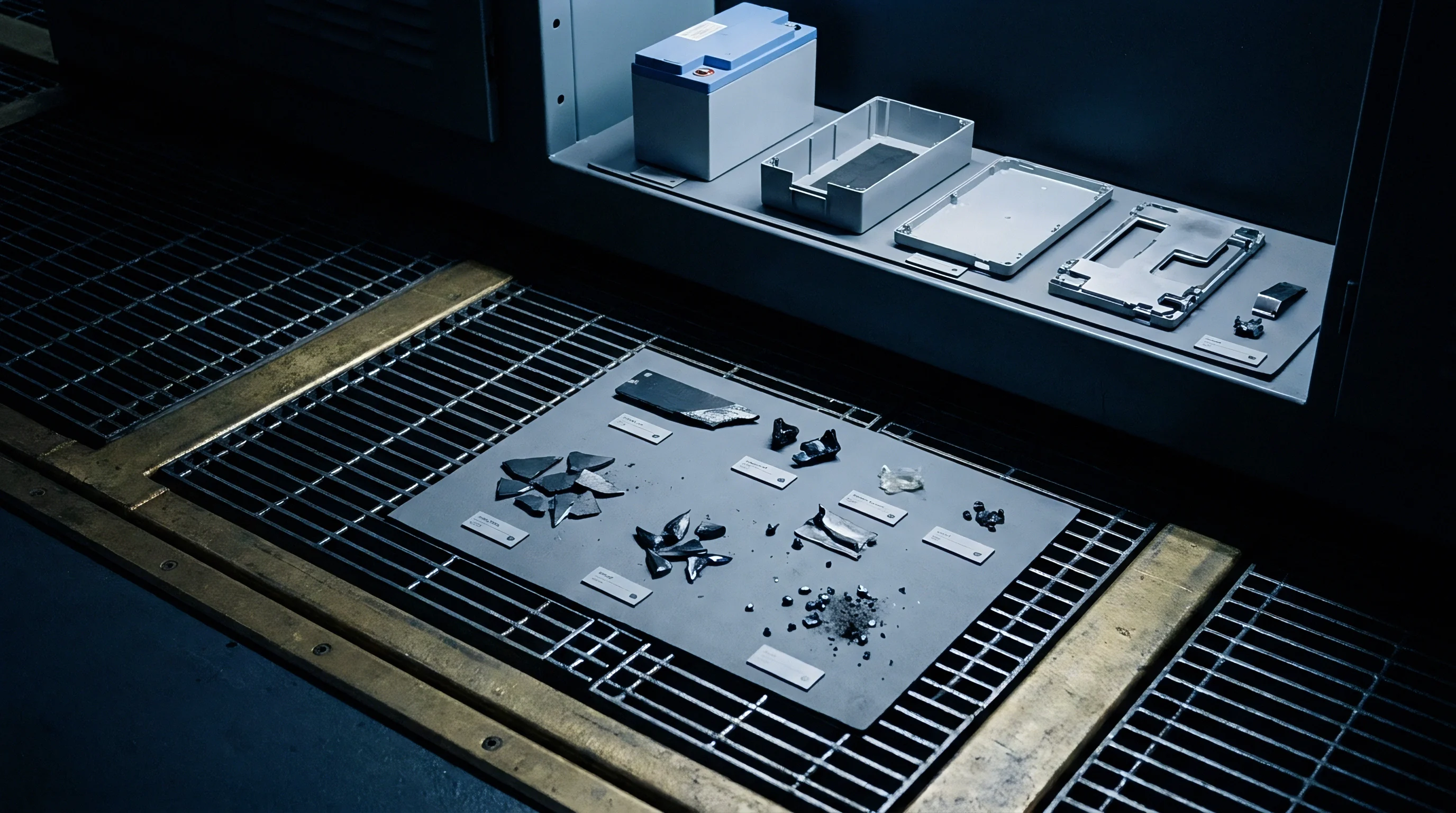
Segregating suspect lots keeps damaged cells away from production inventory and prevents warehouse fire hazards. Non-conforming pallets enter dedicated quarantine zones designed to contain potential thermal runaway events and store off-gassing components safely. Quarantine procedures isolate commercial risk, establishing legal custody boundaries while freight holds undergo vendor review.

Dangerous Goods Freight Containment Protocols
Pallets exhibiting elevated temperatures or physical damage enter dedicated blast-resistant isolation zones equipped with continuous off-gas monitoring. Storage infrastructure requires non-combustible concrete flooring, five-meter separation distances between pallet racks, and dedicated infrared thermal imaging cameras connected to facility alarm systems. Active off-gas detectors flag early emissions of hydrogen, carbon monoxide, and organic solvent vapors from compromised cell vents.
Quarantine spaces maintain secondary containment trays to catch corrosive liquid electrolyte leaks. Ambient temperatures inside battery quarantine areas must remain below 20 °C to suppress parasitic side reactions inside unstable cells. Quarantine personnel utilize insulated safety tools, flame-resistant personal protective wear, and self-contained breathing apparatus during physical handling of damaged pallet loads.
Tightened inspection protocols double the sample size extracted from consecutive incoming pallets whenever two out of five batches fail initial screening.
Evidence Documentation for Carrier and Vendor Claims
Commercial recovery relies on immediate photographic, thermal, and electronic logging before freight bills are signed. Incoming inspectors take high-resolution, time-stamped photographs of shipping labels, shock sensor status, broken wooden pallets, and damaged outer box partitions. Thermal imaging logs record pallet surface temperature profiles upon container opening to prove self-heating occurred during transit.
Defect samples undergo non-destructive CT scanning or teardown analysis inside independent accredited laboratories to isolate root causes. Documented proof distinguishing transit abuse from factory manufacturing defects determines whether financial claims hit the logistics carrier’s cargo insurance policy or the battery manufacturer’s quality warranty bond.
- High-resolution photographic evidence records external carton crushing, pallet band indentation, and original container loading states prior to unloading operations.
- Continuous temperature logging data extracted from transit data recorders proves cargo space thermal spikes exceeded environmental transport specifications.
- Signed freight bills of lading marked with specific visual damage notations preserve legal rights under international Carriage of Goods by Sea rules.
- Independent laboratory analysis reports establish whether cell internal short-circuits resulted from manufacturing burrs or external transit vibration impacts.
When quarantine protocols lack physical isolation and strict environmental controls, localized cell self-heating can quietly propagate into thermal events that destroy entire warehouse facilities.


Settlement
Financial adjustments for rejected cell lots deduct re-inspection, storage, and replacement logistics costs directly from pending supplier invoices. Resolving discrepancies demands a transparent mathematical framework that translates electrical and physical defect rates into landed cost adjustments. Commercial agreements enforce clear yield thresholds, shifting financial burdens back to the manufacturer when delivered lots fail incoming inspection metrics.

Landed Cost Reconciliation Arithmetic
Calculating net landed cost per usable kilowatt-hour incorporates freight tariffs, customs duties, incoming test labor, and scrap disposal fees. Consider an incoming shipment lot of 100 pallets containing 50,000 units of 100Ah LiFePO4 prismatic cells priced at $120 per kilowatt-hour cell cost. The total base FOB purchase value equals $1,920,000 for a nominal 16,000 kilowatt-hour shipment energy capacity.
Freight charges, import duties, customs clearance, and local drayage add $180,000, creating an initial baseline landed cost of $131.25 per kilowatt-hour before inspection. Incoming sampling reveals a 3.5 percent defect rate comprising high AC-IR values and physical swelling beyond tolerance. Under contractual terms, a defect rate exceeding the 0.40 percent Major AQL threshold forces a 100 percent tear-down sorting audit of all 100 pallets at the supplier’s expense.
Sorting labor consumes 400 technician hours at $85 per hour, amounting to $34,000. Testing identifies 1,750 unusable defective cells representing 560 kilowatt-hours of lost capacity. Hazardous waste disposal charges for defective units run $4.50 per cell, totaling $7,875.
The table below outlines the full landed financial adjustment calculation applied against the final vendor invoice payment.
| Cost Component | Base Cost Value | Discrepancy Adjustment | Reconciled Settlement Value |
|---|---|---|---|
| Base Cell FOB Purchase Value | $1,920,000 | -$67,200 (1,750 Defective Units) | $1,852,800 |
| Freight, Duty, and Customs Fees | $180,000 | -$6,300 (Pro-rata Freight Refund) | $173,700 |
| 100% Tear-down Sorting Labor | $0 | +$34,000 (Billed to Vendor) | -$34,000 (Vendor Credit) |
| Hazardous Scrap Disposal Fee | $0 | +$7,875 (Billed to Vendor) | -$7,875 (Vendor Credit) |
| Dock Quarantine Storage Fee | $0 | +$4,500 (15 Days at $300/Day) | -$4,500 (Vendor Credit) |
| Net Payable Vendor Invoice | $2,100,000 | -$119,875 Total Adjustment | $1,980,125 |

Commercial Debit Note Construction and Yield Recovery
When incoming defect rates breach contract thresholds, buyers issue debit notes that offset cell replacement costs against active letters of credit. The debit note itemizes base cell costs, prorated transit tariffs, administrative testing labor, and quarantine holding fees into a single enforceable commercial claim. Including detailed test log data and statistical sampling certificates prevents supplier rejection of commercial claims.
Contracts specify replacement delivery timelines alongside financial offsets. A vendor must ship replacement cells via expedited air freight at their sole expense within 14 calendar days of receiving a formal discrepancy notice. If replacement units fail incoming inspection screening, the buyer retains contractual rights to cancel remaining purchase order balances without penalty and invoice the vendor for all production line downtime expenses incurred.
Commercial recovery concludes when final wire payments or letter of credit releases match the reconciled financial settlement schedule. Purchasing practices that integrate automated test data logs directly into freight accounting systems automate discrepancy logging, reducing administrative resolution cycles from months to days.