Optimizing Thermal Carbonization Temperatures for Biomass Hard Carbon Anode Performance
Pyrolysis between 1100C and 1300C balances turbostratic interlayer spacing with closed pore volume to maximize plateau capacity while capping irreversible SEI losses.
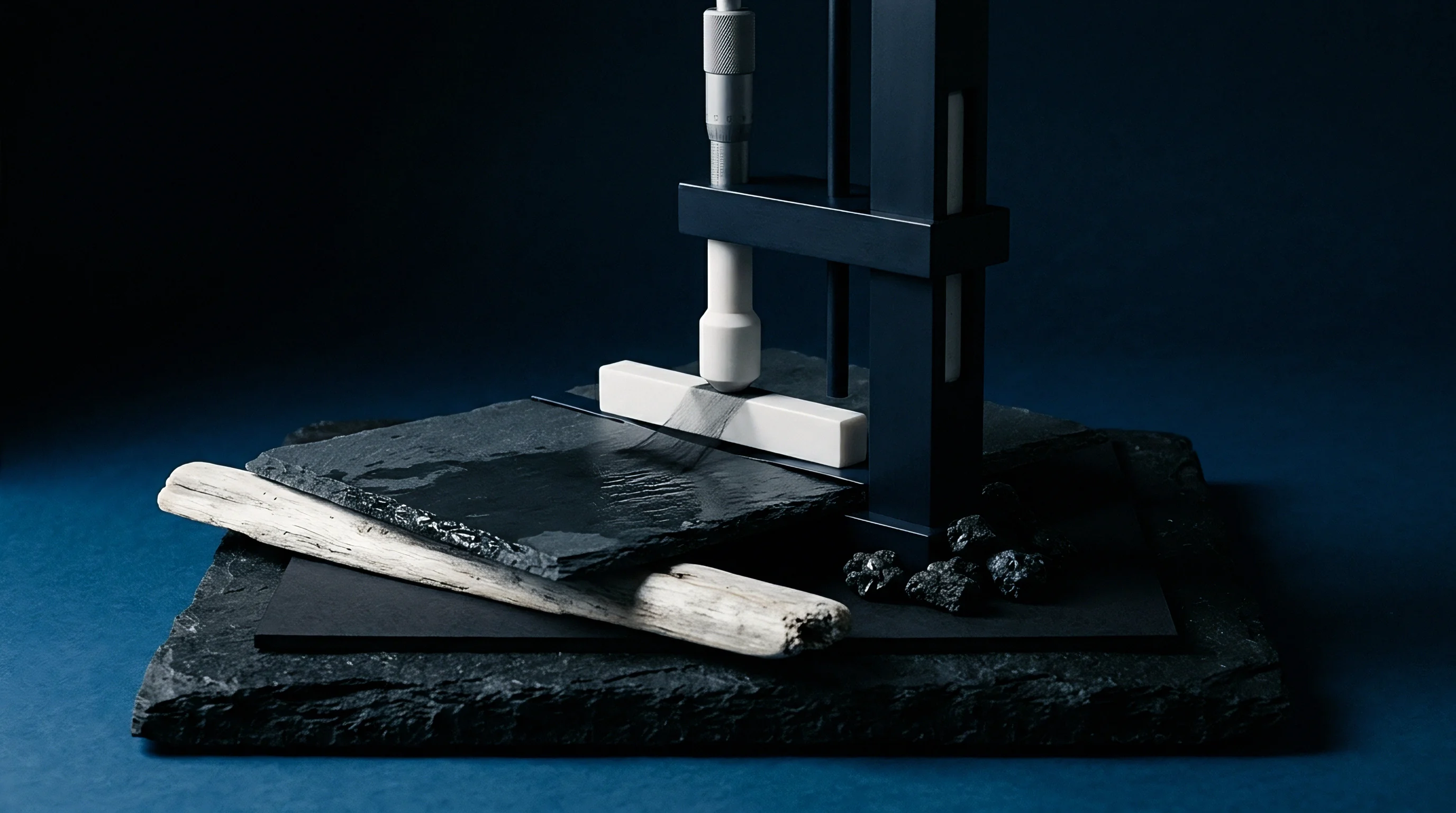

Char
Retort heating profiles directly dictate the ratio of slope capacity to low-voltage plateau capacity in biomass-derived hard carbon anodes. Raw biomass precursors, including coconut shells, hardwood residues, and agricultural starches, contain complex biopolymer networks of cellulose, hemicellulose, and lignin. Thermal devolatilization breaks these biopolymers down across distinct temperature bands: hemicellulose decomposes between 220°C and 315°C, cellulose collapses between 315°C and 400°C, and lignin degrades gradually across a broad thermal range from 200°C to 900°C.
The aromatic structure of lignin resists complete thermal degradation, forming the skeleton of non-graphitizable carbon. Pre-carbonization steps executed between 400°C and 700°C strip volatile organic compounds, water vapor, and low-molecular-weight tars from the precursor matrix. Mass loss during this initial phase reaches 50 to 65 percent of dry feedstock weight.
The resulting intermediate char holds an extensive network of open micropores and high concentrations of surface heteroatoms.
Higher lignin content in raw biomass precursors yields a denser aromatic carbon framework during low-temperature devolatilization.
Oxygen, hydrogen, and nitrogen atoms bound to the aromatic carbon rings escape as gaseous carbon monoxide, carbon dioxide, methane, and water vapor during primary pyrolysis. Oxygen content drops from roughly 40 percent in raw coconut shell feedstock down to less than 2.0 percent once thermal treatment reaches 1000°C. Hydrogen evacuation leaves behind unpassivated radical carbon sites that re-order into small aromatic domain clusters known as basic structural units. The spatial arrangement of these basic structural units sets the precursor for closed pore formation during subsequent high-temperature thermal carbonization.
Inadequate devolatilization control leads to tar redeposition within kiln exhaust ducts, creating batch contamination risks and maintenance downtime. Maintaining precise atmospheric flow with inert argon or nitrogen gas during primary thermal treatment carries away volatile fragments before secondary cracking reactions deposit disordered pyrolytic carbon onto the open char surface. The initial pre-carbonization profile establishes the physical boundary conditions for crystallite alignment and pore evolution in the secondary high-temperature stage.
The choice of biomass feedstock chemistry predetermines the minimum temperature threshold required to drive residual oxygen below one weight percent.

Lattice
Microstructural ordering accelerates when carbonization temperatures exceed 1000°C. X-ray diffraction patterns reveal a shifting broader 002 peak corresponding to the interlayer distance between parallel graphene sheets. Interlayer spacing, designated as d002, contracts continuously as heat input increases. At 900°C, d002 spacing measures roughly 0.395 nanometers.
Raising the carbonization temperature to 1200°C reduces d002 spacing to approximately 0.372 nanometers. At 1400°C, interlayer spacing narrows to 0.358 nanometers, approaching the graphitic limit of 0.335 nanometers.
Raman spectroscopy tracks defect density across the carbon framework through the intensity ratio of the disorder-induced D-band at 1350 inverse centimeters to the crystalline G-band at 1580 inverse centimeters. High temperature supplies the thermal energy needed to heal dangling bonds, vacancies, and non-aromatic structural defects within the short-range graphene sheets. The ID/IG ratio drops from 1.38 in char treated at 900°C down to 0.82 in material carbonized at 1400°C, indicating progressive crystallite lateral growth and aromatic domain extension.
| Carbonization Temperature (°C) | Interlayer Spacing d002 (nm) | BET Surface Area (m²/g) | Raman ID/IG Ratio | Closed Pore Volume (cm³/g) |
|---|---|---|---|---|
| 900 | 0.395 | 285.4 | 1.38 | 0.021 |
| 1100 | 0.381 | 18.2 | 1.15 | 0.068 |
| 1300 | 0.370 | 2.8 | 0.94 | 0.115 |
| 1500 | 0.358 | 1.1 | 0.82 | 0.042 |
The transformation of open micropores into closed internal nanovoids represents a defining physical change during high-temperature carbonization. Surface area measured by nitrogen gas adsorption drops precipitously as carbonization progresses from 900°C to 1300°C. Gas molecules cannot access internal closed voids once graphene sheets cross-link and seal access channels. Closed pore volume reaches a peak near 1300°C, creating internal storage reservoirs for alkali ions.
Carbonization at 1300°C reduces specific surface area below 5 square meters per gram while maintaining interlayer spacing above 0.37 nanometers.
Thermal processing outside the target window degrades electrochemical storage pathways through distinct structural failure mechanisms.
- Under-Carbonization Defect Retention leaves high concentrations of residual oxygen functional groups and open micropores that promote continuous electrolyte decomposition and severe gas generation inside the cell envelope.
- Over-Graphitization Lattice Collapse occurs when excess thermal energy forces turbostratic carbon layers into parallel alignment, destroying closed nanovoid volumes and reducing interlayer spacing below the radius required for unhindered sodium-ion transport.
- Surface Vitrification Barrier Formation happens when localized thermal spikes fuse particle perimeters, trapping residual volatile gases internally and causing structural cracking during subsequent calender pressing operations.
- Heteroatom Volatilization Voids form when rapid ramp rates force sulfur and nitrogen species out of the lattice abruptly, tearing open closed pore walls and creating macro-voids that lower volumetric tap density.
Selecting a carbonization profile below the thermal threshold required to seal open micropores leads to high initial capacity loss, low cell-level energy density, and rapid electrolyte exhaustion in battery field operation.
Plateau
Alkali-ion storage in hard carbon anodes divides into two distinct electrochemical zones visible on galvanic charge-discharge curves: a sloping voltage region above 0.1 volts versus Na/Na+ or Li/Li+, and a flat voltage plateau below 0.1 volts. Sloping capacity arises from ion adsorption at surface defects, edge sites, and unpassivated heteroatom locations. Plateau capacity stems from ion insertion into closed nanovoids and intercalation between parallel graphene sheets with expanded interlayer spacing.
Carbonization temperature determines the distribution between these two storage mechanisms.
Which Thermal Threshold Minimizes Irreversible Capacity in Coconut Shell Precursors?
Carbonizing biomass at 1300°C achieves the optimal balance between defect removal and closed pore preservation. Thermal treatment at 1000°C leaves high surface area and residual defects, yielding a sloping capacity of 165 milliamp-hours per gram and a plateau capacity of only 85 milliamp-hours per gram. Initial Coulombic Efficiency at 1000°C drops to 74 percent because electrolyte breaks down rapidly across open active surface sites, forming a thick, non-conductive Solid Electrolyte Interphase layer.
Elevating the temperature to 1300°C drops sloping capacity to 70 milliamp-hours per gram while driving plateau capacity up to 235 milliamp-hours per gram. Total reversible capacity reaches 305 milliamp-hours per gram with an Initial Coulombic Efficiency exceeding 88 percent.
Low-voltage plateau capacity provides the tight voltage profile needed for stable pack-level state-of-charge tracking. When carbonization temperature crosses 1400°C, closed pores shrink rapidly due to aggressive aromatic ring condensation. Plateau capacity collapses from 235 milliamp-hours per gram down to 90 milliamp-hours per gram, while sloping capacity drops further.
Total reversible capacity falls to 150 milliamp-hours per gram, rendering the carbon unsuitable for high-energy density cells.
Carbonized anodes produced at temperatures exceeding 1450°C exhibit reduced d002 spacing and limited closed porosity, forcing low-voltage storage down to potential levels dangerously close to zero volts. Under high-rate charging or low-temperature operation, sodium ions deposit as metallic dendrites on the carbon surface rather than inserting into closed pores, initiating internal micro-short circuits that compromise cell safety files.
A initial coulombic efficiency rating below 83 percent triggers automatic batch rejection under standard cell manufacturing incoming inspection protocols.
Manufacturing battery-grade hard carbon from coconut shell feedstock demands a rigorous thermal execution sequence to align electrochemical metrics with cell design requirements.
- Charge primary rotary retort with screened coconut shell char possessing a particle size range between two and five millimeters.
- Ramp temperature at four degrees Celsius per minute under continuous nitrogen sweep to 600°C to strip residual moisture and light oil fractions.
- Hold at 600°C for two hours to ensure complete core devolatilization across the particle bed before primary carbonization.
- Transfer intermediate char to secondary high-temperature tube furnace operating under positive argon pressure.
- Escalate temperature at eight degrees Celsius per minute from 600°C to the target soaking setpoint of 1280°C.
- Maintain isothermal soaking at 1280°C for exactly 180 minutes to complete closed pore consolidation and surface area reduction.
- Cool furnace load under continuous inert atmosphere until internal bed temperature falls below 80°C prior to air exposure.
Whether multi-stage thermal profiles can permanently bypass the trade-off between surface defect elimination and closed pore thermal collapse remains open to industry verification across larger commercial batch runs.
Tolerance
Industrial rotary kilns and push-kilns experience thermal gradients that directly disrupt hard carbon quality. A thermal variance of ±20°C across the hot zone of a continuous calcination furnace alters crystallite ordering across a single production lot. Particles passing near wall heating elements experience higher peak thermal input than material moving along the core bed axis.
This thermal distribution broadens the d002 spacing range, producing a mixed material where individual particles display mismatched electrochemical profiles.
Raw biomass feedstocks contain inorganic minerals, including silica, potassium oxide, sodium chloride, and iron compounds. Thermal carbonization below 1100°C fails to vaporize volatile alkali salts, leaving conductive mineral residues inside the carbon framework. These residual inorganic impurities act as localized catalytic centers, promoting continuous electrolyte oxidation during extended cycling.
Operating carbonization kilns above 1250°C aids in driving off volatile alkali metal impurities, reducing total ash content below 0.15 weight percent without requiring aggressive acid-leaching washing steps.
| Hot Zone Setpoint (°C) | Zone Variance (°C) | Ash Content (wt%) | Tap Density (g/cm³) | ICE Value (%) | Energy Cost ($/kg Carbon) |
|---|---|---|---|---|---|
| 1050 | ±12 | 0.42 | 0.72 | 78.5 | 0.85 |
| 1180 | ±15 | 0.22 | 0.81 | 83.2 | 1.25 |
| 1280 | ±18 | 0.11 | 0.88 | 88.6 | 1.75 |
| 1380 | ±24 | 0.08 | 0.94 | 85.1 | 2.40 |
Indirect-fired rotary kilns offer uniform gas-solid contact and precise residence time control, reducing intra-batch d002 standard deviations below 0.002 nanometers. Direct-fired systems introduce combustion product contamination and thermal hot spots that degrade surface properties. Kiln residence time interacts with peak temperature; a 60-minute soak at 1300°C yields microstructural properties equivalent to a 180-minute soak at 1220°C, allowing processing facilities to trade thermal dwell time against electrical power consumption.
Heating rate variations exceeding five degrees Celsius per minute across the retort zone alter internal micropore distributions.
Audit procedures for qualifying biomass carbonization vendors demand direct inspection of thermal monitoring hardware and kiln temperature mapping logs.
- Thermocouple Calibration Records verify that multi-zone hot furnace sensors undergo quarterly calibration traceable to national metrology standards.
- Inert Gas Purity Logs confirm nitrogen or argon delivery lines maintain oxygen concentrations below ten parts per million throughout high-temperature calcination cycles.
- Batch Ash Content Assay Reports establish that raw material washing and high-temperature thermal purification steps consistently achieve mineral residual levels below 0.15 percent.
- Particle Size Distribution Tracking validates that thermal processing does not cause uncontrolled particle agglomeration or thermal shock fracture prior to electrode slurry preparation.
Minor temperature dips during continuous calcination do not alter anode performance when average bed residence time compensates for transient thermal drops.
Dossier
Commercial qualification of biomass-derived hard carbon anodes hinges on connecting furnace processing histories directly to cell manufacturing economics. Specifying hard carbon requires establishing strict control windows on material CoA documents. Standard specifications for battery-grade hard carbon call for a d002 interlayer spacing between 0.368 and 0.375 nanometers, a BET specific surface area under 5.0 square meters per gram, a tap density equal to or greater than 0.85 grams per cubic centimeter, and an Initial Coulombic Efficiency of at least 86 percent in standard half-cell testing protocols.
Operating carbonization kilns at 1300°C demands significantly higher electrical power input compared to 1000°C operation. Thermal radiation losses scale with the fourth power of absolute temperature. Electrical energy consumption increases from 4.2 kilowatt-hours per kilogram of finished carbon at 1000°C up to 8.8 kilowatt-hours per kilogram at 1300°C in conventional electric rotary kilns.
Carbon yield drops concurrently from 38 percent to 31 percent relative to intermediate char weight as residual heteroatoms continue off-gassing. Processing expenses rise from $1.10 per kilogram to $2.20 per kilogram purely on energy and mass yield impacts.
Higher landed costs for 1300°C carbonized material find commercial justification in pack-level performance gain. Higher Initial Coulombic Efficiency reduces the mass of active cathode material tied up in irreversible initial alkali-ion consumption, directly reducing cell manufacturing material cost per watt-hour. Furthermore, lower specific surface area minimizes binder consumption during slurry mixing, allowing cell manufacturers to increase active hard carbon loading up to 95 weight percent in double-side coated electrode formulations.
Low tap density materials below 0.70 grams per cubic centimeter require higher solvent ratios during electrode manufacturing, leading to long drying oven residence times, low coating line speeds, and poor volumetric energy density in finished pouch or cylindrical cells. Thermal carbonization at 1280°C achieves particle shrinkage and internal densification, pushing tap density above 0.88 grams per cubic centimeter without initiating undesired graphitic domain alignment.
Sourcing agreements establish that any delivered hard carbon consignment displaying a BET surface area exceeding 6.0 square meters per gram or an ash content above 0.20 percent shall be rejected at the port of entry at supplier expense.