Inert Gas Atomization Dynamics in Powder Production
Supersonic gas jets destabilize liquid metal streams through high-shear wave growth, where tight gas-to-metal ratio tuning maximizes spherical powder yield.

Nozzle
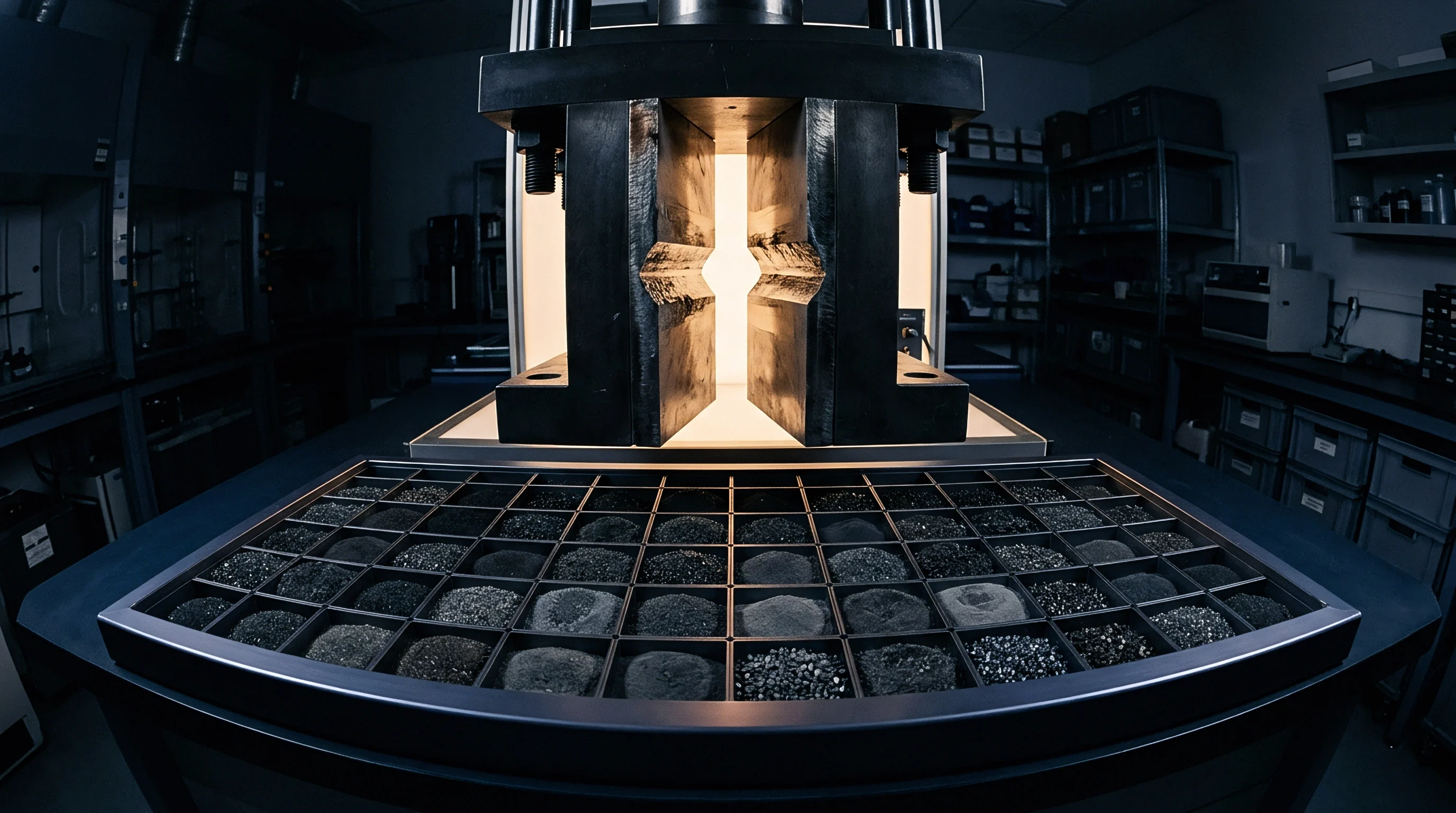
Molten metal streams exiting a refractory ceramic guide tube encounter high-velocity supersonic jets at the atomization focal point, where momentum exchange initiates liquid disintegration. In close-coupled arrangements, the distance between the orifice exit and the gas ring apex measures between 1.5 and 3.0 millimeters, establishing a narrow high-shear zone. Precision alignment holds the liquid column centered inside the convergent-divergent gas field to maintain a symmetric stagnation pressure profile.
Deviations exceeding 50 micrometers off-axis introduce asymmetric wave amplification, causing stream deflection against the ceramic tip and severe droplet coarsening.
Delivery Geometry and Melt Flow Dynamics
Fluid delivery tubes engineered from high-density boron nitride or zirconia-stabilized alumina dictate liquid stream orifice dimensions, typically ranging from 1.2 to 4.5 millimeters in diameter. Viscosity resists shear strain. Liquid metal flow rates correlate directly with the square of orifice diameter and the square root of metallostatic head height inside the tundish vessel.
At a liquid density of 7,200 kilograms per cubic meter, a 2.5-millimeter delivery diameter generates mass flow rates between 8.0 and 14.5 kilograms per minute depending on tundish overpressure and melt superheat.
A back-pressure zone forms directly below the delivery tip due to gas expansion mechanics. Suction pressures between minus 5 and minus 25 kilopascals draw the liquid melt downward, preventing melt freeze-off and tip clogging. Liquid filaments pinch off.
When back-pressure fluctuates into positive values due to gas jet misalignment, liquid metal recirculates upward onto the guide tube surface, solidifying into crust formation that truncates atomization runs.
Atomization at a gas-to-metal ratio of 2.8 kilograms per kilogram under 4.5 megapascal argon pressure produces a median volumetric particle diameter of 28.4 micrometers.

Gas Ring Pressure Calibration
Inlet manifold pressure determines gas velocity at the nozzle exit orifice, where supersonic expansion generates Mach numbers between 1.8 and 2.6. High pressure raises gas velocity. Operating gas pressures between 3.5 and 7.0 megapascals supply the necessary kinetic energy to destabilize high surface tension metal melts.
The gas mass flow rate scales linearly with plenum pressure, requiring precise mass-flow controller loops to maintain target gas-to-metal mass ratios across batch melting cycles.
| Plenum Pressure (MPa) | Gas-to-Metal Ratio (kg/kg) | Median Diameter D50 (µm) | Fine Fraction Less Than 15µm (%) | Specific Gas Consumption (Nm³/kg) |
|---|---|---|---|---|
| 3.5 | 1.5 | 45.2 | 8.4 | 0.85 |
| 4.5 | 2.2 | 32.8 | 16.1 | 1.24 |
| 5.5 | 2.8 | 24.6 | 23.8 | 1.58 |
| 6.5 | 3.6 | 18.1 | 31.5 | 2.03 |
Adjusting the convergence angle between 18 and 35 degrees alters the focal point distance and acoustic shock structure. Narrow angles increase kinetic transfer efficiency but heighten liquid stream instability, whereas wider angles create acoustic recirculation zones that blow liquid droplets onto the gas ring face. Uncontrolled deposit formation on the nozzle assembly alters jet geometry mid-run, shifting particle size distributions out of specification and forcing emergency melt aborts.


Breakup
Liquid sheet and stream disintegration proceeds through two distinct physical stages within the supersonic gas expansion zone. Initial wave generation destabilizes the molten column into primary liquid ligaments, followed immediately by secondary droplet shatter driven by aerodynamic drag forces. The relative magnitude of inertial forces versus surface tension forces governs this transformation, parameterized by the dimensionless Weber number and Ohnesorge number.

Primary Disintegration Phenomena
Extremely high shear stress at the gas-liquid interface triggers Kelvin-Helmholtz hydrodynamic instabilities, producing surface waves along the liquid melt column. Inertia drives droplet fragmentation. As wave amplitudes reach critical thresholds, thin liquid sheets peel away from the main melt stream, shearing into elongated filaments and ligaments.
Surface tension pulls liquid spheres clean. High melt superheat reduces viscosity and surface tension, accelerating filament pinch-off times to below 10 microseconds.
Primary droplet sizes range from 100 to 500 micrometers depending on liquid velocity and local gas density. Gas density drops rapidly downstream. Rayleigh-Taylor instabilities act concurrently along the accelerated liquid front, breaking larger fluid chunks into irregular droplets before thermal solidification begins.
Instability growth rates scale directly with gas density and the square of velocity relative to the liquid melt flow.
ASTM F3049 mandates that raw powder sampling routines record gas jet pressure, melt superheat temperature, and nozzle tip orifice clearance for every production batch.

Secondary Aerodynamic Fragmentation Modes
Droplets created during primary disintegration enter surrounding supersonic gas flows where rapid momentum deceleration induces further fragmentation. Weber numbers exceeding 12 force droplets out of spherical equilibrium into bag-breakup or sheet-thinning regimes. At Weber numbers above 100, catastrophic shear stripping dominates, stripping micro-droplets directly from the parent droplet periphery to form sub-10 micrometer fines.
- Bag Breakup Mode occurs at Weber numbers between 12 and 50, where droplet centers hollow out into thin liquid inflated bags that burst into fine sprays.
- Stripping Breakup Mode dominates at Weber numbers between 50 and 100, peeling liquid sheets continuously from droplet edges until liquid cores dissipate.
- Catastrophic Breakup Mode takes place above Weber numbers of 100, where extreme shock waves shatter liquid droplets instantaneously into dense clouds of sub-micron fragments.
- Viscous Resistance Loss occurs when local melt cooling raises viscosity above 0.05 Pascal-seconds, arresting secondary shatter before target droplet sizes form.
Secondary fragmentation ceases when local Weber numbers drop below the critical threshold of 12 or when droplet temperature falls below the liquidus point. Rapid cooling transforms liquid droplets into solid spherical particles within milliseconds of leaving the focal zone. Powder processors blaming out-of-spec coarse distributions on raw material melt chemistry usually mask improper nozzle suction pressures or insufficient gas velocity ratios in their atomization towers.


Argon
Inert shielding gas Selection governs heat transfer rates, surface oxidation kinetics, and overall droplet acceleration mechanics during powder generation. Chemical inertness prevents metal oxide formation on fresh liquid droplet surfaces, preserving low surface energy states essential for rapid spheroidization before freezing. Operating costs correlate strongly with gas thermal conductivity and atomic mass factors.
What Driving Pressure Prevents Satellite Attachment?
Recirculation currents inside the atomization tower lift solidified fine particles back into the high-temperature spray zone, where they collide with molten or semi-solid larger droplets. Fines cling to coarse spheres. Raising plenum gas pressure to 5.0 megapascals accelerates primary gas jet velocity, directing turbulence downward and suppressing thermal recirculation eddies near the nozzle zone.
Satellite formation degrades powder flowability and reduces tap density by creating irregular particle surface projections. Maintaining high downward gas momentum limits collision frequency between solid fines and semi-molten droplets in the tower shaft. Coarse grains sink first.
Cold gas increases kinetic impact, forcing solidified satellite particles to bounce off larger droplets rather than bonding during flight.
High gas jet velocity suppresses turbulent recirculation currents that carry solid fines back into semi-molten droplet streams.

Thermal Trajectories and Cooling Rates
Heat transfer from molten droplets into surrounding inert gas occurs predominantly through forced convection, yielding cooling rates between 10,000 and 1,000,000 Kelvin per second. Heat transfers into gas streams. Droplet cooling rate inversely scales with the square of droplet diameter, creating distinct microstructural grain variations across different particle size fractions derived from the same melt bath.
- Purge atomization tower vessel with inert gas until internal oxygen concentration drops below 10 parts per million.
- Preheat inert gas delivery manifold and gas ring assembly to 150 degrees Celsius to prevent thermal shock condensation.
- Establish baseline gas plenum pressure at target setpoint and verify stability across all pressure transducer channels.
- Initiate liquid metal stopper rod lift, monitoring vessel back-pressure differential continuously during initial melt stream entry.
| Inert Medium | Molar Mass (g/mol) | Thermal Conductivity (mW/m·K) | Sonic Velocity at 20°C (m/s) | Relative Cooling Rate Index |
|---|---|---|---|---|
| Argon | 39.95 | 17.7 | 319 | 1.0 |
| Nitrogen | 28.01 | 26.0 | 349 | 1.6 |
| Helium | 4.00 | 151.3 | 1007 | 8.4 |
| Argon-Helium Mix (70/30) | 29.16 | 57.8 | 482 | 3.1 |
High cooling rates achieved in helium environments suppress microsegregation and extend solid solubility limits in complex nickel and aluminum alloys. Nitrogen offers cost advantages and elevated heat transfer over heavy noble gas options, but nitriding reactions with reactive elements like titanium, aluminum, and niobium restrict its application. The underlying threshold where gas turbulence transitions from stable droplet cooling to destructive acoustic resonance remains an open research subject across high-pressure gas atomization practices.


Sieve
Classifying raw atomized powder lots requires removing oversized splatters and ultra-fine dust to isolate target particle size bands. Mechanical screening systems, ultrasonic sieves, and air classifiers split broad run-of-atomizer distributions into tight commercial cuts such as 15 to 53 micrometers for laser powder bed fusion or 53 to 150 micrometers for directed energy deposition. Efficient separation hinges on breaking electrostatic particle agglomeration without causing mechanical powder contamination.

Particle Size Distribution Limits
Laser diffraction measurements characterize powder size distributions using volumetric percentile values D10, D50, and D90. Fine powders pack tightly. Span values, calculated as the difference between D90 and D10 divided by D50, quantify distribution width, where narrower spans improve flow consistency across automated powder feeding systems.
Oversized particles larger than 150 micrometers cause nozzle blockages, while excess sub-10 micrometer fines induce powder dusting and severe flowability degradation.
Tap density measurements according to ASTM B527 indicate particle packing efficiency and morphological consistency. Spherical powders lacking internal porosity achieve tap densities exceeding 60 percent of theoretical solid density, whereas irregular or heavily satellited lots fail to cross 48 percent. Hall flow meter readings below 25 seconds per 50 grams confirm acceptable inter-particle friction properties for automated additive manufacturing feed systems.
Hall flow times under 20 seconds per 50 grams indicate minimal satellite attachment and optimal spherical morphology.

Morphological Classification and Satellites
Scanning electron microscopy verifies particle surface topography, shape factor, and satellite attachment ratios across classified batches. Spherical shape factors above 0.92 ensure uniform thermal absorption during additive laser melting operations. Internal gas entrapment, originating from gas pocket absorption during primary jet breakup, generates hollow powder particles that transform into unwanted keyhole porosity in final consolidated metal components.
- Chemical Oxygen Bounds require total oxygen content below 200 parts per million for titanium alloys and below 300 parts per million for nickel superalloys.
- Apparent Density Checks enforce minimum packing thresholds to guarantee consistent layer thickness during automated recoater blade passes.
- Particle Shape Metrics verify high aspect ratios and low sphericity deviations across all classified size fractions prior to packaging.
- Internal Porosity Audits utilize cross-sectional optical metallography to quantify argon gas voids embedded inside individual powder spheres.
Powder classification yields scale directly with the accuracy of nozzle alignment during atomization. A broad particle size distribution reduces usable yield for target applications, raising unit costs through expensive powder recycling steps.


Fraction
Economic feasibility in powder production depends on maximizing the yield of target size fractions relative to total melted mass. Gas consumption represents the single largest variable operating expense, often exceeding the cost of electrical energy required for induction melting. Balancing gas pressures against specific powder size requirements controls landed costs per kilogram of saleable metal powder.

Landed Cost Arithmetic and Powder Yields
Calculating overall yield involves tracking mass losses from tundish skull residues, tower wall deposits, and non-conforming coarse or fine screening cuts. High yields reduce scrap costs. Operating at elevated gas pressures increases fine powder fractions below 15 micrometers, which yields high value for metal injection molding but represents low-value scrap for electron beam additive systems.
| Application Standard | Target Size Cut (µm) | Maximum Oxygen Limit (ppm) | Minimum Tap Density (g/cm³) | Typical Atomization Yield (%) |
|---|---|---|---|---|
| Laser Powder Bed Fusion | 15 – 53 | 250 | 4.40 | 38 – 48 |
| Directed Energy Deposition | 53 – 150 | 150 | 4.65 | 32 – 42 |
| Metal Injection Molding | 0 – 22 | 400 | 4.10 | 18 – 25 |
| Electron Beam Melting | 45 – 106 | 200 | 4.50 | 28 – 35 |
Reclaiming and remelting out-of-spec coarse powder fractions adds thermal processing costs, alloy element burn-off losses, and crucible lining wear. Optimizing close-coupled geometry to push median particle sizes directly into the desired fraction band minimizes costly secondary recycling loops and lowers specific gas consumption per kilogram of qualified material.

Specification Seams in Purchase Agreements
Procurement contracts specify strict acceptable tolerance bands for chemical composition, particle size distribution spans, flow rates, and internal gas porosity levels. Batch rejections occur when minor element evaporation, such as aluminum loss in titanium or manganese loss in stainless steel alloys, alters chemical composition beyond master specification limits during high-vacuum melt cycles.
In accordance with ISO 17025 certified testing protocols, lot acceptance documentation mandates chemical composition analysis via inductively coupled plasma optical emission spectroscopy, alongside gas fusion analysis for interstitial oxygen, nitrogen, and hydrogen contents. Incorporating clause 8.2 of AWS A5.02 into supply contracts transfers financial liability for batch contamination directly to the atomization converter whenever inert gas purity falls below 99.999 percent purity standards.